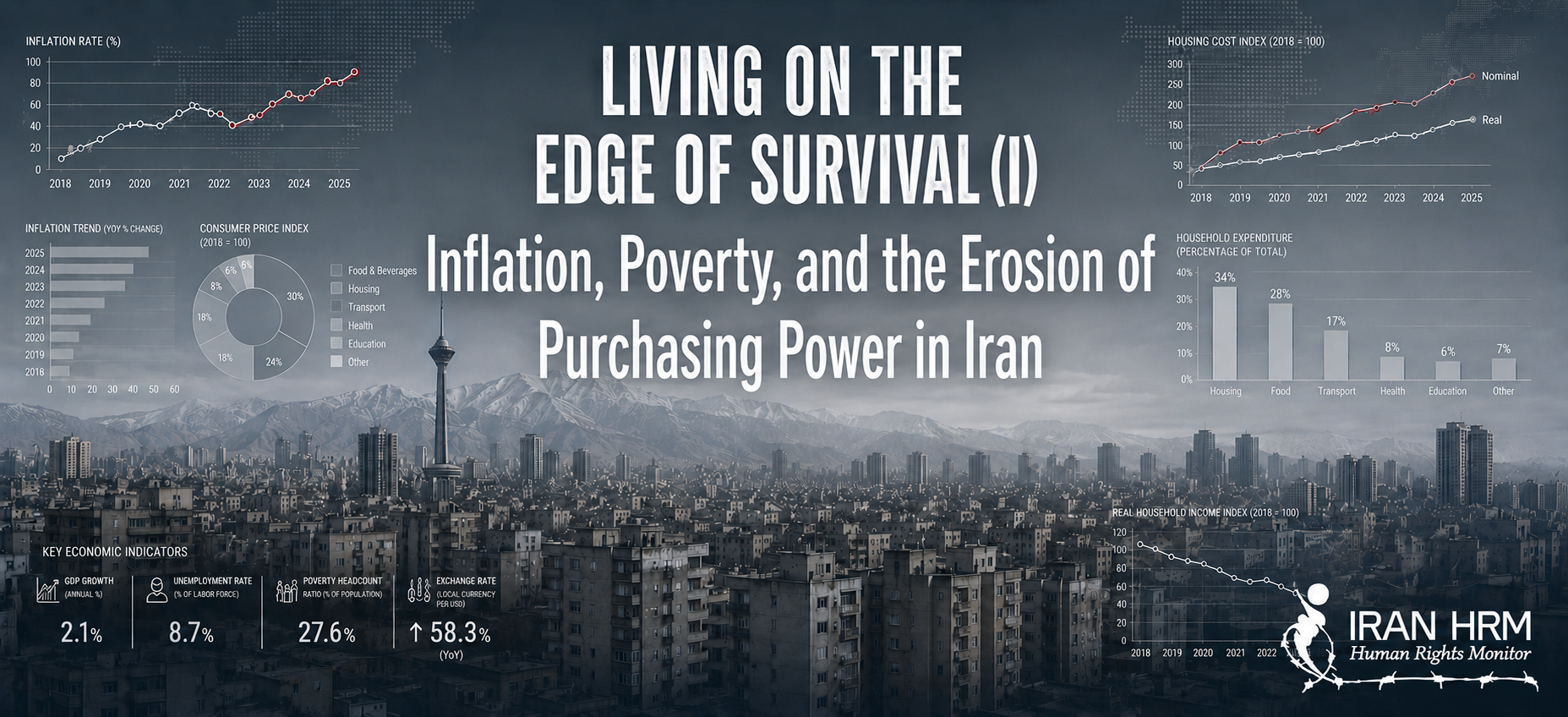
Rising living costs, widening gaps between income and household expenses, expanding poverty, and growing pressure on vulnerable populations across Iran

Between 2024 and 2026, the continued rise in living costs and the rapid increase in the prices of goods and services placed growing pressure on Iranian households. Official statistics, statements by government officials, assessments by international organizations, and first-hand accounts from citizens all point to a consistent trend: the gap between income and the cost of living has steadily widened.
Under these conditions, poverty is no longer merely an economic indicator. For millions of people, it has become a daily reality that directly affects access to food, housing, healthcare, education, and other basic necessities. The economic crisis has increasingly extended beyond macroeconomic indicators and entered the everyday lives of ordinary citizens.
 The Poverty Line and the Growing Gap Between Income and Living Costs
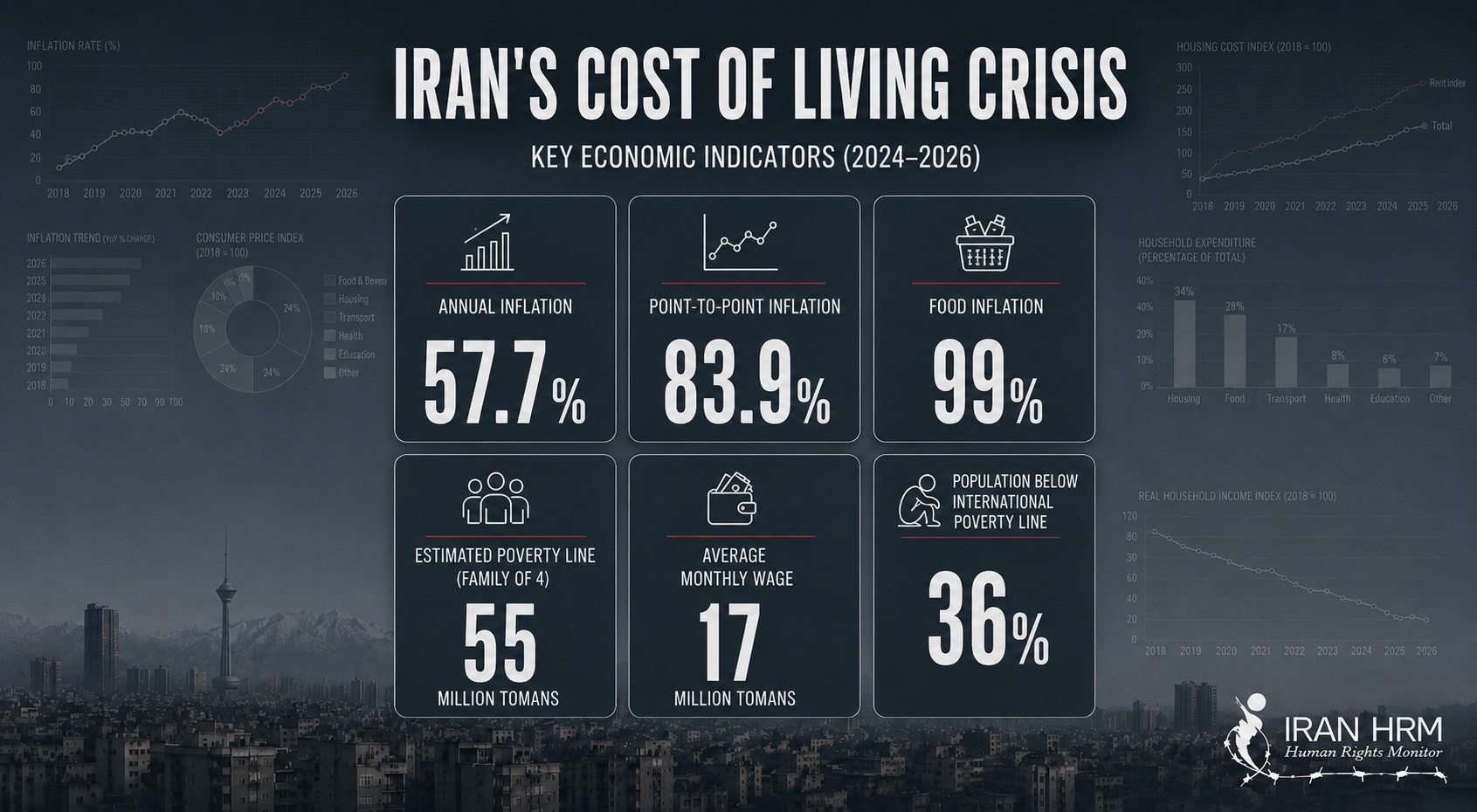
“The poverty line for a family of four has exceeded 550 million rials (55 million tomans) per month.”
This assessment, made by labor market expert Hamid Haj Esmaeili, is among the clearest indicators of the widening gap between household income and living expenses in contemporary Iran. While economic estimates place the poverty line above 55 million tomans per month, average wages remain significantly below the level required to meet basic living costs.
This gap is not merely an economic statistic. For millions of households, it translates into a continuous decline in purchasing power and increasing difficulty in meeting essential needs. Expenses that were once considered part of ordinary life have become daily concerns for a growing number of citizens; from purchasing food and paying rent to covering healthcare and educational costs.
The impact of economic hardship is visible not only in national indicators but also in household survival strategies. Field reports and case studies indicate that increasing numbers of families have been forced to eliminate non-essential expenses, reduce food consumption, postpone medical treatment, borrow money to pay rent, and work multiple jobs simultaneously. In some cases, economic pressure has contributed to severe social crises.
Warnings about declining purchasing power have not been limited to economists. Government officials and members of parliament have also acknowledged the widening gap between income and living costs.
Nasrollah Pejmanfar, Chairman of the Parliament’s Article 90 Commission, warned during discussions on the 2025 state budget:
“A 20 percent salary increase has been proposed while inflation is projected at 33 percent. This means that compensation levels have not been adequately addressed in the budget bill, and the livelihood problems of government employees will certainly increase.”
Several months later, Mojtaba Yousefi, spokesperson for Parliament’s Budget Consolidation Commission, stated:
“With the budget submitted by the government, employees’ purchasing power will decline by 25 percent next year.”
Asad Salehi, a member of the Supreme Labor Council, also commented on workers’ living conditions:
“The gap between workers’ wages and actual market prices has deepened year after year, and the purchasing power of this segment of society continues to decline.”
These statements demonstrate that concerns regarding declining purchasing power and rising economic pressure are reflected not only in international assessments and economic analyses, but also in the statements of officials and institutions within Iran itself.
Official data published by the Statistical Center of Iran indicate that annual inflation reached approximately 57.7 percent in May 2026. During the same period, point-to-point inflation was reported at approximately 83.9 percent, meaning that the cost of purchasing a similar basket of goods and services had nearly doubled compared to the previous year.
The International Monetary Fund (IMF) has also warned that Iran’s inflation rate could reach approximately 68.9 percent in 2026, placing the country among those experiencing the highest inflation rates in the world.
The burden of inflation has not been distributed equally across society. According to data from the Statistical Center of Iran, annual inflation for the second income decile reached approximately 50.4 percent, compared with 46.3 percent for the tenth income decile. This disparity indicates that inflation exerts its greatest pressure on households with the fewest financial resources. Because low-income households spend a larger share of their income on food, housing, energy, and transportation, rising prices have had a disproportionately severe impact on their daily lives.
At the same time, official reports and statements by domestic experts point to expanding poverty, declining purchasing power, and growing difficulty in accessing necessities.
Ahmad Meydari, Iran’s Minister of Cooperatives, Labor and Social Welfare, acknowledged in January 2025 that preserving workers’ purchasing power had become one of the country’s most pressing economic policy challenges. He warned that the continuation of inflationary trends could further reduce the purchasing power of working-class households.
The expansion of poverty among women-headed households presents particularly alarming dimensions. According to data released by the Iranian Welfare Database, approximately 55 percent of women-headed households fall within the country’s poorest income decile. Women-headed households now account for more than one-fifth of all households in Iran, while many of these women work in informal, low-income occupations without stable social protection or long-term economic security.
International Assessments: A Broader Picture of Economic Hardship
Assessments by international organizations also point to intensifying economic pressure on Iranian households.
In its latest estimates, the World Bank reported that approximately 36 percent of Iran’s population lives below the international poverty line. This figure highlights the vulnerability of a significant portion of society to economic shocks and rising living costs.
The World Bank has further noted that low-income households have borne the heaviest burden of food inflation and housing costs. Rising prices for food and rent have disproportionately affected vulnerable groups, further reducing their ability to meet basic needs.
In its April 2026 World Economic Outlook, the International Monetary Fund (IMF) warned that Iran’s inflation rate could reach approximately 68.9 percent, placing the country among the nations experiencing the highest inflation levels worldwide.
Assessments by the United Nations Development Programme (UNDP) indicate that vulnerable households in Iran spend approximately 45 percent of their total consumption expenditure on food. As a result, increases in food prices directly affect both the quality and quantity of their diets.
The United Nations High Commissioner for Refugees (UNHCR), in its assessment of conditions in Iran, has referred to a “cost-of-living crisis,” emphasizing that rising prices for essential goods, housing, utilities, and energy have made access to basic necessities increasingly difficult for many households. The agency warned that a significant number of families are living at or near subsistence levels.
The International Labour Organization (ILO) has likewise warned that rising prices and declining real incomes are placing growing pressure on household living standards and workers’ purchasing power. According to the organization’s assessment, the continuation of inflationary trends could further reduce workers’ real incomes and deepen the economic vulnerability of low-income groups.
The United Nations Development Programme has also estimated that approximately 39 percent of Iran’s employed workforce operates within the informal economy. Workers in this sector typically lack job security, social insurance coverage, and effective social protection mechanisms, leaving them particularly exposed to economic shocks.
Taken together, the assessments of international organizations present a picture consistent with official data and domestic statements: a society in which a substantial share of the population faces rising living costs, declining purchasing power, and increasing difficulty in accessing basic necessities.
These findings extend beyond economic indicators alone. Field reports from different regions of Iran suggest that rising living costs, declining purchasing power, and growing economic uncertainty have become part of the daily reality of millions of households.
The Human Impact of the Crisis
Behind every economic indicator are individuals whose lives are directly shaped by these developments.
Sanaz, a woman-headed household living in eastern Tehran, described the collapse of her income in stark terms:
“From June 10 to July 6, I earned only two million tomans.”
Zahra, a street vendor working in the Tehran metro system, spoke of the emotional toll of economic hardship:
“My sense of loneliness never ends. Sometimes I feel as if I have been abandoned in a deep well with no rope to climb out.”
Shiva, a university graduate in Persian literature who turned to ride-hailing work to support herself, explained:
“For two or three weeks, work completely dried up. I had to borrow money from my brother.”
The consequences of economic pressure extend beyond declining income. Nader, a 42-year-old worker in Iran’s film industry, lost his job in early 2026 while his wife’s online business income also disappeared. The family exhausted its savings paying rent before eventually being forced to leave their rented home and move in with relatives in another city.
As Nader explained:
“We were using our savings to pay the rent, but if we had continued, there would have been nothing left for food or medical expenses.”
In another documented case, a dismissed worker from the Marvdasht Petrochemical Complex, unemployed for more than two months, reported that financial hardship had forced him and his elderly mother to reduce their food consumption to a single meal per day.
He stated:
“I have an elderly mother, and I feel ashamed in front of her. We have reduced our meals to one a day, and even that is difficult to afford.”
Conclusion
The evidence presented in this chapter indicates that rising living costs, declining purchasing power, and widening gaps between income and essential expenses have increased economic pressure on many Iranian households. For a growing number of families, these pressures extend beyond financial hardship and increasingly affect access to basic necessities.
One of the most visible consequences of this trend has been its impact on food consumption and household nutrition. The following chapter examines food inflation, food insecurity, and the implications of rising food costs for the right to adequate food in Iran.
━━━━━━━━━━━━━━━━━━━━━━━━━━
📖 Continue the Report Series
Part II: Food Security and the Right to Food in Iran (2024–2026)