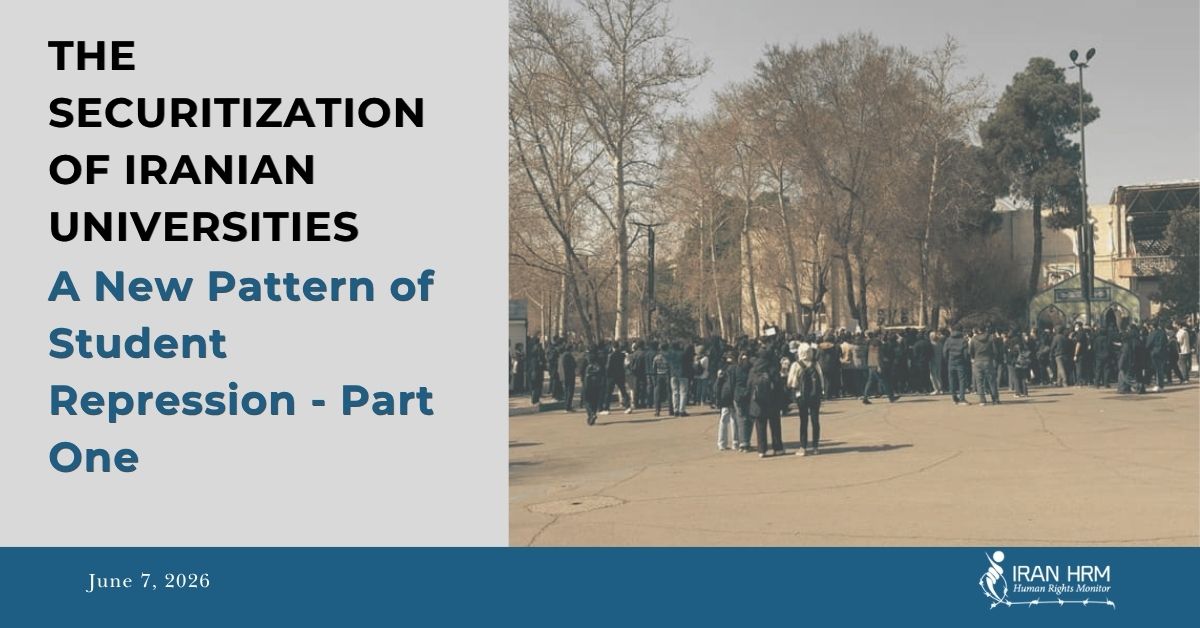
From March 2026 to June 2026, universities across Iran witnessed a new wave of summonses, suspensions, expulsions, restrictions on access to educational systems, arrests, and judicial prosecutions targeting students. Reports published from universities throughout the country indicate that these measures were not limited to a handful of isolated incidents. Rather, similar patterns emerged across multiple institutions of higher education, ranging from the creation of disciplinary and security cases based on student union activities and online expression to the denial of educational services, disciplinary sanctions, and the referral of certain cases to security and judicial authorities.

Although this report focuses on universities for which more extensive documentation and evidence are available, existing information indicates that pressure on students was not confined to a small number of institutions. Other universities in cities including Shiraz, Mashhad, Tabriz, Isfahan, and Tehran also experienced various forms of disciplinary and security-related measures against students.
The significance of this trend lies not merely in the number of students targeted. The central issue is the use of university educational and administrative structures as instruments of political and security pressure. In many cases, disciplinary committees, university security offices (Harasat), administrative mechanisms, and, in some cases, security and judicial institutions operated in a coordinated manner. For this reason, this report examines developments within Iranian universities not simply as a collection of disciplinary rulings, but as evidence of the growing securitization of higher education in Iran.
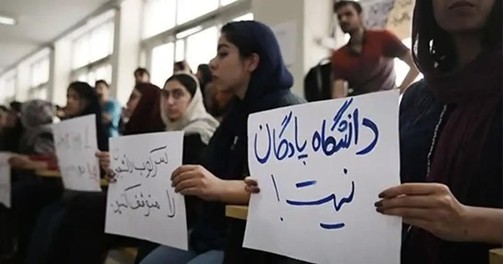 Students Who Were Targeted
Published individual case files demonstrate that the repression of students during this period took both disciplinary and security-judicial forms.
At the University of Tehran, Mahyar Eftekhari was suspended for two academic semesters by a ruling issued by the university disciplinary committee in late May 2026. At the same university, Seyed Yasin Hassanzadeh, a 2021-entry Industrial Engineering student and Secretary of the Islamic Students Association of the University of Tehran and Tehran University of Medical Sciences, was arrested at his home on 12 May 2026 and released one day later. The authorities did not officially disclose the charges against him.
Ali Taheri-Kia, a student at the University of Tehran, was arrested near the university dormitory area on 3 January 2026. He was later convicted by Branch 7 of the Tehran Revolutionary Court on charges of “assembly and collusion.” Abbas Yousefi, another University of Tehran student, was arrested on 8 January 2026 while returning to the dormitory area near Enghelab Street. He was subsequently released on bail on 17 March 2026. Abolfazl Karimi Saraskandroud was also arrested on 2 January 2026 while returning to his dormitory and was released on bail on 10 February 2026. Reports concerning his case indicated a deteriorated physical and psychological condition following his release, as well as a possible alteration of the charges brought against him.
At Iran University of Science and Technology, Majid Jamshidzadeh was arrested during the January 2026 protests and was subsequently sentenced to five years’ imprisonment by Branch 15 of the Tehran Revolutionary Court. The reported charges against him included “assembly and collusion to disrupt national security” and “disrupting public order.” His case represents one of the clearest examples of the connection between student protest activity, security-related prosecution, and the issuance of a severe judicial sentence.
At Shahid Beheshti University, Sattar Goharifar was arrested on 8 January 2026. Reports indicated that he was transferred to Tehran Greater Prison and remained in a state of judicial uncertainty in the weeks that followed. At the University of Birjand, the names of Sheida Namjou and Zeinab Ivani were linked to the suppression of the January 2026 protests and to the entry of security forces into the university campus and the women’s dormitory. In addition, Erfan Arabi, a student at Islamic Azad University in Birjand, was arrested in connection with the January protests and, on 12 May 2026, was sentenced to eight years’ imprisonment by a Revolutionary Court.
At Sharif University of Technology, Fariborz Kohanzad was arrested on 28 April 2026 and transferred to an undisclosed location. Arman Hajmohammadi, a graduate student at the same university, was arrested in Yazd around 28 March 2026. Reports indicated that he was arrested violently and without the presentation of an official warrant. Ariana Kouchaki, also a student at Sharif University of Technology, was arrested in Tehran on 1 June 2026. At the time the initial reports were published, neither her place of detention nor the charges against her had been disclosed.
These cases do not represent the full scope of incidents documented during the reporting period. They nevertheless demonstrate that measures taken against students extended well beyond disciplinary sanctions. In several cases, arrests, judicial prosecutions, proceedings before Revolutionary Courts, and prison sentences occurred alongside restrictions imposed through university disciplinary mechanisms.
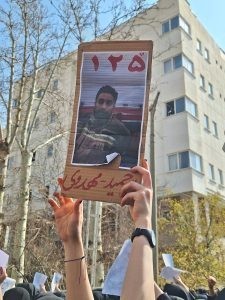 From Isolated Statistics to a Nationwide Pattern
A university-by-university review demonstrates that pressure on students has been imposed in a concentrated and multi-layered manner.
University of Tehran: The Broadest Wave of Disciplinary Cases
At the University of Tehran, student reports documented a widespread surge in disciplinary proceedings. According to these reports, approximately 150 to 200 students were involved in preparing defense statements or undergoing disciplinary procedures during the spring of 2026. Some students were informed by telephone that disciplinary cases had been opened against them. In certain instances, accusations such as “creating unrest and disorder” or being a “principal actor in an illegal gathering” were attributed to students, who were then instructed to submit their written defenses via email.
Iran University of Science and Technology: The Introduction of Security Terminology into Disciplinary Committees
At Iran University of Science and Technology, more than 100 disciplinary cases were reported. Student sources described remote proceedings, online submission of defenses, and the use of accusations such as “acting against national security” and “assembly and collusion.” The scale and nature of these proceedings suggest that disciplinary committees during this period were not merely addressing ordinary university violations. In some cases, they introduced the language and logic of national security accusations into the university environment.
University of Birjand: Suspensions and Deprivation Following Protests
At the University of Birjand, 50 disciplinary rulings were reported in April 2026. Approximately 20 students were suspended for two academic semesters, with the suspension counting toward the maximum permitted duration of study. Nearly 30 additional students were deprived of welfare and student services until graduation.
These rulings were issued following the January 2026 protests and after security forces entered the university campus and student dormitories. The sequence of events is significant: protest activity and security intervention were followed by disciplinary sanctions.
Sharif University of Technology: Expulsions and Reliance on Online Activity
At Sharif University of Technology, student sources reported approximately 30 to 40 disciplinary cases. Some of these cases resulted in severe penalties, including 6 to 7 expulsions or significant restrictions on continuing education, as well as dozens of suspension orders.
The importance of the Sharif cases lies in reports indicating that disciplinary files relied specifically on students’ online activities, Telegram messages, social media posts, and even profile photographs as evidence.
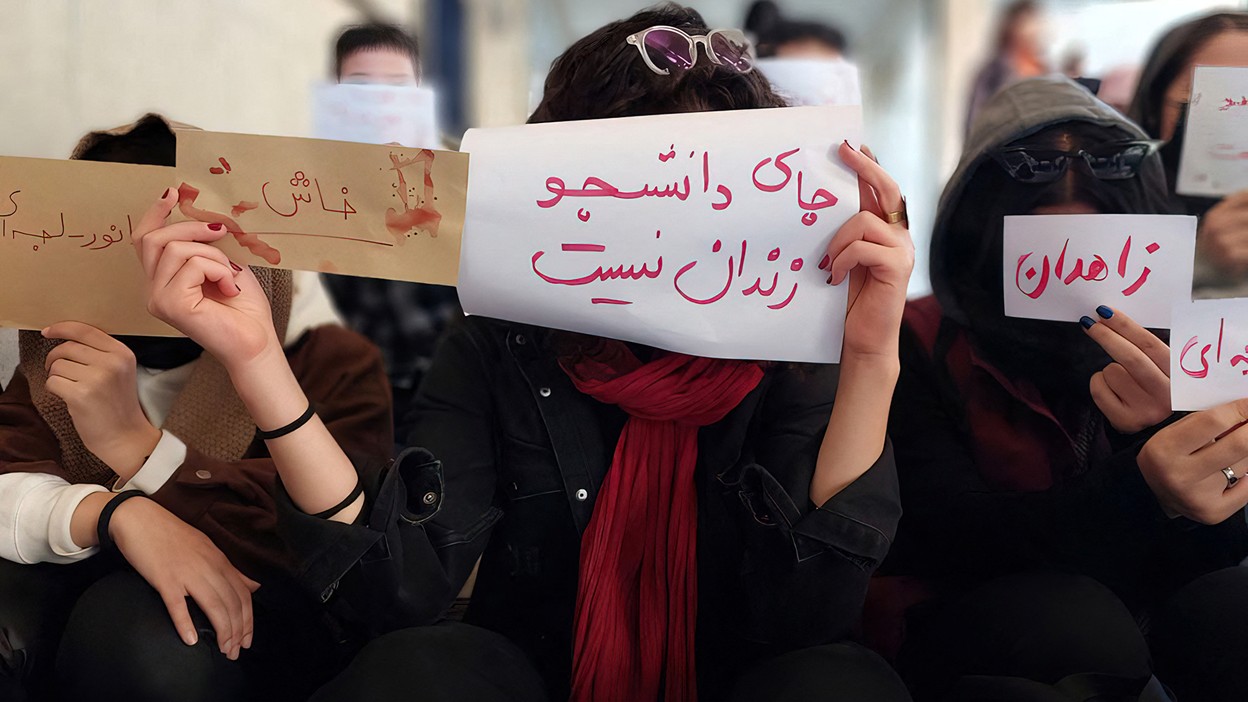 Official statements by university administrators also pointed to the involvement of institutions beyond the university itself in matters related to student protests. In March 2026, Masoud Tajrishi, President of Sharif University of Technology, urged students to refrain from what he described as “illegal gatherings” and announced that the Prosecutor’s Office had also become involved in matters related to the protests. This statement suggests that some cases were pursued beyond the framework of university disciplinary procedures.
Student reactions to these measures were also noteworthy. Following the issuance of a series of disciplinary rulings against students at Sharif University, 53 student organizations and publications signed a joint letter calling for the suspension and review of the sanctions. The signatories criticized the handling of disciplinary cases, warned against the expansion of disciplinary measures and their impact on the academic environment, and called for the revocation of rulings that, in their view, jeopardized students’ educational futures.
The publication of this letter demonstrated that concerns regarding these disciplinary measures were not limited to the students directly targeted. A broader segment of the university community also expressed opposition to these developments.
Shahid Beheshti University: Blocking Access to Educational Systems
At Shahid Beheshti University, the pattern of repression was implemented primarily through the restriction of access to educational systems and the effective denial of university services.
Student sources reported that approximately 40 to 45 students were initially summoned, after which around 25 educational accounts were completely blocked. These restrictions were imposed before the completion of formal disciplinary proceedings and deprived students of course registration, add/drop services, midterm grade registration, and other essential educational functions.
Criminalization of Online Activity and Violations of Student Privacy
One of the most significant features of the recent wave of repression has been the transformation of students’ online activities into the basis for disciplinary and security-related cases.
In disciplinary cases at Sharif University of Technology, student testimonies indicate that some severe sanctions were based on activity conducted through Telegram, Twitter, private groups, or content posted on personal social media pages. One student report stated that three students were expelled solely because of their activities on Telegram and Twitter. In one case, a student’s profile photograph was used as evidence. In another, a message posted in a private student group was cited in disciplinary proceedings.
This issue is significant for two reasons.
First, it demonstrates that students’ online activities, including those conducted within private groups or personal accounts, have effectively been subjected to monitoring and surveillance.
Second, disciplinary committees have relied on information that, under both procedural and legal principles, may constitute an intrusion into students’ privacy. When private messages, profile photographs, or the reposting of online content become evidence in disciplinary proceedings, the distinction between the university environment and a student’s private life effectively disappears.
A similar pattern can be observed at other universities. At the University of Tehran, students faced accusations such as “creating unrest” and being a “principal actor in an illegal gathering.” At Shahid Beheshti University, reported accusations included “disrupting university public order,” “insulting religious sanctities,” and “insulting Iranian-Islamic symbols.” At Iran University of Science and Technology, the language of accusations moved even closer to the sphere of national security, including charges such as “acting against national security” and “assembly and collusion.”
These accusations are generally unrelated to academic misconduct. At the center of many cases are the expression of opinions, participation in protests, student union activities, membership in or with student groups, or the publication of online content.
As a result, the disciplinary committee has increasingly shifted from an administrative mechanism intended to address university violations into a tool for restricting students’ expression, communication, and civic engagement.
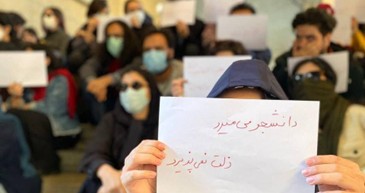 The evidence reviewed thus far provides a picture of the scope and methods of pressure imposed on students across Iranian universities, ranging from arrests and suspensions to disciplinary cases based on student activism and even participation in social media platforms. However, examining individual student cases alone is insufficient to fully understand this trend.
The fundamental question is on what legal basis these measures are being implemented and whether they are consistent with universities’ own regulations and disciplinary procedures. What roles do university security offices (Harasat), disciplinary committees, and state security institutions play in this process? How do some cases move from university campuses into the jurisdiction of Revolutionary Courts?
Part Two of this report examines these mechanisms and their legal and human consequences.