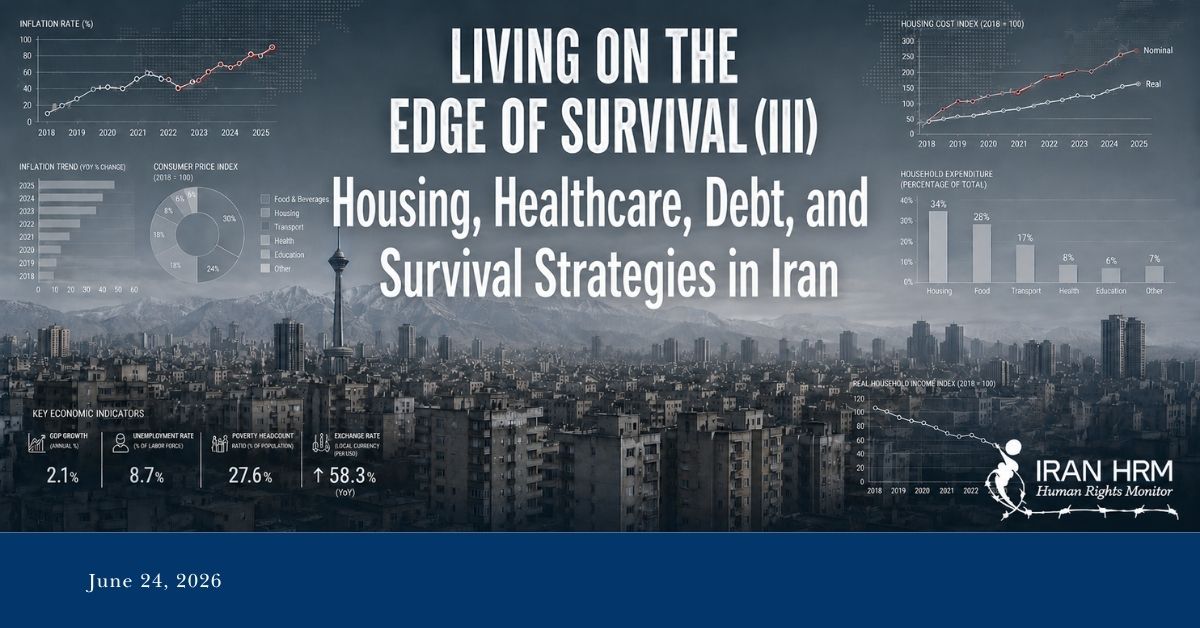
For many Iranian households, the consequences of the economic crisis no longer end at the dining table. When income is no longer sufficient to meet everyday expenses, economic pressure spreads into other dimensions of life; from securing shelter and paying rent to accessing healthcare, maintaining employment, and preserving a minimum level of economic security.

Under such conditions, any economic shock can have consequences far beyond a decline in purchasing power. The loss of a job, a sudden increase in rent, illness within the family, or the disappearance of a source of income can become more than a financial setback. For many households, such events can trigger a crisis that affects the very foundations of daily life.
In some cases, economic hardship has resulted in tragic responses.
Ahmad Baladi, a 20-year-old resident of Ahvaz, set himself on fire in front of municipal officials after authorities demolished his family’s small business, which represented their sole source of income. He died several days later from severe burn injuries. The case attracted widespread public attention and became a symbol of the vulnerability of households whose livelihoods depend on informal economic activities and daily earnings.
Although exceptional and tragic, this incident occurred within a broader context in which millions of households face rising housing costs, barriers to healthcare, job insecurity, indebtedness, and a continuing erosion of purchasing power.
Housing Costs and the Growing Burden on Households
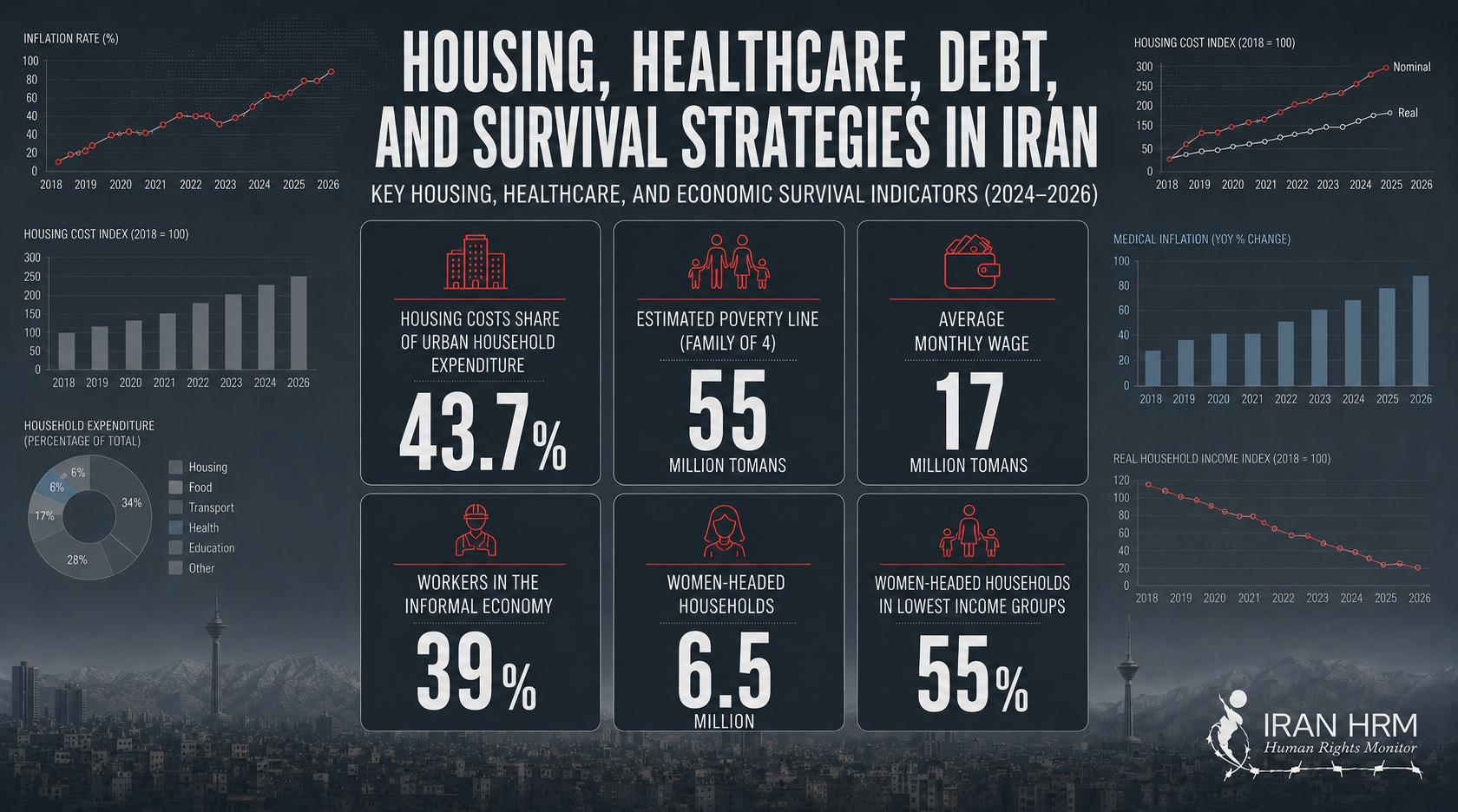 According to official data, approximately 43.7 percent of urban household expenditures in Iran are devoted to housing, fuel, and utilities. This represents the largest category of household spending and demonstrates that housing exerts a greater influence on family livelihoods than any other area of expenditure.
This situation exists at a time when economic estimates place the poverty line for a family of four above 55 million tomans per month, while average wages remain substantially below that threshold. As a result, a growing share of household income is absorbed by rent and housing-related expenses.
Between 2024 and 2026, rising rents and housing costs placed increasing pressure on both low-income households and the middle class. For many families, the issue was no longer home ownership; it became the struggle to remain in their existing homes and continue paying monthly rent.
The consequences of this trend are visible in the daily lives of tenants across the country. A 45-year-old woman living in Tehran’s Bahar neighborhood, who had lived independently for more than two decades, reported that after her monthly rent rose to 400 million rials, she could no longer afford to maintain an independent household and was forced to search for a roommate for the first time in her life.
As she explained:
“I lived alone for more than twenty years, but now I am forced to change my standards of living.”
Official and media reports indicate that rising housing costs have pushed some households toward more peripheral neighborhoods, smaller housing units, or areas with fewer services and resources. Under these conditions, housing is no longer merely an economic commodity. It has become one of the most important determinants of household welfare and security.
In some cases, the rising cost of living has forced residents to leave major cities altogether. A veteran editor in Iran’s publishing sector, who had lived and worked in Tehran for more than twenty years, reported that in 2026 he was compelled to leave the capital and return to his hometown of Kashan because of rising housing costs and declining employment opportunities. His experience reflects a broader pattern of reverse migration driven by the growing cost of living in Tehran.
From Homeownership to Simply Keeping a Roof Overhead
The rising cost of housing has affected more than the ability of families to purchase homes. For many households, maintaining their existing place of residence has itself become an increasing challenge.
The United Nations High Commissioner for Refugees (UNHCR) has described rising housing costs as part of Iran’s broader “cost-of-living crisis” and warned that increases in the prices of essential goods, services, and rent have made access to basic necessities more difficult for many households.
The growing share of household budgets devoted to housing has consequences extending well beyond shelter. When a substantial portion of income is consumed by rent and housing-related expenses, fewer resources remain available for food, healthcare, education, and other essential needs. As a result, the housing crisis becomes intertwined with broader patterns of poverty and economic deprivation.
Media reports and social assessments in recent years indicate the expansion of settlement in peripheral areas and increasing pressure on low-income households to find housing that matches their limited financial resources. For many families, the choice between housing quality, access to services, and affordability has become part of everyday reality.
Informal Settlements and Urban Marginalization: The Hidden Cost of the Housing Crisis
The burden of rising housing costs extends beyond increasing rents. For a portion of Iranian society, it has resulted in forced relocation to peripheral neighborhoods, informal settlements, and underserved urban areas.
According to officials responsible for urban regeneration programs, between 7 and 8 percent of Iran’s population lives in informal or marginal settlements. These areas are often characterized by inadequate infrastructure, limited public services, insufficient educational facilities, weak transportation networks, and restricted access to healthcare.
The expansion of informal settlements is not merely a reflection of housing shortages. It is also an indicator of the widening gap between household income and the cost of living. When rent absorbs a substantial share of household resources, families are often compelled to relocate to less expensive areas with fewer services and opportunities.
Homelessness: The Most Severe Form of Housing Deprivation
At the lowest end of this cycle, some individuals and families face the risk of losing shelter altogether.
Although official statistics on homelessness in Iran remain limited and fragmented, media reports and social assessments in recent years have documented growing concern regarding both visible and hidden forms of homelessness. These include living in overcrowded shared rooms, relying on relatives for extended periods, residing at workplaces, or using public spaces as temporary shelter.
In some cases, households have been forced to adopt arrangements that were previously considered outside the norm in order to avoid homelessness. Shared living arrangements among unrelated adults, returning to parental homes in middle age, long-term residence with relatives, and the subdivision of small housing units among multiple families have all emerged as coping mechanisms in response to rising housing costs.
The combined pressure of escalating rents, declining purchasing power, and unstable incomes has increased the risk of housing loss among lower-income groups. Under such conditions, housing security has become one of the most important components of household economic and social security.
The right to adequate housing is recognized in international human rights instruments. Any trend that restricts access to suitable shelter for larger segments of society has consequences extending beyond economics and directly affects human dignity, health, and social security.
Housing, Poverty, and Food Security: Interconnected Crises
The housing crisis in Iran is no longer merely an economic issue. It has increasingly become a structural factor contributing to the erosion of economic and social rights.
Analysis based on official household data indicates that tenant households spend approximately 44 percent of their total expenditures on housing, while their average daily caloric intake has fallen to approximately 1,815 calories. This represents a decline of roughly 28 percent compared with 2006 levels. These findings suggest that many families are effectively sacrificing food security in order to maintain access to shelter.
At the same time, officials responsible for urban regeneration programs have acknowledged that between 7 and 8 percent of the population lives in informal settlements. In addition, approximately six million tenant households, representing nearly twenty million people, are directly exposed to continuing rent increases.
Under these conditions, rising housing costs and declining purchasing power have pushed many families toward shared housing arrangements, reverse migration from major cities, relocation to peripheral settlements, and in some cases homelessness.
The economic burden of housing is not limited to tenants. Approximately 39 percent of Iran’s workforce is employed in the informal economy, a sector that enjoys the lowest levels of social protection and is particularly vulnerable to inflation, unemployment, and rising housing costs.
Taken together, these trends indicate that the housing crisis has become a structural driver of poverty, food insecurity, and the gradual erosion of family stability in Iran.
Healthcare Deprivation: When the Cost of Treatment Exceeds Household Means
The economic pressures experienced between 2024 and 2026 affected not only access to food and housing. Rising healthcare and medical costs also made access to essential treatment increasingly difficult for segments of Iranian society.
Farid Hashemnejad, head of the Iranian Dental Technicians Association, stated in May 2026 that the prices of some materials used in dental services had increased by as much as 100 percent.
He warned:
“Some implant procedures that previously cost around 300 million rials now cost nearly twice that amount.”
Hashemnejad further noted that rising prices had forced part of the population to forgo dental care altogether, stating:
“Inflation has completely pushed a portion of the population out of the dental services market.”
These statements reflect a broader trend in which the cost of treatment, medication, and healthcare services has increased at a pace exceeding the financial capacity of many households.
The burden of medical expenses extends far beyond dental care. In one documented case, the spouse of a cancer patient reported that the cost of a life-saving medication had risen from 65 million tomans during the early stages of treatment to 114 million tomans by the fifth treatment cycle. According to the family, they faced an impossible choice: continue treatment while absorbing escalating costs or postpone essential medical care.
At a time when a large share of household income is already consumed by rent and food expenses, healthcare often becomes a secondary priority. The result is delayed treatment, abandonment of medical care, reliance on incomplete treatment, or borrowing money to cover healthcare costs.
From a human rights perspective, access to healthcare and medical services forms part of the right to the highest attainable standard of physical and mental health. When treatment costs exceed the financial means of significant segments of society, this fundamental right becomes effectively inaccessible for many citizens.
The Informal Economy and Household Survival Strategies
The experience of the cancer patient’s family reflects a broader reality in which many households are increasingly forced to rely on informal financial resources simply to meet essential needs.
Under such conditions, debt is not incurred for investment or economic advancement. Instead, borrowing becomes a means of paying rent, purchasing food, obtaining medical treatment, or covering other basic living expenses.
As living costs rise and purchasing power declines, many households have adopted a range of survival strategies. These include working longer hours, holding multiple jobs simultaneously, sending additional family members into the labor market, reducing consumption, borrowing money, and participating in the informal economy.
Among women-headed households, these survival strategies have taken many forms. Numerous women have turned to street vending, selling goods in metro stations, home-based work, online sales, and other low-income service occupations in an effort to compensate for declining earnings. Some have reported that economic stagnation and reduced consumer demand now threaten even these limited sources of income.
The United Nations Development Programme (UNDP) estimates that approximately 39 percent of employed people in Iran work in the informal economy. These workers generally lack social insurance, job security, and many forms of institutional support, making them particularly vulnerable to economic shocks.
Field evidence suggests that a significant share of this informal economy rests on groups with limited access to social protection. Street vendors, small-scale traders, ride-hailing drivers, and day laborers are among those whose income depends directly on daily market conditions and who are often the first to experience declining earnings during periods of economic disruption.
Labor market experts have repeatedly warned about the expansion of informal economic activity. Labor market specialist Hamid Haj Esmaeili has argued that the informal economy is accounting for an increasing share of economic activity in Iran, weakening labor protections, reducing oversight, and increasing job insecurity.
Shiva, a university graduate in Persian literature who turned to ride-hailing work in order to support herself, described her experience:
“For two or three weeks, work completely dried up. I had to borrow money from my brother.”
Her testimony illustrates how even university-educated individuals are increasingly forced to rely on unstable and informal employment in order to cope with declining incomes and rising living costs.
Under these conditions, many households are compelled to depend on informal financial resources, borrowing, or reductions in consumption in order to bridge the gap between income and expenses. For a growing segment of society, the challenge is no longer improving living standards but simply maintaining a minimum level of subsistence.
Debt, Borrowing, and the Erosion of Economic Security
One of the most direct consequences of rising living costs has been growing household dependence on debt and borrowing.
When income is insufficient to cover essential expenses such as food, rent, healthcare, and education, borrowing becomes a tool for meeting basic needs.
Field accounts indicate that borrowing is increasingly used not for investment or economic development but for everyday survival. From loans used to pay rent and purchase food to borrowing for medical treatment, debt has become an integral part of the survival strategies adopted by a growing number of households.
Domestic and international assessments indicate that the continuous decline in purchasing power, the expansion of informal employment, rising housing costs, and escalating food prices have all contributed to this cycle. As a result, segments of Iranian society face not only income poverty but also chronic economic insecurity.
Conclusion
An examination of official statistics, international assessments, and documented personal testimonies indicates that between 2024 and 2026 a substantial portion of Iranian society experienced a continuing erosion of purchasing power and a steady increase in living costs. High inflation, rapidly rising food prices, growing housing expenses, and escalating healthcare costs have intensified pressure on households and widened the gap between income and the cost of living.
The consequences of these developments are visible not only in economic indicators but also in the daily lives of ordinary people. Evidence suggests that many households have been forced to reduce food consumption, postpone medical treatment, borrow money to meet essential needs, enter the informal economy, relocate their homes, or fundamentally alter their way of life. Testimonies collected from different regions of the country describe families reducing meals, abandoning treatment, sharing housing with others, or leaving their communities because of mounting economic pressures.
Assessments by the World Bank, the International Monetary Fund, the United Nations Development Programme, the International Labour Organization, UNICEF, and other international institutions present a similar picture. Their findings indicate that the effects of the economic crisis have fallen disproportionately on vulnerable groups, including low-income households, women-headed households, informal-sector workers, children, and residents of deprived regions.
From a human rights perspective, access to adequate food, suitable housing, healthcare, and a decent standard of living are rights recognized under the International Covenant on Economic, Social and Cultural Rights. The evidence presented throughout this report indicates that, for a significant portion of Iranian society, the enjoyment of these rights is facing growing restrictions.
In a country possessing some of the world’s largest oil and gas reserves, the testimonies and evidence collected in this report point to a different reality; one in which millions struggle to maintain minimum living standards, secure daily food, pay rent, or obtain essential medical treatment. The gap between the country’s economic potential and the living conditions experienced by large segments of its population remains one of the most significant economic and social rights challenges facing Iran today.
━━━━━━━━━━━━━━━━━━━━━━━━━━
📚 Read the Full Series
Part I: Poverty, Inflation, and the Erosion of Purchasing Power