Food Security and the Right to Food
If inflation and declining purchasing power are the first visible signs of an economic crisis, its most tangible effects can be observed at the family dining table.

Between 2024 and 2026, food prices in Iran continued to rise at a pace exceeding that of many other goods and services, placing severe pressure on low-income households. For many families, the issue was not merely that food had become more expensive; it was that access to an adequate, diverse, and nutritious diet had become increasingly difficult.
Official reports, assessments by international organizations, and testimonies from citizens indicate that food insecurity has become one of the most significant social and human consequences of Iran’s economic crisis.
“Sometimes we could not even afford plain bread.”
This testimony from a tenant woman living in Eslamshahr offers a human portrait of a crisis that is also reflected in official statistics and international assessments. Between 2024 and 2026, rising food prices became one of the most serious pressures on household livelihoods in Iran, making access to sufficient and nutritious food increasingly difficult for lower-income groups.
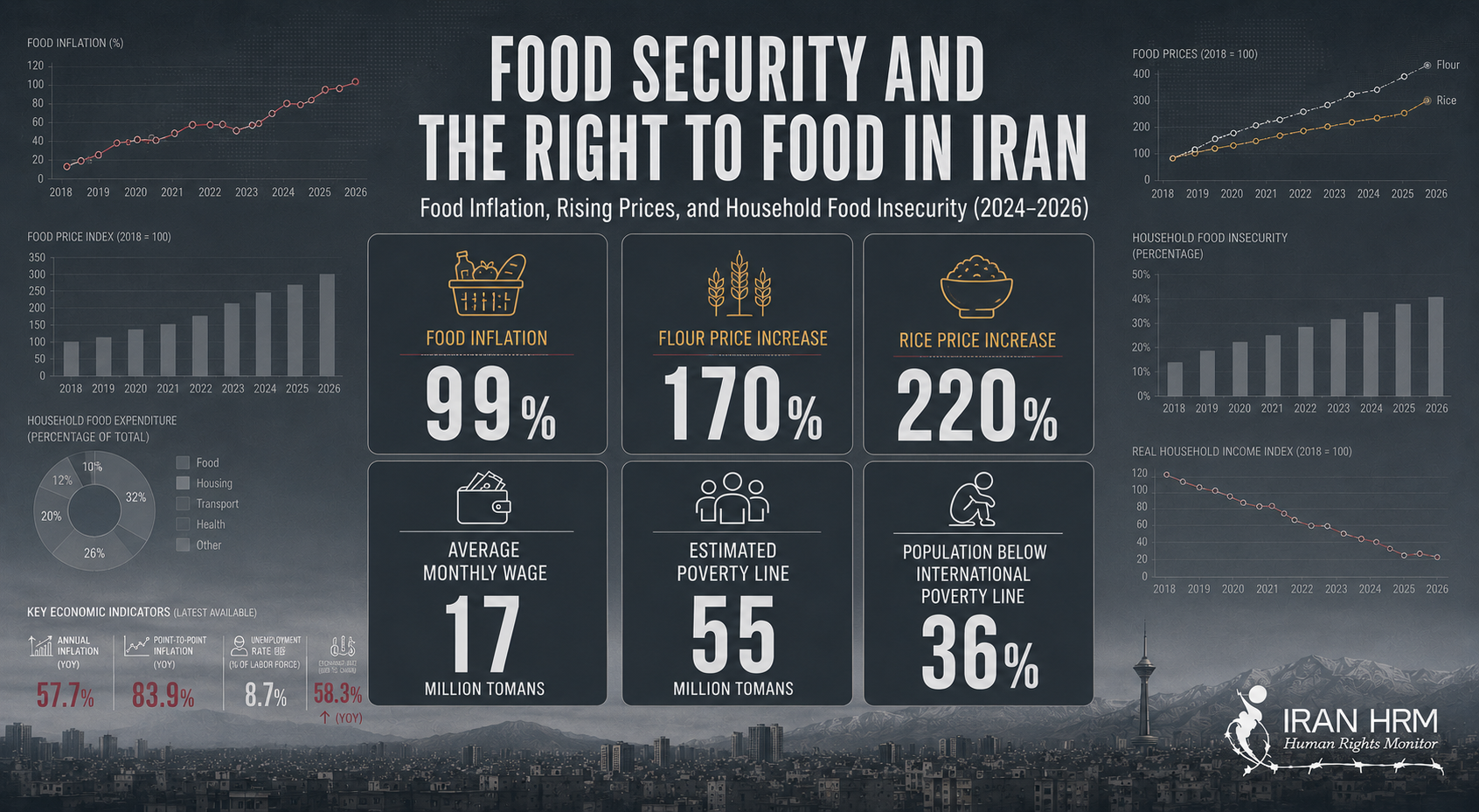
In its April 2026 Poverty and Macroeconomic Outlook report, the World Bank estimated food inflation in Iran at approximately 99 percent in February 2026; a figure substantially higher than overall inflation during the same period. This gap demonstrates that the actual pressure on household food consumption, particularly among low-income families, is significantly greater than what general inflation indicators alone suggest.
The Food and Agriculture Organization of the United Nations (FAO), in its assessment of 10 June 2026, reported that retail wheat flour prices in Tehran increased by approximately 170 percent in April 2026 compared with the previous year, while rice prices rose by approximately 220 percent. The same report recorded a roughly 140 percent increase in the government’s guaranteed wheat procurement price.
Field evidence suggests that rising food prices have not merely altered consumption patterns but have also pushed some households toward dependence on credit purchases. One report from Tehran described how several young women divided responsibility for obtaining food on credit: one purchased cooking oil and tomato paste on account, another obtained bread and cheese through informal credit arrangements, while a third was responsible for acquiring legumes. Such arrangements illustrate the survival strategies adopted in response to escalating food costs.
These figures indicate that Iran’s food crisis is not simply the result of general inflation. Some of the most basic food staples, including flour, bread, rice, and cereals, have experienced price increases far exceeding overall inflation rates. For households that devote a substantial share of their income to food, such increases translate directly into reduced purchasing power and fewer dietary choices.
According to the United Nations Development Programme (UNDP), vulnerable households in Iran allocate approximately 45 percent of their total consumption expenditure to food. The organization has warned that elevated food inflation increases the likelihood that vulnerable families will either reduce the quality of their diets or consume less food overall.
Field reports further indicate that many low-income households have gradually removed nutritionally valuable foods from their consumption baskets. Labor and economic experts have repeatedly warned that meat, dairy products, fruit, and other key sources of protein and micronutrients have become infrequently consumed or increasingly inaccessible for a growing number of families.
From a human rights perspective, these warnings carry particular significance. When families are forced to reduce either the quality or quantity of food they consume in order to cope with rising prices, the crisis becomes more than a matter of income and inflation. It becomes a question of the right to adequate, safe, and nutritious food.
Article 11 of the International Covenant on Economic, Social and Cultural Rights recognizes the right of every individual to adequate food and an adequate standard of living. Sharp increases in food prices, combined with declining purchasing power, have seriously undermined the realization of this right for segments of Iranian society.
 Food Insecurity and Malnutrition: From Economic Pressure to Physical Harm
Rising food prices do not merely reduce household purchasing power. When families are compelled to reduce either the quantity or quality of the food they consume, the consequences can directly affect health, child development, and overall well-being.
The United Nations Development Programme (UNDP) has warned that high food inflation in Iran may push vulnerable households toward lowering the quality of their diets or reducing overall food consumption. This concern is particularly significant for families that already spend a large share of their income on food and therefore have limited capacity to absorb further price increases.
Assessments by UNICEF indicate that food insecurity has become a serious concern in parts of Iran. In reports concerning Sistan and Baluchestan Province, UNICEF has identified food insecurity as one of the region’s principal challenges and noted that significant numbers of children suffering from acute malnutrition have required treatment and nutritional support.
Women-headed households, who account for approximately 22.5 percent of all households in Iran, are among the groups most vulnerable to food insecurity. Approximately 55 percent of these households fall within the country’s poorest income decile, increasing their exposure to rising food prices and declining living standards.
According to UNICEF data, Sistan and Baluchestan records the highest rate of child malnutrition in the country, estimated at approximately 11.7 percent. These figures demonstrate that the consequences of the economic and food crisis are not evenly distributed across Iran and that economically marginalized regions face substantially greater risks.
The World Food Programme (WFP) has also warned that sharp increases in food prices weaken households’ ability to cope with future economic shocks. Families that already devote most of their income to food possess far fewer resources to absorb the effects of illness, unemployment, rent increases, or other economic disruptions.
The implications of food insecurity extend beyond nutrition alone. Food insecurity can contribute to increased vulnerability among children, deteriorating public health outcomes, reduced educational performance, and growing pressure on low-income families. For this reason, many international organizations regard access to sufficient and nutritious food not merely as a welfare concern but as a fundamental human right.
Available evidence suggests that Iran’s food crisis cannot be understood simply as a matter of more expensive groceries. For a portion of the population, particularly those living in deprived regions and low-income households, the crisis has become directly linked to health, child development, and access to minimum standards of living.
Domestic Warnings: When the Public’s Food Basket Becomes a Subject of Official Concern
The rise in food prices and the decline in household purchasing power have not been highlighted solely in international reports. Government officials, members of parliament, labor representatives, and domestic experts have repeatedly warned about the livelihood consequences of these developments.
Asad Salehi, a member of Iran’s Supreme Labor Council, stated:
“The gap between workers’ wages and actual market prices has deepened year after year, and the purchasing power of workers continues to decline.”
These remarks come at a time when food prices have risen faster than many other categories of goods and services. For households that devote a substantial share of their income to food, declining purchasing power translates directly into reduced access to adequate and nutritious nutrition.
A baker in Tehran reported that some customers can no longer afford a full loaf of bread and instead ask to purchase half a loaf or even a smaller portion of traditional sangak bread. According to his account, many of these customers come from low-income or salaried households whose purchasing power has been eroded by rising living costs.
Taken together, assessments by the World Bank, UNDP, FAO, UNICEF, and the World Food Programme, alongside statements by domestic officials and experts, present a broadly consistent picture: rising food costs have placed disproportionate pressure on lower-income households and have increasingly challenged the food security of segments of Iranian society.
For many families, the issue is no longer simply that food has become more expensive. The deeper concern is the growing difficulty of securing an adequate, diverse, and nutritious diet; a condition whose consequences extend beyond household economics and affect health, child development, and overall quality of life.
Conclusion
The evidence presented in this chapter indicates that the consequences of rising food prices extend far beyond household consumption patterns. Food insecurity increasingly affects public health, family well-being, and overall living standards, raising broader concerns regarding the right to adequate food.
At the same time, the pressure created by rising food costs leaves fewer resources available for housing, healthcare, and other essential needs. The next chapter examines how these pressures contribute to housing insecurity, barriers to medical care, household debt, and the survival strategies adopted by many Iranian families.
━━━━━━━━━━━━━━━━━━━━━━━━━━
📖 Continue the Report Series
Part III: Housing Crisis, Healthcare Costs, Debt, and Survival Strategies in Iran (2024–2026)