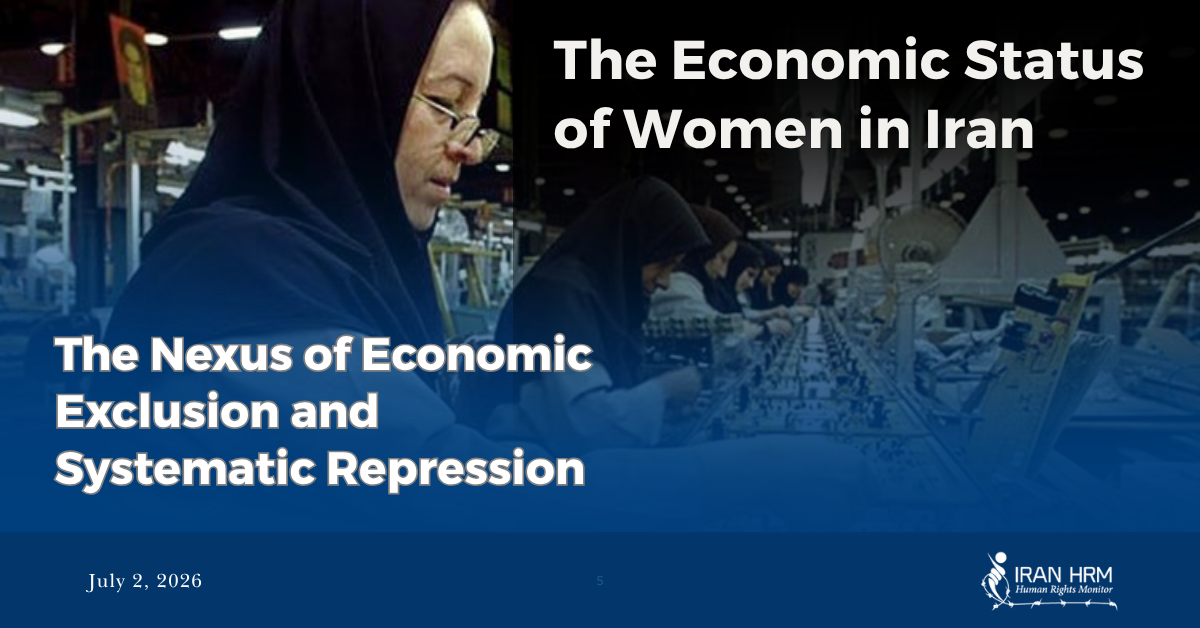
The economic status of women in Iran extends far beyond mere statistical indicators or labor market metrics. It vividly demonstrates how economic crises, structural discrimination, restrictive laws and practices, and social repression are deeply intertwined—ultimately depriving women of their right to employment, financial independence, and equal participation in development. Official data and domestic press reports reveal that the decline in women’s economic participation, the drop in the employment-to-population ratio, the surging numbers of young women classified as NEET (Not in Education, Employment, or Training), and the statistical reclassification of unemployed women as “housewives” are all indicators of a gradual yet profound purging of women from the formal economy.[1][2][3]

A Statistical Profile of the Crisis: Low Participation, Unequal Employment, and Submerged Women
By the end of 1404 (early 2026), reports indicated a decline in the country’s overall economic participation rate to approximately 40.6%, with some accounts putting it closer to 38%. This implies that a massive portion of the working-age population is completely absent from formal production and the labor market.[2][3] Furthermore, this rate places Iran among the countries with the lowest economic participation rates globally. Within this framework, domestic accounts show that the female economic participation rate has plummeted from roughly 17% to between 12% and 13.4%, while the female employment-to-population ratio is reported at around 11.4%.[1][3] These figures underscore a deep structural and gender gap within the Iranian economy: while male economic participation was reported at approximately 67.9% in 1404, female participation stood at a mere 13.4%—a staggering gap of over 54 percentage points.[3]
The Economic Exclusion of Women: From Overt Unemployment to Statistical “Housewifization”
A critical element in analyzing the economic status of women in Iran is that many women who lose their jobs do not necessarily remain classified as “unemployed” in official statistics; instead, they are categorized as “housewives,” “students,” or “economically inactive.” Consequently, while official unemployment rates may superficially decrease or stabilize, the underlying reality of the labor market deteriorates. In a report by Tose’e Irani, economist Zahra Karimi notes that women are invariably the first victims of workforce downsizings, with approximately 200,000 women’s jobs destroyed over the past three years.[2] Simply put, many women who lose their livelihoods or abandon their job searches due to the lack of decent opportunities disappear from unemployment metrics entirely. They still practically require work and income, but because they are relegated to the categories of “housewives” or “economically inactive,” they remain invisible to state policymakers, resulting in a total absence of serious initiatives to reintegrate them into the workforce.
The Economy of Repression: Synchronized Controls Over Bodily Autonomy and Livelihoods
The repression of women in Iran is not confined to the streets, schools, universities, or digital spaces; the labor market serves as one of its primary battlegrounds. United Nations reports on Iran have established that the state curtails the fundamental rights of women and girls across multiple spheres—including bodily autonomy, freedom of expression, education, work, and other economic, social, and cultural rights—utilizing surveillance, punishments, fines, judicial harassment, and professional bans to enforce a rigid gender order.[4][5] Therefore, when a woman is forced out of the workforce due to systemic discrimination, job insecurity, mandatory hijab pressures, the absence of childcare services, or substandard wages, it is not merely an instance of economic inefficiency. This displacement is an active component of a broader mechanism of structural repression and enforced financial dependency.
Young Women and the NEET Crisis: An Educated Generation Denied a Future
According to a report by Donya-e-Eqtesad, the population of youth aged 15 to 24 who are not in employment, education, or training (NEET) surpassed 2.7 million in 1404, with young women accounting for more than 1.79 million of this figure.[3] This statistic carries significant weight, proving that the female employment crisis does not just impact current job seekers, but fundamentally jeopardizes the future of the younger generation. The rising educational attainment of women, when met with a lack of equal access to decent work, culminates in systemic social frustration, economic dependency, forced migration, or a long-term exit from the cycle of empowerment.
Depressed Wages, the Absence of Decent Work, and the Burden of Unpaid Care
Existing literature repeatedly highlights that prevailing wage offers in various cities, particularly for women, are so low that they fail to cover the basic costs of commuting, childcare, and workplace pressures.[1][2] When a woman is faced with a monthly wage offer of around 10 million Tomans amidst rampant inflation, formal employment can represent an added financial liability rather than a gateway to independence. The total deficit of childcare infrastructure, combined with patriarchal market perspectives and social constraints, systematically drives women toward unpaid domestic labor—a sector entirely omitted from GDP and employment data, yet functioning as the invisible pillar sustaining social reproduction and family survival.
Human Rights Implications for International Bodies: From Warning to Action
For the United Nations Entity for Gender Equality and the Empowerment of Women (UN Women) and other international bodies, the economic status of women in Iran must be evaluated through the lens of the right to work, the right to equality, the right to economic security, and the right to be free from gender-based discrimination. Reports by the UN Fact-Finding Mission and the UN Human Rights Office have consistently emphasized that the restriction of women in Iran is systemic in nature, extending from clothing regulations to educational and professional bans.[4][5] In addition to violating the right to work, these measures constitute an explicit breach of Iran’s obligations under Articles 6 and 7 of the International Covenant on Economic, Social and Cultural Rights (ICESCR), which guarantees the right to decent work and just and favorable conditions of work. Consequently, the international community’s response must transcend issuing statements or expressing concern. It is imperative that the economic exclusion of women be placed on the agenda of international institutions as an intrinsic component of a broader pattern of gender-based oppression—a pattern that simultaneously violates the right to work and economic security while rendering women more vulnerable to violence, dependency, and social marginalization.
Proposed Actions for the International Community and UN Women
The international community, particularly UN Women, can support Iranian women through several concrete avenues:
- First, establishing a regular mechanism to collect and publish gender-disaggregated data concerning employment, hidden unemployment, the wage gap, informal labor, unpaid care work, gender-based layoffs, and the impacts of repressive policies on women’s livelihoods.
- Second, urging international statistical and economic agencies to demand a meticulous gender, age, geographical, educational, and marital status breakdown of Iranian data, ensuring that women submerged in official registries under the labels of “housewife” or “inactive” become visible to policymakers once again.
- Third, UN Women could compile an independent thematic report focusing on “Economic Exclusion and Gender Oppression of Women in Iran” to complement existing human rights documentation. This report should delineate the hidden process of livelihood deprivation as a primary mechanism of “Gender Persecution” and the structural manifestation of “Gender Apartheid” in Iran. Historically, international attention has heavily centered on street-level crackdowns, mandatory hijab laws, and detentions, while their systematic link to women’s economic deprivation has remained under-examined.
- Fourth, prioritizing direct support for independent women’s organizations, female labor activists, economic journalists, and women’s rights defenders. This includes supporting secure documentation practices, education on economic and social rights, creating confidential reporting channels, and protecting individuals facing security threats for exposing discrimination or repression.
- Fifth, international bodies must demand that the Iranian government abolish all punitive measures and restrictions that tether women’s access to work, education, public services, and social life to compliance with discriminatory standards. UN reports demonstrate that the escalation of surveillance, judicial harassment, and punishment targeting women and girls has persisted and expanded following the 2022 (1401) protests.[4][5] Consequently, women’s right to employment must be viewed in tandem with the right to bodily autonomy, security, freedom of movement, and social participation. If a woman is barred from employment, universities, banking services, public transportation, or public spaces due to her attire, civic engagement, or peaceful protest, this is not merely a civil violation; it is a tool of economic and social coercion designed to systematically push women out of public life.
- Sixth, the international community can utilize bilateral human rights dialogues, periodic reviews, and UN mechanisms to demand a time-bound roadmap from Iran to eradicate discrimination in the labor market. This includes guaranteeing non-discrimination in hiring and firing, protecting female workers and job seekers, ensuring equal access to social security and insurance, introducing childcare infrastructure, recognizing the economic value of unpaid care work, and prohibiting any employment bans based on attire or civic activities.
- Seventh, it is crucial that the voices of women inside Iran—particularly female laborers, women-headed households, young women outside education and employment cycles, and those residing in small towns and marginalized regions—be directly reflected in international summits and reports. Without integrating their lived experiences, international policies risk remaining at the level of abstract generalities.
Mechanisms for Accountability and Enforcing Consequences for Non-Compliance
Demands placed upon the international community gain true meaning only when concrete consequences are attached to non-compliance. If the Islamic Republic fails to implement international recommendations, treaties, or mandates regarding the economic and social rights of women, the international response must not be confined to recycled expressions of concern or generic statements.
- The first step requires establishing clear, measurable, and time-bound indicators. The female economic participation rate, female employment-to-population ratio, gender wage gap, the number of women barred from employment or education due to mandatory hijab enforcement or civic activism, the socio-economic status of female laborers and women-headed households, access to social security and insurance, and the structural recognition of unpaid care work must all be transformed into official monitoring benchmarks.
- The second step is independent verification. Reports issued by the Iranian government must never serve as the final source of assessment, given that a core aspect of the problem lies in statistical manipulation and the erasure of women from the “unemployed” or “economically active” classifications. The United Nations—particularly its human rights mechanisms—must cross-reference Iran’s official data with civil society documentation, individual testimonies, reports from labor and women’s rights defenders, Special Rapporteurs, independent human rights organizations, and international agency databases. The Independent International Fact-Finding Mission on Iran, mandated by the UN Human Rights Council to investigate ongoing serious human rights violations and to collect, preserve, and maintain evidence for future independent legal proceedings,[7] must utilize this capacity to systematically document the economic exclusion of women, rather than limiting its scope to overt cases of street-level violence or detentions.
- The third step is formalizing “non-compliance” within official UN reporting structures. Every monitoring report concerning Iran must explicitly grade the regime’s compliance with international recommendations and mandates: full cooperation, partial cooperation, deficient data provision, active obstruction, or total non-compliance. This tiered grading must be formally integrated into the reports of the Human Rights Council, the Special Rapporteur on the situation of human rights in Iran, the Universal Periodic Review (UPR) mechanism, and thematic reports addressing violence against women, poverty, the right to education, and the right to work. Once non-cooperation is officially coded and recorded, the government can no longer bypass recommendations without incurring political costs.
- The fourth step involves explicitly naming the institutions and officials complicit in the socio-economic disenfranchisement of women. When ministries, security apparatuses, the judiciary, law enforcement forces, universities, municipalities, banking institutions, or state and quasi-state employers play an active role in gender-based dismissals, professional bans, educational expulsions, service terminations, or economic coercion against women, their institutional roles must be meticulously documented in official public reports. This is vital to establish accountability, deter recurrence, and dismantle systemic impunity.
- The fifth step is anchoring international engagement to women’s rights indicators. Any technical cooperation, training programs, developmental assistance, or economic partnerships conducted with Iranian state institutions must be strictly contingent upon meeting minimum compliance thresholds regarding women’s rights. State entities involved in barring women from work, education, public services, or economic security must not benefit unconditionally from standard international cooperation, professional accreditation, or development projects. Conversely, international backing should be proactively redirected toward independent institutions, civil society organizations, women’s rights activists, journalists, and groups working to document gender discrimination and economic exclusion.
- The sixth step entails utilizing accountability tools that go beyond mere recommendations. While the United Nations does not independently enforce sanctions, its investigative documentation and findings can serve as the legal and factual basis for sovereign states, regional unions, and parliaments to impose targeted human rights sanctions against officials and entities driving this repression. These measures include travel bans, asset freezes, the prohibition of formal institutional cooperation, and restricting access to international programs. Furthermore, the evidence gathered can be leveraged in future judicial proceedings, including universal jurisdiction mechanisms, to pursue corporate and individual criminal responsibility. Human rights organizations have continually emphasized that expanding the mandate of the UN Fact-Finding Mission on Iran remains crucial for preserving evidence and building pathways toward future accountability.[8]
Consequently, the core international demand must move away from accepting vague promises of “improving the status of women” from the Islamic Republic. Instead, the regime must be compelled to answer to specific, quantified indicators—and should it fail to do so, it must incur definitive institutional, legal, and political costs. Without such an accountability framework, international recommendations degenerate into toothless texts. However, by formalizing non-compliance metrics, enforcing independent verification, preserving evidence for future prosecution, and conditioning international engagement, the economic exclusion of women can successfully shift from an ethical warning to a matter of enforceable international accountability.
Conclusion: An Economy Without Women is Development Without Justice
The economic status of women in Iran reveals that their systematic elimination from the labor market operates simultaneously as a consequence of economic failure and a deliberate tool for reproducing gender-based oppression. The collapse of female economic participation, the profound structural employment gap, the surging population of young women trapped outside education or employment cycles, and the statistical concealment of unemployment under the guise of domestic care work collectively expose a single, unyielding reality: women in Iran are systematically denied economic independence through a synchronized matrix of financial pressure, legal discrimination, social engineering, and political repression.
Therefore, the primary demand presented to the international community—and specifically to UN Women—is to formally recognize the economic exclusion of women as a structural arm of gender persecution in Iran, and to define actionable, measurable, verifiable accountability mechanisms coupled with tangible consequences. In contemporary Iran, defending the right to employment and financial autonomy is indistinguishable from defending human dignity, liberty, and equality. Yet, this defense yields results only when non-compliance carries a distinct cost. Without relentless pressure, rigorous documentation, official registries of non-cooperation, direct amplification of the voices of women inside Iran, and the strategic activation of international accountability channels, this fundamental right will remain permanently sidelined in the margins of abstract reports and generic declarations.
References
- Sazandegi Newspaper, “200,000 Women Have Lost Their Job Seats Over the Past Year,” Published: June 29, 2026 (8 Tir 1405).
- Tose’e Irani Newspaper, Reza Asadabadi, “Iran’s Labor Market Shrinks Day by Day, Job Opportunities Increasingly Restrained,” Published: June 27, 2026 (6 Tir 1405).
- Donya-e-Eqtesad Newspaper, Mohammad Hossein Hosseini, “How to Protect the Workforce During Economic Crises?”, Published: June 30, 2026 (9 Tir 1405).
- UN News, “Iran: Repression of women ‘intensifying’, two years on from mass protests,” Published: September 13, 2024.
- OHCHR, “Iran: Government continues systematic repression and escalates surveillance to crush dissent in the aftermath of protests,” Published: March 14, 2025.
- World Bank Open Data / ILOSTAT, Female Economic Participation Index in Iran, Latest available data for 2024, Accessed: 2026.
- OHCHR, “Independent International Fact-Finding Mission on the Islamic Republic of Iran,” Mandate, extensions, and responsibilities regarding the collection, preservation, and accessibility of evidence for independent legal proceedings, Accessed: 2026.
- Amnesty International, “Iran: UN expands Fact-Finding Mission’s mandate in landmark development to address human rights crisis,” Published: April 3, 2025.