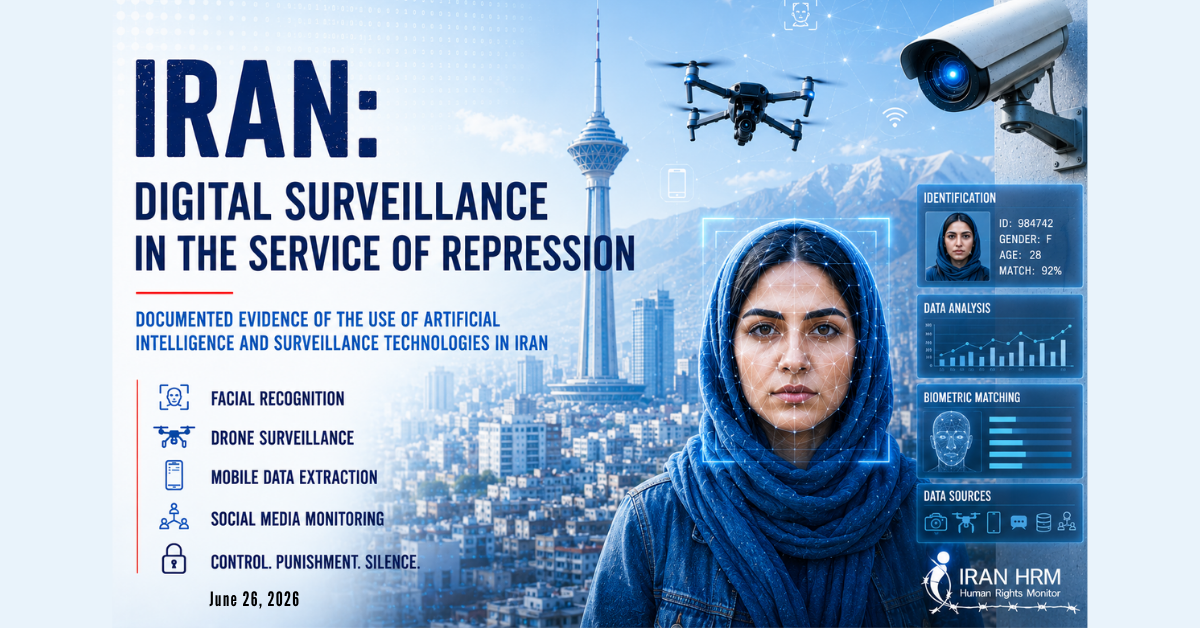
Documented Evidence of the Use of Artificial Intelligence and Surveillance Technologies in Iran
In recent years, artificial intelligence, facial recognition systems, big data analytics, smart surveillance cameras, and monitoring drones have fundamentally transformed the ways in which governments exercise authority and social control across the world. While these technologies can serve legitimate public purposes such as improving public services and urban management, under authoritarian governments the very same tools can be employed to conduct mass surveillance, identify political opponents, and restrict fundamental freedoms.

In Iran, official government documents, reports issued by the United Nations Independent International Fact-Finding Mission on Iran, findings by UN Special Rapporteurs, and investigations conducted by leading international media organizations indicate an expanding use of smart surveillance cameras, facial recognition systems, drones, social media monitoring, and the extraction of data from mobile phones. Following the nationwide protests between 2022 and 2025 and the arrest of tens of thousands of citizens, an increasingly urgent question has emerged: to what extent have these technologies become an integral component of the mechanisms used to identify, monitor, and suppress the population?
Drawing on official documents issued by the ruling regime in Iran, reports by the United Nations, and investigations by internationally recognized media outlets, this report distinguishes between verified facts, evidence-based findings, official statements by government authorities, and expert analysis in order to present a documented assessment of the role that emerging technologies play in Iran’s system of repression.
Chapter One: Identifying Protesters: The Beginning of the Digital Repression Era
The nationwide protests between 2022 and 2025 represented one of the most significant political and social challenges faced by the ruling regime in Iran during the past four decades. Mai Sato, the United Nations Special Rapporteur on the situation of human rights in Iran, Volker Türk, the United Nations High Commissioner for Human Rights, together with other international bodies, reported the arrest of tens of thousands of people, including women, children, university students, journalists, lawyers, political and civil society activists, and members of ethnic and religious minorities.
This report does not claim that all of these arrests were carried out through artificial intelligence or other advanced surveillance technologies. The available evidence does, however, demonstrate that alongside traditional security methods, the clerical regime has increasingly relied on digital technologies to expand its capacity to identify, track, and monitor citizens.
Mobile Phones: A Gateway to Identifying Protest Networks
The United Nations Independent International Fact-Finding Mission has reported that the mobile phones of many detainees were confiscated and that security authorities examined their contents, including messages, photographs, videos, contact lists, communication records, and social media accounts. According to documented findings, information extracted from one detainee’s phone was, in some cases, subsequently used to identify, summon, or arrest other individuals. Consequently, the mobile phone of a single protester can become a tool for expanding the identification of entire protest networks.
SIM Card Deactivation: Digital Deprivation as a Tool of Control
The UN Fact-Finding Mission also reported that during 2024, the SIM cards of a number of civil society activists, journalists, and university students were deactivated. Beyond interrupting personal communications, this measure deprived those affected of access to banking services, authentication text messages, online accounts, and numerous essential digital services. The deactivation of SIM cards without a transparent judicial process constitutes a form of digital deprivation capable of severely disrupting both everyday life and professional activities.
Facial Recognition on University Campuses
The UN Fact-Finding Mission and the Associated Press reported that on April 20, 2024, facial recognition technology was used at the entrance to Amirkabir University of Technology in Tehran to identify students, resulting in approximately 200 female students being denied entry to the university. This represents one of the first documented instances of facial recognition technology being deployed at a higher education institution in Iran and demonstrates that surveillance technologies have expanded into academic environments.
Monitoring Social Media Activity
According to the UN Fact-Finding Mission, on April 23, 2024, within the framework of the “Noor Plan,” the commander of the West Tehran Police announced that 21 Instagram accounts belonging to prominent women had been blocked and that their online activities were under continuous surveillance. This measure demonstrates that citizens’ online activities may serve as grounds for summonses, intimidation, account restrictions, or the initiation of criminal or security-related proceedings.
Aerial Surveillance Through Drones
The UN Fact-Finding Mission documented the deployment of camera-equipped drones during the Tehran International Book Fair on May 10, 2024, and on Kish Island on May 16, 2024.
In June 2025, officials of the ruling regime in Iran publicly announced the expansion of aerial surveillance over Tehran. Alireza Zakani, Mayor of Tehran, stated: “The agreement on visual surveillance covering Tehran’s 5,980 square kilometer jurisdiction has been finalized.” Hamidreza Saremi, Deputy Mayor of Tehran, stated: “Satellite and drone surveillance is conducted on a permanent basis.” Hossein Hassani Ahangar, President of Imam Hossein University affiliated with the Islamic Revolutionary Guard Corps, stated: “We monitor Tehran’s surrounding areas using drones and satellite imagery.”
These official statements, particularly given the cooperation between the Tehran Municipality and the university affiliated with the Islamic Revolutionary Guard Corps, indicate the expansion of large-scale urban surveillance capabilities. During periods of public unrest, such capabilities may be used to monitor demonstrations, track movements, and identify individuals participating in protests.
Internet Shutdowns and Communication Disruptions
On January 9, 2026, Reuters reported that the ruling regime in Iran restricted or shut down internet and telephone services in certain areas in an effort to contain protests. Such measures impede the transmission of images and eyewitness reports, while limiting the ability of citizens to organize, communicate with family members, obtain legal representation, inform the media, and access emergency medical assistance.
Reuters reported on January 16, 2026, that drones were flying over Tehran following the suppression of protests. On February 14, 2026, the Associated Press further reported that security authorities had used footage from municipal surveillance cameras, privately owned security cameras, and drone imagery to identify and arrest some protesters. Although such reporting should be interpreted with caution given the restrictive environment inside Iran, these accounts are consistent with a broader pattern in which technology is increasingly employed to identify, monitor, and pursue citizens.
Taken together, the available evidence indicates that alongside traditional methods of repression, the ruling regime in Iran has increasingly incorporated digital technologies to enhance its capacity to identify, track, and monitor citizens. These measures do not appear to constitute isolated practices; rather, they form part of a broader legal, technical, and institutional infrastructure that has steadily developed in recent years.
Chapter Two: The Architecture of Digital Surveillance in the Islamic Republic
The deployment of emerging technologies to control citizens in the Islamic Republic is not merely a temporary response to episodes of public unrest. Official documents, legislation, statements by government officials, and international reports indicate that, over recent years, a legal, technological, and institutional infrastructure has been developed to expand digital surveillance. This infrastructure enables the large-scale collection, analysis, and utilization of citizens’ personal data.
Artificial Intelligence in Official Legislation
One of the clearest indicators of this development is the formal incorporation of “artificial intelligence” into the Islamic Republic’s legislative framework. Article 28 of the proposed Family Support through the Promotion of the Culture of Chastity and Hijab Bill authorizes the use of “smart systems,” “fixed and mobile cameras,” and “artificial intelligence” to identify and record alleged violations. The publication of this provision through official state media demonstrates that the use of advanced surveillance technologies has become part of the government’s official policy.
Smart Cameras and the Noor Plan
Ahmadreza Radan, Commander-in-Chief of Iran’s Law Enforcement Command, stated:
“Individuals are identified through cameras and smart equipment.”
This approach was also reflected in the implementation of the “Noor Plan.” According to official reports, the initiative relies on images captured by surveillance cameras and smart monitoring systems to identify individuals, issue warning text messages, and initiate law enforcement measures.
Expansion of Facial Recognition Systems
Reports by the United Nations Independent International Fact-Finding Mission and investigations conducted by international media organizations indicate that the Islamic Republic has expanded its use of facial recognition technology in recent years. In April 2024, the use of facial recognition at the entrance of Amirkabir University of Technology in Tehran to identify students was documented.
At the same time, investigations by Le Monde and Forbidden Stories reported cooperation between Iranian institutions and Russian companies specializing in facial recognition technology, including NtechLab, as well as the reported use of the FindFace platform. While the operational details of these collaborations require further independent verification, the investigations point to the continued expansion of facial recognition infrastructure in Iran.
Aerial Surveillance and Continuous Monitoring
Alireza Zakani, Mayor of Tehran, stated:
“The agreement on visual surveillance covering Tehran’s 5,980 square kilometer jurisdiction has been finalized.”
Hamidreza Saremi, Deputy Mayor of Tehran, stated:
“Satellite and drone surveillance is conducted on a permanent basis.”
Hossein Hassani Ahangar, President of Imam Hossein University affiliated with the Islamic Revolutionary Guard Corps, stated:
“We monitor Tehran’s surrounding areas using drones, satellite imagery, and aerial platforms.”
These official statements indicate that the use of drones and satellite imagery is no longer confined to military purposes but has become part of a broader system of continuous surveillance over urban spaces.
Technological Partnerships
Investigations by international media organizations and cybersecurity firms indicate that the expansion of the Islamic Republic’s surveillance infrastructure has not relied solely on domestic capabilities. Le Monde and Forbidden Stories have reported cooperation with Russian companies in the field of facial recognition technology. The cybersecurity firm Threatstone 71 has also reported that certain companies affiliated with the Islamic Revolutionary Guard Corps have cooperated with Chinese firms in the areas of surveillance equipment, communications technologies, and cyber operations.
Although some of these findings require additional independent verification, when considered alongside official documents they contribute to a broader picture of the steady expansion of the Islamic Republic’s surveillance infrastructure.
Digital surveillance in the Islamic Republic is therefore not the product of a single technology or a single institution. Rather, it is built upon an interconnected network of legislation, smart surveillance systems, cameras, facial recognition technology, drones, and coordinated cooperation among security and law enforcement agencies. Together, these components have significantly strengthened the government’s capacity to identify, track, and monitor citizens while creating the infrastructure for the broader use of technology as an instrument of repression.
Chapter Three: Building Security Cases Through Digital Technologies
The expansion of Iran’s digital surveillance infrastructure has extended well beyond the passive monitoring of citizens. Available evidence indicates that these technologies have become integrated into the processes of identification, intelligence gathering, case building, summonses, and arrests. Alongside conventional security methods, they are playing an increasingly significant role in controlling dissent.
Extraction of Mobile Phone Data
Within this framework, data extracted from mobile phones, surveillance camera footage, social media activity, and telecommunications records can be combined to accelerate the identification of individuals and their networks.
Tracking Through Telecommunications Data
Some detainees have reported that interrogators appeared to know their whereabouts during protest events, a pattern that is consistent with the use of telecommunications data to track individuals. However, the specific use of Cell Site Location Information (CSLI) in individual cases still requires additional direct evidence and independent verification.
Identification Through Surveillance Cameras
An investigation by Forbidden Stories documented an example of this pattern in the case of a 13-year-old girl identified under the pseudonym “Hasti.” According to the investigation, footage recorded by a bank’s surveillance camera led to the identification of her father. Security forces subsequently located the girl through her school, pursued her, and arrested her. The report states that the incident resulted in severe physical injuries and lasting neurological trauma.
Security Use of Facial Recognition Technology
In one investigative account, a woman identified under the pseudonym “Maryam” reported that after appearing without a mandatory head covering in a café, she was confronted in court with a photograph of herself that, in her words, “could not have been obtained by any other means.”
This case alone does not establish the widespread deployment of facial recognition technology. However, when considered alongside the United Nations’ findings regarding Amirkabir University of Technology and investigations into the reported use of the FindFace platform, it reinforces concerns that the government is moving toward automated identification of citizens.
Building Security Cases Through Social Media Data
Online activity has likewise become an integral component of the identification process. The examination of photographs, videos, user accounts, and online communications, combined with information extracted from mobile phones, has expanded the authorities’ ability to identify individuals and map relationships among activists.
The United Nations Fact-Finding Mission has documented cases in which citizens’ activities on social media resulted in summonses, arrests, or the imposition of security-related restrictions. Law enforcement officials have likewise acknowledged the continuous monitoring of users’ online accounts within the framework of the “Noor Plan.”
Within the Islamic Republic, technology is therefore used not merely for passive surveillance but as an operational instrument of the security apparatus. This process begins with the collection of personal data, progresses to identification and the construction of security cases, and in some instances culminates in summonses, arrests, and criminal prosecution.
Conclusion
The evidence and documentation examined in this report indicate that, in recent years, the Islamic Republic has transformed digital surveillance from a supplementary tool into one of the central pillars of its security apparatus. Although it is not yet possible to determine with certainty the role played by these technologies in every security-related case, the cumulative body of official documents, United Nations reports, and independent investigations demonstrates that smart surveillance cameras, facial recognition systems, telecommunications data, mobile phones, and drones have been used with increasing frequency to identify, track, and pursue citizens.
The human rights implications of this expanding surveillance architecture are examined in the second report of this series.