“We, the surviving political prisoners, bear witness to what took place in Qezel Hesar Prison—a day marked not only by bloodshed, but by extraordinary brutality, humiliation, and blatant violations of human rights; one of the darkest days of our lives. On that day, every one of our fundamental rights—from the right to life and human dignity to health and a fair trial—was openly and violently trampled.”

—Excerpt from the testimony of political prisoners who survived the “Bloody Saturday of Qezel Hesar”
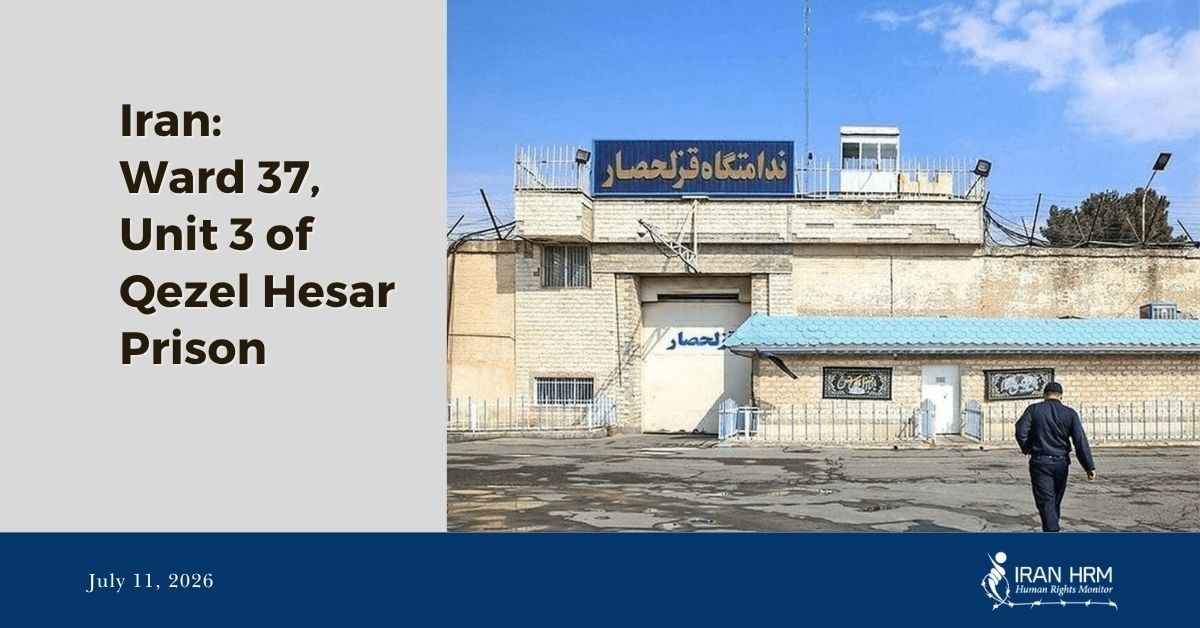
Following the suppression of the nationwide protests of January 2026, a number of those arrested were transferred to Ward 37, Unit 3 of Qezel Hesar Prison. The conditions prevailing in this high-security ward indicate that its purpose extends far beyond the deprivation of liberty. The combination of severe restrictions, the methods by which the ward is administered, and the treatment of detainees point to a structured mechanism designed to isolate prisoners, maintain constant psychological pressure, tightly control communication, and systematically erode both the physical and mental resilience of those detained.
Many of the detainees held in this ward face broadly defined national security charges carrying severe penalties, including the risk of death sentences. At the same time, judicial proceedings are conducted in an environment of extreme secrecy and security. In many cases, families remain without reliable information regarding the legal status of their relatives, the progress of investigations, scheduled court hearings, or even their overall condition. This prolonged uncertainty, combined with the hardships of detention itself, has become an additional form of punishment imposed on the detainees.
Families likewise endure continuous psychological suffering. Telephone calls are brief and infrequent, visits are restricted to short cabin meetings, and the flow of information is tightly controlled. Restricting contact with relatives is not merely an administrative measure; it serves as a means of intensifying psychological pressure on detainees while simultaneously reducing the ability of families and the public to monitor their condition or seek accountability.
The detainees are held under conditions of severe overcrowding, inadequate sleeping space, limited access to medical care and sanitary facilities, constant surveillance, and pervasive security controls. For many of them, months of interrogation, solitary confinement, and sustained security pressure preceded their transfer to Qezel Hesar. Their relocation to Ward 37 therefore represents not the end of repression, but the continuation of the same cycle of coercion within the prison system.
Ward 37: A High-Security Facility Designed to Isolate Protest Detainees
Ward 37, Unit 3 is located adjacent to Ward 35—commonly referred to as the “Secure Ward”—and has been designated for detainees arrested during the January 2026 nationwide protests. Concentrating these detainees within a separate high-security ward has drastically limited their contact with other prisoners, their ability to exchange information, and even their regular communication with family members. This separation is not merely an administrative or protective arrangement; rather, it functions as part of a broader security strategy intended to deprive detainees of outside support, collective solidarity, and the free flow of information.
Detainees are permitted only one brief telephone call per week, while family visits are limited to short cabin meetings conducted under close supervision. These restrictions, combined with stringent control over movement and communications, impose significant psychological pressure on both detainees and their families while severely limiting the possibility of conveying information about conditions inside the ward.
At the same time, severe overcrowding, insufficient sleeping space, poor ventilation, inadequate medical and sanitary facilities, and restricted access to necessities have created harsh living conditions. Many detainees entered Ward 37 after enduring months of detention, interrogation, and security pressure, and continue to experience ongoing physical and psychological deterioration.
The operational pattern observed in Ward 37 closely corresponds to practices documented by the United Nations Fact-Finding Mission on Iran and the UN Special Rapporteur on the situation of human rights in Iran. According to these reports, prolonged isolation, restrictions on family contact, limitations on access to information, and sustained psychological pressure are not simply incidental consequences of imprisonment; rather, they constitute mechanisms designed to weaken detainees’ resistance and increase their vulnerability to further coercion.
Violence as a Mechanism of Repression
The conditions prevailing in Ward 37 extend far beyond restrictions on family contact or inadequate living conditions. Testimonies from prisoners and documented reports emerging from Qezel Hesar Prison indicate that violence, intimidation, and sustained coercion constitute integral elements of the administration of this high-security ward. Any attempt by detainees to protest prison conditions, request medical treatment, object to imposed restrictions, or simply assert their basic rights may be met with beatings, transfer to solitary confinement, or additional punitive measures.
This pattern became particularly evident during the large-scale assault carried out by prison guards against the political prisoners’ ward on 26 July 2025, an incident widely referred to by prisoners as the “Bloody Saturday of Qezel Hesar.” During the operation, dozens of masked guards, accompanied by senior prison officials, stormed the ward and assaulted detainees using punches, kicks, batons, and degrading verbal abuse. Prisoners were handcuffed behind their backs, dragged across the floor, slammed against walls, and transferred to solitary confinement despite sustaining serious injuries. Testimonies describe severe facial swelling, bleeding, fractures, knee and back injuries, and multiple wounds resulting from repeated blows by prison personnel.
Several months later, on the evening of 29 March 2026, prison guards again entered the political prisoners’ ward under the pretext of conducting a routine inspection. Once the prisoners had been ordered out of their cells, six political prisoners were separated from the others for transfer ahead of their executions. When fellow prisoners protested, the guards responded with another wave of severe violence, beating numerous detainees before transferring several of them to solitary confinement. The operation demonstrated that physical violence was not merely a reaction to resistance but formed part of a broader system of control exercised within the prison.
The repetition of such raids, combined with beatings, threats, humiliation, prolonged intimidation, and the denial of basic rights, has created an environment of constant fear. Prisoners are subjected not only to physical harm but also to continuous psychological pressure intended to erode their resilience, destroy any sense of security, and discourage collective resistance.
The conditions documented in Ward 37 closely resemble patterns identified in reports issued by the United Nations concerning the treatment of protest detainees in Iran. Prolonged isolation, severe restrictions on family contact, physical violence, constant threats, and the deliberate creation of an atmosphere of fear together constitute a system capable of progressively breaking a detainee’s psychological resistance. United Nations human rights mechanisms have repeatedly warned that such conditions significantly increase the risk of coercion, including the extraction of forced confessions and the fabrication of criminal cases against detainees.
The Enforcers of Repression: The Role of Qasem Sahraei and Prison Officials
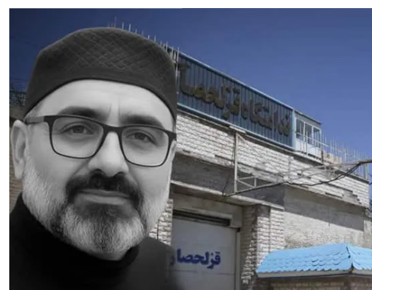
Among the numerous testimonies emerging from Qezel Hesar Prison, the name Qasem Sahraei appears more frequently than that of any other prison officer. Formerly known as the a senior duty officer at Rajai Shahr continued to serve after his transfer to Qezel Hesar as Deputy Officer and Duty Officer of Unit 3, where he became one of the principal figures responsible for implementing security measures and violent crackdowns against detainees.
Multiple prisoner testimonies indicate that his role extends well beyond administrative supervision. According to survivors, Sahraei has personally participated in raids on prison wards, the physical assault of detainees, forced transfers to solitary confinement, and the intimidation of prisoners. Witnesses state that he frequently escorted detainees to areas outside the coverage of prison surveillance cameras, where they were subjected to beatings accompanied by verbal abuse, humiliation, and threats.
In an open letter, one political prisoner reported being threatened by Sahraei with gang rape. Following publication of that letter, prison officers reportedly stormed the prisoner’s cell and subjected him to another severe assault. Fellow detainees later testified that the pressure applied to his throat during the attack was so intense that they believed, for several moments, he would not survive.
Reports further indicate that Sahraei’s violent conduct has not been limited to political prisoners. prisoners convicted of non-political offences have likewise described repeated incidents of physical abuse and degrading treatment. Nevertheless, his role in operations targeting detainees arrested during the nationwide protests has been particularly prominent.
During the events known as the “Bloody Saturday of Qezel Hesar,” prisoners testified that Sahraei openly encouraged guards to intensify the violence. According to multiple independent testimonies, he repeatedly shouted:
“We will kill every one of you.”
When several prisoners protested the brutality, witnesses reported that he responded:
“Yes, we are doing it—and we will make all of you disappear.”
In another account from the same operation, prisoners recalled that while several detainees were being taken away for the implementation of death sentences, Sahraei shouted:
“Yes, we’ll be gone one day—but before that, we’ll finish every last one of you.”
Sahraei was not the only official identified by prisoners. Testimonies also repeatedly mention Allah-Karam Azizi, the Governor of Qezel Hesar Prison; Hassan Ghobadi, Deputy Governor; Esmail Farajnejad, the prison’s Deputy for Health Affairs; Kamareh’i, Head of the Prison Intelligence Protection Office; and Ashrafabadi, another senior intelligence protection official. Prisoners identify these individuals as officials who were present during violent raids, forced transfers, and security operations carried out inside the prison.
The repeated appearance of these names across independent prisoner testimonies does not suggest isolated acts of individual misconduct. Rather, it points to the existence of an organized institutional structure in which violence, intimidation, isolation, and the denial of fundamental rights are systematically employed as instruments to control detainees, break their resistance, and instill fear among those arrested during the nationwide protests.
Legal Assessment: A Systematic Pattern of Repression
The evidence concerning conditions in Ward 37, Unit 3 of Qezel Hesar Prison—supported by prisoner testimonies and documented reports—does not point to isolated or sporadic violations of detainees’ rights. Rather, it reveals a coherent and systematic pattern in which isolation, denial of family contact, physical violence, intimidation, psychological coercion, and prolonged legal uncertainty are employed simultaneously as instruments of control over those arrested during the January 2026 nationwide protests.
The findings of the United Nations Independent International Fact-Finding Mission on the Islamic Republic of Iran, together with reports issued by the UN Special Rapporteur on the situation of human rights in Iran, have consistently identified prolonged isolation and detention in high-security facilities as methods used to weaken detainees’ psychological resilience, sever their connection with the outside world, and create conditions conducive to further coercion. These mechanisms have warned that restricting access to family members, legal counsel, and independent oversight places detainees at heightened risk of torture, coercion, and other forms of ill-treatment.
Within this context, the severe restrictions imposed on family contact in Ward 37 represent far more than ordinary prison regulations. By isolating detainees from their relatives and limiting the flow of information, authorities place both prisoners and their families under sustained psychological pressure. Families are deprived of reliable information regarding the welfare of their loved ones and are often unable to pursue effective legal remedies or mobilize public attention. At the same time, detainees remain in an environment characterized by uncertainty, isolation, and fear.
International human rights mechanisms have repeatedly warned that such conditions create an environment in which forced confessions become substantially more likely. Prolonged isolation, physical abuse, intimidation, psychological exhaustion, and the denial of meaningful access to legal representation have been identified as recurring methods used to compel detainees to make self-incriminating statements that may later be relied upon during criminal proceedings or publicly disseminated through state-controlled media.
The repeated use of physical violence, threats of death, transfers to solitary confinement, and the denial of basic rights is likewise incompatible with Iran’s obligations under the International Covenant on Civil and Political Rights (ICCPR), as well as the United Nations Standard Minimum Rules for the Treatment of Prisoners (the Nelson Mandela Rules). These standards require that all people deprived of liberty be treated with humanity and dignity and prohibit torture and all forms of cruel, inhuman, or degrading treatment or punishment.
Viewed as a whole, the conditions documented in Ward 37 are consistent with the broader pattern described by United Nations human rights bodies regarding the treatment of protest detainees in Iran. Arrest, prolonged isolation, psychological coercion, physical violence, restricted communication, and opaque judicial proceedings function not as separate incidents but as interconnected elements of a broader security apparatus designed to suppress dissent, weaken resistance, and facilitate severe judicial outcomes.
Conclusion
Ward 37, Unit 3 of Qezel Hesar Prison is not merely another high-security section within the prison system. It has become one of the principal locations used to hold detainees arrested during January 2026 nationwide protests, where isolation, severe restrictions on family contact, sustained physical and psychological pressure, organized violence, and prolonged legal uncertainty are imposed simultaneously.
Prisoner testimonies, accounts of violent raids, and the documented role of prison officials indicate that the purpose of this system extends beyond detention alone. It creates an environment in which detainees’ resistance is gradually eroded, their contact with the outside world is severed, and the conditions for further coercion are established. Under such circumstances, the risks of torture, cruel or inhuman treatment, forced confessions, and the imposition of severe sentences, including the death penalty, become immediate and well-founded concerns.
This pattern demonstrates that the repression of protest detainees does not end with arrest. It continues inside prison through security mechanisms designed to isolate, intimidate, and break detainees.
Silence regarding the situation of those held in Ward 37 means overlooking one of the most critical stages in the post-protest cycle of repression. United Nations human rights mechanisms, the Special Rapporteur about human rights in Iran, the Independent International Fact-Finding Mission, and other relevant international bodies must place Ward 37 and the fate of its detainees under urgent scrutiny. They must call for the immediate protection of all detainees held there, unrestricted access to legal counsel and medical care, regular family contact, and independent investigations into allegations of torture, violence, forced confessions, and other serious human rights violations.