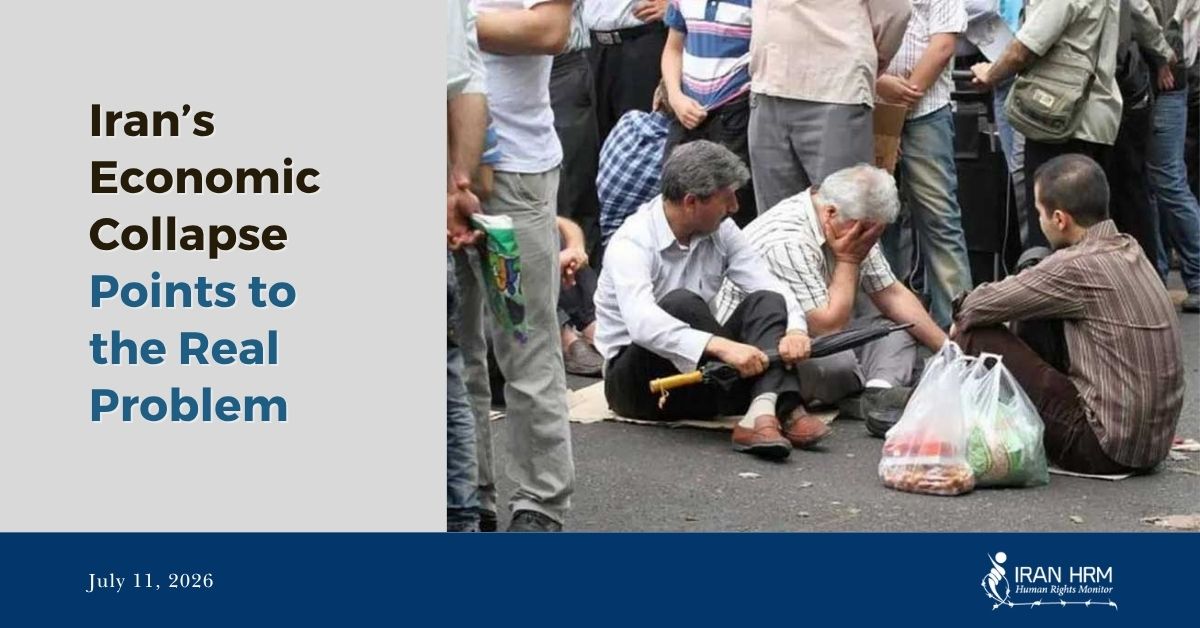
What does it mean when even bread disappears from the tables of ordinary Iranians?
As Iran’s economy continues to deteriorate under an authoritarian government that prioritizes repression and regional militarization, even the most basic staple of survival—bread—is becoming unaffordable for millions. For countless low-income families, bread has long been the last defense against hunger. Today, that final safety net is disappearing.

In Tehran alone, the monthly cost of bread can now exceed 2 million tomans, consuming a significant share of a worker’s income. At the same time, the official monthly minimum wage stands at around 16 million tomans. For many workers, this means eliminating meat, poultry, fish, dairy products, and even eggs from their diets. Bread was the only affordable staple left. Now that, too, is slipping out of reach.
The obvious question is: what is left to eat?
Iranian State Media Acknowledge the Depth of the Crisis
Even media outlets affiliated with the Islamic Republic have begun openly acknowledging the severity of Iran’s economic decline.
On July 9, Eghtesad News, in an article titled “Bread Retreats from Workers’ Tables,” cited official data from the Statistical Center of Iran showing annual inflation for the “bread and cereals” category had reached 114.2 percent, while year-on-year inflation stood at 140.6 percent.
The report concluded that families now have to pay more than twice as much for the same amount of bread as they did a year ago. It also warned that if households reduce bread consumption by just 20 percent because of rising prices, each person would lose roughly 170 kilocalories per day. Combined with the already widespread reduction in consumption of meat, dairy products, eggs, and legumes, such cuts would directly undermine nutritional health.
Iran’s economic crisis has now reached the point where even middle-income households struggle to secure the minimum daily calories needed for survival. This represents more than a temporary downturn. It signals a profound transformation of the country’s social structure and the erosion of the middle class—the traditional pillar of economic growth, social stability, and cultural development.
The Middle Class Is Disappearing
On July 9, the newspaper Siasat-e Rooz, in an editorial titled “From Food Coupons to Calories: A Bitter Admission of Expanding Poverty,” acknowledged the broader consequences of this decline.
The paper argued that when the middle class loses purchasing power, job security, and hope for the future, the consequences extend far beyond household budgets. Investment, production, education, marriage rates, family formation, mental health, and public trust all begin to deteriorate.
It further noted that if income deciles seven, eight, and nine are no longer meaningfully distinguishable from one another, serious questions must be asked about what has happened to the social class that once served as the engine of Iran’s economy.
Perhaps even more alarming, the article acknowledged that some middle-income families are now unable to obtain the minimum caloric intake required for daily life. Once an economy reaches the point where the issue is no longer the loss of luxury goods but the inability to purchase basic food, it is no longer facing a routine economic fluctuation. It is confronting structural impoverishment.
Inflation Is Deepening Regional Poverty
The newspaper Sazandegi, writing on July 8 under the headline “The Provincial Distribution of Poverty,” warned that inflation is not affecting all parts of Iran equally.
While much attention has focused on the shrinking middle class, the paper argued that a more troubling development has received less notice: the changing geography of poverty. Provinces already burdened by high unemployment, low incomes, and structural deprivation have suffered disproportionately from inflation.
According to the report, inflation has not only weakened the middle class but has made Iran’s poorest provinces even poorer.
Economists describe this phenomenon as the “inheritance of poverty”—a condition in which poverty is transmitted from one generation to the next. Children born into low-income families in economically disadvantaged provinces are significantly less likely to receive quality education, adequate nutrition, proper healthcare, or meaningful employment opportunities. As a result, escaping poverty becomes increasingly difficult, and regional inequalities become entrenched.
From this perspective, inflation is no longer simply a monetary issue. It has become a powerful driver of long-term inequality.
Sixteen Years of Declining Living Standards
Another Iranian outlet, Eghtesad24, published an analysis on July 7 titled “Sixteen Years of Rising Poverty: How Iranian Wages Fell to Just $3 a Day.”
The article described a dramatic collapse in the dollar value of Iran’s minimum wage between 2010 and 2026. What was once the equivalent of roughly $400 per month has fallen to below $100.
The report characterized this as more than statistical decline. It described it as a process of gradual, structural impoverishment fueled by comprehensive sanctions, repeated currency devaluations, and government wage suppression.
Between 2018 and 2025, Iran remained trapped in chronic stagflation. During this period, average wages hovered around $140 per month in dollar terms, while governments consistently prevented wage increases from keeping pace with inflation and the collapsing value of the national currency.
According to the article, the burden of this economic mismanagement fell almost entirely on salaried workers, while wealth became increasingly concentrated among quasi-state institutions, politically connected monopolies, and beneficiaries of preferential access to foreign currency.
The Way Forward
The economic catastrophe unfolding in Iran—and increasingly acknowledged by the country’s own media—reveals the priorities of the ruling establishment.
Rather than focusing on improving living standards or ensuring that ordinary citizens can afford the necessities of life, the government continues to devote enormous resources to expanding its missile, drone, and nuclear capabilities, while financing allied proxy forces across the region.
Many critics argue that the international community should abandon expectations that economic engagement alone will moderate the government’s behavior. Instead, they contend that Tehran should face sustained international accountability for its domestic repression and for alleged crimes against humanity.
They further argue that reducing the state’s capacity for repression—including its reliance on executions and political violence—would create the conditions not only for greater freedom inside Iran but also for improved regional stability. In their view, lasting peace and economic recovery depend on addressing the political structures that have produced both domestic hardship and regional instability.
The evidence increasingly suggests that Iran’s economic collapse is not simply the result of economic mismanagement. It is the consequence of political priorities. Any meaningful solution must therefore confront those priorities directly.