Legal Dimensions of the New Execution Crisis in Isfahan
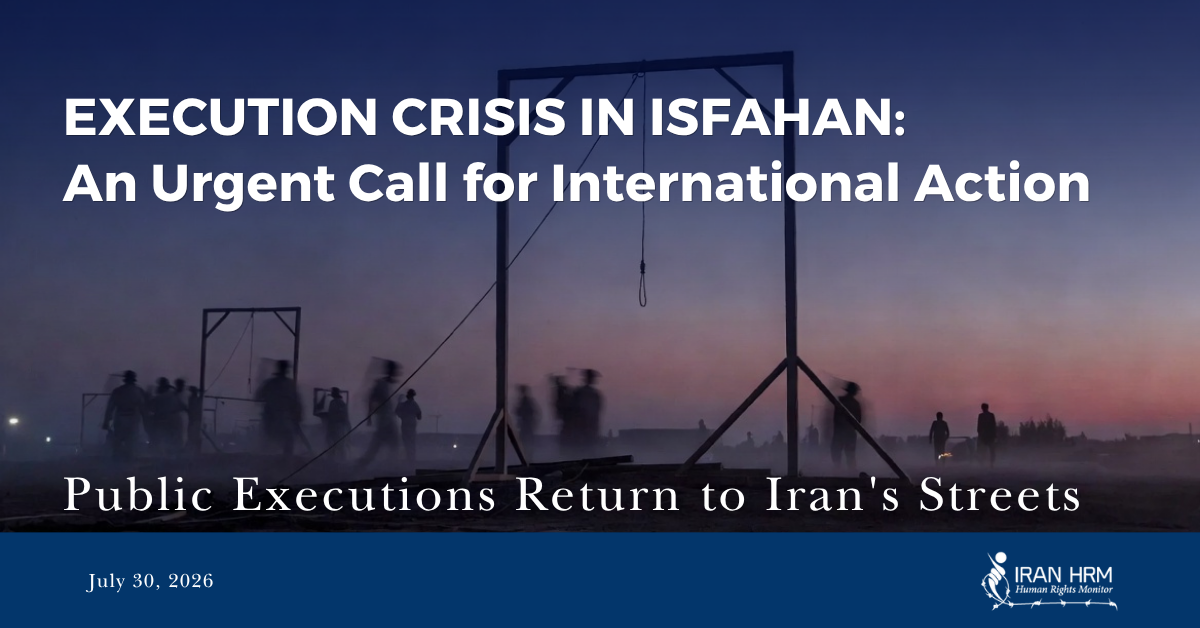
The new wave of executions, particularly public executions in Isfahan Province, demonstrates a clear and structural violation of human rights and international standards. According to legal documentation, at dawn on July 28, 2026, two detainees from the January 2026 nationwide protests—Abolfazl Sepahi Badjani (24 years old) and Amirhossein Safari Hosseinabadi (27 years old, with a disability)—were hanged in public at Alikhani Square in Isfahan. These two individuals are part of the 12 protesters who were sentenced to death in the case known as the “Isfahan Alikhani Square Case” by Judge Mohammad-Reza Tavakoli, Head of Branch 1 of the Isfahan Revolutionary Court.

The judiciary listed their charges as “enmity against God”, “corruption on Earth”, “involvement in the death of four law enforcement officers,” “possession of firearms and Molotov cocktails,” “arson at a police station,” and “blocking streets.” This comes after two other defendants in the same case, Erfan Esfandiari and Gol-Mohammad Mohammadi, were previously executed on July 19, 2026.
Reports and Citizen News from Isfahan
According to local reports and citizen news received from Isfahan:
- During public protests against the execution of these two defendants at Alikhani Square in Isfahan, approximately 130 people were arrested.
- Contrary to the public belief that the Alikhani Square case involved 12 defendants, citizen sources emphasize that there are actually 14 defendants in total, two of whom are under 18 years old.
- Three other defendants in the case—Ghaem Hosseini (20 years old) (cousin of Gol-Mohammad Mohammadi), Amirhossein Maleki (19 years old), and Ali Dashti (19 years old) —are on the verge of execution, and their families have been summoned for a final visit.
- The situation inside Dastgerd Prison in Isfahan is reported to be extremely tense, to the point that when Ghaem Hosseini’s family arrived for their final visit, they were told: “Leave, we will call you ourselves.”
- Alireza Sepahi, another detainee in this case who was scheduled to be executed alongside Abolfazl Sepahi and Amirhossein Safari at dawn on July 28, suffered a heart attack during his transfer to the execution site and is currently hospitalized under heavy security at Al-Zahra Hospital.
- Repressive forces used stun guns and direct gunfire against citizens to disperse the crowd.
Full Statement and Press Update by Mai Sato (UN Special Rapporteur)
Concurrent with the release of reports and deep concerns regarding the situation of the Isfahan defendants, UN bodies and rapporteurs reacted to these developments. In this context, Ms. Mai Sato, the UN Special Rapporteur on the situation of human rights in the Islamic Republic of Iran, issued an urgent statement expressing grave concern over the erection of public gallows:
“The authorities of the Iranian government executed two more defendants in the ‘Alikhani Square’ case in public in Isfahan early this morning. Gallows had been erected in the square. Families had been summoned for a final visit. The area remained under heavy security measures throughout the night, and reports of clashes between security forces and individuals gathered near the location were published.
Accounts received from inside the country speak of those who stayed awake near the square all night—a deeply moving act. They stood together so that no one would experience death alone. For many Iranians, execution has become the only constant in their lives, something the government has turned into a daily routine.
Public executions constitute cruel, inhuman, and degrading treatment and punishment. These executions bring justice to no one: not to the defendants who were deprived of the right to a fair trial; not to the four security personnel whose deaths were never adjudicated in an open and independent court; and not to the society that is forced to witness these scenes. The objective of these executions is to instill terror and consolidate state authority through the spectacle of death—a display that exposes the public, including children, to severe psychological harm.
So far, four of these young individuals have been arbitrarily executed. The remaining defendants continue to await execution. Reports have reached me indicating that Shervin Bagherian Jebelli and three others had their final visit with their families today, an alarming sign that they may face immediate execution.
Stop all executions immediately. Pending the complete abolition of the death penalty, its implementation must be subjected to a nationwide moratorium.”
Legal Documentation by Amnesty International and Reactions from Supranational Bodies
Amnesty International’s Assessment of Show Trials
Alongside the reports by the UN Special Rapporteur, international human rights organizations, including Amnesty International, analyzed the legal details of these convictions by examining documents, trial proceedings, and detention conditions of the Isfahan defendants. Amnesty International emphasized in its legal report:
“The public execution of protesters in Iran demonstrates a further escalation in the authorities’ use of the death penalty to suppress and stifle protests. They were sentenced to death following a grossly unfair group trial—a proceeding dedicated to the killing of four officers and allegations of public property destruction. We have documented that protesters are sentenced to death for charges such as property destruction, arson, blocking roads, and disturbing public order—acts that, under international law, should never carry the death penalty. These convictions were issued during closed-door proceedings marked by enforced disappearances, torture to extract confessions, and an absolute denial of access to legal counsel.”
EU Sanctions and Warning by the UN Fact-Finding Mission
Simultaneously with the publication of these documents, the UN Independent International Fact-Finding Mission on Iran intervened directly, warning against the irreversible consequences of the sentences issued in the “Alikhani Square” case. Emphasizing the failure to observe legal standards in due process, the committee demanded an immediate halt to the execution of these sentences.
In response to these blatant violations, the European Union placed five judges who issued capital punishment sentences and cruel punishments on its official sanctions list. In connection with cases in Isfahan Province, Mohammad-Reza Tavakoli (Head of Branch 1 of the Isfahan Revolutionary Court and issuer of the death sentences related to the Isfahan Alikhani Square case) is directly targeted under these sanctions.
The Iranian Regime’s Instrumental Use of International Legal Terminology to Legitimize Executions
While the Iranian judiciary faces widespread international condemnation over the issuance of death sentences based on charges such as moharebeh (enmity against God) and efsad-fil-arz (corruption on Earth) in cases like the Isfahan trials, judicial officials have shifted toward altering legislation. The passage of the “International Crimes Bill” in Parliament and its submission to the Guardian Council (following statements by Mohammad-Mehdi Hadi, Deputy Head of Legal Affairs for the Judiciary) does not signify alignment with the international criminal justice system rather, it represents a deliberate attempt to reconfigure tools of repression under the guise of new legal rhetoric.
The judiciary intends to incorporate terms such as “genocide,” “crimes against humanity,” “war crimes,” and “aggression” into domestic statutes. However, this terminological shift does not alter the underlying nature of suppression. The regime has realized that titles like “moharebeh” no longer serve their past function in global public opinion; hence, it seeks to replace the same policy of repression with modern legal vocabulary. This bill represents an effort to transition from the traditional model of “security jurisprudence” to “security law,” without any alteration to the unjust judicial structure or the defendants’ right to due process.
Process of Arrest, Violation of Rights, and Execution of Gol-Mohammad Mohammadi
Structural Pattern of Violating Defendants’ Rights in the Alikhani Square Case
Examining the details of Gol-Mohammad Mohammadi’s case as one of the first individuals executed in the “Alikhani Square” case provides a clear picture of the dominant pattern employed by the judicial and security apparatus in dealing with Isfahan protesters. The fate of this 23-year-old prisoner serves as a concrete and tangible example of the cycle of human rights violations—from arbitrary arrests to the issuance and execution of death sentences and extrajudicial pressures on families:
- After his arrest during the January 2026 protests, Gol-Mohammad Mohammadi remained in detention without legal status for months.
- Security officers raided the family home and confiscated the mobile phones of all family members.
- Over months of repeated inquiries, no clear response was given to the family, and they were threatened to cease their follow-ups.
- He was completely deprived of access to an independent and chosen lawyer.
- Following the execution, security officers stationed themselves around the family home, monitoring all movements.
- The family was notified that they are prohibited from installing a gravestone for 40 days and are forbidden from inscribing terms such as “Javidnam” (your name will remain till eternity) or memorial poems.
- The burial ceremony was held under heavy security presence with severe restrictions imposed on relatives.
The Role of Asadollah Jafari (Chief Justice of Isfahan Province) in Judicial Suppression
Decision-making and the issuance of harsh execution sentences, hand amputations, and widespread arrests in Isfahan are conducted directly under the management of the Chief Justice of this province. An examination of Asadollah Jafari’s record shows that structural cases of suppression in Isfahan are not isolated events, but rather the continuation of management by an individual recognized for years by human rights organizations as a senior perpetrator of human rights violations.
Legal Record of Asadollah Jafari
| Title | Details |
| Name | Asadollah Jafari |
| Current Position | Chief Justice of Isfahan Province |
| Previous Positions | Public and Revolutionary Prosecutor of Mazandaran Province (2007–2017), Chief Justice of North Khorasan Province (2017–2021) |
| International Sanctions | Placed on the European Union’s human rights sanctions list since March 2012 due to his role in widespread human rights violations |
| Charges | Role in carrying out execution sentences, supporting corporal punishment such as hand amputation, cracking down on protesters, restrictions against women, and pressure on followers of the Baha’i faith and other religious minorities |
| Prominent Cases | The “Isfahan House” case and executions of Majid Kazemi, Saeed Yaghoubi, and Saleh Mirhashemi; executions of Erfan Esfandiari, Gol-Mohammad Mohammadi, Abolfazl Sepahi, and Amirhossein Safari; execution of hand amputation sentences in Isfahan |
| Known Stances | Defense of executions and corporal punishments (hudud), emphasis on decisive action against protesters, and support for establishing special branches to handle security cases |
| Human Rights Status | His name appears in numerous reports by domestic and international human rights organizations regarding violations of citizens’ rights and unfair trials |
Key Cases Under His Management:
| Case | Year | Subject |
| Isfahan House | 2023 | Execution of Majid Kazemi, Saeed Yaghoubi, and Saleh Mirhashemi |
| Four Political Prisoners of Isfahan | 2026 | Execution of Erfan Esfandiari, Gol-Mohammad Mohammadi, Abolfazl Sepahi, and Amirhossein Safari |
| Hand Amputation Execution | 2025 | Execution of amputation sentence for two prisoners in Isfahan |
| Isfahan Protests | 2022–2026 | Formation of thousands of security cases |
With the appointment of Asadollah Jafari as Chief Justice of Isfahan Province in November 2021, a significant volume of security cases was opened. In June 2026, Jafari officially announced that over four thousand cases related to protests had been opened in Isfahan Province, and their processing continues “without leniency.”
Conclusion and Call for Practical International Action
The continued execution of death sentences, issuance of capital punishment in closed-door courts, deprivation of defendants’ access to lawyers of their choice, and the use of public executions in Isfahan constitute explicit violations of Articles 6 and 14 of the International Covenant on Civil and Political Rights (ICCPR). The international community and governments of the free world bear a legal and moral responsibility to move beyond mere statements and take the following practical actions:
Practical and Executive Solutions for International Bodies and Governments:
- Conditioning Diplomatic and Economic Relations: Conditioning any negotiations, economic agreements, or political and diplomatic relations with the Iranian government on an immediate halt to death sentences and the abolition of the death penalty for protesters; and in case of non-compliance, isolating this government by closing embassies and expelling its ambassadors and agents.
- Exercising the Principle of Universal Jurisdiction: Pursuing judicial action and issuing international arrest warrants for judicial officials and judges who issue death sentences in Isfahan of laid the ground for it (including Asadollah Jafari Mohammad Reza Tavkoli).
- Expanding Targeted Human Rights Sanctions: Designation of all individuals involved in Revolutionary Courts and officials of Isfahan detention centers on comprehensive human rights sanctions lists.
- Pressuring for Inspection of Isfahan’s Dastgerd Prison: Compelling Iranian authorities to unconditionally admit representatives of the UN High Commissioner for Human Rights and the Special Rapporteur to inspect Dastgerd Prison in Isfahan and other prisons across the country (such as Qezel Hesar and Evin) to assess the condition of defendants at risk of execution.