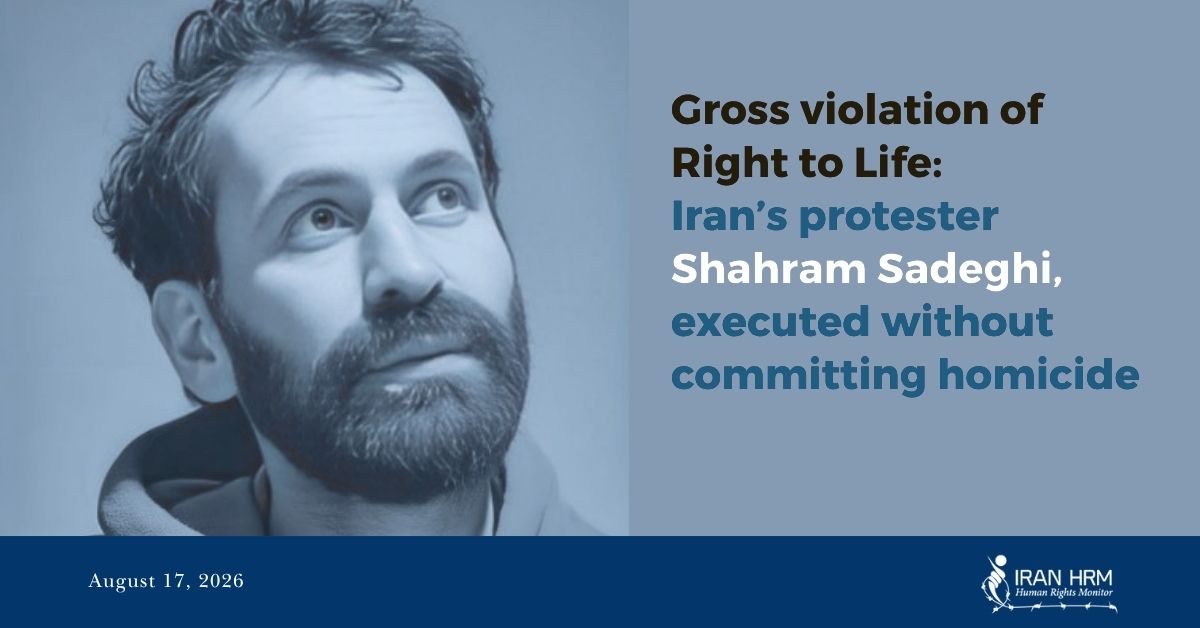
The official news agency of the Islamic Republic (IRNA) reported on August 16, 2026:

“Shahram Sadeghi, the driver of the ‘car of death’ at Golzar Intersection in Karaj, who ran over several law enforcement officers on January 8, 2026, was executed today, Sunday, August 16, following the confirmation of his sentence by the Supreme Court.”
قوه قضاییه: راننده خودروی مرگ چهارراه گلزار کرج اعدام شد – ایرنا
https://www.irna.ir/news/86236452/
State Media admit: 7 Injured, Zero Deceased!
In this report prepared by IRNA regarding this execution, the agency writes:
“On the night of January 8 of last year (1404 Persian calender), amidst the American-Zionist coup, Shahram Sadeghi, driving a Pride vehicle known as the ‘car of death,’ attacked officers near Golzar Intersection in Karaj and ran over several personnel. The deliberate running over of law enforcement officers, which caused shock and astonishment among bystanders, resulted in severe injuries to seven FARAJA (police) officers. Sadeghi’s brutal and violent act caused head, leg, hand, and eye injuries to seven police officers.”
This report itself is an explicit admission by the Islamic Republic’s judiciary that even assuming the allegation of running over officers is true, no murder occurred and no individual was killed. On what legal basis, then, was a death sentence issued and executed for this detained protester?
Security-Driven Fabrications and Dismissal of Stolen Vehicle Defense: Executed Over “Missing Phone Log”
IRNA quotes Shahram Sadeghi:
“Following his arrest and during interrogations, despite the existence of conclusive evidence, the defendant claimed that on that night he intended to travel from Eslamshahr, Tehran, to his home in Kordan, Savojbolagh. En route, intending to visit a soup shop at Golzar Intersection, he entered Karaj, where his vehicle was stolen. Shahram Sadeghi further claimed that he immediately reported the theft of his car to the 110 police helpline.”
The judiciary rejected his claim of innocence solely because it could not locate the call log in the system, failing to conduct any supplementary investigation regarding the reported vehicle theft.
Confession or Forced Confession Under Duress?
The IRNA report continues:
“Shahram Sadeghi subsequently acknowledged, in light of the presented evidence and conclusive grounds, that on that night he went to Golzar Intersection in Karaj—a key location for gatherings and calls for the January 8 coup. While Special Units officers of Alborz Province were present to restore order and security, he drove his vehicle at high speed towards the officers without any order to halt or stop being given to him. After injuring seven officers, he continued his path and subsequently burned his vehicle with the cooperation of rioters.”
Mizan News Agency also published a video clip of Shahram Sadeghi in which he is asked: “Did you know that hitting a human being at a highspeed causes death or injury?” to which Shahram responds: “Yes.””
Observing Shahram’s damaged physical appearance and distressed expression in this video, strongly indicates the high probability of confessions extracted under duress and torture.
The Rhetoric of the Head of the Judiciary and the Hasty Execution
Mizan News Agency reflected the stance of the judiciary by publishing the statements of Mohseni-Eje’i, Head of the Judiciary, immediately following Shahram Sadeghi’s affirmative answer in the same video clip:
“You Are Dead Wrong; We Do Not Pay Heed, We Punish the Offender”
“He says do not execute our foot soldier; you are dead wrong to say an offender whose hands are stained with the blood of the people should not be executed. Criminals and collaborators of the enemy must be pursued and prosecuted; this is the legitimate demand of the people. We pay no heed to the words of the arrogant powers; sentences will be issued and executed faster in accordance with the law.’ It then continues: ‘In this context, Shahram Sadeghi, who ran over several officers with a Pride car after attacking them on January 8 of last year, met the retribution for his actions this morning.'”
Weaponizing Article 1 of the Law on Punishing Espionage to Issue the Death Sentence
IRNA further reports:
“Upon the conclusion of the proceedings, the verdict containing the defendant’s conviction to ‘the death penalty’ and ‘confiscation of all assets’ on charges of ‘operational action in favor of the Zionist regime, the United States, and hostile groups under Article 1 of the Law on Intensifying the Punishment of Espionage and Cooperation with the Zionist Regime and Hostile Countries Against National Security and Interests’ was issued by the Revolutionary Court of Karaj. Following notification to the defendant, the case was sent to the Supreme Court for appeal. Subsequently, the Supreme Court upheld the ruling, and early this morning, Sunday, August 16, the death sentence was executed following legal procedures.”
Legal Analysis and Explicit Violations of Domestic and International Law
An examination of the official content published by state media reveals blatant violations of legal and human rights standards:
- Violation of the “Most Serious Crimes” Standard (Article 6 ICCPR): Under Article 6 of the International Covenant on Civil and Political Rights, the penalty of deprivation of life must be strictly limited to the most serious crimes involving intentional killing. Executing an individual who, by the explicit admission of the court itself, committed no murder constitutes a clear case of “Arbitrary Deprivation of Life.”
- Violation of the Absolute Prohibition of Torture and Forced Confessions (Article 7 ICCPR and UNCAT): Judicial reliance on televised confessions and statements recorded under coercion and deprivation of liberty lacks any legal validity.
- Non-Compliance with the “Rule of Doubt” (Dara’) in the Islamic Penal Code: Failing to conduct a comprehensive investigation into the defendant’s claim regarding vehicle theft and dismissing it solely due to the absence of a 110 call log directly contradicts the jurisprudential and legal principle of Tada’u al-Hudud bi al-Shubuhat (the drop of capital punishment in the presence of doubt).
- Misapplication of Espionage and Corruption Charges: Expanding heavy indictment titles such as “action in favor of a hostile state” to an incident that, at most, constituted bodily injury demonstrates the instrumentalization of criminal law to manufacture death sentences.
The Necessity of Practical and Deterrent Measures to Stop the Execution Machine
The hasty execution of Shahram Sadeghi immediately following the joint statement of 32 countries condemning the wave of executions in Iran demonstrates that issuing verbal stances—while valuable as a moral and human rights stance—cannot alone generate sufficient deterrence against the state apparatus of repression.
To meaningfully protect the right to life of protesters, the international community and human rights organizations should complement political statements with concrete, tangible diplomatic and legal measures. Adopting deterrent measures and conditioning official relations on the cessation of executions represent essential and effective steps toward compelling the Iranian government to abide by its international human rights obligations.