Cases of Political Prisoners Sentenced to Death in Iran
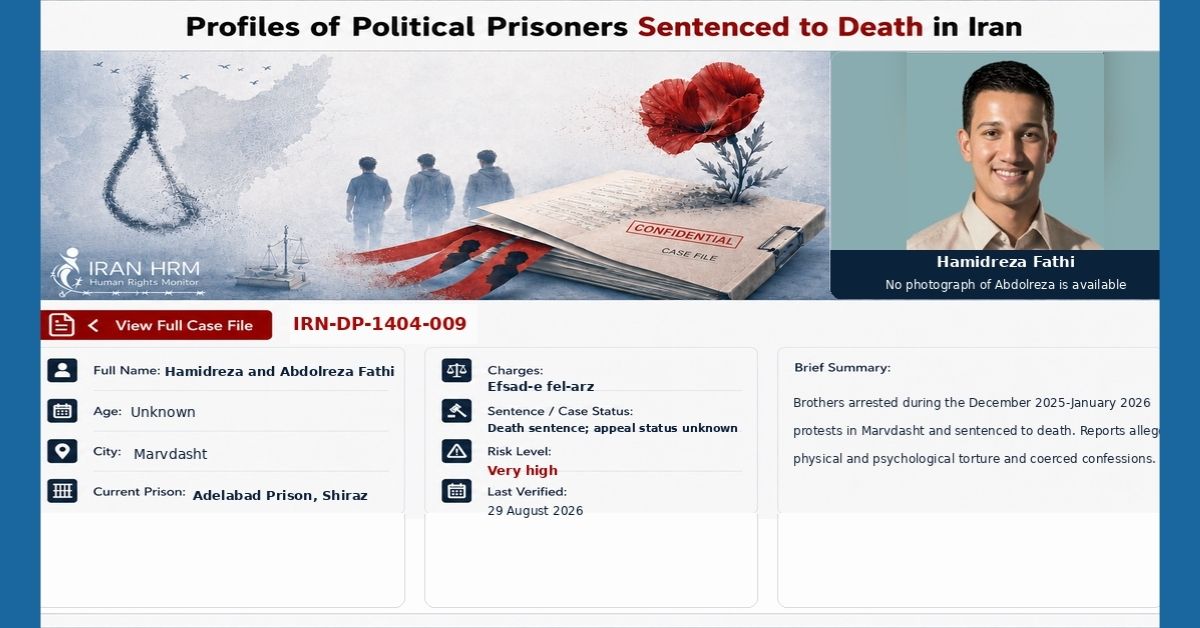
Case No. 9 | Case ID: IRN-DP-1404-009 | Last reviewed: 29 August 2026

| Hamidreza and Abdolreza Fathi, brothers from Marvdasht, were arrested during the nationwide protests of December 2025 and January 2026 and sentenced to death by Branch One of the Revolutionary Court in Shiraz. The officially reported charge is efsad-e fel-arz (corruption on Earth). Reports allege that they were held in solitary confinement, subjected to physical and psychological torture and electric shocks, and pressured to confess in connection with the killing of a member of the Basij. Both brothers remain in Adelabad Prison in Shiraz. The unknown status of any appeal and allegations that the case relies on coerced confessions create grave concern for their lives. |
Key Case Information
| Category | Information |
| Full name | Hamidreza Fathi and Abdolreza Fathi |
| Date of birth | Unknown |
| Age | Unknown |
| Occupation before arrest | Unknown |
| Family status | Unknown |
| Date and place of arrest | December 2025-January 2026, Marvdasht |
| Charges | Efsad-e fel-arz (corruption on Earth); case linked to an allegation of participation in the killing of a Basij member |
| Court | Branch One of the Revolutionary Court in Shiraz |
| Judge | Seyed Mahmoud Sadati |
| Lawyer | Unknown |
| Sentence | Death sentences; appeal or judicial-review status unknown |
| Current place of detention | Adelabad Prison, Shiraz |
Human and Personal Background
Hamidreza and Abdolreza Fathi are brothers from Marvdasht in Fars Province. No reliable information is available concerning their ages, dates of birth, education, occupations or family circumstances. Their names became public after their arrest during the protests of December 2025 and January 2026 and the imposition of death sentences in a joint case. A photograph of Hamidreza Fathi is available, but no verified image of Abdolreza Fathi had been obtained by the time of this report.
Arrest, Trial and Sentencing
Hamidreza and Abdolreza Fathi were arrested in Marvdasht during the protests of December 2025 and January 2026. Saeed Zarei Kordshouli and Hamidreza Sabet-Ray have also been prosecuted in the same case.
On 30 April 2026, reports stated that Branch One of the Revolutionary Court in Shiraz, presided over by Judge Seyed Mahmoud Sadati, had sentenced all four defendants to death on the charge of efsad-e fel-arz (corruption on Earth). The available information does not specify the exact date on which the judgment was issued or served, the full text of the ruling, the evidence relied upon by the court, the number of hearings, or details of the defendants’ access to counsel of their choice.
Available reports indicate that interrogators attempted to obtain confessions concerning participation in the killing of a member of the Basij. It remains unclear, however, whether ‘participation in murder’ was entered as a separate charge in the indictment or judgment, or whether it was solely the subject of interrogation and efforts to obtain confessions. Without access to the judicial record, this allegation must not be presented as an established fact.
Reported Torture and Coerced Confessions
According to information provided by informed sources, Hamidreza and Abdolreza Fathi were subjected to severe physical and psychological pressure in detention. The defendants were reportedly held in solitary confinement and subjected to beatings and electric shocks, including shocks applied to the head, in an effort to compel statements sought by interrogators.
Reports further allege that Hamidreza Fathi’s hand was broken as a result of torture. No individualised information is available concerning the nature and severity of physical injuries sustained by Abdolreza.
In a published audio recording, former political prisoner Abuzar Baragahi spoke about the torture of the defendants and efforts to force them to make fabricated confessions. Some statements cited in the reports have not been attributed to a specific person among the four defendants and must not be ascribed specifically to the Fathi brothers.
If confessions obtained through torture or other ill-treatment formed the principal basis of the sentences, the integrity of the entire judicial process would be gravely compromised. The authorities would be required to exclude such evidence and conduct an independent and effective investigation into the torture allegations.
Government Response and Conduct
The documented conduct of the authorities in this case consists of the brothers’ arrest, their prosecution before Branch One of the Revolutionary Court in Shiraz and the imposition of death sentences. The available information contains no specific official response from judicial or security bodies or from Adelabad Prison authorities concerning the allegations of torture, Hamidreza’s broken hand, solitary confinement or coerced confessions.
It is also unclear whether any independent investigation has been conducted or whether the defendants were given access to independent forensic medical examination to document their injuries. The full judgment, its legal reasoning and the evidence relied upon by the court have not been provided in the available information.
Current Status and Risk of Execution
As of 29 August 2026, Hamidreza and Abdolreza Fathi remained detained in Adelabad Prison in Shiraz. Both have been sentenced to death, but the status of any appeal, judicial review or proceedings before the Supreme Court remains unknown. It is therefore not possible, without further information, to confirm that the sentences are final or that execution is imminent.
Nevertheless, the existence of the death sentences, the lack of transparency concerning the present stage of proceedings, and the serious reports of torture and coerced confessions place the brothers at continuing risk. The judicial authorities must immediately disclose the precise status of the case, the applicable deadline and avenue for appeal, and any prospective step towards execution to their family and lawyers.
Human Rights and Fair Trial Analysis
Right to life: Article 6 of the International Covenant on Civil and Political Rights restricts the death penalty, in countries that have not abolished it, to the ‘most serious crimes’. This standard encompasses only crimes of extreme gravity involving intentional killing. The broad charge of efsad-e fel-arz is not, by itself, sufficient to satisfy this threshold. Unless the individual responsibility of each brother for intentional killing was established through lawful evidence in a fair trial, the imposition of the death penalty would be incompatible with Article 6.
Prohibition of torture: Torture and cruel, inhuman or degrading treatment are absolutely prohibited. Allegations of beatings, electric shocks, prolonged solitary confinement and Hamidreza’s broken hand require a prompt, independent and impartial investigation. Any statement obtained through torture or coercion must be excluded from the proceedings.
Right to a fair trial: Article 14 of the Covenant guarantees effective and confidential access to counsel of choice, adequate time and facilities to prepare a defence, determination by an independent and impartial tribunal, and access to an effective appeal. Uncertainty concerning legal representation, evidence, the judgment and the status of appeal, combined with allegations that coerced confessions were relied upon, raises serious concern about compliance with these safeguards. In a capital case, fundamental fair-trial violations may render the resulting deprivation of life arbitrary.
Conclusion
Hamidreza and Abdolreza Fathi face the most severe and irreversible punishment while fundamental questions concerning the evidence, the voluntary nature of their statements, access to counsel and the status of appeal remain unanswered. The reported torture, particularly Hamidreza’s broken hand and the alleged use of electric shocks, heightens the need to halt any step towards execution and to subject the case to independent review.
Urgent Appeal
United Nations bodies, governments and international human rights organisations are urged to act to protect the rights of Hamidreza and Abdolreza Fathi and prevent their execution.
- Immediately halt any step towards execution and formally disclose the current judicial status.
- Quash the death sentences and transparently disclose the status of any appeal or judicial review.
- Guarantee immediate and confidential access to counsel of choice and adequate facilities for the defence.
- Provide the defendants, their family and lawyers with the judgment, evidence and legal basis for the sentences.
- Conduct an independent investigation into the alleged torture, electric shocks, solitary confinement and Hamidreza’s broken hand, and exclude every statement obtained through coercion.
- Ensure that any retrial takes place before an independent and impartial tribunal without recourse to the death penalty.
- Guarantee regular family contact and access to necessary medical care.