Cases of Political Prisoners Sentenced to Death in Iran
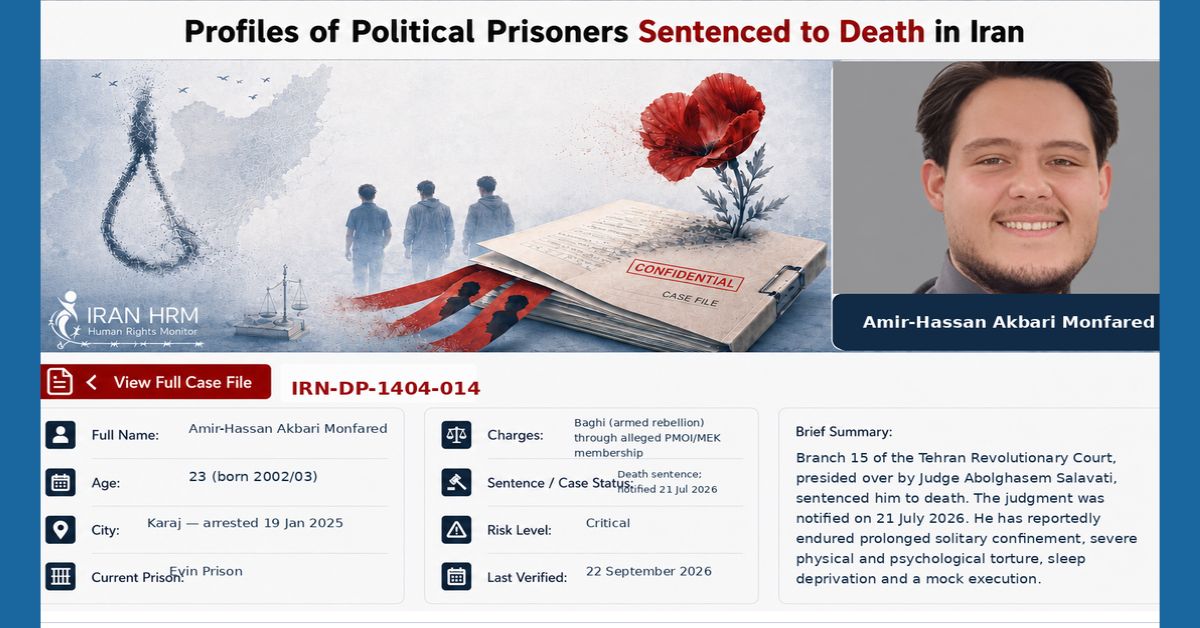
Case No. 14 | Case ID: IRN-DP-1404-014 | Last reviewed: 22 September 2026

| Amir-Hassan Akbari Monfared, a 23-year-old accounting student, was sentenced to death by Branch 15 of the Tehran Revolutionary Court, presided over by Judge Abolghasem Salavati, for baghi (armed rebellion) through alleged membership of the PMOI/MEK. The judgment was notified on 21 July 2026. Reports of severe torture, more than five months in solitary confinement, sleep deprivation and a mock execution, together with the absence of transparent information about judicial review, make the risk of execution urgent. |
Key Case Information
| Category | Information |
| Full name | Amir-Hassan Akbari Monfared |
| Date of birth | 2002/03 (exact date unknown) |
| Age | 23 |
| Occupation before arrest | Video editor and camera operator; fifth-year accounting student |
| Family status | Unmarried |
| Date and place of arrest | 19 January 2025, family home in Karaj |
| Charges | Initial attributed charges: financing terrorism, collusion against national security and membership of hostile groups; conviction charge: baghi (armed rebellion) through alleged PMOI/MEK membership |
| Court | Branch 15 of the Tehran Revolutionary Court |
| Judge | Abolghasem Salavati |
| Lawyer | Safarnia; effective access during the investigation is disputed |
| Sentence | Death; notified on 21 July 2026; appeal or judicial-review status unknown |
| Current place of detention | Evin Prison |
Human and Personal Background
Amir-Hassan Akbari Monfared was born in Karaj in 2002/03. Before his arrest, he worked as a video editor and camera operator and was a fifth-year accounting student. He is unmarried.
The Akbari Monfared family has faced security pressure for decades. His father, Mohammad-Ali Akbari Monfared, was imprisoned in the 1980s and again during the 2022 uprising. He is related to Reza and Maryam Akbari Monfared and other executed members of the family. At the time of Amir-Hassan’s arrest, Arghavan Fallahi was living with the family, and the authorities were seeking an alleged connection between Amir-Hassan and Farshad.
Arrest, Trial and Sentencing
Security agents arrested Amir-Hassan at his family home in Karaj on 19 January 2025. He was first taken to the Ministry of Intelligence facility in Gohardasht, Karaj, and transferred the following day to security detention facilities at Evin Prison. He was held in Wards 240, 209 and 7 of Evin and, after the attack on the prison, was temporarily transferred to Greater Tehran Penitentiary (Fashafuyeh). His father, sister and brother were also arrested. Other family members were later released on bail, but Amir-Hassan remained in detention.
The authorities initially attributed charges including ‘financing terrorism’, ‘collusion against national security’ and ‘membership of hostile groups’ to him. Branch 15 of the Tehran Revolutionary Court, presided over by Judge Abolghasem Salavati, ultimately sentenced him to death for baghi (armed rebellion) through alleged membership of the People’s Mojahedin Organisation of Iran (PMOI/MEK). The judgment was notified on 21 July 2026. His lawyer has been identified as Safarnia, although reports indicate that he lacked effective access to legal counsel during a significant part of the investigation.
The full judgment, the evidence relied upon and the reasoning used to establish the legal elements of baghi have not been made publicly available. The status of any appeal or judicial review is also unknown. Amir-Hassan has not been granted a single day of furlough since his arrest.
Torture, Solitary Confinement and Mock Execution
According to the available information, torture began on the first day of detention. At the intelligence facility in Karaj, agents forced him to drink two jugs of water and then severely punched and kicked him, reportedly causing blood in his urine. After his transfer to Ward 209, an officer drove a metal staple into his hand, leaving a mark for weeks. During 23 days of interrogation in Ward 240, he was punched, kicked and slapped whenever an interrogator rejected an answer.
From 21 to 25 January 2025, rotating teams kept him in an interrogation room for four consecutive days and nights to prevent him from sleeping, beating him whenever he dozed off. The interrogators threatened to arrest his siblings; this threat was later carried out when Zeinab and Amir-Hossein were detained and interrogated for approximately 80 days.
During a mock execution, agents took Amir-Hassan, blindfolded, to the hills near Evin and, after asking whether he wanted to know how judges targeted in a shooting had felt, fired five or six shots around him. Mohammad-Javad Shafiei, an investigator at Criminal District 27, also reportedly told him: ‘Admit that you connected Farshad to the organisation, and we will overlook the rest of your activities and connections with the organisation.’ Amir-Hassan spent more than five months in solitary confinement, including 23 days in Ward 240 followed by continued isolation in Ward 241.
Government Response and Conduct
The judicial authorities have provided no transparent public explanation of the evidence supporting the death sentence, the torture allegations or the reported attempt to obtain a confession. Amir-Hassan’s complaints about unsafe conditions at Fashafuyeh and his detention alongside prisoners accused of violent offences reportedly went unanswered. Rather than conducting an independent investigation into the agents’ conduct, the proceedings culminated in a death sentence. On 6 September 2025, he began a hunger strike over his seriously ill father’s condition and was reportedly threatened in response: ‘We will beat you until you forget your own name.’
Current Status and Risk of Execution
Amir-Hassan Akbari Monfared is currently held in Evin Prison. His death sentence has been formally notified, while the status of any appeal or judicial review remains unclear. The reported torture, prolonged solitary confinement, pressure to accept a political connection and lack of transparency surrounding the evidence and appellate process raise grave concerns about the reliability of any confession and the fairness of the proceedings.
Human Rights and Fair Trial Analysis
Right to life: Article 6 of the International Covenant on Civil and Political Rights restricts the death penalty, in states that retain it, to the ‘most serious crimes’, understood as crimes involving intentional killing. The available information contains no specific allegation that Amir-Hassan committed an intentional killing. Imposing death for alleged political membership is incompatible with this threshold.
Right to a fair trial: Uncertainty over effective access to counsel, undisclosed evidence, pressure to accept an allegation and the possible use of statements obtained under torture violate the fair-trial guarantees and the prohibition on compelled self-incrimination under Article 14 of the Covenant.
Prohibition of torture and inhuman treatment: Severe beatings, deliberate sleep deprivation, threats against relatives and a mock execution violate the absolute prohibition of torture under Article 7. Prolonged solitary confinement and detention in unsafe conditions are also inconsistent with the requirement of humane treatment under Article 10.
Conclusion
Amir-Hassan Akbari Monfared, a young student who has not been accused of any specific intentional killing, was sentenced to death after prolonged detention, solitary confinement and reported torture in proceedings marked by serious fair-trial violations. His life remains at risk until the sentence is quashed, the torture allegations are independently investigated and a genuinely fair process is guaranteed.
Urgent Appeal
United Nations bodies, governments and international human rights organisations are urged to act to protect the rights of Amir-Hassan Akbari Monfared and prevent his execution.
- Immediately halt any step towards execution and formally disclose the current judicial status.
- Quash the death sentence and transparently disclose the status of any appeal or judicial review.
- Guarantee immediate and confidential access to counsel of choice and adequate facilities for the defence.
- Publish the judgment, evidence and legal basis for the sentence where they are not publicly available.
- Conduct an independent and impartial investigation into reported violations, where applicable.
- Ensure any retrial takes place before an independent and impartial tribunal without recourse to the death penalty.
- Guarantee regular family contact and access to necessary medical care.