Executive Summary at a Glance
- Execution of Detained Protesters: Execution of Siavash Jamshidi Kheirabadi (detained during the January 2026 ) on October 3, 2026 on charges of “Moharebeh” (Enmity against God), following the execution of two other protesters, Ali Hemmati and Majid Nikandesh, on September 30, 2026 in Mashhad Central Prison.
- Systemic Pattern in Judicial Proceedings and Confessions: Reliance of courts on forced confessions obtained through standard security agency practices involving pressure and torture, alongside the denial of fair trial rights and a lack of judicial transparency.
- Surge in Executions for General Crimes as Public Intimidation: Execution of at least 11 prisoners convicted of regular/ordinary offenses in Ghezel Hesar, Gorgan, Tabriz, and Zanjan prisons over three days, aimed at instilling public fear and preventing new nationwide protests.
- International Reaction: Joint statement issued by 46 nations at the UN Human Rights Council (September 30, 2026) expressing grave concern over the rising wave of executions targeting protesters, women, and children.
- Need for Concrete Actions: Urgent necessity to make diplomatic relations conditional, impose targeted sanctions on judicial authorities, and exert strategic international pressure to halt Iran’s execution machinery.
Introduction
In the shadow of deep social and political crises, the repressive execution apparatus of the Islamic Republic’s judiciary has accelerated at an unprecedented rate, aiming to intimidate society and prevent new protests. The hasty issuance and implementation of death sentences against protesters and prisoners serve as the regime’s primary tool to deny the right to life and exert societal control.

Execution of Siavash Jamshidi Kheirabadi, Detained in January 2026
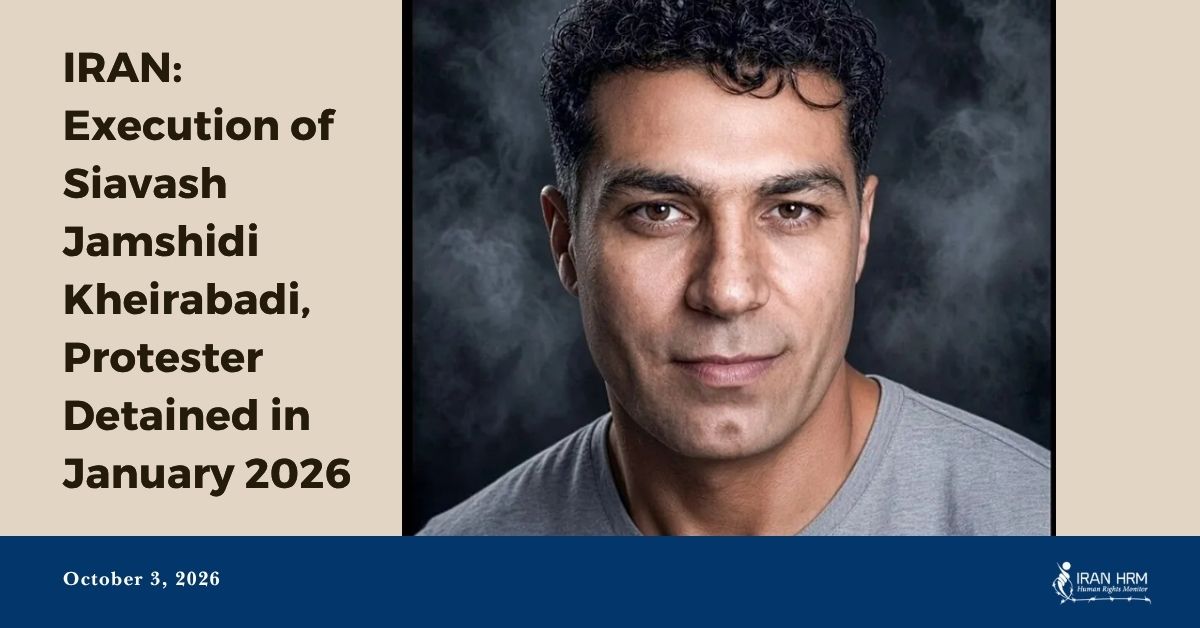
Siavash Jamshidi Kheirabadi, one of the detainees from the nationwide January 2026 [Dey 1404] protests in Shahrekord, was executed this morning, October 3, 2026, following a ruling by the Judiciary of the Islamic Republic.
According to the Judiciary’s Media Center (Mizan News Agency), Jamshidi was sentenced to death on charges of “Moharebeh” (Enmity against God) and “assembly and collusion against national security.” The Judiciary claims that Jamshidi opened fire on police officers during the January protests. In Mizan’s report, a confession attributed to Siavash Jamshidi Kheirabadi was quoted—a statement that, based on extensive evidence from cases involving 2026 protest detainees, is most likely extracted under torture. The Judiciary quoted his confession as follows:
“On January 8, I was heading home from a party. The main road was blocked, so I diverted my route. On Naser Khosrow Street in Shahrekord, I fired at officers using a handgun. Afterward, I went to my brother’s garden, cleaned the weapon, loaded one round into the pistol, and buried an M4 rifle underground.”
Further details regarding his arrest, trial, and execution process are currently unavailable and require independent investigation. Additionally, independent verification of all details regarding the claims made by state authorities and the judicial processing of this case is currently impossible.
Continued Wave of Protester Executions Across Iranian Prisons
It should be recalled that on September 30, 2026, two other detained protesters from the January protests, Ali Hemmati and Majid Nikandesh, were executed in Mashhad Central Prison.
In addition to executing political protesters, the Islamic Republic’s judiciary has further escalated overall execution numbers to terrorize society during an acute social crisis and deter potential demonstrations.
Increase in Executions for Regular Crimes to Instill Societal Fear
In another inhumane measure, at least 11 prisoners convicted of ordinary offenses were executed over a three-day period:
- Qezel Hesar Prison: According to Javan Online, five prisoners were executed at Qezel Hesar Prison on the morning of Wednesday, September 30, 2026. All were charged with murder. One of the executed individuals was identified as Rasoul Karimi.
- Gorgan Prison: On the morning of Wednesday, September 30, 2026, Hosseinali Baranzahi was executed in Gorgan Prison. He was 51 years old, a father of three, and had been arrested 9 years ago on murder charges.
- Tabriz Prison: On the morning of Monday, September 28, 2026, Shahin Babaei was executed in Tabriz Prison. He was a 22-year-old resident of Tabriz who was arrested 5 years ago on drug-related charges. He consistently denied the drug trafficking allegations, but the court ignored his defense.
- Zanjan Prison: On the morning of Sunday, September 27, 2026, three prisoners were executed in Zanjan Prison on drug-related charges. Their identities are as follows:
- Fateh Shafiei: 33 years old, from Zanjan, father of one child. Arrested 3 years ago and sentenced to death.
- Hassan Mehdipour: 30 years old, from Miyaneh. Arrested 2 years ago and sentenced to death.
- Aref Darosti: 51 years old, from Karaj, father of 3 children. Arrested 3 years ago and sentenced to death.
Even setting aside the issue of due process and fair trials, it must be emphasized that many common crimes are the direct product of the economic and social conditions engineered by the Islamic Republic itself. The regime creates the victims and then proceeds to execute them.
International Reactions: Joint Statement by 46 Countries at the UN Human Rights Council
On September 30, 2026, the United Nations Human Rights Council witnessed a joint statement issued by 46 countries concerning the surge in executions and death sentences in Iran. The statement, read by the representative of Liechtenstein during the 63rd session of the Human Rights Council, expressed particular alarm over the execution of protesters and the death sentences handed down to dozens of other protesters, including women and children.
Citing reports and findings from the UN High Commissioner for Human Rights, the Special Rapporteur on Iran, and the International Independent Fact-Finding Mission on Iran, the statement highlighted deep concerns over the sharp increase in executions, especially in cases related to protests and the exercise of fundamental freedoms.
Practical Recommendations to Halt Executions
While international statements mark a positive step, stopping executions in Iran requires concrete and deterrent action. The Islamic Republic will never voluntarily cease executions, as capital punishment is its primary mechanism for survival—creating a constant fear of death among citizens to deter dissent. Therefore, it is imperative for the international community to compel the regime to stop executions through actionable measures. The following measures could serve as effective steps:
- Effective Diplomatic Pressure: Conditioning political and economic relations on an immediate moratorium on executions, as well as recalling ambassadors or downgrading diplomatic representation.
- Urgent UN Intervention: Dispatching international inspection teams and the Fact-Finding Mission to visit Iranian prisons and meet with political prisoners and death-row inmates.
- Targeted Sanctions on Judicial Officials: Expanding international sanctions against judges, prosecutors, and high-ranking judicial and security officials involved in issuing and carrying out death sentences.
- Referring Human Rights Cases to International Bodies: Referring the file on systematic human rights violations and extrajudicial executions in Iran to the UN Security Council and the International Criminal Court (ICC).
- Legal and Media Support: Establishing international support mechanisms to amplify the voices of victims’ families and facilitate independent verification of judicial cases.