
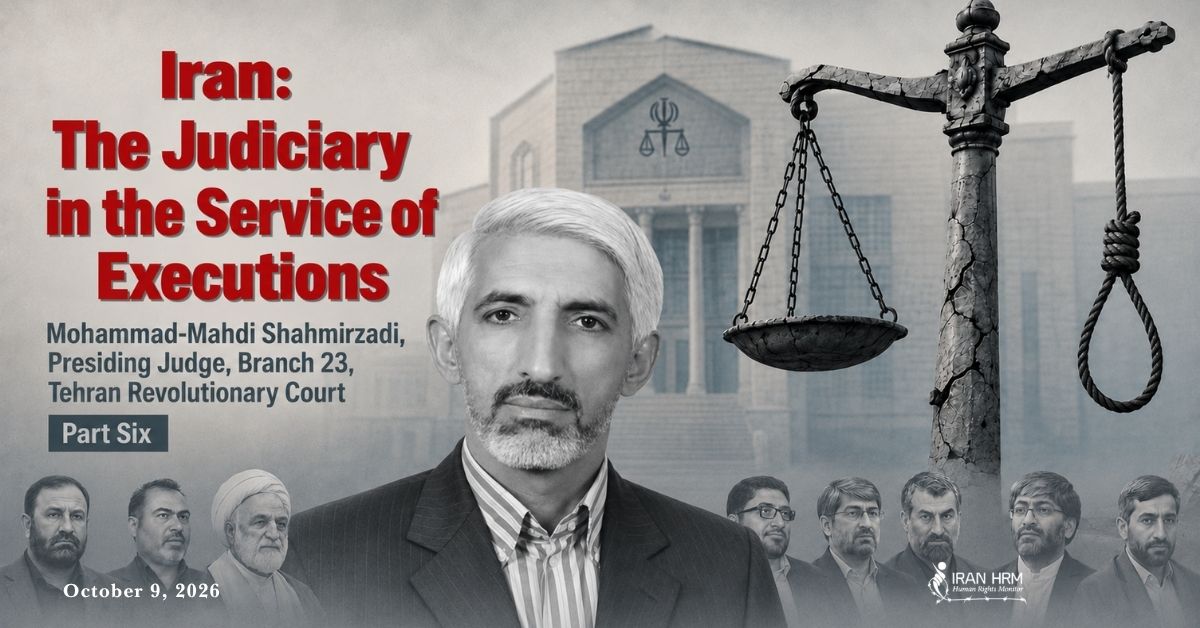
Iran: Judiciary in the Service of Executions –No. 6
The series Iran: Judiciary in the Service of Executions examines the role of judicial officials through whom the Islamic Republic’s judiciary implements policies of repression, imprisonment and execution. Previous reports in this series have documented how increasingly severe punishments, particularly in the aftermath of nationwide protests, form part of a broader judicial approach in which senior officials have called for swift and severe action against protesters and opponents.

Mohammad-Mahdi Shahmirzadi is one of the judges whose name has repeatedly appeared over several years in political and security-related cases before Branch 23 of the Tehran Revolutionary Court. His documented record extends from prison sentences imposed on political, civil and human rights activists to cases that resulted in death sentences in 2026.
The significance of Shahmirzadi’s record lies not merely in the number of cases heard by the branch over which he presided. His continued role within the Revolutionary Court system and the assignment of sensitive political and security cases to Branch 23 provide insight into a judicial mechanism through which the courts have become part of the state’s apparatus of political repression.
Shahmirzadi and Branch 23 of the Tehran Revolutionary Court
Mohammad-Mahdi Shahmirzadi’s name appears in connection with Branch 23 of the Tehran Revolutionary Court from at least early 2020. Reports concerning several subsequent cases also identify him as a judge or presiding judge of that branch.
Published information indicates that, in addition to presiding over Branch 23, Shahmirzadi had at different times served as a judge of the Tehran Revolutionary Court and as head of the Selection Unit of the Tehran Province Judiciary. However, official appointment orders and precise dates marking the beginning and end of these positions are not publicly available.
There is also uncertainty regarding his current administrative status. A report published in 2024 described Shahmirzadi as a retired judge of Branch 23. Yet reports concerning judicial cases in the summer of 2026, including those of Arin Valipour and Mahmoud Ghanbari-Rad, again identified him as a judge or presiding judge of Branch 23 of the Tehran Revolutionary Court. What can therefore be established is that Shahmirzadi continued to be identified as the presiding judge in cases before Branch 23 as late as the summer of 2026, although his formal employment or administrative status remains unclear.
During the period in which Shahmirzadi was associated with Branch 23, the court heard cases involving charges such as “propaganda against the system”, “assembly and collusion against national security”, “insulting the Supreme Leader” and other political and security offences. In 2026, the same branch appeared in two cases that resulted in death sentences.
Prison Sentences: From a Human Rights Lawyer to an Entire Family
One of the prominent cases associated with Branch 23 was that of Mohammad Najafi, a lawyer and human rights defender.
On 7 February 2020, Branch 23 of the Tehran Revolutionary Court sentenced Najafi to an additional six months in prison. The sentence was one of several convictions imposed on him in connection with his human rights activities and public statements. Available documentation confirms that the sentence was issued by Branch 23, and human rights reporting has attributed the proceedings to Shahmirzadi, although the original judgment bearing the name of the sentencing judge is not publicly available.
Approximately one year later, Shahmirzadi’s name was specifically linked to the case of Zahra Safaei and her two children, Parastoo Moeini and Mohammad-Masoud Moeini.
In 2021, Branch 23 of the Tehran Revolutionary Court sentenced the three members of the same family to a nominal total of 20 years in prison. Zahra Safaei received eight years: five years for “assembly and collusion”, one year for “propaganda against the system”, and two years on charges relating to insulting the leadership of the Islamic Republic. Each of her two children received six years: five years for “assembly and collusion” and one year for “propaganda against the system”.
The nominal total of the sentences was 20 years, although under Iran’s rules governing multiple convictions, not all of the individual sentences would necessarily be served consecutively.
The case illustrates how the Revolutionary Courts can transform political activity or association into lengthy terms of imprisonment. In such cases, the court is not merely the venue for adjudicating an ordinary criminal offence; it forms the final judicial stage of a process that begins with the intervention of security agencies and culminates in the imposition of punishment.
2026: Death Sentences Enter Shahmirzadi’s Documented Record
In 2026, two cases specifically linked Mohammad-Mahdi Shahmirzadi to death sentences issued by Branch 23 of the Tehran Revolutionary Court: those of Isa Chari and Arin Valipour.
These cases are particularly significant in assessing Shahmirzadi’s judicial responsibility. Unlike cases in which only the number of the branch is known, reports concerning Chari and Valipour identify Shahmirzadi as the judge or presiding judge of the court that issued the death sentences.
Isa Chari: A Death Sentence Issued by the Branch Presided Over by Shahmirzadi
Isa Chari, aged 37 and the father of two children, was arrested on 7 December 2025 by the Islamic Revolutionary Guard Corps Intelligence Organisation in the Qarchak-Varamin area.
Reports concerning his case have referred to allegations of membership in the People’s Mojahedin Organisation of Iran and activities against national security. One report also stated that the initial incident leading to his arrest involved the destruction of an IRGC sign. However, neither the indictment nor the official judgment is publicly available, and this account therefore cannot be treated as the definitive description of the judicial charges against him.
Branch 23 of the Tehran Revolutionary Court, presided over by Mohammad-Mahdi Shahmirzadi, sentenced Isa Chari to death.
At the time of writing, the precise legal provision relied upon to impose the death penalty, the exact date of the trial hearing and the date on which the judgment was formally served have not been publicly established. Nor is there sufficiently reliable information regarding his access to a lawyer of his choosing, the duration of the proceedings or the substance of his defence.
On 25 July 2026, it was reported that Chari had been transferred to solitary confinement in Ghezel Hesar Prison. A further report two days later provided additional details concerning his place of detention.
The transfer of a prisoner under sentence of death to solitary confinement may heighten concern regarding his situation, but it does not by itself establish that an execution date has been set. As of 7 October 2026, no reliable public information had clarified the final status of any appeal or whether the death sentence had become final.
Arin Valipour: From the Dey 1404 Protests to a Death Sentence
The case of Arin Valipour is directly connected to arrests arising from the nationwide protests of Dey 1404.
Valipour was arrested in Tehran and, following interrogation, transferred to Greater Tehran Prison. Branch 23 of the Tehran Revolutionary Court, presided over by Mohammad-Mahdi Shahmirzadi, sentenced him to death as well as terms of imprisonment.
Published reports have linked the death sentence to allegations including cooperation with Israel and the destruction or burning of public property. One report also referred to the charge of “moharebeh through cooperation with Israel”. In addition to the death sentence, reports referred to five years’ imprisonment for “assembly and collusion”, and one source reported a further three-year sentence for “propaganda against the system”.
However, because the official judgment is not publicly available, the precise statutory provision, the court’s legal reasoning and the specific acts on which the death sentence was based cannot be established with certainty.
By the end of July 2026, an appeal against the judgment had been filed and the case had been referred to the Supreme Court.
On 25 July, while detained in Greater Tehran Prison, Valipour was reported to have harmed himself using the edge of a metal can and was subsequently taken to the prison infirmary. Human rights reports attributed the incident to severe psychological pressure associated with the death sentence, although no independent medical or psychiatric documentation is publicly available to establish the cause or his condition.
Two days later, he too was transferred to Ghezel Hesar Prison.
As of 7 October 2026, no final decision by the Supreme Court had been publicly reported. The death sentence therefore could not at that stage be described as final or as being immediately due for execution.
A Judge Within the Chain of Judicial Repression
In political cases in the Islamic Republic, the judicial process generally represents the final stage of a chain that begins before a case reaches the courtroom: a security body carries out the arrest; interrogation and preliminary investigations follow; the prosecutor’s office issues an indictment; and the trial judge ultimately determines guilt and punishment.
This distinction is important when assessing individual responsibility.
Actions taken during arrest or interrogation cannot, without evidence, automatically be attributed to the trial judge. At the same time, the decision to impose a prison sentence or the death penalty falls within the direct responsibility of the court. Where the identity of the judge is known, his role at that stage can be independently assessed.
Shahmirzadi’s documented record reveals a notable trajectory. In the early 2020s, his name was associated with cases in which the principal punishment was imprisonment for political or security-related conduct. Several years later, amid intensified repression following nationwide protests, two cases before the branch he presided over resulted in death sentences.
This trajectory does not by itself establish Shahmirzadi’s personal motive. It does, however, place him within a judicial mechanism that has applied penalties ranging from lengthy imprisonment to death against defendants prosecuted in political and security cases.
At the same time, it would be inaccurate to attribute every judgment issued by Branch 23 personally to Shahmirzadi in the absence of evidence identifying the judge in the individual case. Other death sentences have, for example, been reported as having been issued by Branch 23 without publicly identifying the sentencing judge. Such cases should not be added to Shahmirzadi’s personal record solely on the basis of the branch number.
The Death Penalty and International Human Rights Law
Iran is a State Party to the International Covenant on Civil and Political Rights. Article 6 of the Covenant restricts the use of the death penalty, in countries that have not abolished it, to the “most serious crimes”.
Under international human rights law, this threshold is understood to apply to crimes of extreme gravity involving intentional killing. The imposition of the death penalty for conduct such as membership in a political organisation, security-related activity, political or intelligence cooperation, propaganda, destruction of property or other acts that do not involve intentional killing therefore raises serious questions regarding compatibility with the right to life.
In the cases of Isa Chari and Arin Valipour, the absence of the full judgments prevents a definitive determination of the conduct that the court found proven and the exact legal provisions on which the death sentences were based. This evidentiary gap should not be filled by unsupported assumptions. Nevertheless, the available information is sufficient to raise the need for independent scrutiny of both the legal basis and the proportionality of the death sentences imposed in these cases.
Article 14 of the Covenant also guarantees the right to a fair trial, including an effective opportunity to present a defence and a hearing before an independent and impartial tribunal.
Publicly available information concerning the two death penalty cases linked to Shahmirzadi is insufficient to reach definitive conclusions regarding access to a lawyer of choice, the duration and quality of the hearings, defence access to the case file or the manner in which evidence was examined. The absence of such information cannot itself be treated as proof that fair-trial rights were violated. However, where judicial proceedings may result in the deprivation of life, the inability to scrutinise these fundamental safeguards heightens the need for judicial transparency.
Continued Judicial Responsibility Without Public Accountability
As late as the summer of 2026, Shahmirzadi continued to be identified in judicial reporting as a judge or presiding judge of Branch 23. On 12 August 2026, his name was again reported in connection with the case of Mahmoud Ghanbari-Rad, who was sentenced to two years’ imprisonment.
This continuity is significant when examining the structure of judicial repression. Judicial officials who have for years handled political and security cases have continued to be entrusted with sensitive cases within the Revolutionary Court system.
In Shahmirzadi’s case, the available documentation is not sufficient to establish a causal link between the severity of sentences imposed and any administrative promotion, and the precise chronology of his professional advancement is not fully documented. What is established, however, is the continuation of his role within one of Tehran’s Revolutionary Court branches over several years and the evolution of cases handled by that branch from lengthy prison sentences against political defendants to death sentences in political and security cases in 2026.
Conclusion
Mohammad-Mahdi Shahmirzadi is one of the judges whose record provides a window into the practical operation of the Islamic Republic’s judiciary in political cases.
From prison sentences against a human rights lawyer and members of a political family to the death sentences imposed on Isa Chari and Arin Valipour, the name of Branch 23 of the Tehran Revolutionary Court — and Shahmirzadi himself — has repeatedly appeared in political cases over a period of several years.
Individual responsibility for each judgment must be assessed on the basis of the documentation relating to that specific case. Actions by security agencies, prosecutors or even all decisions issued by a particular branch cannot automatically be attributed to a single judge. In the cases of Isa Chari and Arin Valipour, however, Shahmirzadi is specifically identified as presiding over the branch that imposed the death sentences.
These sentences were issued in a broader environment in which the Islamic Republic’s judiciary has pursued increasingly severe and rapid action against protesters and political opponents. Examining the role of judges such as Mohammad-Mahdi Shahmirzadi is therefore not merely an examination of an individual official, but part of documenting a judicial mechanism through which Revolutionary Courts, imprisonment and the death penalty have been used as instruments of political repression.