A Case Study of Statements and Actions by Seyyed Mohammad-Mehdi Hosseini Hamedani, Representative of the Supreme Leader in Alborz Province and Friday Prayer Leader of Karaj
Executive Summary

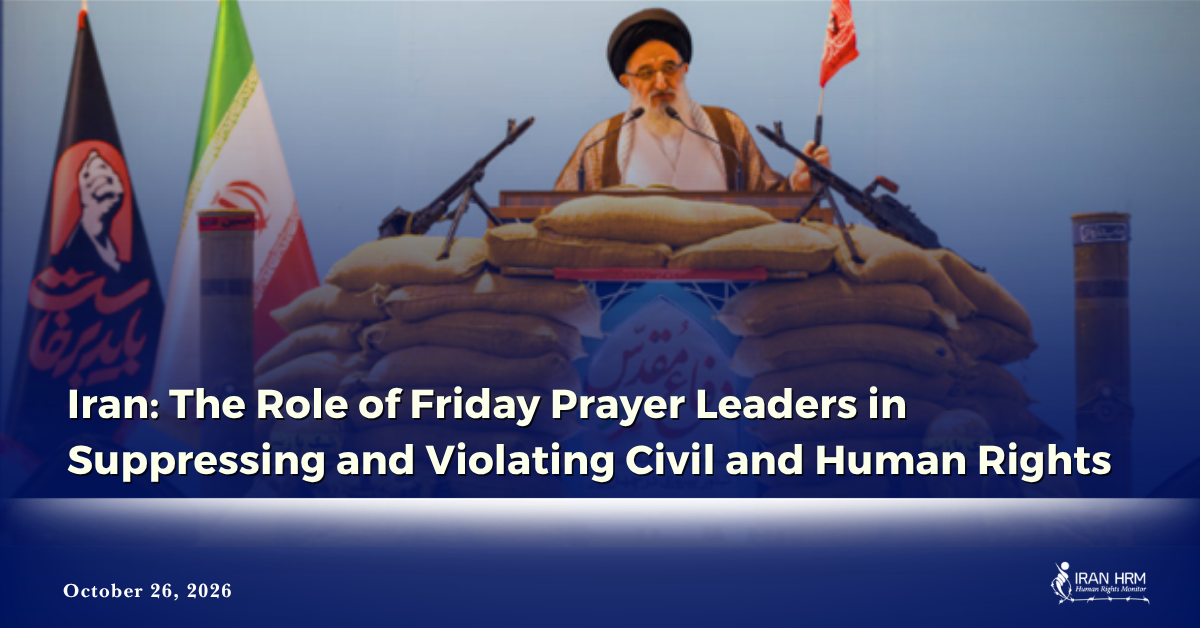
This report structuralizes and examines the role of Friday prayer leaders in the political system of the Islamic Republic of Iran, focusing on the positions and statements of Seyyed Mohammad-Mehdi Hosseini Hamedani, the Representative of the Supreme Leader in Alborz Province and Friday Prayer Leader of Karaj. The findings of this report demonstrate that the institution of Friday prayer within Iran’s ruling political structure operates far beyond a religious ritual; it functions as an executive and ideological arm designed for social engineering, suppression of dissent, legitimization of coercive state actions, and state-directed public opinion control. A meticulous review of Hosseini Hamedani’s speeches reveals alarming dimensions of human rights violations, including: theorizing severe punishments for critics using religious allegories (such as the story of Samiri), securitizing civic behavior, advocating for mandatory hijab enforcement linked with religious superstitions (attribution of droughts to lack of hijab), and promoting a culture of violence and militarism.
Introduction
In the political architecture of the Islamic Republic of Iran, Friday prayer leaders serve as direct representatives of the Supreme Leader in various provinces and cities. Their position is defined such that the Friday prayer podium is recognized not as an independent space for worship, but as a “headquarters” (Ghararghah) and a critical pillar for political and security guidance of the country. An examination of the stances taken by Seyyed Mohammad-Mehdi Hosseini Hamedani as Karaj’s Friday Prayer Leader illustrates how public pulpits and state budgets are utilized to disseminate hate speech, curtail fundamental freedoms, and demand state-sponsored crackdowns on civic activists and dissidents.
Section 1: The “Headquarters” Doctrine and Militarization of the Cultural Sphere in Cognitive Warfare
In defining the function of the Friday prayer institution, Hosseini Hamedani strips it of any civil-religious identity, endowing it with a strictly security-political purpose. Referencing directives from the Supreme Leader, he emphasizes that Friday prayers “carry out an essential part of the Supreme Leader’s office operations.”
- Within this discourse, mosques are depicted as “frontline trenches” and the Friday prayer as a “headquarters” for designing, organizing, and directing macro-level social activities.
- By raising the concept of “cognitive warfare and the war of wills,” he claims that the enemy seeks to alter societal beliefs and consequently change public behavior, asserting that the Friday prayer leader’s duty is to confront opposing currents.
Human Rights Analysis: Transforming mosques and Friday pulpits into operational bases for social control constitutes a clear violation of the independence of religious and civil institutions and paves the way for systemic breaches of citizens’ fundamental rights, including freedom of thought and expression.
Section 2: Criminalization of Dissent, Hate Speech, and Calls for Severe Punishments (The Allegory of Samiri)
One of the most dangerous dimensions of Hosseini Hamedani’s statements involves theorizing coercive state action against ideological and political opponents through religious allegories. Citing the story of “Samiri”* and his severe punishment in religious texts, he directly addressed the judiciary, demanding severe crackdowns on critics:
- He explicitly declared: “All those who in various ways operate to promote deviation, division, and polarization in society must be identified and punished.”
- He asserted that “Under specific circumstances, punishments must be made harsher,” alleging that organized social actions can carry structural consequences.
Conflict with International Law:
- Using vague concepts lacking clear legal definition—such as “deviation,” “division,” and “polarization”—to suppress critics directly violates the fundamental principle of Legality of Crimes and Punishments (Nullum Crimen Sine Lege).
- These statements stand in direct contradiction to Article 18 (Freedom of thought, conscience, and religion) and Article 19 (Freedom of expression) of the International Covenant on Civil and Political Rights (ICCPR), constituting explicit incitement to discrimination and suppression of dissidents.
Section 3: Engineering Bodies and Society; Mandatory Hijab, Superstition, and Suppression of Women
Hosseini Hamedani links voluntary dress and opposition to the mandatory hijab directly to a security and ideological crisis, demanding the highest levels of state pressure against women:
- He characterizes unveiling (Kashf-e Hijab) as stepping “onto the enemy’s field,” emphasizing the necessity of an all-out confrontation against dissenting women.
- In a notable remark, he introduced the “atrocious state of hijab” as a primary cause for the cessation of rainfall (droughts), deploying superstitious rhetoric to justify legal authoritarianism.
- He called for coercive administrative and judicial measures—such as sealing commercial premises, revoking business licenses, and fearless execution of enforcement by officials.
Conflict with International Law:
- These positions blatantly violate Article 17 (Right to Privacy), Article 19 (Freedom of Expression), and Article 26 (Non-discrimination and Equality Before the Law) of the ICCPR. State enforcement of women’s dress codes and intrusion into personal choices constitute systemic gender-based discrimination.
Section 4: Promotion of the Culture of Sacrifice, Martyrdom, and Ideological Militarism
During a meeting with officials from the Foundation of Martyrs and Veterans Affairs, Hosseini Hamedani emphasized the necessity of strengthening media and cultural approaches to promote the culture of “sacrifice and martyrdom” both domestically and internationally. The organized promotion of warmongering and martyrdom-centric discourse in the public domain, alongside efforts to export it, forms part of an ideological militarism doctrine that directly conflicts with principles of sustainable peace and human rights.
Conclusion
The positions and statements of Seyyed Mohammad-Mehdi Hosseini Hamedani demonstrate that Friday prayer podiums in Iran function not as spiritual sanctuaries for citizens, but as centers generating discourses of repression, hate speech, and the legitimization of human rights violations. Repeated demands for punishing dissidents, the securitization of women’s civil demands regarding clothing, and efforts to erase societal intellectual diversity warrant an immediate response from international human rights mechanisms.
Demands and Recommendations to UN Human Rights Special Procedures
- To the Special Rapporteur on the Situation of Human Rights in Iran: Conduct a comprehensive investigation into the role of politico-religious institutions operating under the Supreme Leader (such as Friday Prayer Headquarters) in inciting violence, civil suppression, and systematic violations of citizens’ rights.
- To the Special Rapporteur on the Promotion and Protection of the Right to Freedom of Opinion and Expression: Monitor and document statements by religious figures that utilize vague concepts (such as “deviation” and “Samiri”) to criminalize dissent and peaceful criticism.
- To the Special Rapporteur on Violence Against Women and Girls: Assess the destructive impacts of state directives mandating severe restrictions, business closures, and judicial pressures imposed on women under the guise of mandatory hijab.
- To the Special Rapporteur on the Independence of Judges and Lawyers: Raise alarms over the interference of Friday prayer leaders and state entities in dictating the severity and nature of sentences to the judiciary, thereby dismantling judicial independence.
Operational Outcomes and International Horizons (Following UN Engagement)
The intervention and action of UN bodies and Special Procedures will serve as the framework for the following tangible legal and international outcomes:
- Elevating the Issue to State International Responsibility: Documenting these breaches in official UN Human Rights Council and General Assembly reports paves the way for referring the role of the Supreme Leader’s representatives and Friday Prayer Headquarters to the Fact-Finding Mission (FFM) and other international accountability mechanisms.
- Providing Evidentiary Basis for Targeted Human Rights Sanctions: Official UN reports act as primary evidentiary sources for the EU, US, UK, and other jurisdictions to apply targeted Magnitsky-style human rights sanctions against individual Friday prayer leaders (such as Seyyed Mohammad-Mehdi Hosseini Hamedani), the Central Council of Friday Prayer Leaders, and their affiliated media apparatuses.
- Dismantling Claims of Judicial Independence: Establishing that Friday prayer leaders actively dictate judicial outcomes and policy disables the regime’s claims of judicial independence, enabling global legal bodies (such as the International Bar Association) to challenge the legitimacy of sentences issued pursuant to these pulpits’ directives.
- Establishing Grounds for Universal Jurisdiction: Documenting the systematic incitement to repression and the theorization of extreme punishments (e.g., the Samiri allegory) provides prosecutors in states exercising universal jurisdiction with the legal framework to initiate criminal investigations and arrest warrants should these officials travel abroad.
Footnote:
Explanatory Note: The Story of Samiri and Its Symbolism In religious narratives (Quran, Surah Ta-Ha), “Samiri” is a figure who, during the absence of Moses, constructed a golden calf that produced a lowing sound and persuaded the Israelites to worship it, leading them into apostasy. In the discourse of Islamic Republic officials, “Samiri” serves as a political-religious symbol to brand individuals who, in the regime’s view, divert society from its official ideological path, causing factionalism, deception, and ideological rift. The use of this religious allegory by Friday prayer leaders against critics and political dissidents, functions as an ideological labeling technique. By equating political criticism with “apostasy and Samiri’s sedition,” officials seek to rationalize extraordinarily harsh punishments and judicial crackdowns.
Sources and References
- Official Website of Ayatollah Seyyed Mohammad-Mehdi Hosseini Hamedani (Friday Prayer Leader of Karaj), News Section: https://hoseinihamedani.ir/category/news/
- Etemad Online, Report on Karaj Friday Prayer Leader’s Remarks Regarding Mandatory Hijab and Droughts: https://www.etemadonline.com/بخش-سیاسی-9/591375-امام-جمعه-کرج-مسئله-حجاب
- Fararu, Report on Calls for Confrontation, Sealing Businesses, and Enforcing Hijab Laws: https://fararu.com/fa/news/600199/