Executive Summary

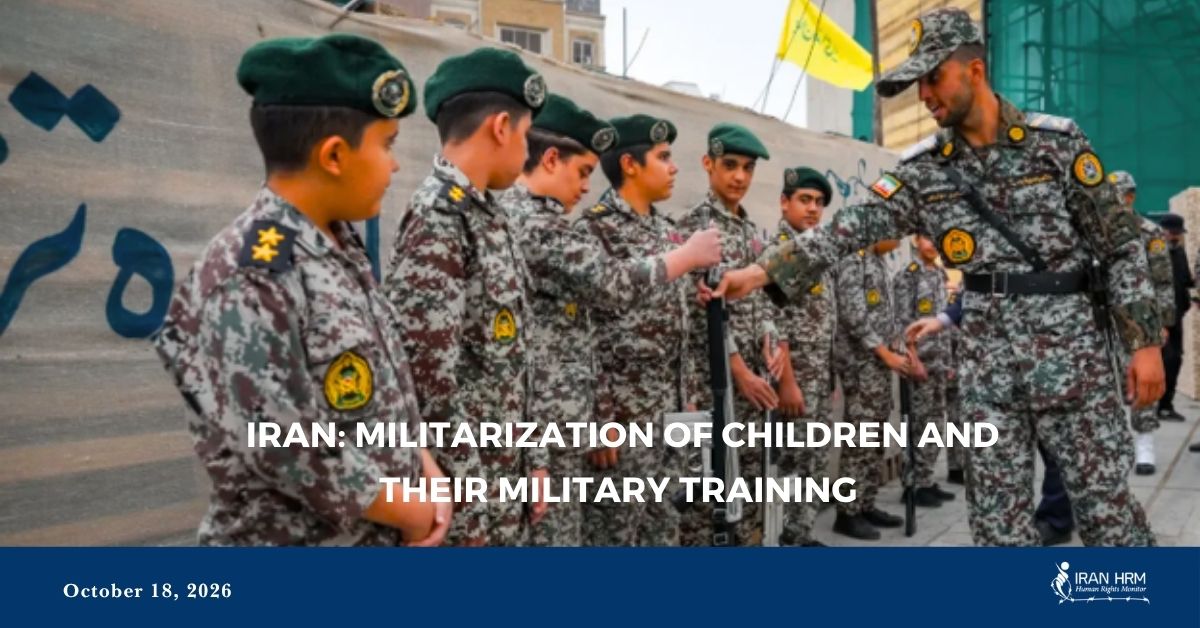
In October 2026 (Mehr 1405), the publication of documented images and reports in Iranian domestic media, including Rouydad 24 and ISNA, revealed alarming dimensions of the military training of children and adolescents in public spaces. According to these images, military and security forces operating under the so-called “Jan-Fada” battalions in various parts of Tehran, including Azadi Square and Haft-e Tir Square, have been training children and adolescents in handling firearms, including assault rifles, scoped rifles, and machine guns. These actions, conducted with the presence and supervision of official forces and in the view of the general public, reflect the continuation of a pattern pursued over past decades through the mobilization and military organization of students. Relying on visual evidence and official statements, this report examines the dimensions of this phenomenon, the historical background of using children in military and security structures and assesses the compliance of these practices with the international obligations of the Islamic Republic of Iran regarding child rights.
Section 1: Field Evidence; Military Training of Children in Tehran Squares (October 2026)
During government-sponsored exhibitions and gatherings held in October 2026 in Tehran, numerous images depicting direct military training provided to children drew widespread reactions:
- Haft-e Tir Square, Tehran (October 4, 2026 ): Media images show senior military officers in IRGC uniforms instructing boys and girls on how to handle, assemble/disassemble, and aim heavy and semi-heavy military weapons. (Rouydad 24, October 4, 2026 – )
Azadi Square, Tehran (September 27, 2026): Booths in this square featured children dressed in paramilitary uniforms (resembling commando units) practicing aiming with scoped rifles and machine guns mounted on military vehicles. In some images, children are trained to aim at target baskets featuring specific images. (Rouydad 24, September 27, 2026– )
- Psychological and Instrumental Dimensions: Conducted under the direct supervision of military commanders in public urban spaces, these training sessions constitute a blatant instance of the instrumental use of children, the normalization of overt violence, and the promotion of militarism among the country’s youth.
Section 2: Historical Continuity; From Iran-Iraq War Child Soldiers to Suppression Patrols
The recruitment and deployment of children in military and security structures in Iran is not a temporary deviation; it is part of a strategic doctrine with deep roots in past decades:
- The Iran-Iraq War (1980–1988):
- The Iranian government extensively deployed students and children (even under 15 years old) as “volunteers and Basij forces” on frontlines. Plans such as “Student-Pasdar (IRGC member)” were executed under the direct supervision of senior regime officials, turning schools into recruitment bases.
- As explicitly admitted by military authorities (including Major General Yahya Rahim Safavi), approximately one million students were dispatched to the fronts.
- Reports, memoirs, and narratives from the Iran-Iraq war refer to the use of ideological and religious symbols, such as the distribution of “keys to heaven” among some teenage volunteers. These narratives, alongside evidence of the widespread presence of students on war fronts, inclusing sweeping mine fields demonstrate the efforts to encourage and mobilize children and adolescents to participate in war-related activities.
- Use of Children in Suppressing Popular Protests (2022 and 2026 Uprisings ):
- During nationwide protests (particularly the 2022 uprising and subsequent protests in 2025), numerous human rights and civic reports indicated that security agencies deployed children and adolescents (some as young as 12) in street patrols, checkpoints, and plainclothes units to identify and suppress protesters.
- Rahim Nadalipour, Cultural Deputy of the Tehran IRGC, stated on Shabakeh Khabar (Channel News) TV on March 26: “We have launched this initiative across various areas—specifically, intelligence and operational patrols. Our young people—teenagers and youths—have repeatedly come forward, expressing a desire to participate in these patrols. Regarding the Basij checkpoints—which you can currently see throughout the cities—we have received a very high number of requests from teenagers and young people wanting to take part. Given the ages of those coming forward and requesting to participate, we have set the minimum age at 12; meaning that now, 12- and 13-year-old kids want to be involved in this sphere.”
- Section 3: Legal Paradox; Age of Criminal Responsibility and Domestic Contradictions
While the regime forces children into military training and security exploitation, domestic laws establishing a minimum age of 18 for certain civil rights and responsibilities, such as obtaining a driver’s license, indicate that the Iranian legislator considers 18 as the necessary benchmark for maturity and sufficient responsibility. Nonetheless, the recruitment laws of the army and the IRGC set the minimum recruitment age at 16. This disparity raises serious questions regarding the criteria used to evaluate the maturity of adolescents, particularly regarding military and security activities that expose them to severe physical and psychological risks.
This contradiction reveals that whenever security interests and the preservation of the power structure are at stake, the “legal age” is lowered—even to under 12—and the physical and psychological well-being of children is gambled with within paramilitary structures (such as the “Jan-Fada” battalions).
Section 4: Legal Assessment and Flagrant Violation of International Obligations
The military training of children and adolescents and their organization within the “Jan-Fada” paramilitary structures raise grave concerns regarding the compliance of these actions with the international obligations of the Islamic Republic of Iran concerning child rights, civilian protection, and the prohibition of child involvement in military activities. These concerns are examined under the Convention on the Rights of the Child, the Optional Protocol on the Involvement of Children in Armed Conflict, the Rome Statute of the International Criminal Court, and the Paris Principles.
- Convention on the Rights of the Child (CRC – 1989):
- Article 38: Member states are obligated to take all feasible measures to ensure that persons who have not attained the age of 15 years do not take a direct part in hostilities and to refrain from recruiting persons under 15 into their armed forces. Firearms training for children in public spaces is fundamentally incompatible with the protective purpose and philosophy of this convention (to which Iran has acceded).
- Optional Protocol to the CRC on the Involvement of Children in Armed Conflict (OPAC):
- The OPAC prohibits governments from forcibly recruiting individuals under 18 and obligates states to ensure that persons under 18 do not take a direct part in hostilities. Furthermore, non-state armed groups are under no circumstances permitted to recruit or use persons under 18.
- Rome Statute of the International Criminal Court (ICC – Article 8):
- Pursuant to Article 8(2)(b)(xxvi) and 8(2)(e)(vii) of the Rome Statute, “conscripting or enlisting children under the age of fifteen years into the national armed forces or groups or using them to participate actively in hostilities” is classified as a “war crime.”
- Paris Principles and Commitments (2007) on Children Associated with Armed Forces:
- The Paris Principles broadly define children associated with armed forces and armed groups, recognizing their participation in military, security, support, logistical, and propaganda roles as instances of association with armed forces, emphasizing the necessity of preventing such practices.
Section 5: Conclusion and Recommendations
The establishment and equipping of the “Jan-Fada” battalions and the military training of children in urban squares pose a grave alarm to the global community and human rights bodies. This practice represents a clear continuation of the destructive policies of past decades (war child soldiers) utilizing modern tools.