Executive Summary

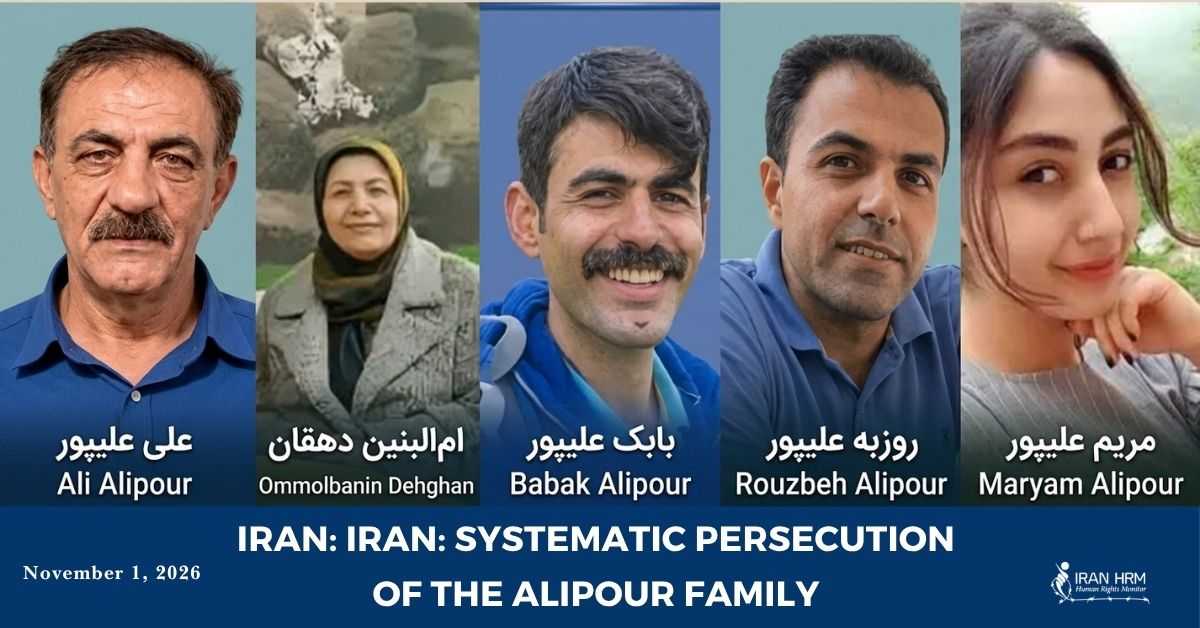
This report examines the case of the Alipour family as a documented example of the concerning pattern of security and judicial pressure exerted against relatives of political prisoners and executed individuals in the Islamic Republic of Iran.
In this case, Babak Alipour was executed on March 31, 2026 (11 Farvardin 1405) in Ghezel Hesar Prison on charges of “Baghi (armed rebellion) through membership in the People’s Mojahedin Organization of Iran (PMOI).” Subsequently, his brother, Rouzbeh Alipour, remains in detention and judicial limbo. Furthermore, the father of the family, Ali Alipour, was arrested on October 20, 2026 (28 Mehr 1405), on October 27, he appeared before a judicial authority in a closed session and was subsequently transferred to Lakan Prison in Rasht, while authorities continue to refuse official disclosure of charges or the legal basis for his continued detention.
This pattern raises serious concerns regarding the instrumentalization of security and judicial mechanisms to exert pressure on the families of political prisoners and executed victims.
Introduction and Legal Framework
In international human rights law, criminal responsibility and punishment are strictly personal. No individual should be subjected to punishment, harassment, persecution, or restriction due to family ties, emotional bonds, or kinship with another person. This principle is a cornerstone of the rule of law and fair trial, recognized across a broad spectrum of international human rights instruments and standards.
Nevertheless, United Nations human rights bodies have repeatedly warned in recent years against the expanding phenomenon of exerting pressure on relatives of political prisoners, human rights defenders, protesters, journalists, and executed individuals. These measures manifest as arbitrary arrests, summons, threats, denial of fundamental rights, judicial and security pressures, or other forms of harassment targeting relatives. In human rights discourse, this trend is frequently examined under concepts such as “Reprisals Against Family Members” and “Family-Based Repression.”
Beyond obligations under Articles 9, 14, and 17 of the International Covenant on Civil and Political Rights (ICCPR) concerning personal liberty, fair trial, and the protection of privacy and family life, States are obligated to refrain from any punitive or restrictive measures against family members of individuals due to the activities, beliefs, or legal status of their relatives.
The case of the Alipour family is a notable illustration of concerns in this area. According to available information, this family has faced a chain of judicial and security measures within a short timeframe—ranging from the execution of Babak Alipour and the prolonged detention of Rouzbeh Alipour to the arrest, trial, and imprisonment of the father, Ali Alipour. Examining this sequence of events provides a clear picture of the human, social, and legal consequences of exerting pressure on the families of political prisoners and executed individuals.
Focusing on the Alipour case, this report aims to demonstrate how consecutive security and judicial actions against members of a single family can extend beyond individual impact to dismantle the security, stability, dignity, and normal life of an entire family unit—a situation demanding independent review and scrutiny by UN human rights mechanisms.
Case Overview
Within less than a year, the Alipour family has faced a series of security and judicial measures, including:
- The execution of one of the family’s sons;
- The arrest and continued imprisonment of the second son;
- The arrest of the mother and the sister
- The arrest of the father;
- The confiscation of the family’s electronic devices and personal belongings;
- The closed judicial session of the father;
- His transfer to Lakan Prison in Rasht.
This sequence of events has subjected the family to multi-layered judicial, security, psychological, and social pressures.
Part I: The Execution of Babak Alipour
Babak Alipour, born in 1991 (1370), a political prisoner and law graduate, was executed on March 31, 2026 (11 Farvardin 1405) alongside Pouya Ghobadi in Ghezel Hesar Prison under the charge of “Baghi through membership in the PMOI.” His trial—alongside 5 other political prisoners: Vahid Bani-Amerian, Mohammad Taghavi, Pouya Ghobadi, Shahrokhi Daneshvarkar, and Abolhassan Montazar—was held in a joint case before Branch 26 of the Tehran Revolutionary Court, presided over by Judge Iman Afshari, on October 6, 2024 (15 Mehr 1403). On Saturday, November 30, 2024 (10 Azar 1403), he and his co-defendants were sentenced to death, imprisonment, and exile.
Prior to the execution, international human rights organizations and UN human rights experts had warned against the risk of carrying out death sentences in this case. Reports also indicate that the family was denied a final visitation and farewell, and following the execution, faced restrictions regarding the return of the body and disclosure of the burial site.
Part II: Detention of Rouzbeh Alipour, Maryam Alipour, and Ommolbanin Dehghan (Brother, Sister, and Mother)
Rouzbeh Alipour was arrested in Tehran on January 26, 2026 (6 Bahman 1404) alongside his 63-year-old mother, Ommolbanin Dehghan, and 31-year-old sister, Maryam Alipour. Sources close to the family report that security agents subjected the family to physical assault during the arrest and transferred them to security detention centers without providing a clear explanation for the arrest. Rouzbeh Alipour was severely tortured during detention, resulting in severe fractures to his arms and legs. Serious injuries to his head and face were also observed, and despite his critical physical condition, he has been denied adequate medical treatment over the past four months.
Initially held in the Ministry of Intelligence detention facility in Greater Tehran Prison (Fashafoyeh), he was transferred in mid-May 2026 (Ordibehesht 1405), following partial recovery from torture injuries, to Ghezel Hesar Prison, where he is held in Unit 3, solitary confinement section known as the “Security Ward”—a section where prisoners are practically cut off from the outside world.
What is currently certain is that Rouzbeh Alipour remains in a state of prolonged limbo in prison. Human rights sources reported the continued detention of Babak’s mother and sister until April 2026. However, at the time of drafting this report, no public or verifiable information regarding their current status, potential release, or judicial fate is available.
Part III: Arrest of the Father, Ali Alipour
On the morning of October 20, 2026 (28 Mehr 1405), security forces raided Ali Alipour’s home in Rasht and arrested him. At the same time, electronic devices belonging to family members were confiscated. He was transferred to the security detention facility known as “Shohadaye Ghomnam.” No clear explanation regarding the reasons for arrest or potential charges was provided at the time of apprehension.
Note for Reader: The detention facility known as “Shohadaye Ghomnam” is a security detention center operated by intelligence agencies in Rasht (capital of Gilan Province). It serves as a temporary detention site, interrogation center, and a location for exerting pressure on political and civil activists, as well as justice-seeking families in the Gilan region. Individuals transferred to this center are initially deprived of fundamental rights, including access to legal counsel, regular family contact, and transparent notification of charges. Interrogations are conducted under the strict supervision of security handlers.
According to published reports, Ali Alipour appeared before a judicial authority in a closed session in Rasht on October 26, 2026 (4 Aban 1405). Nevertheless, the specific details of the charges, the nature of the hearing, access to defense counsel, and the outcome of the proceedings have not been independently verified or announced by official authorities.
The sole official remark reported was attributed to the Head of the Rasht Intelligence Department regarding the justification for his arrest and trial, quoting the security official as saying: “There is no need for a specific reason for his arrest and trial. It is enough that he was previously a political prisoner and insists on his beliefs.” While these statements have not been independently verified, the reported content heightens concerns regarding security targeting of Ali Alipour due to his beliefs and political background.
Transfer to Lakan Prison, Rasht
On October 29, 2026 (7 Aban 1405), Ali Alipour was transferred from the “Shohadaye Ghomnam” security detention facility to Ward 12 of Lakan Prison in Rasht. Despite this transfer, no transparent information regarding his charges, case status, or the legal basis for his continued detention has been published.
Legal Assessment
- The Principle of Personal Criminal Responsibility and Prohibition of Family-Based Repression
A fundamental principle of criminal law and international human rights law is the principle of personal criminal responsibility. According to this principle, no person should be subjected to punishment, persecution, detention, or restriction due to family ties, emotional connection, or kinship with another individual.
Although the term “Family-Based Repression” is not defined as an independent legal title in international treaties, UN Special Rapporteurs and human rights bodies have repeatedly warned against exerting pressure, intimidation, and detention against relatives of political prisoners, human rights defenders, protesters, and executed individuals.
In the present case, the execution of a family member, the arrest and torture of the brother, the arrest and limbo of the mother and sister, and the subsequent arrest and imprisonment of the father present a concerning picture of security pressure expanding from an individual to an entire family unit.
- Violation of the Right to Liberty and Security of Person (Article 9, ICCPR)
Article 9 of the International Covenant on Civil and Political Rights prohibits arbitrary detention and obligates States to promptly inform detained individuals of the reasons for their arrest in a transparent manner.
Regarding Ali Alipour, up to the time of drafting this report, no transparent information has been provided regarding his alleged charges, the legal basis of his detention, or the reasons for his continued deprivation of liberty.
Similarly, regarding Rouzbeh Alipour, despite months passing since his arrest, no clear information regarding his case status, charges, judicial proceedings, or anticipated trial date has been published. Continued detention coupled with a lack of judicial transparency raises serious concerns regarding compliance with Article 9 of the Covenant.
- Serious Concerns Regarding Torture and Inhuman Treatment (Article 7, ICCPR)
According to the information received, Rouzbeh Alipour was severely beaten during his arrest, resulting in fractures to his arms and legs. Reports also indicate severe injuries to his head and face and long-term deprivation of appropriate medical care.
If verified, these acts fall within the scope of cruel, inhuman, or degrading treatment or punishment under Article 7 of the ICCPR. His prolonged detention in the “Security Ward” and practical deprivation of regular contact with the outside world further compound these concerns.
- Violation of Fair Trial Guarantees (Article 14, ICCPR)
According to available information, Ali Alipour appeared before a judicial authority in a closed session on October 26, 2026 (4 Aban 1405). However, information regarding the nature of the hearing, charges, access to chosen counsel, presented evidence, and potential outcome is unavailable.
This lack of transparency eliminates the possibility of independent assessment regarding compliance with fair trial guarantees and creates serious concerns regarding the defendant’s defense rights. Furthermore, Rouzbeh Alipour’s prolonged limbo is irreconcilable with fair trial principles and trial within a reasonable time.
- Violation of Privacy and Family Rights (Article 17, ICCPR)
Article 17 of the ICCPR prohibits States from arbitrary interference with an individual’s privacy and family life. Repeated arrests of family members, confiscation of personal and electronic belongings, consecutive security pressures, and the creation of ongoing uncertainty inflict profound damage on family life, psychological security, and social cohesion.
In this case, the pressure applied was not restricted to a single individual but engulfed multiple family members across different periods.
- Continued Harm Post-Execution and the Right to Human Dignity
According to international standards, the execution of a death sentence must not in itself serve as a basis for restrictions or pressure against the relatives of the executed individual.
However, in this case, not only was Babak Alipour’s family deprived of a final visitation and farewell, but following the execution, family members faced a sequence of arrests, summons, judicial limbo, and security pressures. Together, these events raise the concern that the punitive consequences have transcended the executed individual and extended to his relatives.
Conclusion
The case of the Alipour family is not merely a collection of isolated arrests or disparate security measures. What emerges from examining the sequence of events is a continuous pattern of security and judicial pressure against members of a single family within a timeframe of less than a year.
The family first faced the execution of Babak Alipour. Subsequently, his brother, mother, and sister were arrested. Rouzbeh Alipour was reportedly subjected to severe torture and continues to be held in prison in limbo. The current status of his sister and mother remains unverified. Following this, the father of the family was arrested, brought before judicial authorities in an opaque process, and transferred to Lakan Prison in Rasht.
Collectively, these events demonstrate that the effects of state repression were not confined to an individual but gradually encompassed the entire family structure. In this case, the family has not only lost their loved one but has also faced detention, judicial limbo, psychological pressure, continuous insecurity, and the gradual dissolution of normal family life.
Accordingly, the case of the Alipour family represents a striking example of concerns regarding the use of security and judicial mechanisms against relatives of political prisoners and executed individuals in the Islamic Republic of Iran, requiring independent and urgent scrutiny by UN special procedures.