Case No. 17 | Case ID: IRN-DP-1404-017 | Last reviewed: 2 November 2026
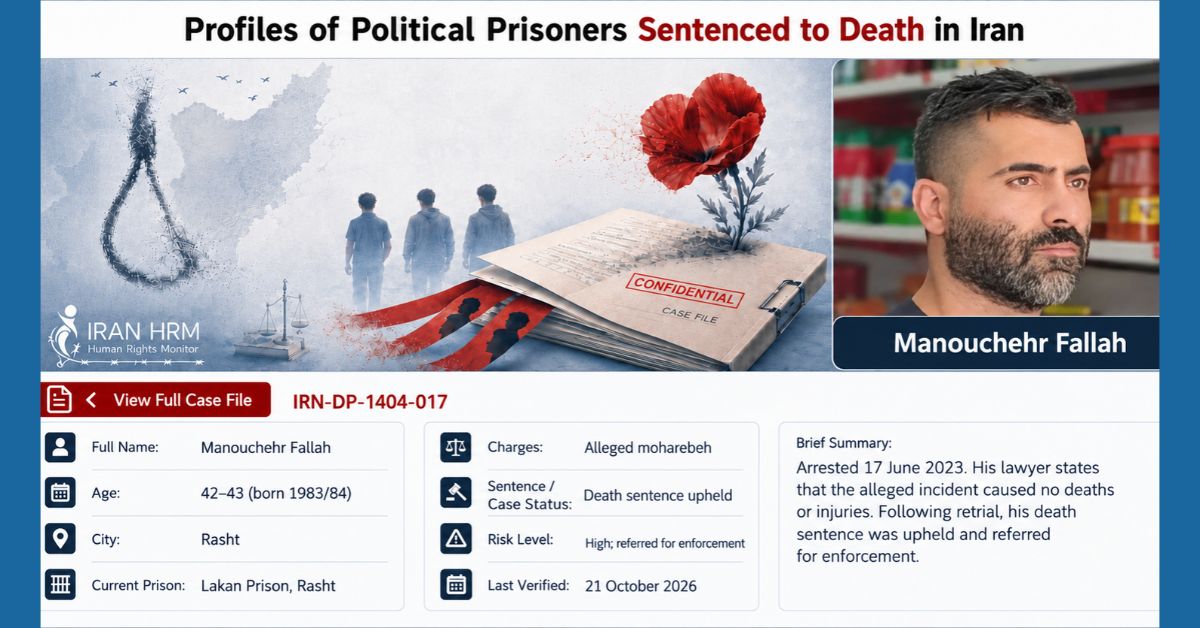
| Manouchehr Fallah, a political prisoner aged 42–43 held in Lakan Prison in Rasht, faces execution after the Supreme Court again upheld his death sentence and his case was referred to the Criminal Sentences Enforcement Unit in Rasht. He has been detained since 17 June 2023. According to his defence lawyer, the alleged act underlying the sentence caused no deaths or injuries. Referral of the case for enforcement heightens the need for urgent intervention to protect his life. |
Key Case Information
| Category | Information |
| Full name | Manouchehr Fallah |
| Date of birth | 1983/84; exact date unknown |
| Age | 42–43 |
| Occupation before arrest | Sales representative |
| Family status | Father of a daughter named Asal |
| Date and place of arrest | 17 June 2023; exact place of arrest unknown |
| Charges | Moharebeh; in the first case, “insulting Khamenei” and “propaganda against the system” |
| Court | Branch Two, Revolutionary Court in Rasht; retrial before Branch One |
| Judge | Ahmad Darvish-Goftar; imposed the sentence following retrial |
| Lawyer | Milad Panahipour |
| Sentence | Death; upheld again by the Supreme Court and referred for enforcement in Rasht |
| Current place of detention | Lakan Prison, Rasht |
Human and Personal Background
Manouchehr Fallah, born in 1983/84 and from Rasht, Gilan Province, worked as a sales representative before his arrest. He is the father of a daughter named Asal. The letter he wrote on 8 February 2025 to mark his only daughter’s sixteenth birthday illustrates the impact of his imprisonment and death sentence on his family life.

Arrest, Trial and Sentencing
Security forces arrested Fallah on 17 June 2023. The available information does not specify the exact place of arrest. According to the case information, the investigating judge granted bail, but the final registration of the bail and his provisional release did not take place. In his first case, Branch Three of the Revolutionary Court in Rasht, presided over by Mehdi Rasekhi, sentenced him to a total of 22 months and 17 days’ imprisonment on charges of “insulting Khamenei” and “propaganda against the system”. The enforceable sentence was stated to be one year and three months and, according to the information provided, ended in July–August 2024. He was nevertheless not released.
On 22 July 2024, Fallah began a 28-day hunger strike in protest at the uncertainty surrounding his situation and the obstacles to his provisional release. In a second case, Branch Two of the Revolutionary Court in Rasht sentenced him to death for moharebeh (enmity against God) in 2024/25. According to the available information, the hearing took place by videoconference without his chosen lawyers present. After the Supreme Court upheld the initial sentence, it was overturned following the acceptance of an application for retrial, and the case was referred to another branch of equal jurisdiction. In May–June 2026, Branch One of the Revolutionary Court in Rasht, presided over by Ahmad Darvish-Goftar, again imposed the death sentence. According to the latest report, dated 21 October 2026, the Supreme Court upheld this sentence as well, and the case was referred to the Criminal Sentences Enforcement Unit in Rasht.
Fallah’s defence lawyer, Milad Panahipour, has stated that his client is accused of detonating a small sound bomb outside the Gilan judiciary building on 1 June 2023. According to the lawyer, an expert assessment estimated the damage to the building at 15 million tomans, and the incident caused no deaths or injuries. The lawyer explained that the court imposed the death sentence by invoking Article 687 of the Islamic Penal Code and treating the alleged act as destruction intended to disrupt public order and oppose the government. He argued that this reliance on the provision lacked a legal basis. The attribution of this act to Fallah does not constitute independent proof of his responsibility.
Statements from Prison or by Family
In his letter to Asal, Fallah recalls his daughter’s childhood, rejects the allegations and describes the circumstances underlying his protest against poverty and injustice. The judge’s name in the excerpt below is reproduced as it appears in the letter and differs from the name of the retrial judge identified in the case account.
| “Your first cries, your childhood smiles, the moment you began to speak and said ‘Daddy’, your first steps and even your falls — all of these gave meaning to life for me.”
“On the eve of your birthday, Judge Mohammad Ali Darvish-Goftar has notified me of my death sentence, perhaps to force me to surrender. But he does not realise that I learned the path I have chosen not from the pages of books, but from life itself and the suffering of the people. Poverty and injustice have been my teachers, and now that this awareness has taken root within me, I regard silence in the face of it as an unforgivable sin.” Manouchehr Fallah, letter to his daughter Asal — Lakan Prison, Rasht, 8 February 2025 |
Government Response and Conduct
The reported conduct of the judicial authorities includes keeping Fallah in detention after the enforceable sentence in his first case had ended, conducting a trial without his chosen lawyers present, reimposing the death sentence after an application for retrial was accepted, and referring the case for enforcement. The available information contains no detailed official response to the lawyer’s objections concerning the legal basis of the sentence and the absence of fatalities or injuries.
Current Status and Risk of Execution
According to the latest information, dated 21 October 2026, Fallah is held in Lakan Prison in Rasht, and his case has been referred to the Criminal Sentences Enforcement Unit in Rasht. No execution date has been announced. Although the timing of an execution cannot be established, this situation requires urgent action to protect his life.
Human Rights and Fair Trial Analysis
Right to life: Article 6 of the International Covenant on Civil and Political Rights restricts the death penalty in countries that have not abolished it to the “most serious crimes”. As interpreted by the Human Rights Committee, this threshold encompasses only crimes of extreme gravity involving intentional killing. If the lawyer’s account that there were no deaths or injuries reflects the circumstances of the case, the alleged act does not meet this threshold.
Right to a fair trial: The reported trial in the absence of Fallah’s chosen lawyers raises serious concerns about effective defence and compliance with Article 14 of the Covenant. Violations of fair trial guarantees in proceedings resulting in a death sentence also render that sentence arbitrary under Article 6.
Continued detention: Detention after the first sentence had been served requires an independent legal basis and an effective opportunity to challenge the detention. The available information is insufficient to establish the precise legal basis for the entire period of detention.
Conclusion
Manouchehr Fallah’s case combines the risk of execution with serious questions about the basis of the sentence and defence safeguards. The absence of fatalities or injuries, according to his lawyer, and the referral of the case for enforcement make it essential to halt the execution and ensure independent and fair proceedings.
Urgent Appeal
United Nations mechanisms, governments and international human rights organisations are urged to act to protect Manouchehr Fallah’s life and prevent his execution.
- Immediately halt all steps towards execution and formally disclose his judicial status.
- Quash the death sentence and transparently disclose the status of any challenge, appeal or cassation proceedings.
- Guarantee immediate and confidential access to counsel of choice and adequate facilities for the defence.
- Publish the judgment, evidence and legal basis for the sentence where they are not publicly available.
- Conduct an independent and impartial investigation into reported violations, where applicable.
- Ensure any retrial takes place before an independent and impartial tribunal without recourse to the death penalty.
- Guarantee regular family contact and access to necessary medical care.