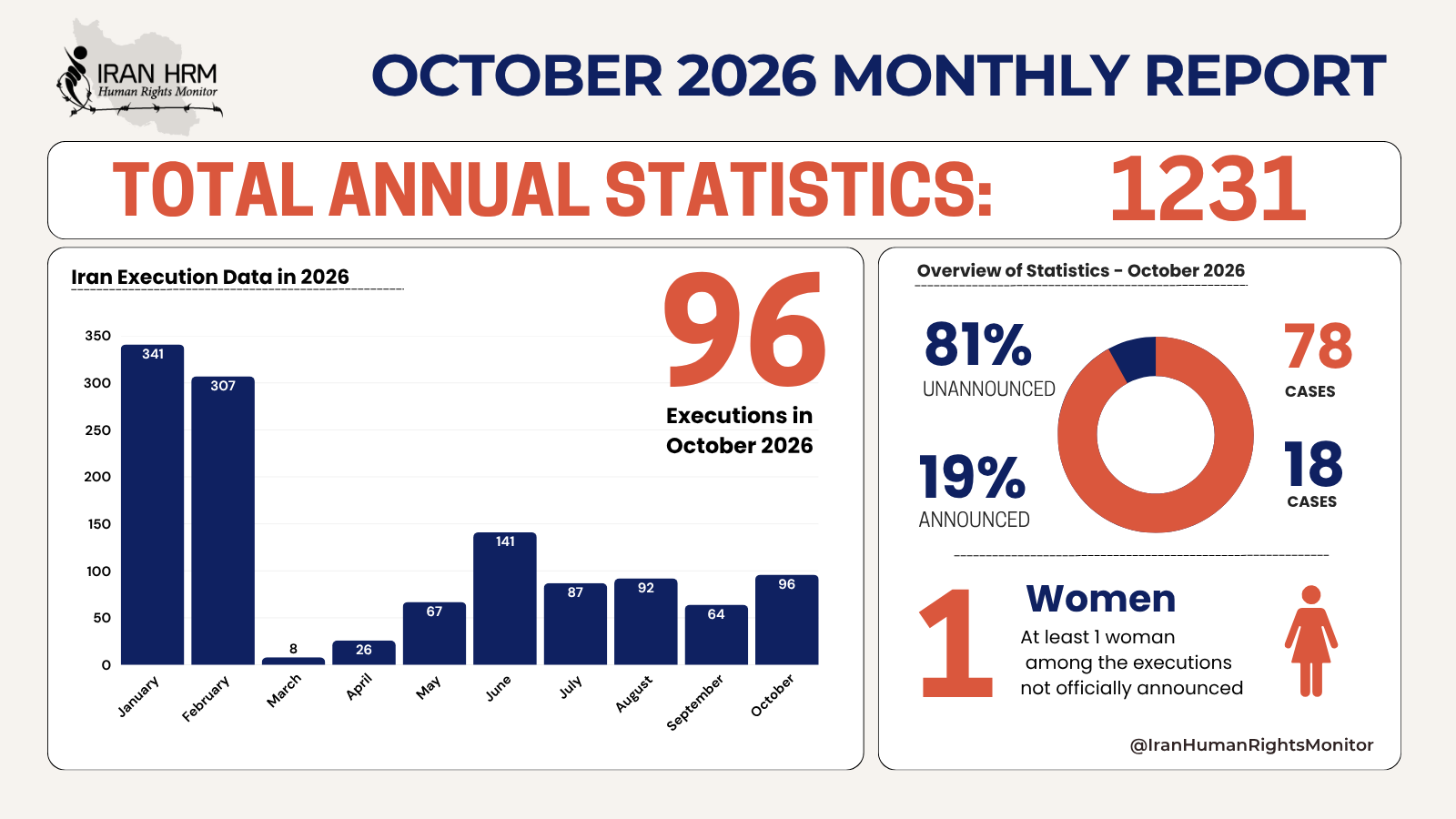
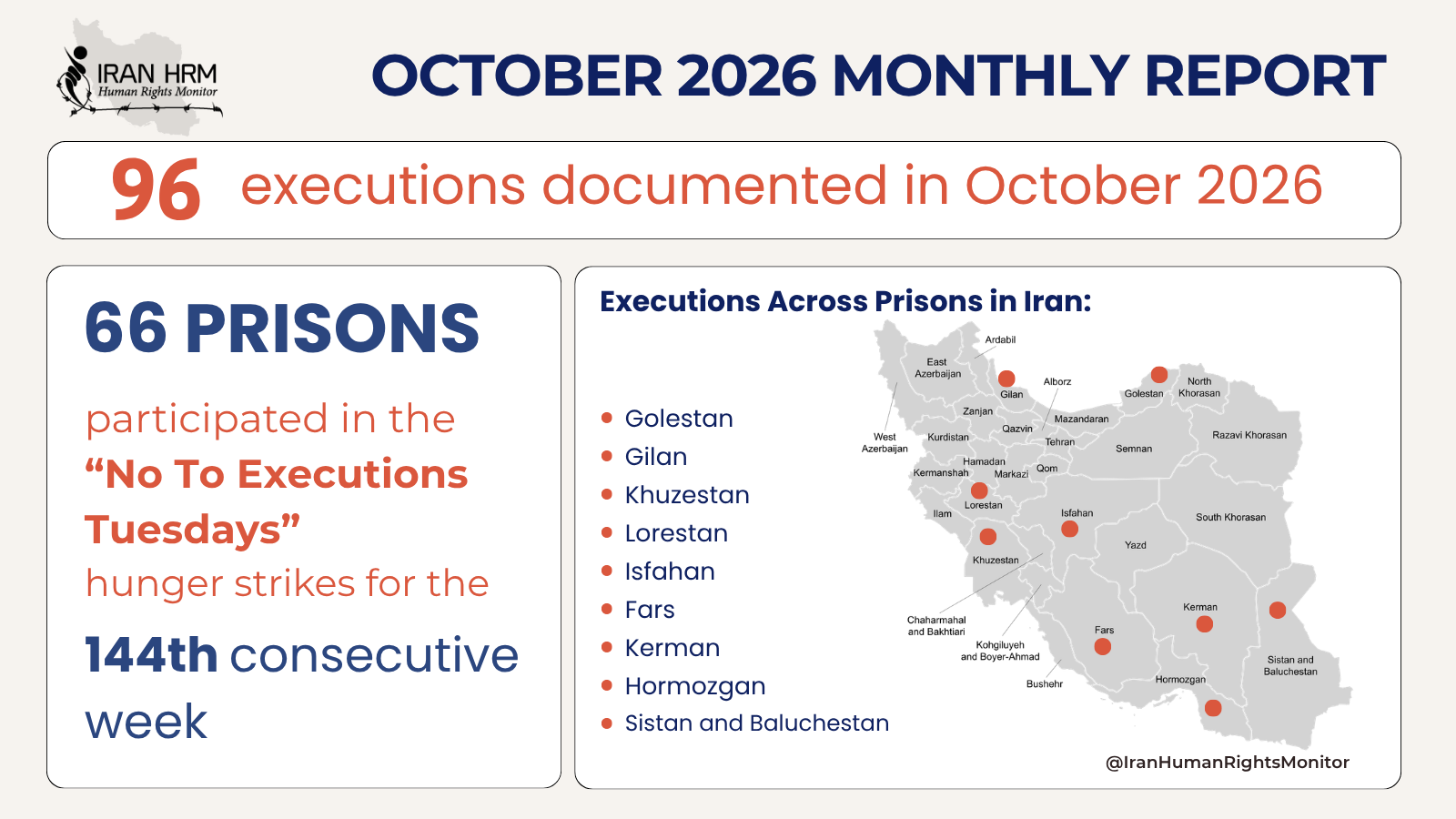
Iran HRM Monthly Report documented at least 96 people were executed in Iran in October 2026. Most of these executions, 78 cases, were never officially announced. Only 18 were reported by state media, while at least one woman was among those executed without public disclosure.

Executions: At Least 96 Prisoners Executed in October
Iranian authorities executed at least 96 prisoners during October 2026, continuing the extensive use of capital punishment.
Of these executions, 78 cases, approximately 81% of the monthly total, were not publicly announced by Iranian authorities, while only 18 were reported through state media. At least one woman was among those whose executions remained unannounced.
The lack of transparency surrounding the majority of executions raises serious concerns about accountability, access to information, and the ability of families and independent observers to scrutinize the implementation of death sentences.
Executions were reported in prisons across multiple provinces, including Isfahan, Gilan, Fars, Kerman, Lorestan, Khuzestan, Golestan, Sistan and Baluchestan, and Hormozgan.
Executions Across Iranian Prisons
Reports documented numerous executions during the first half of October.
On October 3, Mostafa Sharifi was executed in Urmia Prison. On October 4, Mahmoud Alishahi and Samad Hojjatpour were executed in Shiraz.
On October 7, five prisoners were hanged in different prisons: Ahmad Bazvand in Khorramabad, Ahmad Nikdel in Dezful, Mehdi Alizadeh in Shiraz, a prisoner whose identity was not disclosed in Qezel Hesar Prison, and 28-year-old Abbas Anjom-Rooz in Kerman.
On October 11, eight prisoners were executed. Ayoub Mohammad-Nabil, Masoud Khodayari, and Behnam Mozaffarzadeh were executed in Rasht; Esmail Khalili Baseri in Shiraz; and Mehdi Ranjbaran, 28-year-old Manouchehr Nazari, and 30-year-old Faramarz Akbarpour in Gorgan.
Danial Jahanian was also executed in Bandar Abbas in a case concerning the death of a State Security Force (SSF) lieutenant.
On October 12, four prisoners were executed, including Omar Darastaran in Zahedan Prison, 33-year-old Amin Khajeh-Nezami and 38-year-old Habibollah Ghanbarzehi in Kerman, and 23-year-old Mehdi Mirzaei in Hamadan.
On October 13, another prisoner was executed in Minab in connection with allegations concerning the death of a police officer. The prisoner’s identity was not disclosed.
These cases illustrate the geographical extent of executions and the continuing implementation of death sentences across Iranian prisons.
 Execution of Prisoners Detained During the January 2026 Uprising
One of the most serious developments during October was the execution of individuals arrested in connection with the January 2026 nationwide protests.
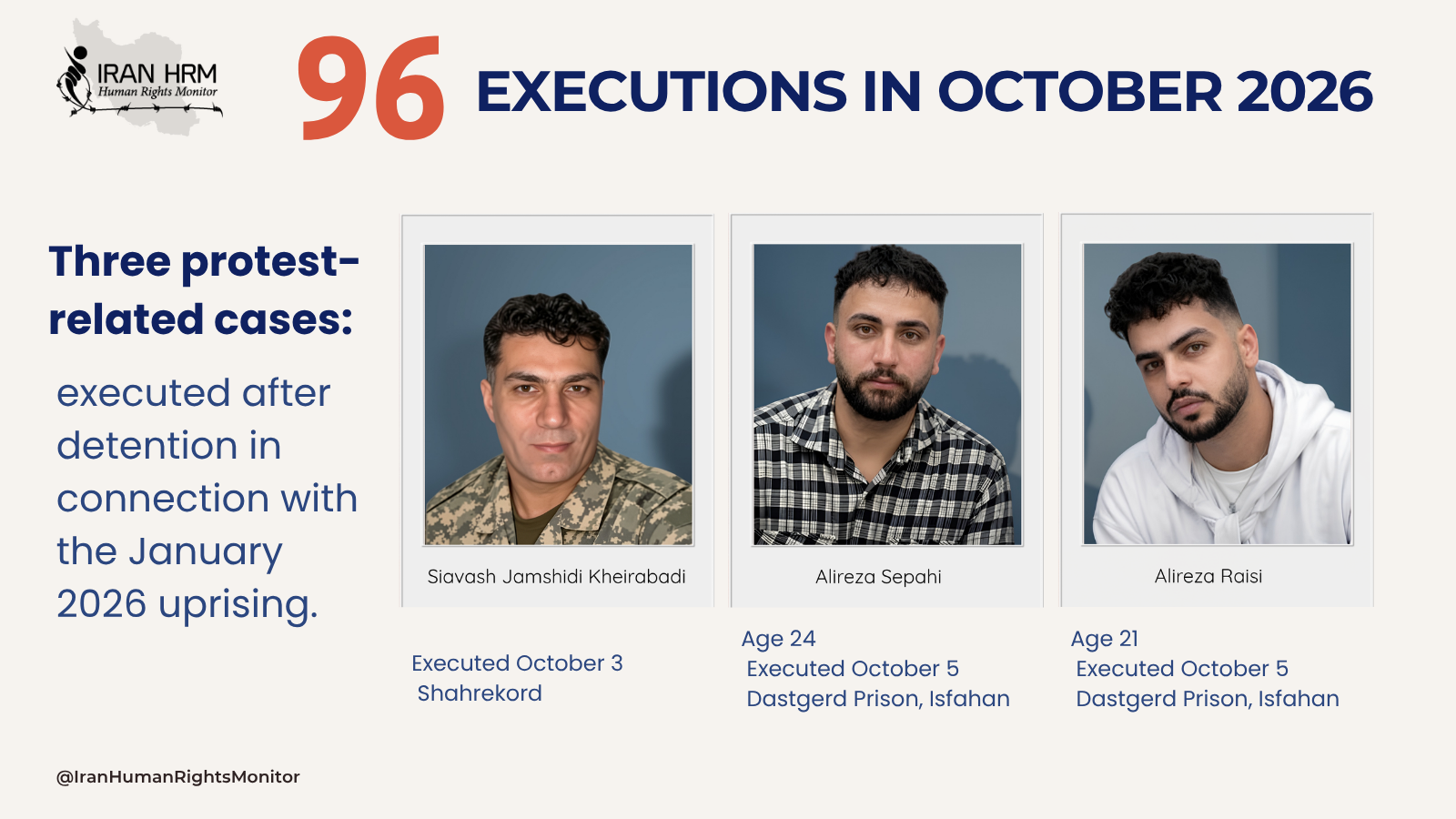
Execution of Siavash Jamshidi Kheirabadi
On October 3, the Iranian judiciary announced the execution of Siavash Jamshidi Kheirabadi, a detainee associated with the January 2026 uprising, in Shahrekord.
According to the judiciary’s Mizan news agency, he had been convicted of moharebeh (enmity against God) on allegations involving the use of firearms, shooting, and gathering and colluding against national security.
The judiciary alleged that Jamshidi Kheirabadi had repeatedly participated in the January protests, communicated with others about demonstrations, and used online platforms to organize activities described by authorities as threats to national security.
Officials further accused him of firing at police officers and possessing firearms, including a military weapon.
The judiciary did not disclose the precise date of his execution.
His case raises serious concerns about the use of broadly defined national security offenses and capital punishment against individuals detained during periods of widespread public protest.
Execution of Alireza Sepahi and Alireza Raisi in Isfahan
In the early hours of October 5, 2026, Iranian authorities executed Alireza Sepahi, 24, and Alireza Raisi, 21, in Dastgerd Prison in Isfahan.
Both men had been detained in connection with the January 2026 uprising and were defendants in the case known as the “Alikhani Square” case.
The Iranian judiciary convicted them on charges including moharebeh (enmity against God), “corruption on Earth,” and offenses against national security.
The case concerned the deaths of four members of the security forces’ Special Units during protests in Isfahan.
Their death sentences were issued by judges Morteza Barati Dorcheh and Mohammadreza Tavakoli.
The proceedings raised serious concerns about the defendants’ access to legal representation and their right to a fair trial.
Reports indicated that defendants in the Alikhani Square case were denied the right to choose their own lawyers and that even court-appointed defense lawyers were prevented from accessing case files.
Five other defendants in the same case—Erfan Esfandiari, Gol-Mohammad Mohammadi, Amirhossein Safari, Abolfazl Sepahi, and Ghaem Hosseini—had reportedly been executed during July and August 2026.
Another 23 defendants received prison sentences ranging from five to ten years, while several others remained under death sentences.
The executions of Sepahi and Raisi took place just days before October 10, the World Day Against the Death Penalty, drawing renewed attention to the use of capital punishment in protest-related cases and the risk facing other defendants.
 Executions on National Security and Armed Activity Charges
Ali Sina Mostafavi was among those executed in October following accusations related to armed activity.
He was accused of attempting to carry out an armed operation during the 40-day conflict involving Iran, the United States, and Israel.
On October 12, Iranian authorities executed Omar Darastaran in Zahedan Prison.
He had been accused of membership in Jaish al-Adl and involvement in armed attacks against security and military facilities.
According to the judiciary’s official account, the charges concerned alleged attacks on State Security Force and Islamic Revolutionary Guard Corps (IRGC) facilities in Rask County, the Parood base, and military facilities in Chabahar County in April 2024.
Political Prisoners Facing Execution
On October 22, reports confirmed that Iran’s Supreme Court had upheld the death sentence of political prisoner Manouchehr Fallah, who was convicted on charges of membership in MEK.
His case was subsequently referred to the Implementation of Verdicts Office in Rasht, placing him at imminent risk of execution.
Fallah, born in 1984, was arrested at Rasht Airport in June 2023 and subsequently detained in Lakan Prison.
In February 2025, Branch 2 of the Revolutionary Court in Rasht, presided over by Judge Mohammad Ali Darvish Goftar, sentenced him to death.
Following a judicial review, the Supreme Court referred the case to another branch for reconsideration. This branch was presided over by Ahmad Darvish Goftar, the father of the judge who had issued the earlier sentence.
In May 2026, the court again sentenced Fallah to death.
The Supreme Court’s confirmation of this ruling in October 2026 removed a significant remaining judicial safeguard and created an immediate threat to his life.
Other Political Prisoners Under Death Sentences
During October, further concerns emerged regarding the issuance and confirmation of death sentences against several prisoners.
The “No to Executions Tuesdays” campaign drew attention to the following cases:
Ilia Bin Rashid, an Arab protester in Isfahan, whose death sentence was among those highlighted by the campaign.
Reza Zanganeh, a political prisoner held in Karaj Central Prison, who faced a death sentence.
Hassan Golshan-Nejad, detained in Mashhad Prison on security-related charges, whose case was also identified among recent capital sentences.
These cases, together with the confirmation of Manouchehr Fallah’s death sentence, demonstrate the continuing danger facing political prisoners and individuals prosecuted on protest-related or national security charges.
Arrest of Ali Alipour, Father of Executed MEK Member Babak Alipour
On October 20, 2026, at approximately 8 a.m., Iranian security forces arrested Ali Alipour at his home in Rasht.
Ali Alipour is the father of Babak Alipour, a member of MEK, who was executed in Qezel Hesar Prison on March 31, 2026, alongside Pouya Ghobadi, another member of the organization.
Following his arrest, Ali Alipour was transferred to the detention facility known as Shohada-e Gomnam (Anonymous Martyrs).
Security agents also confiscated electronic equipment and mobile phones belonging to him and other members of his family.
His son Rouzbeh Alipour, Babak’s brother, had previously been arrested in February 2026.
Rouzbeh was initially held in Fashafuyeh Prison, also known as the Greater Tehran Central Penitentiary, before being transferred to Ward 37 of Unit 3 in Qezel Hesar Prison.
By October, he remained in prolonged legal uncertainty.
Family members were reportedly denied a final visit before his execution. Authorities subsequently refused to hand over his body and had not disclosed the location of his burial site nearly seven months later.
“No to Executions Tuesdays” Campaign Reaches 144th Week
On Tuesday, October 27, 2026, prisoners across 66 Iranian prisons participated in coordinated hunger strikes marking the 144th consecutive week of the “No to Executions Tuesdays” campaign.
The campaign, launched at Qezel Hesar Prison on January 30, 2024, has developed into a nationwide prison-based protest movement opposing the death penalty.
The participating prisoners continued their weekly actions despite reported threats, restrictions on communication, pressure from prison authorities, and punitive measures against those involved.
In their latest statement, the prisoners condemned the continued issuance and implementation of death sentences and warned about the large number of prisoners facing execution.
They drew particular attention to the cases of Manouchehr Fallah, Ilia Bin Rashid, Reza Zanganeh, and Hassan Golshan-Nejad.
The campaign received growing international support during the final days of October.
On October 27, Andrea Bolaños Vargas, the UN Special Rapporteur on the situation of human rights defenders, announced her participation in a solidarity hunger strike supporting imprisoned human rights defenders threatened with execution.
She called for an end to executions and the release of those detained because of their human rights activities.
David R. Boyd, a former UN Special Rapporteur on human rights and the environment, announced on October 26 that he would undertake a 24-hour hunger strike the following day in solidarity with Iranian political prisoners and in opposition to the death penalty.
Ana Lorena Delgadillo, a member of the UN Working Group on Enforced or Involuntary Disappearances, also announced her intention to join a solidarity hunger strike the following week.
These actions demonstrated growing international attention to the campaign and to the situation of prisoners facing death sentences in Iran.
The participation of international human rights figures reinforced the prisoners’ demand for an end to executions and greater protection of fundamental human rights:
Call to Action
The human rights situation in Iran during October 2026 was characterized by the continued use of capital punishment, executions of individuals detained during nationwide protests, death sentences against political prisoners, and pressure on the families of executed detainees.
Iran Human Rights Monitor (Iran HRM) strongly condemns the continued use of the death penalty and the documented violations of fundamental rights.
Iran HRM calls on the United Nations, the UN Human Rights Council, the Office of the High Commissioner for Human Rights, the UN Special Rapporteur on the situation of human rights in Iran, and relevant international human rights organizations to:
Demand an immediate halt to executions in Iran; take urgent measures to protect Manouchehr Fallah and other prisoners facing death sentences; call for independent investigations into protest-related executions; and demand an end to arbitrary arrests and pressure against relatives of political prisoners.
The continuation of executions and the growing number of prisoners facing death sentences demand sustained international scrutiny, effective protective measures, and accountability for serious human rights violations.