Executive Summary
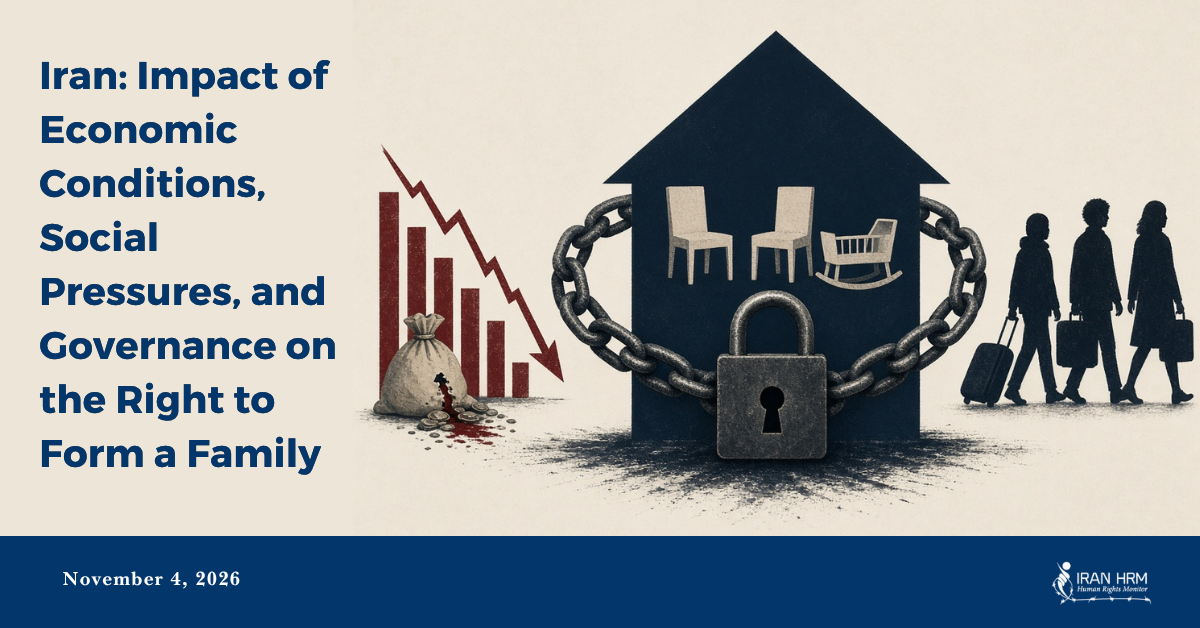
This report examines the impact of the economic, social, and governance policies of the Islamic Republic of Iran on the right to form a family—a fundamental right recognized under Article 16 of the Universal Declaration of Human Rights (UDHR), Article 23 of the International Covenant on Civil and Political Rights (ICCPR), and Article 10 of the International Covenant on Economic, Social and Cultural Rights (ICESCR). These instruments obligate states to create conditions enabling individuals to form families in practice and enjoy sustainable family life.

The findings of this report indicate that in Iran, a sharp decline in marriage rates, rising age at marriage, the housing crisis, widespread poverty, chronic inflation, job insecurity, youth unemployment, and the escalating migration of young and skilled human capital have severely restricted a significant portion of the population’s ability to form families.
An examination of existing evidence demonstrates that this situation is neither merely the result of demographic shifts nor individual choices; rather, it is shaped within the context of economic, social, and governance policies that have led to exacerbated poverty, diminished purchasing power, a housing access crisis, and widespread uncertainty about the future.
While officials of the Islamic Republic have continuously emphasized population growth, marriage, and childbirth in recent years, statistical evidence shows that many of the conditions necessary for the practical enjoyment of the right to form a family remain unfulfilled. The trends concerning marriage, fertility, and migration reflect a stark gap between the government’s declared objectives and existing economic and social realities, which stem directly from the policies of the ruling system in Iran.
Accordingly, this report concludes that the core concern is not merely a decline in marriage or fertility rates, but the gradual restriction of the effective enjoyment of the right to form a family as a result of a series of structural factors, a significant portion of which are directly linked to the policies and performance of state institutions. These conditions can lead to an increase in social harms, instability in family relations, and the erosion of social cohesion.
Introduction and Legal Framework
In international human rights law, the family is recognized as the “natural and fundamental group unit of society” and is entitled to the highest level of protection by society and the state. Article 16 of the Universal Declaration of Human Rights and Article 23 of the International Covenant on Civil and Political Rights (ICCPR) explicitly recognize the right of men and women of full age to marry and to found a family, obligating states to protect this right.
In this regard, the United Nations Human Rights Committee, in its General Comment No. 19, emphasizes that the protection of the family is not merely a negative obligation requiring state non-interference in private life; rather, it entails “positive obligations” on the part of the state. Under these obligations, states are mandated to adopt all necessary legislative, administrative, economic, and social measures to ensure that citizens have the real and practical opportunity to enjoy the right to form a family.
Furthermore, Article 10 of the International Covenant on Economic, Social and Cultural Rights (ICESCR) stipulates that the widest possible protection and assistance should be accorded to the family, particularly for its establishment and while it is responsible for the care and education of dependent children. The realization of this right, pursuant to Article 2 of the said Covenant, requires the state’s commitment to “maximum available resources” to guarantee welfare, adequate housing, sustainable employment, and economic security.
Accordingly, the assessment of the right to form a family in any country cannot be limited to the absence of explicit legal prohibitions. If a state’s economic policies, budgetary prioritizations, and governance patterns operate in a manner that renders the achievement of housing, employment, and minimum living standards impossible for a large segment of society, the state has effectively failed in its positive obligations and has caused the structural denial or restriction of the right to form a family. Relying on this legal framework, this report evaluates the status of the right to form a family in Iran.
Section I: Trends in Marriage and Family Formation in Iran
According to recent data published by the National Population Studies and Research Institute, the average age of marriage in Iran has reached approximately 28 years for men and 24 years for women. These figures indicate a continuation of the upward trend in the age of marriage compared to past decades.
Concurrently, the number of registered marriages has experienced a sharp decline. Available data shows that annual marriages have dropped from approximately 891,000 in 2010 to around 481,000 in recent years—a decrease of nearly 46 percent.
The rising age of marriage cannot be viewed merely as the result of cultural shifts or individual preferences. This trend must be analyzed alongside a constellation of structural factors, including the housing crisis, soaring rental costs, declining purchasing power, chronic inflation, job insecurity, and the difficulties young people face in achieving economic independence.
From a human rights perspective, the core issue is not simply the rising age of marriage; rather, it is the reality that a growing number of young people face serious barriers in attaining the minimum economic and social conditions necessary to form a family. Such a situation highlights a profound gap between the legal recognition of the right to form a family and the possibility of its practical enjoyment in daily life.
Section II: The Housing Crisis, Governance, and the Right to Form a Family
Access to adequate housing is a fundamental prerequisite for the formation and sustainability of a family. However, available evidence indicates that over the past two decades, access to housing for Iranian youth has become increasingly difficult, transforming housing from a basic need into one of the most significant barriers to family formation.
According to available data, housing costs account for approximately 43.7 percent of total urban household expenditures, and annual rental inflation reached around 36.5 percent in 2025.
This situation is neither the result of routine market fluctuations nor the natural interplay of supply and demand. Evidence shows that the housing crisis in Iran has been shaped within the context of economic and governance policies that have led to chronic inflation, the continuous depreciation of the national currency, the erosion of household purchasing power, and a reduction in citizens’ ability to access housing.
According to World Bank data, the inflation rate in Iran reached approximately 42.2 percent in 2025. Several consecutive years of high inflation have led to a persistent decline in household purchasing power and widened the gap between citizens’ incomes and the costs of securing housing.
Available data shows that the share of housing costs in urban household budgets has continuously increased over the past two decades. This share rose from approximately 29.2 percent in 2001 to over 38 percent in 2021, with housing costs for urban households surging by more than 5,700 percent during this period.
Furthermore, despite the implementation of various government housing programs and the allocation of public resources to this sector, reports continue to point to the persistence of the crisis, the decline of household purchasing power, and the inability of a vast portion of young people to enter the housing market. Consequently, a significant segment of the youth faces escalating economic barriers in acquiring independent housing and initiating a shared life.
From a human rights perspective, the state’s responsibility is not limited to the formal recognition of the right to marry. Pursuant to Article 23 of the International Covenant on Civil and Political Rights (ICCPR) and Article 10 of the International Covenant on Economic, Social and Cultural Rights (ICESCR), states are obligated to create conditions that enable individuals to form families in practice and enjoy sustainable family life.
Within this framework, when economic and governance policies lead to sustained high inflation, diminished purchasing power, a widening gap between income and housing costs, and restricted youth access to adequate shelter, the impacts are not merely economic. Such conditions directly impair citizens’ ability to marry, establish a family, and maintain a sustainable family life.
Accordingly, the housing crisis in Iran can be understood not merely as an economic challenge, but as one of the primary consequences of policymaking and governance that has restricted the practical enjoyment of the right to form a family for a large portion of citizens, particularly the youth.
Section III: Poverty, Economic Insecurity, and the Right to Form a Family
In addition to the housing crisis, existing evidence indicates that poverty, chronic inflation, and economic insecurity have become major practical obstacles to the formation and sustainability of families in Iran.
According to World Bank data, Iran’s inflation rate in 2025 stood at approximately 42.2 percent. Several consecutive years of high inflation have resulted in the continuous erosion of household purchasing power, a surge in living costs, and the undermining of young people’s economic capacity to initiate independent lives.
Simultaneously, the youth unemployment rate for those aged 15 to 24 was reported at approximately 21.9 percent in 2025. In other words, nearly one-fifth of economically active youth are unemployed—a situation that directly impacts their ability to marry, secure housing, and form a family.
Poverty has also become a persistent feature of Iran’s economy. Reports based on official and semi-official data indicate that roughly 30 to 31 percent of Iran’s population, equivalent to approximately 25 to 30 million people, live below the poverty line. Furthermore, some reports suggest that this situation has remained entrenched at a high level since 2019 without any significant reduction.
These conditions are not merely the result of episodic economic shifts. Numerous reports have linked the expansion of poverty to factors such as chronic inflation, non-inclusive economic growth, the structural dependence of the economy on oil revenues, the depreciation of the national currency, and the failure of economic policies to preserve household purchasing power. Published research also demonstrates that even in years when economic growth was registered, its effects failed to yield a perceptible reduction in poverty.
Consequently, millions of Iranian citizens find themselves in a position where securing basic life necessities has become a challenge in its own right. Under such circumstances, forming a family, covering marriage expenses, accessing independent housing, and planning for children become distant goals for many young people.
Pursuant to Article 23 of the International Covenant on Civil and Political Rights (ICCPR) and Article 10 of the International Covenant on Economic, Social and Cultural Rights (ICESCR), states are obligated to create conditions enabling citizens to exercise the right to form a family in practice. When widespread poverty, unemployment, and economic insecurity become an enduring reality for a large segment of society, this ceases to be merely an economic issue; it becomes a matter concerning the state’s fulfillment of its obligations to protect the family and guarantee the practical enjoyment of the right to form a family.
Accordingly, widespread poverty and economic uncertainty in Iran can be understood as core structural consequences of economic and governance policies that have restricted the effective enjoyment of the right to form a family for a vast portion of citizens.
Gender Dimensions and the Disproportionate Burden on Young Women and Girls
The structural and economic barriers to the right to form a family in Iran exert disproportionate and discriminatory impacts on young women and girls. Although economic crises, poverty, unemployment, and livelihood insecurity affect society as a whole, women face a dual layer of economic and legal deprivation that severely curtails their ability to lead independent lives and form families.
Labor market data indicates that women’s economic participation in Iran remains among the lowest in the world. In recent years, women’s economic participation rate has been estimated at roughly 14 to 15 percent—a figure that stands in stark contrast to the male economic participation rate, which hovers around 67 percent according to modeled ILO and World Bank data [World Bank, ILO Modelled Estimates]. Moreover, the unemployment rate among young and educated women has frequently been reported as significantly higher, with jobless rates for young female graduates and women aged 20–24 reaching approximately 30 to 35 percent, and a substantial portion of university-educated women encountering severe obstacles in securing sustainable employment [World Bank, Iran Statistical Center reports]. This situation undermines women’s economic independence and increases their financial dependency.
These conditions persist while the costs of housing, marriage, and family life steadily rise, forcing many young households to rely on dual incomes to meet basic living requirements. Consequently, the restriction of employment and income opportunities for women directly impacts not only their individual standing but also the possibility of forming and sustaining a family.
In addition to economic barriers, women in Iran face structural legal restrictions. For instance, under current laws, the right to divorce is not distributed equally between men and women, with men possessing broader powers to dissolve a marriage. Furthermore, in many matters concerning child custody, guardianship, and final decision-making, legal authority is vested in the father or paternal grandfather. Additionally, under the Civil Code, a husband may, under certain conditions, restrict his wife’s employment or prevent her from pursuing certain professional activities. This legal framework denies women a legal status equal to that of men within family relations.
Evidence concerning the migration of specialized personnel further reveals that educated women are increasingly represented among applicants for emigration. A study published in 2026 in the journal BMC Nursing demonstrated that 35.8 percent of surveyed nurses and nursing students exhibited a high inclination to emigrate, with economic and occupational factors playing a significant role in this decision.
From a human rights perspective, the combination of economic inequalities and legal discrimination subjects young women and girls to compounded barriers in enjoying the right to form a family. In such a context, the state’s responsibility extends beyond merely supporting the institution of the family; it encompasses eliminating structural discrimination, guaranteeing equal economic opportunities, and reforming the legal frameworks that prevent women and men from enjoying equal economic, social, and familial rights.
Within this framework, the persistence of economic and legal inequalities against women, coupled with broader economic and social crises, raises serious concerns regarding the Islamic Republic of Iran’s compliance with its obligations under Article 3 of the International Covenant on Civil and Political Rights (ICCPR) and Article 3 of the International Covenant on Economic, Social and Cultural Rights (ICESCR) concerning gender equality, and directly contributes to restricting women’s effective enjoyment of the right to form a family.
Government Budgetary Priorities and Their Impact on Household Welfare
The assessment of the right to form a family requires examining not only poverty and inflation, but also the state’s allocation of public resources. Pursuant to Article 2, paragraph 1 of the International Covenant on Economic, Social and Cultural Rights (ICESCR), states are obligated to use “maximum available resources” to achieve progressively the realization of economic, social, and cultural rights. Consequently, the prioritization of the public budget and resource distribution serve as key indicators in evaluating a state’s adherence to its human rights obligations.
At a time when approximately 30 to 31 percent of Iran’s population (equivalent to 25 to 30 million people) live below the poverty line, and when the housing crisis, youth unemployment (standing at 21.9 percent for ages 15 to 24), and chronic inflation (42.2 percent in 2025) have severely eroded the livelihood capacities of young households, official data and international bodies indicate the continuous and intensified channeling of massive public resources toward military and security sectors.
According to data from the Stockholm International Peace Research Institute (SIPRI), Iran’s military expenditures in 2025 were estimated at approximately $7.4 billion. Official Iranian budgetary analyses further show that in the national budget (including the 1404 / 2025–2026 fiscal year), appropriations for military and security institutions increased significantly, with a major share of public and oil revenues allocated to these entities. For instance, resource allocation reviews indicate that in 2025, the Islamic Revolutionary Guard Corps (IRGC) received a budget nearly 1.8 times greater than that of the regular Islamic Republic Army, illustrating the pivotal position of military and security institutions within the country’s power structure and budgeting framework.
In sharp contrast to this prioritization, welfare and social indicators point to severe resource deprivation. Notably, public expenditures on education in Iran stood at approximately 2.8 percent of Gross Domestic Product (GDP) in 2023, according to UNESCO data—a level far below regional and global standards for supporting human development.
From a human rights perspective, the core issue here is not a quantitative comparison of budgets, but the assessment of “the state’s structural and deliberate choices.” When a state facing widespread livelihood crises, structural poverty, and youth incapacity to form families directs the country’s maximum financial resources toward military and security institutions and mechanisms of repression, while allocating insufficient shares to welfare, employment, and housing infrastructure, it effectively violates the principle of “using maximum available resources for the realization of economic and social rights.”
This resource allocation pattern establishes the state’s direct responsibility in creating, perpetuating, and consolidating the structural barriers to the right to form a family, demonstrating that citizens’ inability to marry and enjoy a sustainable family life is the direct consequence of the government’s non-welfare and security-driven priorities.
Beyond undermining the right to form a family, the consequences of this state performance transcend the domestic sphere and render the entire social fabric vulnerable. The inability of youth to access basic livelihoods and the forfeiture of individual future-planning prospects lead to widespread despair, the deepening of the trust deficit between citizens and the government, rapid population aging, and the erosion of human capital. At a deeper level, this economic and social blockade triggers a dramatic surge in social harms driven by desperation and livelihood crises—including rising rates of delinquency and urban crime, the expansion of financial and structural corruption, the spread of anomalies, and psychological-moral collapse within society—ultimately resulting in the breakdown of support networks and the severe erosion of national cohesion.
Section IV: Youth Migration, Social Despair, and the Erosion of Family Formation Capacity
Available reports indicate that migration from Iran is no longer confined to academic elites, having instead transformed into a pervasive phenomenon among students, professionals, healthcare personnel, and skilled labor.
According to data published by the OECD, Iranian migration to developed countries surged by approximately 141 percent between 2020 and 2021, with the number of new migrants rising from roughly 48,000 to approximately 115,000. Researchers have described this trend as one of the fastest rates of migration growth to wealthy nations during that period.
Alongside general migration trends, developments between 2024 and 2026 within specialized groups present a deeply concerning picture. In the healthcare sector, Iranian Ministry of Health officials announced in 2026 that within a single span, 380 nurses had left the country, 800 had resigned, and 1,800 had abandoned their jobs. The same report identified the shortage of nursing personnel as one of the most critical challenges facing the health system.
Prior to this, representatives of nursing trade bodies had reported that approximately 3,000 nurses emigrated from Iran within a single year. These reports cited livelihood difficulties, income disparities, staff shortages, mandatory overtime, occupational burnout, and widespread dissatisfaction with working conditions as the primary drivers of migration. One report noted that the salary of a newly hired nurse does not even cover the cost of housing rent.
Recent academic research further confirms the persistence of this trend. A study published in 2026 in the journal BMC Nursing revealed that 35.8 percent of surveyed nurses and nursing students exhibited a high propensity to emigrate, with this inclination being more pronounced among younger and single individuals. Researchers attributed this situation primarily to domestic factors, including occupational and economic conditions.
The widespread migration of professionals and youth cannot be viewed merely as the result of individual decisions. Existing evidence shows that economic hardships, unemployment, declining purchasing power, limited professional opportunities, unfavorable working conditions, and uncertainty about the future are among the primary push factors driving migration.
Crucially, the escalating migration of Iranian citizens cannot be reduced solely to economic factors. Research and available reports demonstrate that alongside livelihood struggles, factors such as the restriction of civil and social rights, the absence of a clear vision for effective participation in public life, political repression, human rights violations, and diminished hope for change have also played a role in the decisions of many youth and professionals to leave the country. The Stanford Iran 2040 Project study cites poor governance, political repression, human rights violations, and an unfavorable economic outlook as key drivers of Iranian emigration.
Similarly, social analyses published in 2024 indicate that a significant portion of Iranian youth view migration not merely as a means to increase income, but as a pathway to attain broader personal, professional, and social opportunities while escaping domestic restrictions. Researchers have characterized this state of affairs as a symptom of declining hope for improvement and a growing sense of deadlock among a segment of Iran’s younger generation.
From the standpoint of the right to form a family, the significance of this trend extends beyond migration numbers. A substantial proportion of emigrants are within the core ages of marriage, family formation, and childbearing. When youth and professionals are compelled to leave the country to achieve economic security, professional advancement, or even minimum living standards, migration becomes an indicator of the failure of economic and social policies to provide the conditions necessary for sustainable family life.
Within this framework, the escalating migration of youth and skilled personnel can be understood not merely as a demographic issue, but as a consequence of economic and social conditions stemming from governance policies and patterns that directly impair the practical enjoyment of the right to form a family in Iran.
Legal Assessment
The central question of this report is not why marriage rates or fertility levels in Iran have declined. The primary question is whether the policies and decisions of the Iranian government have created the necessary conditions for the practical enjoyment of the right to form a family or, on the contrary, have led to the erosion of this right.
Pursuant to Article 23 of the International Covenant on Civil and Political Rights (ICCPR) and Article 10 of the International Covenant on Economic, Social and Cultural Rights (ICESCR), states are not merely obligated to grant legal recognition to marriage; they are duty-bound to ensure the economic and social conditions required to establish and support a family. This obligation entails adopting policies that guarantee citizens’ access to housing, employment, economic security, and the prerequisites for sustainable family life.
The evidence examined in this report demonstrates that a significant segment of Iranian youth lives under conditions that severely curtail the practical enjoyment of the right to form a family. The housing crisis, chronic inflation, expanding poverty, diminishing purchasing power, job insecurity, and the accelerating migration of youth and professionals are not isolated phenomena; rather, they are interrelated consequences of a specific pattern of governance and policymaking developed over recent years.
During years when millions of citizens faced livelihood crises, severe housing access barriers, and a continuous drop in purchasing power, the Iranian government continued to allocate—and increase—a substantial share of public resources to military and security institutions. Conversely, indicators related to poverty, housing, and youth employment demonstrate no proportional improvement. This pattern of resource allocation raises the legitimate question of whether the state has utilized the “maximum available resources” at its disposal to fulfill the economic and social rights of its citizens and to protect the family.
Furthermore, evidence regarding the widespread migration of youth, university students, nurses, and other specialized personnel shows that a considerable number of citizens in their prime ages for marriage and family formation seek economic security, professional advancement, and social stability abroad. This reality is not merely a matter of individual choice; it reflects a sharp decline in trust regarding domestic capacity to guarantee the conditions necessary for building a sustainable future.
Consequently, state responsibility cannot be reduced to managing macro-economic indices alone. When economic, social, and budgetary policies operate in a manner that restricts access to adequate housing, sustainable employment, and livelihood security for a broad cross-section of youth, the impacts directly invade the realm of the right to form a family. Under such circumstances, the impairment of the ability to marry and found a family cannot be attributed solely to personal choices or natural economic developments; it must be assessed as a foreseeable outcome of governance policies and priorities.
Accordingly, this report concludes that the core issue in Iran is not the lack of legal recognition of the right to form a family, but the existence of structural conditions—largely created or exacerbated by state policies, budgetary priorities, and governance patterns—that in practice impede millions of citizens from effectively enjoying this fundamental right. This situation raises grave questions regarding the state’s compliance with its obligations under Article 23 of the ICCPR and Article 10 of the ICESCR.
Conclusion
This report demonstrates that the main issue in Iran is not the absence of legal recognition of the right to form a family, but the pivotal role of state policies and priorities in restricting the practical realization of this right.
The evidence examined indicates that many of the obstacles confronting young people in marrying, founding a family, and maintaining a sustainable family life are the direct or indirect consequences of the economic, social, and budgetary policies of the Islamic Republic of Iran. The housing crisis, pervasive poverty, eroding purchasing power, occupational insecurity, and the rising tide of youth and professional migration do not exist in isolation; they are rooted in a framework of deliberate governance choices and priorities.
While authorities of the Islamic Republic continuously emphasize population growth, marriage, and procreation, empirical evidence reveals that the government has failed or disinclined to provide the essential conditions for youth access to housing, stable employment, livelihood security, and a predictable future outlook—all of which are fundamental prerequisites for family formation.
On this basis, the diminished capacity of youth to form families cannot be attributed solely to individual choices or broader economic shifts. This status quo must be evaluated in light of the responsibility of the Islamic Republic of Iran in generating, perpetuating, or intensifying conditions that restrict the effective enjoyment of the right to form a family for millions of citizens. From this perspective, the issue at hand is not merely a demographic challenge, but a matter directly bound to the execution of Iran’s human rights obligations under Article 23 of the ICCPR and Article 10 of the ICESCR.
Demands Directed at United Nations Mechanisms
In light of the evidence presented in this report regarding the structural and direct role of the policies of the Islamic Republic of Iran in depriving and practically restricting the “right to form a family,” international human rights mechanisms of the United Nations are requested to include the following actions in their agendas:
- The Special Rapporteur on the situation of human rights in the Islamic Republic of Iran is requested to:
- Dedicate a specific section in future periodic reports to the Human Rights Council and the UN General Assembly evaluating the “impact of economic policies, budgetary priorities, and governance patterns on the right to form a family”;
- Formally establish and document this situation as an instance of violation of positive state obligations under Article 23 of the International Covenant on Civil and Political Rights (ICCPR) and Article 10 of the International Covenant on Economic, Social and Cultural Rights (ICESCR).
- The Committee on Economic, Social and Cultural Rights (CESCR) is requested to:
- In line with its mandate to monitor Covenant compliance, request the Government of Iran to explain how massive resource allocations to military and security entities—amid 30 percent poverty rates and a housing crisis—comply with the principle of “maximum available resources” under Article 2 of the Covenant;
- Issue binding recommendations in upcoming periodic reviews calling for the “dismantling of structural barriers to family formation and the reallocation of public budgetary resources toward public welfare.”
- The Special Rapporteur on extreme poverty and human rights is requested to:
- Conduct thematic research and field evaluations on the direct link between structural poverty, chronic inflation, and livelihood insecurity with the erosion of the family unit and the deprivation of youth’s capacity to marry and build independent lives in Iran.
- The Special Rapporteur on adequate housing as a component of the right to an adequate standard of living is requested to:
- Assess the dimensions of the housing crisis in Iran (including severe rental inflation and the high proportion of housing expenses in household budgets) not merely as a market challenge, but as a direct structural barrier to the right to form a family and establish state responsibility in perpetuating this crisis.
- The Special Rapporteur on discrimination against women and girls is requested to:
- Examine and highlight the disproportionate and discriminatory impacts of economic crises and existing legal frameworks (including low female labor force participation rates, legal employment barriers, and inequalities in family law) on depriving young Iranian women and girls of financial independence and restricting their right to form families.
- The Special Rapporteur in the field of cultural rights and other relevant procedures are requested to:
- Address the impact of social blockades, suppression of fundamental freedoms, and pervasive despair on the “widespread and involuntary migration of youth and professionals” and its irreversible consequences regarding demographic collapse and the deferral or denial of the right to form a family.
- The United Nations Human Rights Council and all Special Procedures are requested to:
- Demand transparent, verifiable, regular, and uncensored data disclosures from the Government of the Islamic Republic of Iran regarding poverty, housing, youth unemployment, professional brain drain, and military expenditures, while urging structural reforms of economic and welfare policies in alignment with international human rights commitments.
Appendix:
| Index Category | Key Statistics & Data (2025–2026) | Relevant Legal Instruments & Articles | State Obligations & Legal Duties |
| Macroeconomic Indicators & Poverty | • Annual Inflation: 42.2% (2025)
• Population Below Poverty Line: 30%–31% (approx. 25–30 million people) |
• Article 10 of the ICESCR
• Article 11 of the ICESCR (Right to an adequate standard of living) |
The state is obligated to guarantee livelihood security and economic support for the family unit during and after its establishment. |
| Housing Crisis & Shelter | • Share of Housing in Urban Household Budget: 43.7% (up from 29.2% in 2001)
• Annual Rental Inflation: 36.5% (2025)
• Growth in Urban Housing Costs: Over 5,700% (over two decades) |
• Article 10 of the ICESCR
• Article 11(1) of the ICESCR (Right to adequate housing)
• CESCR General Comment No. 4 |
Adopting necessary measures and economic policies to facilitate citizens’ access to independent and adequate housing as a prerequisite for family formation. |
| Youth Employment & Human Capital | • Youth Unemployment Rate (Ages 15–24): 21.9% (2025)
• Annual Decline in Marriages: -46% (dropped from 891,000 to 481,000 cases) |
• Article 6 of the ICESCR (Right to work)
• Article 23 of the ICCPR |
Providing sustainable employment and economic independence to enable the practical enjoyment of the right to marry. |
| Inequality & Gender Dimensions | • Women’s Economic Participation Rate: 14%–15% (among the lowest globally)
• Healthcare Emigration Propensity: 35.8% of nurses/nursing students (BMC Nursing 2026) |
• Article 3 of the ICCPR
• Article 3 of the ICESCR (Ensuring gender equality)
• Article 23 of the ICCPR |
Eliminating structural and legal discrimination, guaranteeing equal employment opportunities, and ensuring equality within family law for women. |
| Budgetary & Military Allocations | • Annual Military Expenditure: $7.4 Billion (SIPRI 2025)
• IRGC-to-Army Budget Ratio: 1.8x in the 1404/2025–2026 budget
• Share of Education in GDP: 2.8% (UNESCO 2023) |
• Article 2(1) of the ICESCR
• Human Rights Committee General Comment No. 19 (Positive Obligations) |
The state’s duty to allocate “maximum available resources” toward public welfare rather than military and repressive expenditures. |
| Brain Drain & Elite Migration | • Growth of Migration to OECD Countries: +141% (2020–2021)
• Nurse Departures, Resignations & Job Abandonments: 2,980 personnel in one year (2026) |
• Article 12 of the ICCPR (Freedom of movement)
• Article 23 of the ICCPR |
Creating a sustainable outlook, social stability, and job security to prevent the involuntary deprivation of the right to form a family at home. |