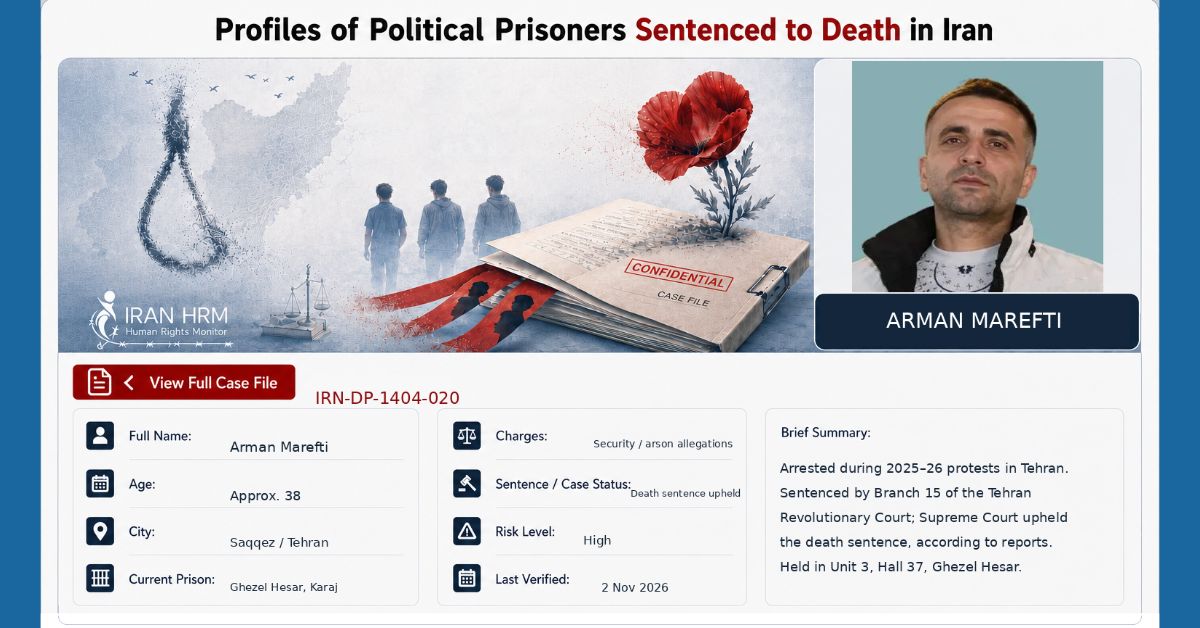
Case No. 20 | Case ID: IRN-DP-1404-020 | Last reviewed: 12 November 2026

| Arman Marefati, approximately 38, from Saqqez and resident in Tehran, was arrested in Tehran during the nationwide protests of 2025–2026. Branch 15 of the Tehran Revolutionary Court sentenced him to death on charges attributed to the authorities relating to national security and damage to religious premises. According to a report dated 2 November 2026, the Supreme Court upheld the sentence. He is held in Qezel Hesar Prison in Karaj. The reported execution of two co-defendants makes clarification of his position urgent. |
Key Case Information
| Category | Information |
| Full name | Arman Marefati |
| Date of birth | Exact date unknown |
| Age | Approximately 38 |
| Occupation before arrest | Unknown |
| Family status | Unknown |
| Date and place of arrest | During the nationwide protests of 2025–2026, Tehran; exact date unknown |
| Charges | Attributed national-security offences, damage to and arson of religious premises |
| Court | Branch 15, Tehran Revolutionary Court |
| Judge | Abolghasem Salavati |
| Lawyer | Name and access status unknown |
| Sentence | Death sentence; reportedly upheld by the Supreme Court on 2 November 2026 |
| Current place of detention | Qezel Hesar Prison, Karaj, Unit 3, Hall 37 |
Human and Personal Background
Arman Marefati is from Saqqez in Kurdistan Province and lived in Tehran before his arrest. The available report gives his age as approximately 38. No documented information is provided about his occupation, education or family circumstances.
Arrest, Trial and Sentencing
Arman Marefati was arrested in Tehran during the nationwide protests of 2025–2026. After a period of detention in Greater Tehran Prison, he was transferred to Qezel Hesar Prison in Karaj. The precise date of arrest, interrogation conditions and his access to legal counsel are not specified in the available information.
His case was heard by Branch 15 of the Tehran Revolutionary Court, presided over by Judge Abolghasem Salavati. According to the published report, the prosecution initially alleged “assembly and collusion to commit an offence against national security through participation in protests”. During the proceedings, however, the court invoked Article 280 of the Code of Criminal Procedure and changed the legal characterisation of the charges. The subsequent allegations concerned participation in operations against national security, entering religious premises with intent to cause damage, involvement in setting fire to a mosque and a religious seminary, and causing property damage. These are allegations attributed to the judicial authorities, not independently established facts.
Marefti was tried in the same case as Mehrdad Mohammadinia and Ashkan Maleki. According to the information provided, the death sentences of both co-defendants have already been carried out; the dates and circumstances of those executions are not specified. Marefti was sentenced to death by Branch 15 and, according to a report dated 2 November 2026, the Supreme Court upheld his sentence.
Government Response and Conduct
The judicial actions reported in this case comprise the imposition of a death sentence, a change in the legal characterisation of the charges during trial, and confirmation of the sentence by the Supreme Court. The available information does not include the judgment, judicial reasoning, details of the Supreme Court review or an official explanation of how defence rights were safeguarded. It is also unknown whether an application for a stay of execution or a retrial has been made.
Current Status and Risk of Execution
According to the latest information supplied, Marefti is held in Unit 3, Hall 37 of Qezel-Hesar Prison in Karaj. The Supreme Court’s confirmation heightens concern that the case could proceed towards execution, although no execution date has been reported. Details of his family contact, visits, health and current access to counsel remain unknown.
Human Rights and Fair Trial Analysis
Right to life: Article 6 of the International Covenant on Civil and Political Rights restricts the death penalty, in countries that retain it, to the “most serious crimes”. Intentional killing is not mentioned among the published allegations against Marefti. In light of the United Nations Human Rights Committee’s interpretation of that threshold, the compatibility of the death sentence with Article 6 raises serious concerns.
Right to a fair trial: A change in the legal characterisation of charges does not, by itself, establish a violation of fair-trial rights. It is nevertheless essential to determine whether the revised allegations were communicated clearly and in sufficient time, and whether Marefti had adequate time and facilities to prepare his defence and effective access to a lawyer. Article 14 of the Covenant guarantees these safeguards.
Judicial transparency: The absence of information about the judgment, evidence and review process limits independent assessment of compliance with these guarantees. The material provided contains no specific evidence of torture or a coerced confession, and neither can therefore be inferred.
Conclusion
With Marefti’s death sentence reportedly upheld and two co-defendants already executed, immediate clarification of his judicial status, protection of his defence rights and prevention of any execution are essential. The available information does not indicate a scheduled execution date.
Urgent Appeal
United Nations bodies, governments and international human rights organisations are urged to act to protect Arman Marefati’s right to life and prevent his execution.
- Immediately halt any step towards execution and formally disclose his judicial status.
- Quash the death sentence and clarify the status of any judicial review or possible retrial.
- Guarantee immediate and confidential access to counsel of choice and adequate facilities for the defence.
- Publish the judgment, evidence and legal grounds for the sentence if they are not publicly available.
- Independently examine whether defence rights were respected and how the charges were recharacterised during trial.
- Ensure any further trial takes place before an independent and impartial tribunal without recourse to the death penalty.
- Guarantee regular contact and visits with family and access to necessary medical care.