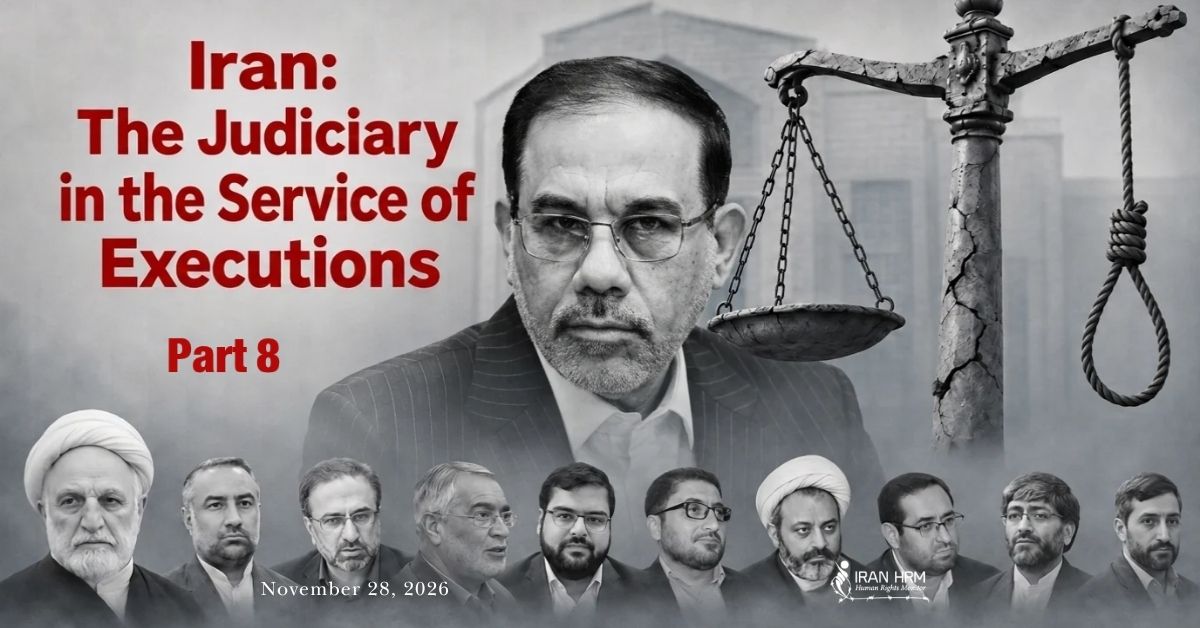
Iran: A Judiciary in the Service of Executions – Part VIII
Asghar Jahangir, also identified in some documents as Ali-Asghar Jahangir, is a long-serving official of the Islamic Republic’s judiciary. On 23 April 2014, he was appointed head of the State Prisons and Security and Corrective Measures Organization, a position he held until June 2020. He subsequently served as Deputy for Social Affairs and Crime Prevention and as spokesperson for the judiciary. On 19 August 2026, he was appointed head of the General Inspection Organization.

Jahangir’s tenure as head of the Prisons Organization coincided with the widespread execution of political prisoners, prisoners of conscience, and individuals convicted of ordinary criminal offenses. Executions of individuals who were under 18 at the time of their alleged offenses, executions following unfair trials, reports of torture to extract confessions, denial of medical care, and failures to protect prisoners’ safety are among the issues requiring examination in his administrative record.
Jahangir’s subsequent positions as judiciary spokesperson, including his public defense of finger amputations, threats to charge protesters with moharebeh (enmity against God), and warnings about capital punishment in security-related cases, reveal further aspects of his role in the judiciary’s punitive and repressive policies.
Asghar Jahangir’s Position within the Judiciary and the Prisons Organization
Jahangir has served at various levels of the judiciary for three decades. His previous positions include head of the Judiciary’s Protection and Intelligence Center, head of the Special Inspection Office, adviser to the Chief Justice, acting head of the Government Employees’ Prosecutor’s Office, Supreme Court judge, and head of the Prisons Organization.
On 9 April 2024, while retaining his position as Deputy for Social Affairs and Crime Prevention, he was appointed judiciary spokesperson. In August 2026, he assumed leadership of the General Inspection Organization. The exact date on which his tenure as spokesperson officially ended has not been established in the available records.
The Prisons Organization is responsible for prison administration, prisoners’ health and safety, classification, visitation, transfers, and preparations for implementing final judicial sentences. Although issuing death sentences falls within the jurisdiction of judges and courts, their implementation and the detention conditions of condemned prisoners fall within the organization’s institutional responsibilities.
The following figures represent recorded executions in Iran during the calendar years overlapping with Jahangir’s tenure as head of the Prisons Organization:
| Year | Recorded executions |
| 2014 | 743 |
| 2015 | 977 |
| 2016 | 567 |
| 2017 | 507 |
| 2018 | 253 |
| 2019 | 251 |
| 2020 | 246 |
During the five full calendar years of Jahangir’s tenure, 2015–2019, a total of 2,555 executions were recorded in Iran. As he held office for only part of 2014 and 2020, the precise number of executions during his tenure remains undetermined.
The available documents do not establish that Jahangir personally issued the death sentences or signed orders authorizing the executions discussed in this report. These cases are therefore examined in relation to his managerial responsibility as head of the Prisons Organization, rather than attributing the issuance of the sentences directly to him.
Execution Cases During Jahangir’s Tenure
Gholamreza Khosravi Savarjani
Gholamreza Khosravi Savarjani, a political prisoner, was executed at Raja’i Shahr Prison on 1 June 2014, approximately five weeks after Jahangir assumed leadership of the Prisons Organization. His case raised concerns regarding violations of the right to defense and the absence of a fair trial.
Mass Execution of 25 Sunni Prisoners
On 2 August 2016, 25 male Sunni prisoners were executed on security-related charges. Serious concerns had been raised regarding the fairness of their trials. This was one of the most prominent cases of mass executions involving members of religious minorities during Jahangir’s tenure as head of the Prisons Organization.
Alireza Tajiki
Alireza Tajiki was only 15 years old when arrested. He was executed on 10 August 2017. He had stated that his confessions were extracted under torture.
Beyond concerns regarding the reliability of his confessions and the judicial proceedings, Tajiki’s execution violated the international prohibition on executing individuals who were under 18 at the time of their alleged offenses.
Mohammad Salas
Mohammad Salas, a member of the Gonabadi Dervish community, was executed on 18 June 2018 in a case involving charges of killing police officers. His case was accompanied by reports of forced confessions and serious concerns regarding judicial proceedings.
His execution represents a prominent case of judicial action against members of religious groups during Jahangir’s tenure as head of the Prisons Organization.
Ramin Hossein Panahi, Zanyar Moradi, and Loghman Moradi
Ramin Hossein Panahi, Zanyar Moradi, and Loghman Moradi were executed at Raja’i Shahr Prison on 8 September 2018.
Their cases involved reports of denial of effective access to legal counsel and allegations of torture to extract confessions. Their simultaneous executions, despite serious concerns regarding compliance with fair trial guarantees, warrant examination as part of the Prisons Organization’s administrative record under Jahangir.
Zeinab Sekaanvand
Zeinab Sekaanvand was executed on 2 October 2018. She was under 18 when the alleged offense, identified as murder, occurred. The reliability of her confessions and the fairness of her trial were also disputed.
Like Alireza Tajiki’s execution, Sekaanvand’s execution contravened Iran’s international obligations prohibiting capital punishment for offenses committed before the age of 18.
Prisoners’ Health, Safety, and Detention Conditions
The Prisons Organization’s responsibilities extend beyond holding convicted prisoners and implementing judicial sentences. Protecting prisoners’ health and lives, ensuring access to medical care, and maintaining appropriate prisoner classification are also among its fundamental duties. The cases of Arash Sadeghi and Alireza Shirmohammadali highlight this aspect of Jahangir’s managerial responsibility.
Arash Sadeghi: Denial of Cancer Treatment
Arash Sadeghi, a political prisoner suffering from bone cancer, experienced delays in accessing specialist treatment and was denied essential medical care in 2018 and 2019.
He was returned to prison only three days after surgery, contrary to medical advice. These actions endangered his health and life.
Although no documented evidence establishes that Jahangir personally decided to deny Sadeghi medical treatment, these incidents directly concern the Prisons Organization’s responsibility to protect prisoners’ health and provide medical care.
Alireza Shirmohammadali: Killed in Greater Tehran Prison
Alireza Shirmohammadali, a 21-year-old political prisoner, was killed by two inmates convicted of violent offenses at Greater Tehran Prison in June 2019.
His case raised concerns about the failure to implement prisoner separation requirements and the dangers of holding political prisoners alongside individuals convicted of violent crimes.
Following the incident, Jahangir stated that the attack had occurred within a short period and that prison officers subsequently transferred Shirmohammadali to the prison infirmary. His explanation addressed only the response following the attack, leaving unanswered questions concerning prisoner classification and preventive measures to protect Shirmohammadali’s life.
Jahangir’s personal involvement in determining the prisoner’s placement has not been established. Nevertheless, prisoner safety and classification fell within the responsibilities of the organization under his leadership.
Jahangir’s Public Positions on Punishment and Repression
Unlike the preceding cases, in which Jahangir’s responsibility is primarily examined at the managerial level, his statements as judiciary spokesperson are directly attributable to him.
Public Defense of Finger Amputations
On 29 October 2024, sentences ordering the amputation of fingers were carried out against Shahab Teimouri and Mehrdad Teimouri at Urmia Prison.
On 5 November 2024, Jahangir defended the punishment in his capacity as judiciary spokesperson, describing it as “entirely within the framework of divine ordinances.” He further emphasized:
“Divinely prescribed punishments cannot be suspended.”
These statements constitute a senior judicial official’s public defense of a punishment classified as cruel and inhuman under international human rights standards.
Threatening Protesters with Moharebeh Charges
On 18 January 2026, addressing the nationwide protests, Jahangir declared that certain actions could constitute moharebeh and incur “the most severe Islamic punishments.”
Under the Islamic Republic’s criminal law, moharebeh can carry the death penalty. Invoking such charges amid nationwide protests and widespread arrests heightens concerns about the use of capital punishment to intimidate protesters.
Threats of Execution, Asset Seizure, and Prosecution of Media Activities
On 31 March 2026, discussing legislation introducing harsher penalties for espionage and cooperation with hostile states, Jahangir stated that certain forms of operational or intelligence cooperation could result in capital punishment and asset seizure.
He also warned against media activities, photography, and dissemination of information where the judiciary considered such actions to constitute collaboration with the enemy.
In June–July 2026, he further stated that voices undermining the three branches of government or the armed forces could be regarded as serving the enemy’s objectives.
Jahangir also announced the arrest of 3,292 individuals and the issuance of 1,061 indictments in security-related cases. Among those reported, 1,258 individuals were associated with activities described as “political, propaganda-related, and media-related.”
These are figures announced by the judiciary and do not establish the validity of the charges or the fairness of the proceedings. The broad scope of the security-related categories employed heightens concerns about the criminalization of political activities, media work, and expressions of dissent.
Table of Key Cases
| Defendant or convicted person | Execution date or status | Place of detention | Charges recorded in the case | Relevant evidence and concerns | Individual responsibility | Institutional responsibility |
| Gholamreza Khosravi Savarjani | 1 June 2014 | Raja’i Shahr Prison | Political/security-related charges | Concerns regarding the right to defense and judicial proceedings | Not established | Documented at the managerial level of the Prisons Organization |
| 25 Sunni prisoners | 2 August 2016 | Location not conclusively established for all individuals in the available case file | Security-related charges | Serious concerns regarding trial fairness | Not established | Documented at the managerial level of the Prisons Organization |
| Alireza Tajiki | 10 August 2017 | Execution site not fully specified in the case file | Criminal case | Aged 15 at arrest; allegations of torture to extract confessions | Not established | Documented |
| Mohammad Salas | 18 June 2018 | Execution documented; location details require verification against original records | Killing police officers | Reports of forced confessions and concerns regarding judicial proceedings | Not established | Documented |
| Ramin Hossein Panahi | 8 September 2018 | Raja’i Shahr Prison | Political/security-related charges | Allegations of torture and restricted access to legal counsel | Not established | Documented |
| Zanyar Moradi | 8 September 2018 | Raja’i Shahr Prison | Political/security-related charges | Allegations of torture and restricted access to legal counsel | Not established | Documented |
| Loghman Moradi | 8 September 2018 | Raja’i Shahr Prison | Political/security-related charges | Allegations of torture and restricted access to legal counsel | Not established | Documented |
| Zeinab Sekaanvand | 2 October 2018 | Exact location requires verification against original records | Murder | Under 18 at the time of the alleged offense; disputed confessions | Not established | Documented |
| Arash Sadeghi | Alive; denial of medical care in 2018 and 2019 | Prison administered by the Prisons Organization | Political prisoner | Delayed cancer treatment and premature return to prison following surgery | Not established | Documented |
| Alireza Shirmohammadali | Killed in June 2019 | Greater Tehran Prison | Political prisoner | Killed by two inmates convicted of violent offenses; concerns regarding prisoner separation | Not established | Documented |
Legal Assessment and Accountability
Article 6 of the International Covenant on Civil and Political Rights (ICCPR) and Article 37 of the Convention on the Rights of the Child (CRC) prohibit executions for offenses committed before the age of 18. Iran is a party to both treaties. The executions of Alireza Tajiki and Zeinab Sekaanvand contravened these obligations.
Article 10 of the ICCPR requires humane treatment of persons deprived of their liberty. The Nelson Mandela Rules also establish access to medical care, safety, adequate detention conditions, and prisoner separation as requirements of prison administration. The cases of Arash Sadeghi and Alireza Shirmohammadali must be examined against these standards.
Article 7 of the ICCPR prohibits torture and cruel, inhuman, or degrading punishment. Jahangir’s public defense of amputation conflicts with the principles established under this article. Judicial threats against protesters and media activities must also be examined in relation to Articles 19 and 21 of the Covenant, which protect freedom of expression and peaceful assembly.
Jahangir’s appointment as head of the General Inspection Organization on 19 August 2026, following years of service within the judiciary and prison administration, raises questions of accountability.
The available documents do not establish the outcome of any independent investigation or specific public proceedings concerning his personal responsibility in the cases examined. This does not necessarily establish that no internal proceedings occurred, but it limits public scrutiny of his conduct and accountability.
Executions as a Tool of Repression and Protest Suppression
Asghar Jahangir’s record illustrates the connection between prison administration, the implementation of capital punishment, and judicial repression in Iran.
His positions on moharebeh, capital punishment, asset seizure, and the prosecution of political and media activities demonstrate how judiciary employs criminal legislation and severe punishments to intensify the climate of securitization within society.
Publicly announcing such punishments during popular protests goes beyond communicating information about judicial proceedings. It serves an intimidating function that can deter citizens from participating in protests, expressing dissent, disseminating information, and demanding their fundamental rights.
Conclusion
Examining Asghar Jahangir’s record within the broader conduct of the Islamic Republic’s judiciary demonstrates that the expansion of executions and the intensification of repressive punishments cannot be viewed merely as a series of isolated judicial decisions. The persistence of these practices, particularly during political crises and popular protests, illustrates the government’s use of capital punishment as an instrument to instill public fear, contain social discontent, and prevent protests from spreading.
Within this structure, responsibility for human rights violations is not confined to judges who issue death sentences. Prison administrators and senior judicial officials involved in implementing sentences, overseeing detention conditions, and publicly justifying inhuman punishments must also be scrutinized in accordance with their authority and actions.
Jahangir’s continued presence at the highest levels of the judiciary, despite documented human rights violations during his administrative tenure and his public defense of inhuman punishments, underscores the need to examine accountability mechanisms within the judicial system.
An independent examination of the conduct and responsibilities of senior judicial officials, including Asghar Jahangir, must form part of international efforts to combat impunity, halt executions, and hold those responsible for human rights violations in Iran accountable.