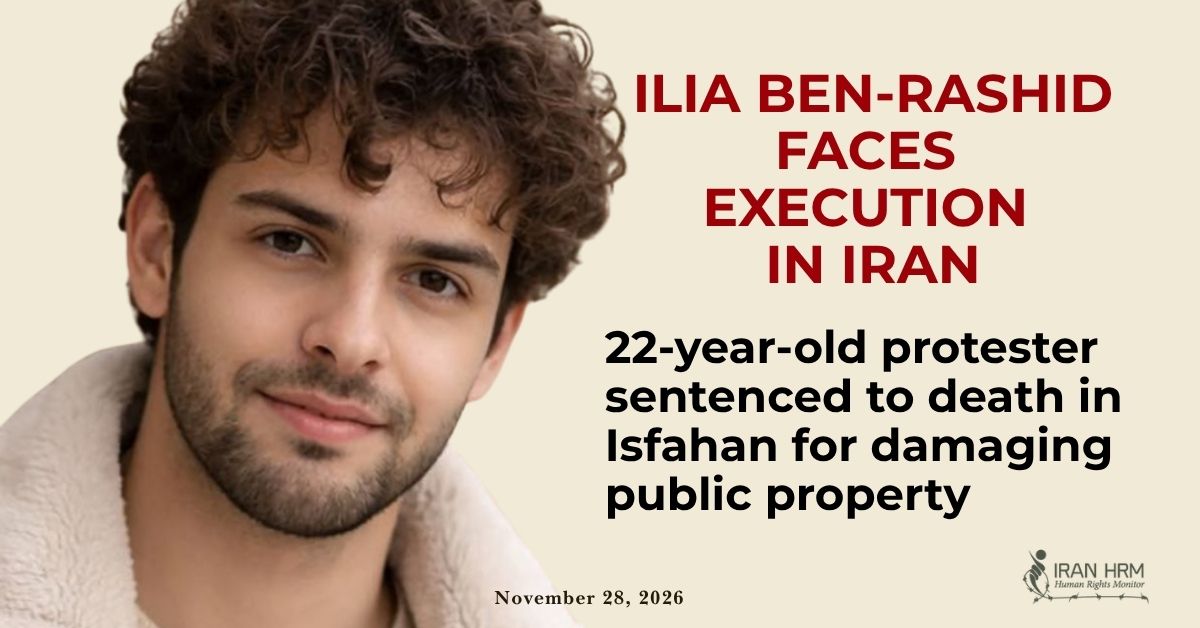
A young man who has lost both parents and has been denied access to a lawyer of his own choosing now faces a death sentence in Dastgerd Prison, Isfahan.

Ilya Ben-Rashid, a 22-year-old native of Ahvaz and resident of Shahin Shahr, Isfahan Province, was arrested in connection with the nationwide protests of January 2026. Branch 5 of the Isfahan Revolutionary Court sentenced him to death on the charge of moharebeh (enmity against God) through participation in the destruction of public property. He was notified of the sentence on 20 October 2026 at Dastgerd Prison in Isfahan.
Ilya has lost both parents and lived with his elderly grandparents before his arrest. He also has a younger sister. His grandparents’ advanced age and physical limitations have severely hindered their ability to pursue his case. He now faces a death sentence following judicial proceedings during which, according to available information, he was denied access to a lawyer of his own choosing.
Arrest, Solitary Confinement and Deprivation of Basic Rights
According to reports received, during the initial days of his detention, he was held in solitary confinement, subjected to severe physical and psychological pressure, and deprived of food and water.
On 21 February 2026, Ilya was formally charged at Branch 2 of the Public and Revolutionary Prosecutor’s Office in Shahin Shahr. His trial before Branch 5 of the Isfahan Revolutionary Court took place via videoconference in early April 2026.
According to available information, Ilya presented his own defence during the hearing while being denied access to a lawyer of his own choosing. The details of his defence, the evidence presented against him and the manner in which the court assessed that evidence remain unclear.
Two Courts: Imprisonment, Flogging and a Death Sentence
In May 2026, Branch 102 of Criminal Court Two of Shahin Shahr and Meymeh sentenced Ilya Ben-Rashid to six months’ imprisonment and 20 lashes on the charge of stealing a desktop computer unit belonging to the Shahin Shahr Health and Treatment Network.
The same court acquitted him of the charge of “disrupting public order and tranquility through participation in protests”. Nevertheless, proceedings concerning national security-related charges against him continued before the Revolutionary Court.
In separate proceedings, Branch 5 of the Isfahan Revolutionary Court imposed the following sentences:
- Death on the charge of moharebeh through participation in the destruction of public property;
- Three years, six months and one day of imprisonment on the charge of “assembly and collusion to commit offences against national security”;
- Nine months and one day of imprisonment on the charge of “propaganda against the system”;
- A two-year prohibition on leaving the country as a supplementary punishment.
The combined prison sentences imposed by the Revolutionary Court amount to four years, three months and two days.
Ilya Ben-Rashid’s death sentence was issued by a court of first instance. No confirmed information is currently available regarding its possible affirmation by the Supreme Court.
A Death Sentence Based on Alleged Damage to Public Property
One of the most serious legal concerns in Ilya Ben-Rashid’s case is the basis upon which the death sentence for moharebeh was imposed.
Under Article 279 of Iran’s Islamic Penal Code, the offence of moharebeh requires the drawing of a weapon under specific statutory conditions. However, the available information concerning Ilya’s case does not establish what evidence, if any, demonstrates that these legal requirements were met.
As a State party to the International Covenant on Civil and Political Rights (ICCPR), Iran is legally bound to comply with the restrictions on the use of capital punishment prescribed under Article 6 of the Covenant.
In paragraph 35 of its General Comment No. 36, the United Nations Human Rights Committee specifies that the death penalty must be restricted to crimes of extreme gravity involving intentional killing. Accordingly, the destruction of public property, even if proven, cannot in itself constitute a lawful basis for imposing the death penalty under international human rights law.
Furthermore, Ilya’s reported denial of access to legal counsel of his own choosing raises serious concerns regarding the fairness of the judicial proceedings. Article 14 of the ICCPR guarantees the right to a fair trial and effective legal defence.
Reports of deprivation of food and water, severe physical and psychological pressure during detention, and the sentence of 20 lashes also warrant serious examination under Article 7 of the Covenant, which prohibits torture and cruel, inhuman or degrading treatment or punishment.
Urgent International Action to Protect Ilya Ben-Rashid’s Life
The case of Ilya Ben-Rashid raises serious concerns regarding the use of capital punishment against individuals arrested in connection with protests and the protection of their fundamental rights throughout judicial proceedings.
The United Nations Special Rapporteur on the situation of human rights in the Islamic Republic of Iran, the Special Rapporteur on extrajudicial, summary or arbitrary executions, and other international human rights bodies are urged to take immediate action to prevent the execution of Ilya Ben-Rashid, seek the annulment of his death sentence, ensure his access to independent legal counsel, and call for an investigation into reports of ill-treatment during his detention.
At the age of 22, Ilya Ben-Rashid faces the deprivation of his right to life — a right that the Iranian authorities are legally obliged to protect and whose safeguarding remains a fundamental responsibility of international human rights mechanisms.