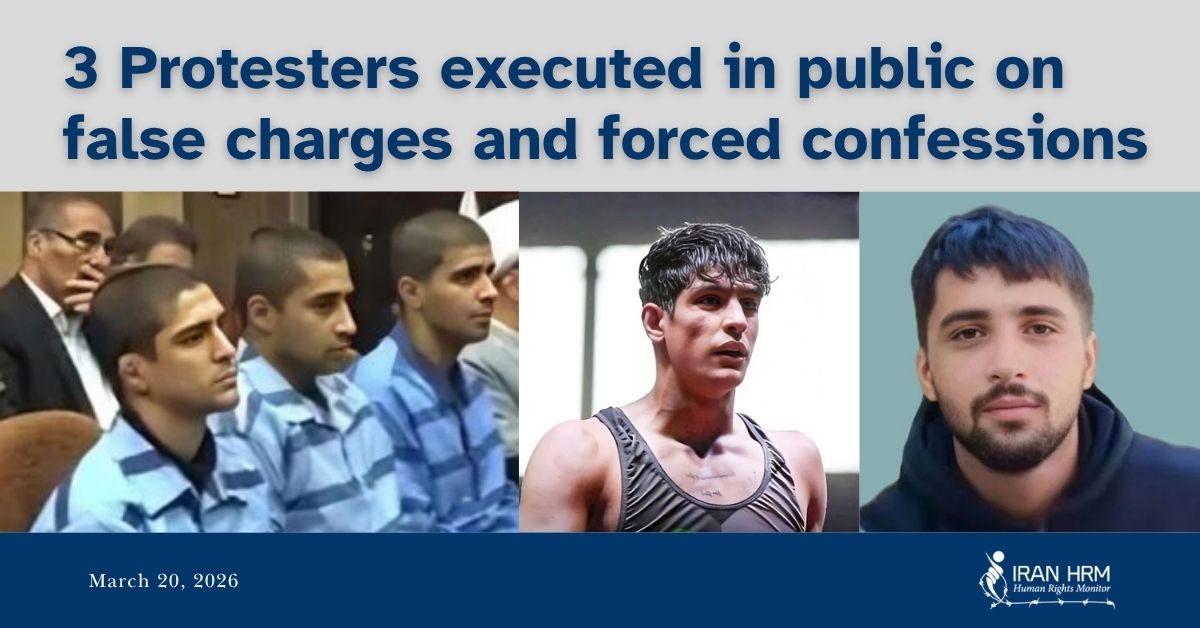
On the 21st day of the massive internet blackout and on the eve of the Persian New Year (Nowruz), the Islamic Republic’s judiciary, in a criminal act, executed three young men arrested during the January 2026 uprising, in public, in the city of Qom. Saleh Mohammadi (19, a national wrestling champion), Mehdi Ghasemi, and Saeed Davoodi were victims of this “death show” in a legal process that was a blatant violation of the “Rule of Law” from start to finish. The charges against these youths, alleging the “murder of agents,” were based solely on security scenarios and forced confessions extracted under brutal torture in solitary confinement. According to Article 169 of the Islamic Penal Code of Iran and international human rights instruments, these confessions—obtained under duress and pressure—lack any legal or religious validity and cannot serve as the basis for a judicial verdict.

Lack of Legal Basis and Violation of Due Process
It must be emphasized that in the absence of a fair, transparent trial and independent legal counsel, the attribution of any crime to these victims is illegal. Instead of proving guilt through substantiated evidence, the judiciary has resorted to “confession through torture,” which is a clear manifestation of organized crime. Even under domestic legal standards, when a verdict is based on tainted confessions, the entire execution process is legally classified as “extrajudicial execution.” The insistence on carrying out this sentence in public was not for the sake of justice but aimed at creating collective terror and intimidation under the cover of the current media and internet blackout.
Self-Defense: An Inherent Right Against Armed Aggression
Regardless of the regime’s unproven claims, it is essential to recall that according to international legal principles and even Articles 156 to 158 of the Islamic Penal Code, “Self-Defense” is the right of every citizen whose life is endangered by an illegal and imminent aggression. During the January uprising, when repressive forces—under Ahmad-Reza Radan’s “Trigger-Ready” order—targeted unarmed gatherings with live ammunition, any resistance by citizens to protect their own lives or others was an exercise of an inherent and legal right. A regime that assaults its citizens with lethal weapons cannot criminalize the resistance of protesters against “field-level intentional murder”; as per all modern legal doctrines, defense against tyranny and illegal armed aggression is a legitimate and permissible act.
Call for International Prosecution of the Perpetrators
We call upon the international community and human rights organizations to condemn the executions of Saleh Mohammadi, Mehdi Ghasemi, and Saeid Davoodi as “State Murders.” The architects of this crime, particularly Gholam-Hossein Mohseni-Eje’i and the presiding judge (once identified), must face international criminal prosecution for issuing execution orders based on confessions under torture and targeting the right to life. Silence in the face of public executions in Qom signifies the acceptance of a savagery that recognizes no legal or human boundaries.
These three public executions, occurring just one day before the New Year, prove that the Islamic Republic’s killing machine knows no red lines. The documented number 11780 recorded on the bodies of victims, the public executions in Qom, and the execution of a Swedish national announced this Wednesday by Sweden’s Foreign Minister, serve as a dire alarm for all human rights bodies to take immediate action to stop the execution of other uprising detainees currently facing the gallows.
Silence in the face of this blatant barbarism will be a green light to the perpetrators to repeat even wider atrocities in the dark corners of this regime.