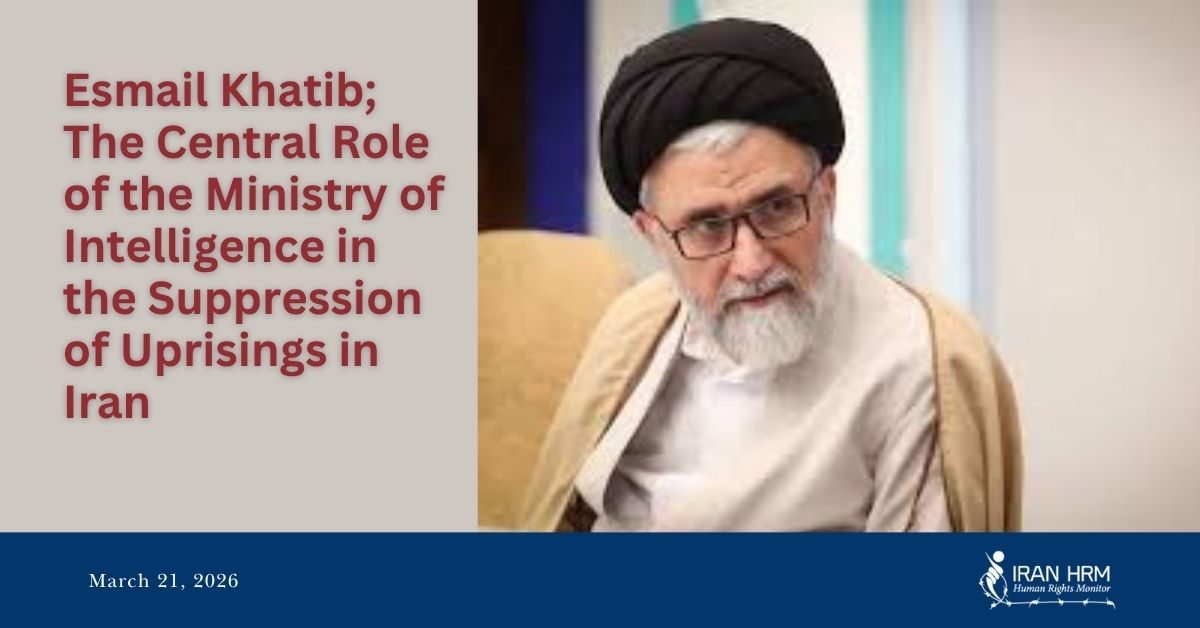
In recent years, the Ministry of Intelligence has evolved into one of the central pillars of structural repression in Iran; an institution that has transformed from a conventional intelligence body into an executive arm for the violent suppression of public protests. This transformation reached its peak during the tenure of Esmail Khatib (2021–2025), a period in which the Ministry, in close coordination with the Islamic Revolutionary Guard Corps (IRGC) and other security institutions, played an active role in controlling society and suppressing dissent.

This report, focusing on the performance of the Ministry of Intelligence during this period, demonstrates how this institution, using security, cyber, judicial, and psychological tools, established an integrated structure aimed at suppressing protests and preventing the formation of organized resistance.
Background and Position of Esmail Khatib within the Security Structure
Esmail Khatib is among those figures whose entire professional trajectory has been rooted within security institutions, and he is widely recognized as a purely security-oriented actor. His background in the IRGC, the Ministry of Intelligence, and later within the Intelligence Protection Organization of the Judiciary enabled him to serve as a key link between security, judicial, and detention systems.
During his tenure in the judiciary, control over security wards and detention facilities was effectively placed under intelligence structures; a development that weakened judicial oversight and reinforced the dominance of security institutions in arrest and interrogation processes.
Khatib is best understood not as a political figure, but as a coordinator of the repression structure; an individual who facilitated operational synergy between the Ministry of Intelligence, the IRGC, and the judiciary.
Structural Transformation of the Ministry of Intelligence; From Intelligence Body to Repression Apparatus
With Khatib’s appointment in 2021, the Ministry of Intelligence entered a new phase in which its function shifted from intelligence gathering to active internal security management. During this period, the boundaries between the Ministry and other security bodies, particularly the IRGC Intelligence Organization, became increasingly blurred.
In Aban 1402 (November 2023), Khatib stated:
“Today, the Islamic Republic is recognized as a decisive power in the region… In the near future, we will witness decisive confrontation with anti-security actions, and extraterritorial security power will increase.”
These remarks indicate that the Ministry frames public protests and civil activities as security threats and considers their suppression a core strategic mission.
Security Doctrine; Hybrid Warfare and Regime Survival
During Khatib’s tenure, the concept of “hybrid warfare” became the central framework guiding the Ministry’s analysis and actions. Within this framework, domestic protests are not viewed as expressions of social grievances, but rather as components of externally driven security threats.
Khatib’s statement that “infiltration has always existed in the country and will continue to exist” reflects a pervasive securitized view of society; one in which any form of dissent or independent activity is interpreted as a security threat.
This framework enabled the Ministry of Intelligence to justify and institutionalize widespread repression as a necessary measure for national security.
The Role of the Ministry of Intelligence in the Suppression of Nationwide Uprisings
January 2018 Uprising; Consolidation of a Hybrid Repression Model
During the nationwide protests of January 2018, while law enforcement and the IRGC were at the forefront of street-level repression, the Ministry of Intelligence played a decisive role in consolidating repression afterward. Intelligence structures, under the influence of Khatib, who at the time headed the Judiciary’s Intelligence Protection Center, were responsible for identifying, tracking, and arresting activists and protest organizers.
During this period, infiltration of social networks, surveillance of communications, and the systematic creation of security cases intensified. Numerous reports indicated that some detainees died under suspicious circumstances in detention; cases that remained unaccountable due to the direct control of security bodies over detention facilities.
2022 Uprising; Expansion of Repression into Digital and Social Domains
During the 2022 nationwide protests, the Ministry of Intelligence became a central pillar of the repression apparatus. By utilizing advanced surveillance tools, including big data analysis, social media monitoring, and facial recognition systems, the Ministry played a key role in identifying protesters.
In this period, repression shifted from reactive arrests to preventive detentions; many individuals were arrested before participating in protests or at early stages of mobilization. Documented reports of arbitrary arrests, physical and psychological torture, and forced confessions indicate the institutionalization of repression within the Ministry.
Khatib’s official rhetoric, including labeling protesters as “terrorist elements,” played a significant role in legitimizing these actions and facilitated harsher measures, including death sentences.
January 2026 Uprising; Peak Coordination and Systematic Violence
The January 2026 uprising marked a turning point in the evolution of Iran’s repression structure. During this period, the Ministry of Intelligence, under Khatib’s leadership, played a central role not only in intelligence gathering but also in designing and executing repression operations.
Following an order by Ali Khamenei on January 9, 2026 (19 Dey 1404) to suppress protests “by any means necessary,” the National Intelligence Coordination Council, chaired by Khatib, became the operational command center. This body, involving the IRGC Intelligence, Army Intelligence Protection, and Law Enforcement Intelligence, coordinated repression across institutions.
The outcome was the widespread use of live ammunition against protesters, mass arrests, and a near-total shutdown of communications in many cities. According to independent estimates, thousands were killed and tens of thousands detained.
At this stage, repression evolved from a reactive measure into a planned operation aimed at total societal control; reflecting the full maturity of the repression structure under Khatib.
Mechanisms of Repression; Safe Houses, Torture, Enforced Disappearance, and Digital Control
Safe Houses; A Parallel Detention and Torture System
The Ministry of Intelligence operates a network of unofficial detention facilities known as “safe houses,” functioning outside judicial oversight. These facilities are used for intensive interrogations, psychological pressure, torture, and forced confessions.
Ward 209 of Evin Prison, Ward 241, and secret detention centers in Urmia, Shiraz, and Ahvaz exemplify this parallel system, where detainees are held in isolation without access to basic legal rights.
Systematic Torture and Sexual Violence
Within these facilities, torture constitutes an integral part of the interrogation process. Methods include electric shocks, sleep deprivation, threats against family members, and continuous psychological pressure.
Reports also document the use of sexual violence against female detainees. In cases such as those reported from Gilan, women described sexual abuse, humiliation, and degrading treatment; indicating the deliberate use of the body as a tool of repression.
Incommunicado Detention and Enforced Disappearance
Holding detainees in complete isolation is a key method employed by the Ministry. In such conditions, individuals are denied access to legal counsel, family contact, and information about their whereabouts.
Cases such as:
- The transfer of Bijan Kazemi to a safe house in Qom
- Abductions using unmarked vehicles
- Removal of injured individuals from hospitals
demonstrate patterns consistent with enforced disappearance under international law.
Digital Repression and Control of Information
During Khatib’s tenure, repression extended into the digital domain. The Ministry employed phone hacking, geolocation tracking, malware deployment, and mass surveillance of social media.
These tools enabled pre-emptive arrests, preventing protest participation before it occurred. Simultaneously, nationwide internet shutdowns and claims regarding the seizure of Starlink devices served to justify and enforce information control.
Pressure on Families; Extending Repression Beyond the Individual
Repression extended to families of victims and detainees. Authorities conditioned the release of bodies on silence, prevented public funerals, and in some cases demanded payments referred to as “bullet fees.”
These measures aimed to prevent funerals from becoming sites of protest and to maintain control over the broader social environment.
Documented Cases of Human Rights Violations; Manifestations of a Structural Policy
Individual cases demonstrate that these repression patterns are systematic and recurrent:
- Aida Najafloo: Prolonged incommunicado detention and denial of medical treatment despite severe health conditions
- Idris Ali, Azad Shojaei, and Rasoul Ahmad Rasoul: Torture, forced confessions, and secret executions without family notification
- Bijan Kazemi: Transfer to a safe house and conditional access to basic rights
- Mohammad Ali Akbari Monfared: Deliberate denial of medical care despite life-threatening conditions
- Amirhossein Abroosh (17): Detention, torture, and disappearance of a minor during protests
These cases confirm that human rights violations are not isolated incidents but part of a structured and systematic policy.
International Responses and Documentation; From Condemnation to Crimes Against Humanity
International human rights bodies have assessed the conduct of the Ministry of Intelligence as involving widespread and systematic violations.
The UN Fact-Finding Mission (A/HRC/55/67, 2024) concluded that repression since September 2022 has included extrajudicial killings, torture, sexual violence, and enforced disappearances, potentially constituting crimes against humanity. Chair Sara Hossain stated:
“Victims and survivors, particularly women and children, were subjected to systematic sexual violence to break their will.”
Amnesty International, following the January 2026 uprising, reiterated that these patterns amount to crimes against humanity and highlighted the use of torture and forced confessions. Diana al-Tahawy noted:
“The pattern of repression in 2026 represents a continuation and escalation of the deadly crackdown seen in 2022.”
The UN Special Rapporteur, Mai Sato, described the situation as “deeply concerning,” emphasizing intensified repression and the targeting of religious and ethnic minorities under security pretexts.
Khatib has also been sanctioned internationally, including by the United States (September 2022) and Canada (October 2022), for his role in systemic human rights violations.
The End of Esmail Khatib; Physical Elimination and Structural Continuity
On March 16, 2026 (26 Esfand 1404), Esmail Khatib was killed during airstrikes targeting command centers in Tehran. An official Ministry statement described him as a “proud commander of the anonymous soldiers,” confirming that he remained actively engaged in security operations until his death.
His death represents not only the removal of an individual but the loss of a key coordinating figure linking the Ministry of Intelligence, the IRGC, and the judiciary. However, the structural mechanisms of repression established during his tenure remain intact.
Conclusion
The performance of the Ministry of Intelligence under Esmail Khatib demonstrates its transformation into a central instrument of systematic repression in Iran. By integrating intelligence, judicial, cyber, and security tools, the Ministry developed a cohesive structure aimed at controlling society and suppressing dissent.
This structure is based on three core pillars: widespread intimidation, control of information, and the systematic use of torture. The uprisings of 2018, 2022, and particularly 2026 confirm that this model represents a sustained and institutionalized policy.
While Khatib played a central role in shaping this system, the most significant development is the entrenchment of this repression model within the Ministry itself; a structure that continues to pose a serious threat to fundamental human rights in Iran.
These articles shed light on the backgrounds of regime officials across ministries and security institutions involved in repression and human rights violations.