Structural Corruption and the Economy as a Tool of Social Control
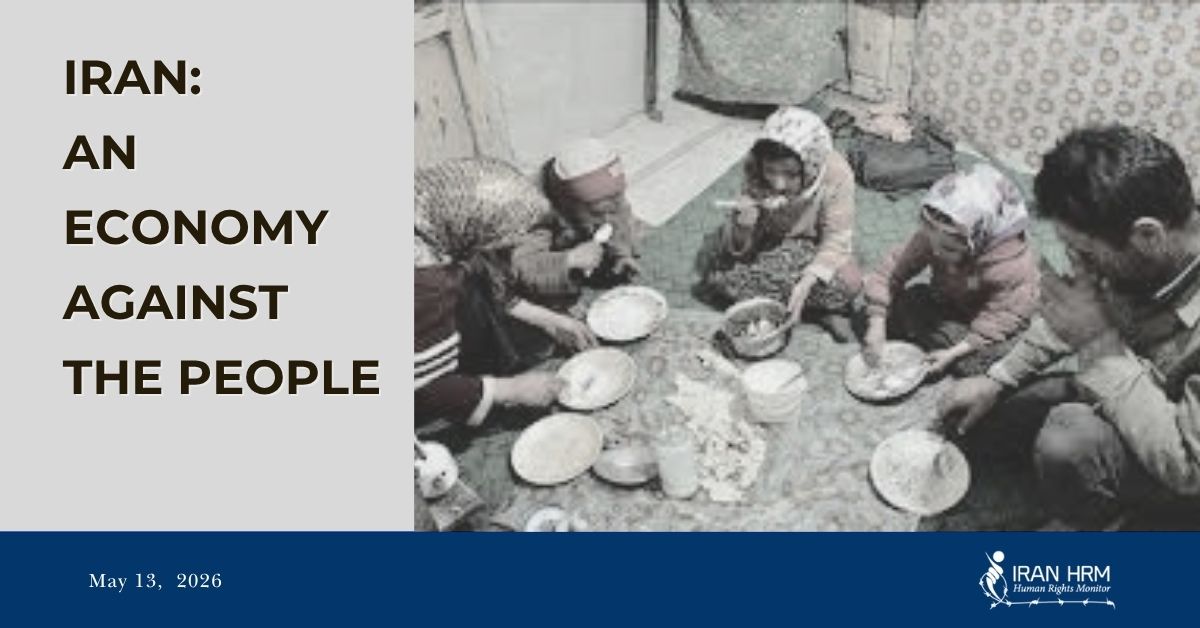
This report continues the article “Wages Below the Survival Line.” If the first one showed that millions in Iran have been deprived of food, housing, healthcare, work, and minimum human needs, this section examines the structural roots: an economy designed not for public welfare, but to preserve power, finance security institutions, reproduce rent networks, and control society.

Iran’s economic crisis is not merely the result of war, sanctions, or market fluctuations. Repeated admissions by economists and state media show that their main sources lie in domestic policies, structural corruption, banking imbalances, unbacked money printing, allocation of public resources to security institutions, and prioritizing regime survival over people’s lives.
Hossein Ragfar, a state-affiliated economist, stated in August 2025: “The current economic situation of the country is heavily affected by the country’s major strategic policies inside the country, not outside it.” This statement undermines the official narrative that attributes all crises to war and external factors.
The Economy as a Tool of Human Rights Violations
In today’s Iran, the economy is no longer merely the domain of production, work, and livelihood. It has become a tool for social control and the weakening of basic human rights. Through inflation, subsidy removal, price increases, instability, currency collapse, and job insecurity, the state erodes purchasing power and deprives citizens of food, housing, health, work, and dignity.
Ragfar has described price increases as “nothing but the plunder of people and consumers who have no voice.” This admission shows that economic policies have become a mechanism for transferring pressure from the state and power networks onto citizens.
Impoverishment is therefore not a secondary consequence. It is part of the method of governance. A citizen who spends all energy securing bread, rent, medicine, and basic expenses loses the capacity for social and political advocacy. A society trapped in survival has less ability to organize, protest, and defend its rights.
For this reason, Iran’s economic crisis cannot be treated only as mismanagement. It is a mechanism for the gradual erosion of society; a mechanism that keeps citizens in permanent emergency through inflation, job insecurity, labor repression, economic instability, and internet restrictions.
Rejecting the War and Sanctions Narrative
The state attempts to blame war, sanctions, and external conditions. Yet state documents and statements by experts close to the system show that the current crisis took root years before recent tensions.
The report “Poverty Under the Shadow of War” showed that the state highlights wartime conditions to conceal chronic economic crises. In May 2026, Arman Melli asked: “What must happen for the current situation to be corrected and for people’s economic conditions to improve?” It also wrote that “little effort has been made to resolve these problems and address the people’s demands.”
These admissions show that war has become more of a cover for evading accountability than the cause of the crisis. Livelihood collapse, inflation, currency depreciation, banking corruption, rent-seeking, production shutdowns, and labor-market erosion are products of decades of policymaking within the same ruling structure.
Sanctions and war can intensify economic pressure. But they do not erase the responsibility of the ruling regime in Iran for resource allocation, repression of protests, systemic corruption, prioritizing security institutions, and failing to protect vulnerable groups. Human rights obligations remain binding in times of crisis.
Budgets for Preserving Power, Not People’s Lives
One of the clearest signs of the anti-human-rights nature of the economic structure is the allocation of public resources. While workers, retirees, tenants, and low-income families struggle to secure food, rent, and healthcare, public funds are directed to religious, propaganda, military, and security institutions.
In June 2025, reports indicated that the Ministry of Oil under Ebrahim Raisi’s government had allocated large resources to seminaries, including “a 100 billion toman contribution to the Gholamreza Ghasemian seminary” and “500 billion tomans for the development of religious schools in Qom.” Under conditions of widespread poverty, this shows that the public budget is distributed according to the interests of power, not social need.
Abbas Moqtadaei, an MP from Isfahan, said: “Workers and retirees call at two or three in the morning and speak about their worries.” His words expose the gap between state spending priorities and social anxiety.
The 2026 budget follows the same pattern. Collected data indicate that the Islamic Revolutionary Guard Corps has received around 196 trillion tomans, while the regular army’s budget is around 80 trillion tomans. At the same time, hundreds of trillions of tomans in oil revenues and petroleum products have been allocated to military and security sectors.
This occurs while hospitals face shortages of medicine and equipment, schools suffer budget crises, teachers face livelihood problems, workers deal with delayed wages, and families cannot meet basic costs. Public resources serve the preservation of the power structure more than public welfare.
From the perspective of economic and social rights, this is crucial. States must use the “maximum of available resources” to realize fundamental rights. When resources are directed to security and ideological institutions instead of health, education, housing, social security, and support for vulnerable groups, the issue is not only poor budgeting; it is a violation of human rights obligations.
Banking Corruption, Imbalances, and Money Printing
Banking corruption is a pillar of Iran’s economic collapse. A banking system that should support production, investment, and development has become a site of rent-seeking, money creation, deficit concealment, and crisis transfer to society.
In December 2025, Sadeq Amoli Larijani said the policy of creating private banks had been “100 percent wrong,” adding: “Banks became the backyard for the corrupt activities of certain people.” This admission from within the power structure shows that the banking crisis is not technical; it is the result of a corrupt and unaccountable mechanism.
Valiollah Seif, former governor of the Central Bank, also described “deep imbalances” in banks and said that banks with improperly valued assets face liquidity problems, while the gap between income and expenses grows daily.
The result is unbacked money printing and inflation imposed directly on people’s lives. Citizens pay the cost of banking corruption, budget deficits, rent-seeking, and state imbalances through currency devaluation, food inflation, higher rents, more expensive medicine, and collapsing purchasing power.
Inflation thus becomes a hidden tax on the poorest. Those without assets, land, foreign currency, or access to rent suffer most. Wage earners, retirees, and informal workers lose purchasing power every day without any ability to compensate.
Collapse of Production and Job Insecurity
The economic crisis has also eroded production and increased factory closures. Reports point to worker dismissals, reduced industrial capacity, and rising unemployment insurance claims in different cities.
In 2026, thousands of workers lost jobs in industrial areas including Rasht, Ilam, and parts of the petrochemical sector. Other reports refer to the destruction of tens of thousands of job opportunities, rising job insecurity, and growing unemployment insurance claims.
In some production units, workers face months of unpaid wages, unpaid insurance, temporary contracts, phased dismissals, and uncertainty. In the oil, gas, petrochemical, steel, mining, municipal, and transportation sectors, labor protests have repeatedly centered on unpaid wages, unstable contracts, and insecurity.
The crisis is therefore not limited to declining purchasing power. It weakens production, employment, and job security. When production erodes, workers become unemployed, insurance systems weaken, families lose income, and pressure increases on children, women-headed households, and the elderly.
This directly violates the right to work, the right to just and favorable conditions of work, and the right to social security.
Collapse of the Rial and the Inflationary Siege
The collapse of the rial is one of the most direct tools of destroying people’s assets. When the national currency loses value, wage earners, retirees, and low-income families are the first victims because their incomes are fixed or rise far more slowly than prices.
Reports from 2025 and 2026 placed Iran among countries whose national currencies were falling at severe speed. Exchange rate increases, especially amid war and regional tension, immediately affect the prices of food, medicine, transportation, energy, and housing.
A Bahar News report in June 2025 showed that the dollar in Tehran’s free market jumped by 10,000 tomans in one day and passed 92,000 tomans. Later data referred to sharper currency jumps and their direct impact on food, medicine, housing, and public services.
This is not merely a currency crisis. It violates people’s right to minimum stability in life, planning, healthcare, education, and livelihood. A citizen who does not know tomorrow’s price of bread, rent, medicine, or transportation is deprived of the ability to plan a human life.
Internet, Livelihood, and the Right to Work
Internet shutdowns and restrictions have become a factor in the livelihood crisis. Millions earn income through online businesses, internet sales, digital services, virtual education, content production, platform-based transportation, and independent work. Disruptions therefore cause income loss, business closure, and economic insecurity.
In Iran, the internet is not only a communication tool. It is part of society’s economic infrastructure. Shutting it down or slowing it, especially during protests or security tensions, deprives part of the workforce of the tools needed to earn income.
Economic experts and some official reports have warned that internet shutdowns, besides restricting access to information, have damaged economic infrastructure and pressured small businesses, women working from home, young people, independent workers, and platform workers.
From a human rights perspective, this is not only a violation of freedom of expression or access to information. It also violates the right to work, livelihood, and participation in economic life.
Rent, Oligarchy, and Media Protecting Power
A major part of Iran’s crisis results from the dominance of rent-seeking networks and power-linked oligarchies. Public resources are not used for production, employment, welfare, and public services; they are consumed through monopoly, corruption, propaganda, and political loyalty-building.
Ragfar has referred to “media outlets that protect the interests of oligarchs and mafias” and said they conceal economic monopolies. This shows that the crisis is preserved not only by wrong policies, but also by media networks, propaganda, and suppression of truth.
People are deprived not only of public resources, but also of the right to know the truth. Affiliated media attribute poverty, corruption, and rent-seeking to external factors while concealing the responsibility of the power structure.
Corruption in essential goods supply chains, import monopolies, preferential currency access, hoarding, unequal subsidies, and support for connected networks transfer resources from people to circles of power. The poorest pay the highest cost.
Human Rights Consequences
The final point of this cycle is the erosion of human dignity. When families must remove essential needs, sell assets, abandon treatment, withdraw children from school, turn to street vending, or even sell body organs to secure bread, rent, or treatment, the issue is no longer an “economic problem.” It is the collapse of minimum human life.
Ragfar stated: “People should not be homeless and hungry and deprived of access to educational and health services… to the point that because of financial hardship they are forced to sell parts of their bodies!” This sentence, from a state-affiliated economist, shows the depth of the human crisis.
Another report, “Human Dignity Under Siege by the Economy and Livelihood,” stressed that securing bread, clothing, and shelter has become an unresolved challenge between people and the state. This retreat to the lowest level of human needs is an assault on dignity.
The social consequences include child labor, school dropout, early marriage, addiction, homelessness, informal settlements, psychological harm, suicides linked to debt and unemployment, and survival-driven crime. These are not separate phenomena. They are the human consequences of structural poverty.
Suppression of Livelihood Demands
The economic crisis is accompanied by suppression of labor and civil demands. Workers, teachers, retirees, nurses, defrauded investors, and other protesting groups have faced security pressure for demanding wages, insurance, pensions, job security, and public services.
The absence of independent labor organizations, restrictions on strikes, targeting of labor activists, and securitization of livelihood demands show that the ruling regime in Iran has not only failed to ensure economic and social rights; it has also blocked peaceful channels for demanding them.
Economic and social rights are not separate from civil and political rights. When workers cannot organize, teachers face pressure for labor protests, and retirees face security measures for demanding adequate pensions, the livelihood crisis becomes a crisis of freedom of expression, assembly, and association.
Warnings About Social Explosion
As poverty and inequality deepen, warnings about a possible “social explosion” have increased. Some officials and state-affiliated experts have openly spoken of unrest caused by economic crisis.
Ali Rabiei stated that “poverty in Iran is a security issue.” Some MPs have warned that if current trends continue, the number of poor people may reach tens of millions.
State media have repeatedly warned about livelihood collapse, public mistrust, and dissatisfaction. These warnings show that even within the power structure, there is deep concern about the consequences of poverty and the erosion of public hope.
Yet the state’s response has generally not been structural reform or genuine support. It has most often been repression, media control, scapegoating, internet restrictions, and transferring the cost of crisis to society.
Legal Analysis; Violated Obligations
As a State Party to the International Covenant on Economic, Social and Cultural Rights, Iran is obligated to guarantee the rights to work, social security, adequate standard of living, food, housing, health, and education.
Articles 6 and 7 guarantee the right to work and just and favorable conditions of work. Widespread unemployment, wages below survival level, job insecurity, unpaid wages, and suppression of independent organizations conflict with these obligations.
Article 9 guarantees social security. Inadequate pensions, delayed payments, exclusion of informal workers from insurance, and weak pension funds undermine this right.
Article 11 recognizes the right to an adequate standard of living, including food, clothing, and housing. Poverty, food insecurity, removal of essential goods, rent crisis, and homelessness indicate violations of this right.
Article 12 guarantees the right to the highest attainable standard of physical and mental health. When families abandon treatment because of poverty, medicine becomes unaffordable, and economic pressure leads to psychological crisis, addiction, or suicide, the right to health is violated.
Taken together, Iran’s economic crisis is not merely a policy failure. It is a pattern of systematic violation of economic and social rights.
 Conclusion of the Two-Part Dossier
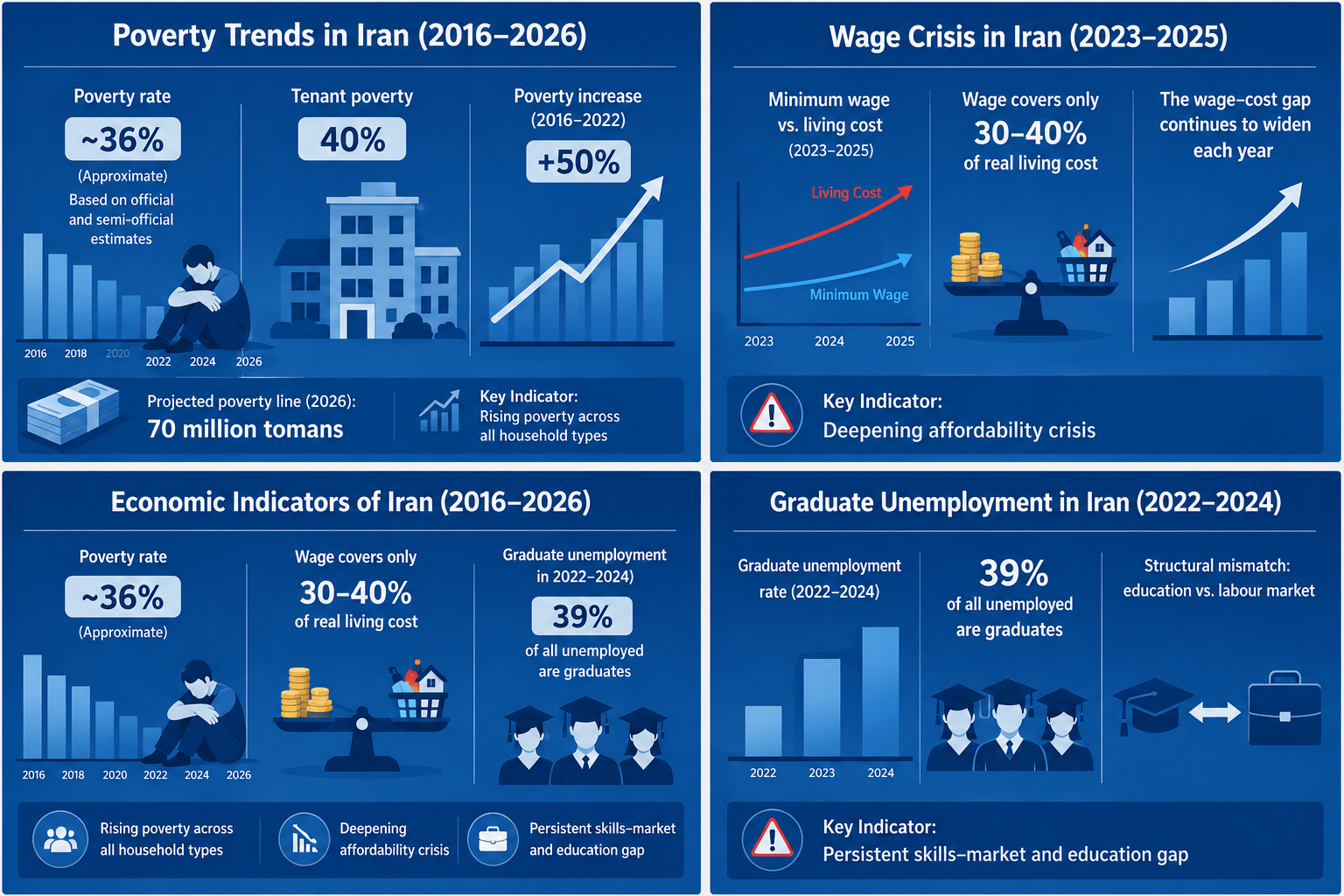
The two reports in this dossier show that Iran’s livelihood and economic crisis is not temporary and is not merely the result of external pressure. The first report showed how wages, purchasing power, food consumption, housing, health, job security, and social hope have fallen below the survival line. This report showed that behind that collapse lies corruption, rent-seeking, security budgets, money printing, banking imbalances, allocation of public resources to institutions of power, internet restrictions, and suppression of labor demands.
The economy in Iran, under the rule of the mullahs, has become a tool against the people. It operates through inflation, poverty, instability, erosion of public services, job insecurity, and the destruction of human dignity. The result is the deprivation of millions of citizens of rights recognized under international law as basic human rights: food, housing, health, work, social security, and dignified life.
This dossier shows that poverty in Iran is not an accident. It is a structural product. If this structure controls public resources, the budget, banks, media, production, the internet, and economic policy, the livelihood crisis will reproduce itself.
In today’s Iran, poverty is no longer only the consequence of economic crisis. It has become one of the tools of governance and the gradual erosion of human rights.