
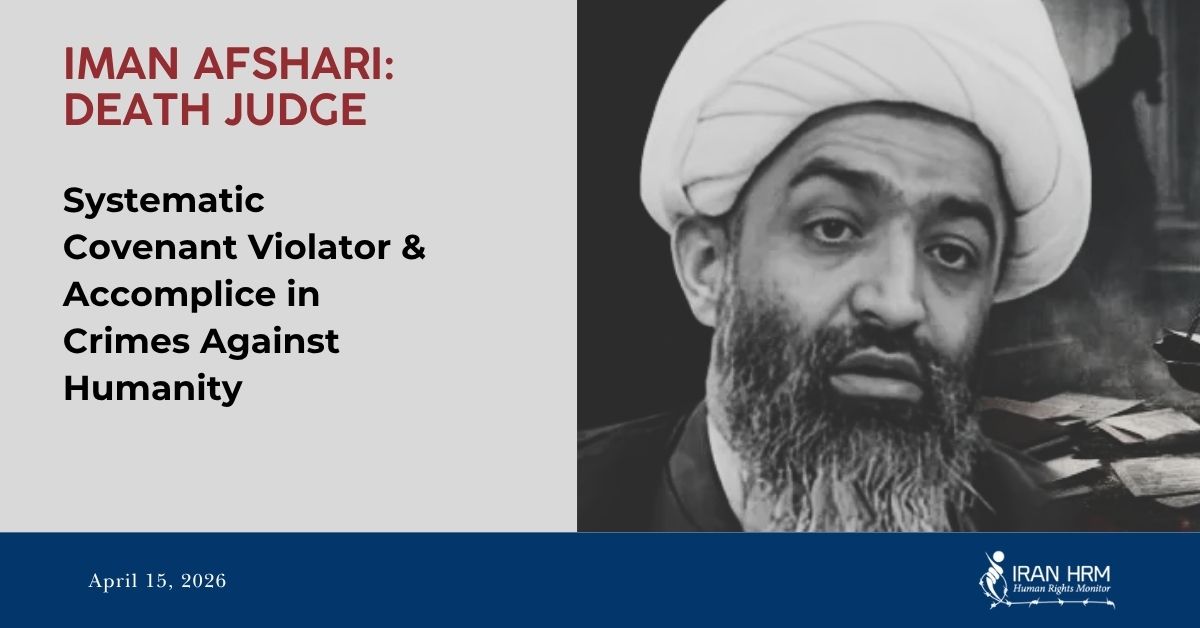
In recent years, the name Iman Afshari has become synonymous with the issuance of death sentences and long-term imprisonment for political prisoners, protesters, civil activists, and religious minorities. As the presiding judge of Branch 26 of the Tehran Revolutionary Court, Afshari is recognized as a figure who has not only trampled upon the fundamental principle of judicial impartiality but has also transformed the court into an instrument for consolidating intimidation and institutionalizing state repression.

An examination of the cases handled by this branch reveals that he acts as the executive arm of security agencies in violating Article 6 of the International Covenant on Civil and Political Rights (ICCPR), the right to life. His most recent crime involves the issuance of death sentences for six political prisoners: Mohammad Taghavi, Vahid Bani-Amerian, Babak Alipour, Pouya Ghobadi, Abolhassan Montazer, and Akbar Daneshvarkar, who were executed on March 30, 31and April 4, 2026 (10, 11, and 15 Farvardin 1405). He also issued a death sentence for female political prisoner Pakhshan Azizi.
Confession to Hostility Against Justice: Security Mandates Above the Law
Numerous political prisoners have testified that Iman Afshari does not even bother to study the case files or evidence, issuing verdicts solely based on reports from the Ministry of Intelligence and the IRGC (Revolutionary Guards). This behavior is a flagrant violation of Article 14 of the ICCPR (Right to a Fair Trial), which emphasizes the independence of the judge.
A prominent example of this approach is the case of film director Mohammad Rasoulof. In July 2019, Afshari sentenced him to one year in prison and social deprivations. When Rasoulof asked if the judge had seen his films, Afshari candidly replied: “No; the analysis provided by the security agencies is sufficient for issuing a verdict.” This admission highlights the worthlessness of the law in the face of security apparatus mandates and violates the principle of a “judge’s conscientious conviction.”
Branch 26 of the Revolutionary Court: A Slaughterhouse for Civil and Political Rights
Iman Afshari has headed Branch 26 of the Tehran Revolutionary Court since the winter of 2018. This branch has become a primary hub for the suppression of nationwide protesters, journalists, women’s rights activists, and religious minorities. Charges such as “Action against national security,” “Propaganda against the state,” “Baghy“ (Armed rebellion), and “Moharebeh“ (War against God) used in this branch often lack precise legal definitions and are utilized to criminalize peaceful activities, violating the principle of legality regarding crimes and punishments.
His record of issuing death sentences extends further, including cases such as:
- Behrouz Ehsani and Mehdi Hassani
- Mohsen Mazloum, Pejman Fatehi, Hazhir Faramarzi, and Vafa Azarbar
- Habib Chaab (Asiod) (who was executed following a state kidnapping and an unfair trial)
- Mahan Sadrat Madani
- Hossein Kheiri
Serial Case-Building and “White Torture”
Shahin Zoghi-Tabar, a political prisoner held in Evin Prison, is a prime example of the victims of Afshari’s sequential case-building. On February 23, 2026 (4 Esfand 1404), he was once again transferred to Branch 26, where he faced Afshari’s direct threat of receiving the “maximum punishment.” The formation of new cases with repetitive titles such as “Propaganda against the state” and “Disturbing public opinion”—immediately following the previous notifications of charges in January/February 2026 (Bahman 1404)—constitutes psychological torture and a violation of the principle of Ne Bis In Idem (Double Jeopardy) for a single act.

Crimes Against the January 2026 Protesters: Execution Based on Ambiguity
Based on a verdict issued by Afshari, four detainees from the January 2026 protests—Mohammad-Reza Majidi-Asl, Bita Ali-Hemmati (Mohammad’s wife), Behrouz Zamani-Nejad, and Kourosh Zamani-Nejad—were sentenced to death and the confiscation of all property on the fabricated charge of “Operational action for a hostile state.” While the cited examples included only participating in gatherings and chanting slogans, Afshari issued the heaviest possible punishment without providing specific details or differentiating the roles of the defendants. Reports of confessions obtained under torture in this case are a gross violation of Article 7 of the Covenant (Prohibition of Torture) and international conventions, which render any confession under pressure legally void.

Call for International Accountability, Application of Universal Jurisdiction
The actions and verdicts of Iman Afshari are not merely judicial errors; they are part of a systematic and widespread attack against a civilian population, which, under international law, constitutes a “Crime Against Humanity.” When a country’s judiciary becomes the terror arm of the state, it is the duty of international bodies and the global community to break their silence.
- We call upon the UN Human Rights Council and the Fact-Finding Mission to include the name of Iman Afshari on the list of high-ranking human rights violators subject to legal and travel sanctions.
- Based on the principle of “Universal Jurisdiction,” prosecutors in member states of international treaties are duty-bound to open criminal files against this judge and take action to arrest and prosecute him should he leave Iran’s borders.
- The international community must understand that any engagement with the Islamic Republic’s judiciary grants legitimacy to the extrajudicial executions and tortures engineered by individuals like Afshari.
The time has come to end “impunity” for judges whose pens are stained with blood. We demand precise documentation of all his verdicts by human rights organizations for the day of reckoning in a fair and public court of justice.