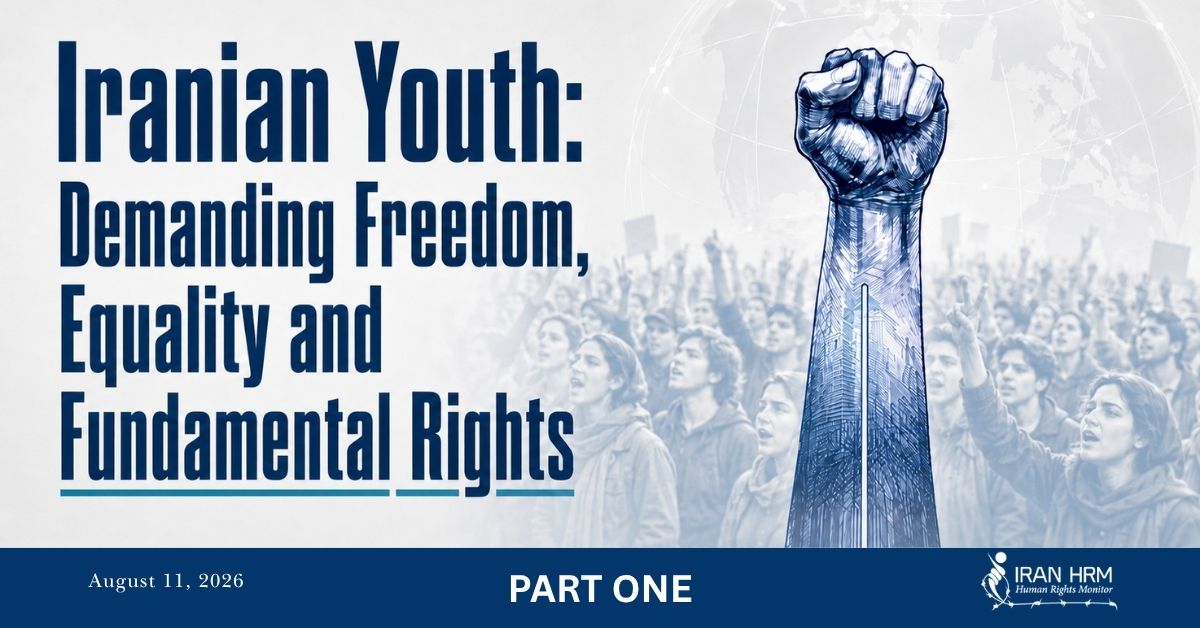
On 17 December 1999, the United Nations General Assembly, through resolution 54/120, designated 12 August as International Youth Day. The observance focuses on issues affecting young people, their participation in social life and decision-making, and the World Programme of Action for Youth, adopted in 1995.

In Iran, young people have played a central role in protests, the student movement and demands for freedom, equality and fundamental rights. This report examines violations of young people’s rights to life and security, education and university autonomy, and employment and economic security.
Rights to Life, Security and Civic Participation
From the protests of December 2017–January 2018 to those of November 2019 and 2022, and the 2025–2026 uprising, university students, school pupils and other young people have been at the forefront of protests and subjected to security and judicial repression.
Reports by the United Nations, the Office of the United Nations High Commissioner for Human Rights, the Special Rapporteur on the situation of human rights in the Islamic Republic of Iran, the Independent International Fact-Finding Mission on the Islamic Republic of Iran and Amnesty International have documented the Iranian authorities’ use of lethal force, mass arrests, enforced disappearances, torture, forced confessions, trials that fail to meet fair-trial standards, and the death penalty. The Islamic Republic has not published age-disaggregated data on victims. International documentation nevertheless indicates that young people and children constitute a significant proportion of those killed, injured, arrested and sentenced to death.
During the nationwide protests of November 2019 and 2022, hundreds of protesters were killed and thousands arrested. International human rights bodies expressed concern about the use of live ammunition and metal pellets, widespread eye injuries, deaths in custody, torture to extract forced confessions, and the denial of access to legal counsel and fair proceedings.
Following the 2025–2026 nationwide uprising, the issuance and execution of death sentences against young protesters intensified. In a joint statement, Mai Sato, Special Rapporteur on the situation of human rights in the Islamic Republic of Iran; Morris Tidball-Binz, Special Rapporteur on extrajudicial, summary or arbitrary executions; Margaret Satterthwaite, Special Rapporteur on the independence of judges and lawyers; Gina Romero, Special Rapporteur on the rights to freedom of peaceful assembly and of association; Alice Jill Edwards, Special Rapporteur on torture and other cruel, inhuman or degrading treatment or punishment; and members of the Working Groups on Enforced or Involuntary Disappearances and on Arbitrary Detention condemned the death sentences imposed on 12 young men for participating in the January 2026 protests. According to the experts, the defendants were tried behind closed doors without respect for fair-trial standards, amid concerns regarding arbitrary detention, enforced disappearance, torture, ill-treatment and the use of forced confessions.
The statement reported that at least 24 people had been executed since the beginning of 2026 in connection with the January protests. Following the execution of two defendants in this case, 10 other young men remain at imminent risk of execution. The UN experts described the use of the death penalty in these cases as a means of instilling fear and deterring future protests, emphasizing: “Under current laws, participation in any protest critical of the Government is virtually impossible without risking reprisals, harassment and prosecution. The cycle of protests and executions will only be broken when civic space is opened and the freedoms of peaceful assembly and expression are guaranteed.”
Abolfazl Sepahi Badjani and Amirhossein Safari Hosseinabadi, arrested during the 2025–2026 nationwide protests, were publicly executed in Alikhani Square, Isfahan, at dawn on 28 July 2026. These were the first public executions in a case linked to political protests in years and were carried out under an extensive security presence. Reports also described objections by citizens at the scene and a response by security forces. Before the sentences were implemented, human rights organizations and UN experts had expressed concern regarding the proceedings, allegations of torture and forced confessions, denial of effective access to independent legal counsel, and violations of fair-trial standards.
Reactions were also recorded within Iran. In an article entitled “Temporarily Suspend Executions,” published on 20 July 2026, the Ettela’at newspaper urged the Head of the Judiciary to suspend executions temporarily and warned of the social and political consequences of increasing executions during a period of crisis. Farrokh Forouzan, a lawyer and sociologist of crime, emphasized the ineffectiveness of executions in preventing crime, while Azar Mansouri, President of the Reform Front of Iran, also warned of the social consequences of their continuation.
Right to Education and University Autonomy
During nationwide protests in recent years, particularly the 2025–2026 uprising, universities were subjected to security, judicial and administrative measures that violated the right to education, academic freedom and university autonomy.
- Students Killed
A review of those killed during the 2025–2026 uprising indicates that security forces targeted dozens of university students with live ammunition and metal pellets during protests. The identities of more than 111 students killed have so far been confirmed, including Mohammadreza Ahangari, a management student at the Science and Research Branch; Mehrdad Ebrahimi, a civil engineering student; Kamyab Ahmadi, an electrical engineering student; Rubina Aminian, a fashion design student; Afshin Esfandiari, an architecture student; Ariana Arjmandi, a psychology student; Amirparsa Ashkboos; Sara Boroumand; Raha Behloulipour, a student at the University of Tehran; Aida Heydari, a medical student at Tehran University of Medical Sciences; and Ahmad Khosravani, a student at Sharif University of Technology. These names represent only part of the verified list.
- Arrest, Abduction and Torture of Students
Following the outbreak of protests, hundreds of students were arrested in cities across Iran. A significant proportion of the arrests were reported as street abductions conducted without judicial warrants. Plain-clothes agents using vehicles without licence plates or official markings arrested students near universities or while they were travelling and transferred them to undisclosed locations. Many were denied contact with their families and access to legal counsel for prolonged periods, while some were subjected to pressure, interrogation and forced confessions.
Documented sentences include 10 years’ imprisonment for Ali Sanei; five years’ imprisonment for Iliya Bakhsha’i; two and a half years’ imprisonment and a two-year travel ban for Raheleh Moeini; and two years’ imprisonment for Ali Taheri-Kia. Danial Habibollahi was held for months in unresolved pre-trial detention and prevented from sitting the master’s degree entrance examination; Ariana Kouchaki also remains in unresolved detention.
- Executions, Death Sentences and Judicial Repression
Mehdi Khanki, a 25-year-old law student, was executed following his arrest. Sepehr Amirzadeh, a medical student; Armin Nourmohammadi, an architecture student; and Ehsan Faridi, a manufacturing engineering student at the University of Tabriz, have been sentenced to death on charges including moharebeh (“enmity against God”) and efsad-e fel-arz (“corruption on Earth”) and remain at risk of execution.
- Denial of the Right to Education
Dozens of students were suspended or expelled, barred from entering university, denied continuation of their studies, deprived of student welfare services and accommodation, or had their student cards blocked without due process. In numerous cases, these measures were imposed without a disciplinary committee hearing or continued after the prescribed period of exclusion had ended.
- Securitization of Universities
At many universities, the Herasat security offices have become an operational arm of intelligence and judicial bodies. Herasat reports have been used directly to initiate cases before Revolutionary Courts, while disciplinary proceedings have been converted into security cases. Summonses, fabricated cases and educational exclusion have been reported at multiple universities.
At the University of Tehran, more than 200 students were summoned or subjected to disciplinary proceedings, and at least 40 faced extralegal measures. At Sharif University of Technology, more than 40 disciplinary cases were opened; over 20 students were suspended and eight expelled. At Iran University of Science and Technology, at least 100 disciplinary cases were opened and no fewer than eight students were barred from their studies. At Soore University, 40 students were summoned, 18 suspended and four expelled. Similar cases were reported at Amirkabir University of Technology, Shahid Beheshti University, the University of Birjand, K. N. Toosi University of Technology, Alzahra University, Sajjad University of Technology in Mashhad, and Allameh Tabataba’i University.
- Pressure on Faculty Members and Academic Independence
Faculty members who supported students or refused to sign disciplinary decisions faced dismissal, termination of contract, suspension, salary stoppage, forced retirement and security summonses. Such measures were reported at the University of Tehran, Sharif University of Technology, Amirkabir University of Technology, Shahid Beheshti University, the University of Kurdistan and Hakim Sabzevari University.
Rights to Employment, Economic Security and a Professional Future
The right to decent work and equal employment opportunities is recognized in article 23 of the Universal Declaration of Human Rights and articles 6 and 7 of the International Covenant on Economic, Social and Cultural Rights. Official statistics and international reports indicate high unemployment, limited employment opportunities, discrimination in recruitment and economic insecurity among young people in Iran.
Youth Unemployment
According to the latest report of the Statistical Center of Iran, the unemployment rate among young people aged 15–24 was 20.3 per cent in the Iranian year ending in March 2026, compared with a reported overall national unemployment rate of 7.5 per cent. The unemployment rate among persons aged 18–35 was reported at 15 per cent.
In its Global Employment Trends for Youth 2024 report, the International Labour Organization (ILO) stated that young people in low- and middle-income countries face insufficient employment opportunities, unstable work and economic insecurity, and that university education does not necessarily lead to stable employment.
Economic Participation and Insecure Employment
Iran’s overall labour-force participation rate was reported at 40.6 per cent for the Iranian year ending in March 2026. The authorities have not published current, disaggregated data on the economic participation of young people and young women, preventing an accurate assessment of these groups. The ILO identifies temporary and informal employment and work without job security as major challenges for young people in developing countries, limiting their access to stable income, social protection and employment security.
Discrimination in Access to Employment
Recruitment by many Iranian state and public institutions depends on ideological and political vetting. UN Special Rapporteurs have also reported structural, ideological and gender-based restrictions in Iran’s labour market. No official statistics have been published on the exclusion from employment of protesters, student activists or former political prisoners; however, UN reports have identified such restrictions as barriers to equal access to employment opportunities.
Migration of Skilled Professionals and Human Capital
According to data from the Iran Migration Observatory, also published by the Islamic Republic News Agency (IRNA), the migration of highly skilled persons and professionals has increased by 82 per cent in recent years, with the annual number of emigrants rising from approximately 60,000 to approximately 110,000.
These reports identify the perceived absence of a professional future, inequality in recruitment, low income relative to living costs, structural discrimination and lack of economic security among the factors driving increased migration by young people and professionals. The ILO likewise identifies the shortage of quality jobs and economic insecurity as factors contributing to the migration of young workers from middle-income countries.
Gaps in Economic Data on Young People
No official, disaggregated statistics have been published on poverty, purchasing power, housing costs or the living conditions of young people. The youth unemployment rate, the overall labour-force participation rate and the increase in the migration of skilled professionals are the available indicators for assessing this generation’s economic security and professional future; however, the absence of disaggregated data prevents a comprehensive assessment.
Concluding Note
Part Two of this report will examine forced migration, health, individual freedoms and the social participation of young people in Iran.