With the escalation of international crises and the deep economic deadlock in Iran—which fosters broader popular protests—the Islamic Republic has accelerated its execution machine to institutionalize repression and terror across society. The regime attempts to guarantee its survival by tightening the noose of suppression around the necks of potential protesters. The indiscriminate issuance of death sentences against detainees serves as the primary tool of the security apparatus to prevent the eruption of public rage.

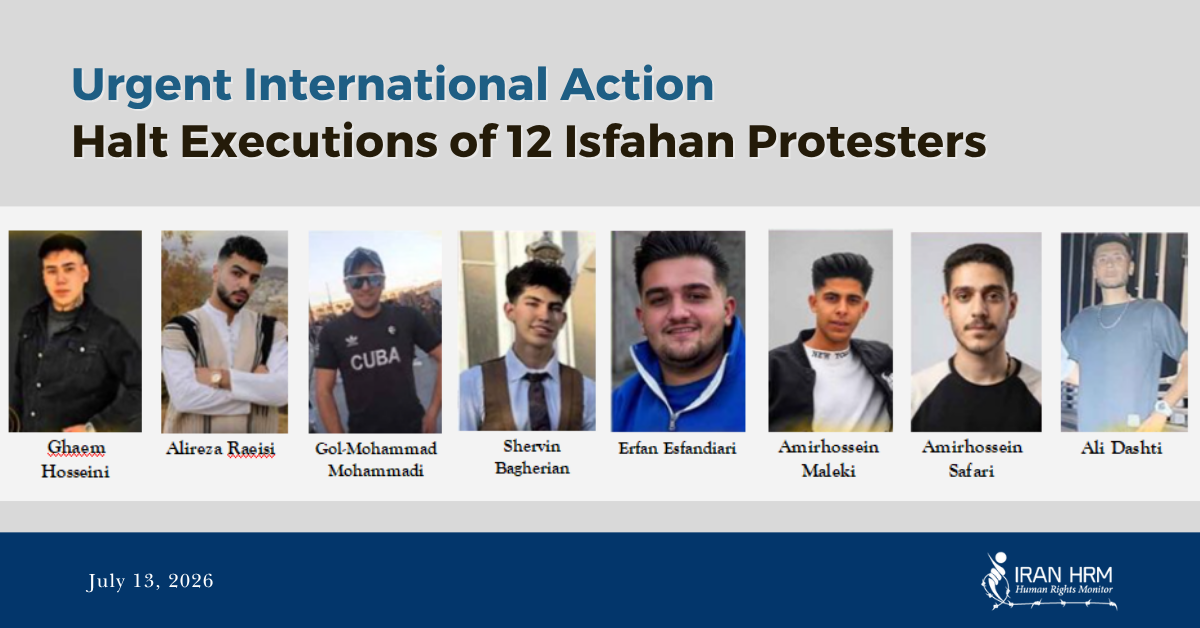
12 Political Prisoners at Imminent Risk of Execution
During the nationwide protests of January 2026 (Dey 1404) in Isfahan, a judicial case known as the “Isfahan Alikhani Square Case” was initiated. In this event, according to claims by judicial and security authorities, four members of the Basij and the repressive Special Forces Unit were killed. Following this incident, at least 59 individuals were arrested and prosecuted. The case was tried in Branch 1 of the Isfahan Revolutionary Court, presided over by Mohammad Barati Dorcheh and Mohammad Tavakoli (also known as Vakili), with Mohammad Nakhjavan serving as the prosecutor. All trial proceedings for the 59 defendants were conducted in just three one-hour sessions; an unlawful process that, from the outset, constituted a glaring example of a show trial.
The defendants were not only deprived of the right to choose an independent lawyer of their choice during the preliminary stage and were restricted solely to judiciary-appointed lawyers under the Note to Article 48 of the Criminal Procedure Code—which mandates that political defendants can only choose representation from a pre-approved list curated by the Chief of the Judiciary, but these lawyers were also denied access to the full case file and the foundational documents of the charges, stripping the defendants of any possibility for an effective defense. Among these detainees, 12 young men have been sentenced to death:
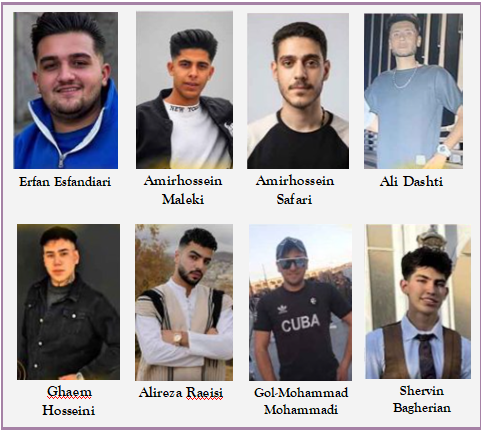
- Alireza Sepahi, 24 years old (four death sentences)
- Abolfazl Sepahi, 23 years old (three death sentences)
- Ghaem Hosseini, 20 years old (two death sentences)
- Gol-Mohammad Mohammadi, Afghan national, 23 years old (one death sentence)
- Shervin Bagherian, 18 years old (two death sentences)
- Erfan Esfandiari, 18 years old (one death sentence)
- Amirhossein Safari, 27 years old (one death sentence)
- Amirhossein Maleki, 19 years old (one death sentence)
- Ali Dashti, 19 years old (one death sentence)
- Abolfazl Ebrahimi, 18 years old (one death sentence)
- Alireza Raeisi, 21 years old (one death sentence)
- Amirhossein Ebrahimi Analoucheh, 19 years old (two death sentences)
Note on Multiple Death Sentences: Under Iran’s judicial system, multiple death sentences are issued concurrently for distinct charges within the same case (such as Moharebeh or Efsad-e Fel-Arz). This practice ensures that even if one verdict is overturned or commuted due to legal challenges or international pressure, the remaining capital sentences ensure the prisoner’s execution.
Among these individuals, 21-year-old Alireza Raeisi is a relative of Ramin Raeisi, a 28-year-old youth who was killed by security forces during the January 2026 protests. Ramin’s body was handed over to his family on January 18 and buried in the Bagh-e Rezvan cemetery in Isfahan. Only one day after the burial ceremony, Alireza Raeisi was arrested. According to reliable reports, his family was kept completely unaware of his whereabouts and status for approximately 20 days (constituting a short-term enforced disappearance). Following this, reports emerged indicating the use of severe torture, threats of air injection, and harmful violence to extract forced confessions against him.
Now, the death sentences issued against these 12 defendants, following a rushed confirmation by the Supreme Court, were forwarded to the Enforcement Unit of the Isfahan Revolutionary Court on July 5, 2026 (14 Tir 1405), and they face an imminent, constant risk of execution and deprivation of life.
A Judiciary That Even Violates Constitutional and National Laws
According to Article 35 of the Constitution of the Islamic Republic, every defendant has the right to choose their own attorney in all courts. Furthermore, Article 34 of the Constitution recognizes access to a fair trial as a fundamental right of citizens. Depriving the defendants of the free choice of legal counsel, restricting the defense to lawyers approved by the Chief of the Judiciary (Note to Article 48), severely limiting access to the case file, and processing a case with such a heavy volume of severe charges in only three brief sessions directly contradict explicit principles of a fair trial, stripping these verdicts of any legitimacy. Moreover, the details of the evidence, the basis for attributing the crimes, and the method of establishing the criminal liability of each defendant have never been transparently published.
Violation of International Legal Frameworks
The sentences issued against these 12 defendants represent a flagrant violation of Iran’s international obligations. Under Articles 9 and 14 of the International Covenant on Civil and Political Rights (ICCPR), to which Iran is a state party without any reservations, the right to a fair trial, having adequate time and facilities to prepare a defense, meeting freely with an independent lawyer, and the absolute prohibition of torture to extract forced confessions are inalienable rights of every defendant. Issuing multiple death sentences based on confessions extracted under torture in minutes-long trials is a blatant violation of the fundamental right to life and the provisions of the “Nelson Mandela Rules” regarding the prohibition of cruel punishment and the torture of detainees.
The Urgent Need for Action
Following the transfer of the case to the Enforcement Unit of the Isfahan Revolutionary Court on July 5, 2026 (14 Tir 1405), these 12 young individuals face an imminent threat on death row. We call upon the UN Special Rapporteur on the situation of human rights in Iran, the Office of the High Commissioner for Human Rights (OHCHR), and international organizations such as Amnesty International to intervene immediately, publicly, and through executive mechanisms. Silence facing this machinery of suppression amounts to condoning the physical elimination of protesters. To halt these inhumane sentences, applying diplomatic pressure and taking urgent international action is a vital and immediate necessity.