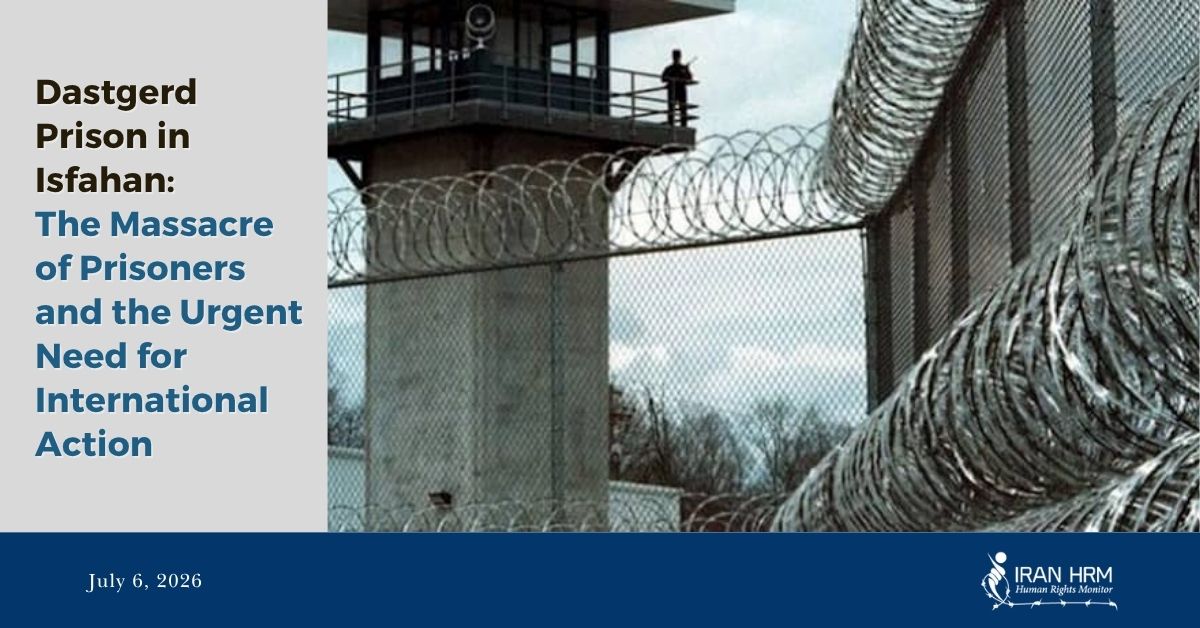
Based on testimonies gathered from eyewitnesses, former detainees, and families of prisoners, the events of March 31, 2026 at Dastgerd Prison in Isfahan constitute grave violations of the right to life, the absolute prohibition of torture and other cruel, inhuman, or degrading treatment or punishment, the right to medical healthcare, the families’ right to know the truth, and the right to an independent and effective investigation.

According to compiled accounts, the crisis at Dastgerd Prison was triggered when projectiles struck a military barracks located directly behind the prison complex, as well as parts of the prison facility itself. However, what transforms this incident into a severe human rights crisis is not merely the explosions and subsequent fire, but the state authorities’ catastrophic and violent response to the prisoners.
Inmates who fled their cells amidst thick smoke, dust, fire, and the imminent fear of structural collapse were not evacuated to a safe zone; instead, they were met with containment, armed blockades, live ammunition, birdshot, tear gas, brutal beatings, and subsequent punitive isolation.
To establish accountability, this report meticulously reconstructs the timeline of events based on eyewitness accounts: the impact of the projectiles, the abandonment of guard posts by prison personnel, the exit of prisoners from their wards, their pleas for emergency exit routes to be opened, the authorities’ refusal to respond, the deployment of the Special Unit forces, the indiscriminate shooting of inmates, the desperate flight of individuals into burning sections for cover, the deaths of numerous prisoners by fire or gunfire, the mass removal of corpses, the enforced silence imposed on families, the transfer of survivors to a high-security punitive ward, post-incident torture and systemic deprivation, and the fabrication of new judicial charges against the survivors.
- The Onset of the Crisis: Projectile Strikes, Fire, and the Abandonment of Wards
Witnesses state that on March 31, 2026 (11 Farvardin 1405), amidst ongoing military conflicts, a military barracks located behind Dastgerd Prison in Isfahan was targeted by air strikes. Simultaneously, two projectiles struck the interior of the prison complex: one hit the soldiers’ barracks and the other landed near the rear wall of the facility, adjacent to a highly restricted sector linked to the Ministry of Intelligence, referred to by inmates as “ALFETA”. The sheer force of the explosions tore off structural ceiling panels and doors across various wards, while shrapnel penetrated the prison’s textile workshop, igniting a massive blaze in that sector.
Following the blasts, inmates report that tower guards and a significant portion of the prison staff abandoned their posts, leaving security gates unattended. Believing the building was collapsing or that the fire would engulf their cells, prisoners broke out of their immediate wards to save their lives. Inmates from Consultation Ward 4 emerged first, followed closely by prisoners from Units 1 and 2, who crowded into the central corridor. Testimonies confirm that their primary demand was the immediate opening of exit routes to the adjacent courtyard to escape the asphyxiating smoke, dust, and advancing fire.
Witnesses emphasize that the prisoners’ exit at this stage was not an organized riot, but an instinctual, life-saving reaction to an immediate hazard. The accumulation of smoke, heavy debris dust, and the deafening sound of explosions triggered widespread panic. In brief, frantic phone calls to their families during those initial hours, inmates reported severe respiratory distress and complete uncertainty regarding the structural integrity of the facility.
- Siege of the Prison and Intervention of Special Unit Forces
As panic escalated inside the facility, forces belonging to the Special Unit—who had reportedly been stationed around the prison perimeter and the opposite Agricultural Jihad zone since the 12-day military conflict in May/June 2025—surrounded the complex. Witnesses state that these heavily armed forces ordered the prisoners through Gate 36 to return to their respective wards. However, with fire and toxic smoke rapidly expanding behind them, returning to smoke-filled cells meant facing certain death.
Families who had rushed to the prison perimeter out of extreme concern for their loved ones described a massive military blockade. Forces from the Islamic Revolutionary Guard Corps (IRGC), the Special Unit, and law enforcement completely sealed off all access routes and the highway facing the prison. Until the early hours of the following morning, the sounds of explosions, intense gunfire, and the screams and agonizing wails of prisoners echoed from inside the facility. Families were strictly barred from approaching the perimeter, making inquiries, or receiving any verified information regarding the state of the inmates.
- Indiscriminate Gunfire, Tear Gas, and Lethal Assaults on Inmates
The critical escalation into a lethal state crackdown occurred when the Special Unit forces infiltrated the interior of the prison. Rather than directing the desperate inmates toward secure assembly areas or establishing emergency evacuation corridors, the forces utilized live ammunition, birdshot, heavy tear gas, and severe physical violence to drive the prisoners back. Eyewitnesses recounted that the gunfire was so relentless that “human beings were falling like rain.” Numerous prisoners were shot while attempting to flee, while others, already wounded and immobilized on the ground, were killed by subsequent close-range gunfire or fatal beatings.
According to one detailed testimony, while localized tension between inmates and guards existed prior to the Special Unit’s arrival, the entire nature of the event shifted drastically once the Special Unit entered, turning into a mass shooting of unarmed prisoners. In a desperate bid to escape the gunfire, groups of prisoners fled toward sections already engulfed in flames; a large number sought refuge inside the prison hall, which was itself catching fire. The authorities deliberately locked the exit doors of the hall from the outside, trapping the inmates inside the burning structure and causing numerous fatalities due to fire and smoke inhalation.
Witnesses further stated that a vast number of wounded prisoners, after being shot or incapacitated, were subjected to secondary assaults with batons, cables, stun guns, wooden clubs, metallic objects, and bladed weapons. These assaults persisted until dawn. A former prisoner who survived the ordeal testified to pulling multiple corpses from underneath piles of bodies, and specifically witnessed the death of an inmate who succumbed to a live ammunition wound to the side, multiple birdshot entry wounds in the lower abdomen, severe head and neck lacerations, a severed Achilles tendon.
- Perishing in Fire, Asphyxiation, and the Mass Removal of Corpses
A significant portion of the fatalities resulted not only from direct gunfire but from thermal trauma and severe smoke inhalation. Inmates who had sought refuge from the gunfire inside the prison hall and adjacent sectors became trapped by the expanding fire. According to a harrowing account, after inmates entered the hall, the exit doors were intentionally locked from the outside, leaving the trapped prisoners to perish inside the inferno. The degree of thermal destruction on several bodies was so absolute that families reported identification was rendered impossible except through DNA matching and genetic sampling from parents.
Discrepancies remain regarding the exact death toll, given the total lack of state transparency. One witness asserted that the number of fatalities far exceeds any official metrics, estimating approximately 200 deaths. Another witness reported that on April 1, 2026, approximately 250 corpses were loaded into the cargo bed of a commercial orange Mercedes-Benz truck and driven out of the prison complex. On the night of April 2, 2026 (13 Farvardin), severely bloated, injured and disfigured bodies were transferred to the Legal Medicine Organization (State Medical Examiner) for processing. Verifying These figures require, above all, the uncoerced testimonies of the inmates and survivors themselves, followed by an independent investigation, access to the official prison registry, ambulance logs, forensic reports, CCTV footage, and uncoerced testimonies from prison staff.
- Families: Enforced Disappearance, Intimidation, and Deprivation of Mourning
From the day of the incident onward, families were subjected to a complete information blackout. According to relatives, until April 7, 2026, no verifiable information regarding the identity of the dead, wounded, or surviving prisoners was provided; instead, families were falsely told that their relatives had been placed in solitary confinement. Families stationed outside the walls during the assault reported hearing prolonged agonizing screams and groans from within, with some describing it as “the sound of human beings being slaughtered.”
In multiple instances, families were denied the right to view the bodies of the deceased, document their injuries, or hold independent memorial services. In one documented case, the body of a victim was so thoroughly incinerated that only the soles of his feet remained intact; despite this horrific condition, his family was denied hospital access prior to his death, and his corpse was withheld post-mortem. The authorities merely notified the family of a remote burial spot. Several families reported being left completely unaware of their loved ones’ burial locations for weeks or being barred from attending the burials under threat of arrest.
- Post-Suppression Repression: The Special Ward, Punitive Isolation, and Medical Deprivation
Following the suppression of the protest, dozens of surviving inmates were segregated by security forces and labeled as “instigators.” According to internal reports, a list of 75 prisoners was compiled, and they were transferred to a highly restrictive Special Ward. Relatives reported that five individuals from this specific group died shortly thereafter; while authorities registered the official cause of death as “smoke inhalation from the fire,” families maintain that they were executed via gunfire by prison guards. Another report corroborates that nearly 300 inmates from various wards were transferred to this Special Ward on the day following the massacre.
Inmates transferred to the Special Ward were reportedly held for approximately one month without access to telephone lines, completely cut off from the outside world, provided with sub-standard food rations, and denied basic hygienic amenities. Some survivors were subjected to hours of torture while bound by their hands and feet and blindfolded. Months after the incident, verified updates indicate that Consultation Ward 4 and Quarantine Unit 10 remain under strict punitive conditions; essential medications are systematically withheld from chronic patients, and medical supplies purchased and delivered to the prison gates by families fail to reach the intended inmates.
- Judicial Fabrications, Extortion of Infrastructure Damages, and Retaliatory Executions
Following the massacre, witnesses report that the Prosecutor’s Office and Ministry of Intelligence agents actively blamed the prisoners for the immense structural damage caused by the air strike projectiles, the explosion of the ammunition depot, and the resulting fires. In an attempt to extort the cost of rehabilitation, the judiciary has opened multiple fabricated criminal files against surviving inmates, compiling what witnesses describe as a “litany of manufactured security charges.” This tactic—clearly aimed at shifting liability away from the state and punishing survivors—demands an immediate independent legal review.
Furthermore, several families and co-detainees have reported the execution of multiple prisoners in the months following the incident, stating that these executions are directly retaliatory and tied to the events of Dastgerd Prison. Specifically, in the case of Reza Pedram Asivand, who was executed shortly after the events, the state judiciary registered his official cause of execution under pre-existing drug-related offenses. However, witnesses assert that his drug charges had not yet received a final judicial confirmation, and his execution was fast-tracked as a punitive measure for his role and presence during the Dastgerd events. This claim underscores the critical necessity of an independent audit of his judicial case file, trial timelines, access to counsel, and the validity of any confessions extracted under duress.
- Current Situation inside Isfahan’s Dastgerd Prison
The aggregate data compiled in this report paints a grim picture of the current conditions inside Dastgerd Prison, where inmates face severe, compounded crises in the present time: extreme overpopulation, a critical deficit of beds forcing many to sleep on concrete floors, restricted access to basic seasonal clothing, substandard food rations, systemic medical neglect, severely restricted family contact, perpetual intelligence surveillance, and brutal disciplinary reprisals against any peaceful grievance.
Compounding these issues are consistent reports of physical abuse inside solitary confinement cells, the pervasive use of degrading and dehumanizing slurs by guards, and intense psychological warfare. Also the influx of hundreds of detainees arrested during the nationwide protests of January 2026 (Dey 1404) has pushed the facility far past its operational capacity, exacerbating these violations. Given the severity of these ongoing abuses, it is expected that independent monitoring bodies are granted immediate access to investigate complaints, review these reports, and guarantee the legal rights of detainees.
Methodology and Standard of Proof
This report is compiled using verified testimonies from eyewitnesses, extensive data from former political prisoners, direct declarations from victims’ families, and structural information smuggled out of Dastgerd Prison. Operating under extreme security crackdowns, total communication blackouts, the witnesses’ profound fear of state retaliation, and the complete absence of access to official public records, maximum effort has been made to publicize and inform about this massacre in this report.
The consistent, repeating patterns across entirely independent testimonies—specifically detailing the projectile impacts, the subsequent fire, the non-violent exit of prisoners for self-preservation, the tactical assault by the Special Unit, the mass shooting, the secondary beatings, the concealed removal of corpses, and the intimidation of mourning families—provide a highly credible threshold of proof that demands immediate international intervention. This document serves as a formal request for the preservation of evidence and the opening of a comprehensive independent investigation.
Applicable International Legal Framework
Incarcerated individuals, by virtue of being under the absolute custody and control of the state, fall under a heightened standard of state protection. The right to life, the absolute prohibition of torture and cruel, inhuman, or degrading treatment or punishment, the right to humane treatment during detention, and the right to medical care are non-derogable norms of international human rights law. Under the International Covenant on Civil and Political Rights (ICCPR), to which Iran is a state party, no one shall be arbitrarily deprived of life, and the state maintains an absolute obligation to prevent predictable and preventable deaths in custody.
The United Nations Standard Minimum Rules for the Treatment of Prisoners (The Nelson Mandela Rules) explicitly mandate that all prisoners must be treated with the respect due to their inherent dignity as human beings. They guarantee access to necessary medical care, prohibit the severance of family communication, and strictly ban collective punishments, physical violence, and degrading disciplinary measures. The documented actions at Dastgerd Prison—including the withholding of medical supplies, punitive isolation, denial of family contact, and physical assaults on wounded persons—stand in flagrant violation of these international benchmarks.
Furthermore, the prohibition of torture is absolute and universal; no emergency situation, state of war, national security threat, or instruction from a superior officer can ever be invoked to justify it. When credible indicators of mass slaughter, torture, or suspicious custodial deaths emerge, international law obligates the global community to launch an immediate, independent, and impartial inquiry to uncover the truth, protect witnesses from reprisal, and bring the perpetrators to justice before an independent tribunal.
Legal Analysis based on Documented Events: Violation of the Right to Life and the Unlawful Use of Lethal Force
Because the inmates were under total custody of the state, the legal responsibility for protecting their lives rested entirely upon the prison administration and the intervening security forces. Using live ammunition against fleeing inmates, the execution of immobilized wounded persons, the intentional sealing of emergency exit routes, and the abandonment of individuals inside a burning facility constitute a catastrophic and arbitrary deprivation of life.
Under the UN Human Rights Committee’s General Comment No. 36 on Article 6 of the ICCPR, the right to life is the supreme right from which no derogation is permitted, obligating states to investigate every single instance of state-inflicted or preventable death with total transparency.
Summary of Documented Findings
- The exit of prisoners from their cells occurred purely as a spontaneous, instinctual reaction to save their lives from incoming explosions, smoke, and structural fire, and must be legally evaluated strictly within that context.
- Instead of initiating a safe civilian evacuation, the state deployed the Special Unit and paramilitary forces who used automatic rifles, birdshot, tear gas, and severe physical trauma to suppress the inmates.
- The fatalities occurred through multiple state-inflicted avenues: direct gunshot wounds, extensive thermal burns, asphyxiation due to locked exit doors, fatal physical trauma from beatings, and the deliberate withholding of emergency medical triage.
- The late-night removal of corpses via commercial transport, the enforcement of an information blackout on families, the restriction of body identification, the ban on forensic photography, and the forced secret burials constitute a clear, systematic pattern of post-incident cover-up and destruction of evidence.
- The punitive relocation of dozens or hundreds of survivors to the Special Ward, the severance of communication, and the denial of food and critical medication prove that the violent state suppression continued long after the gunfire ceased.
- The weaponization of the judiciary to extort infrastructure costs from the victims through manufactured security indictments requires an immediate, independent, and international investigation.
Specific Demands to the Special Rapporteur and UN Mechanisms
This appeal, given the extreme gravity and scale of the atrocities, is submitted directly to the following bodies, demanding decisive and resolute action:
- United Nations Human Rights Mechanisms: Ms. Mai Sato (the Special Rapporteur on the situation of human rights in the Islamic Republic of Iran), the Special Rapporteur on Torture, the Special Rapporteur on Extrajudicial, Summary or Arbitrary Executions, and other relevant mandate holders.
- International Non-Governmental Organizations: Amnesty International and all global human rights organizations defending human rights.
This case demands an immediate, public, and verifiable international response; silence is not an option. Consequently, it is most essential that the following urgent demands and measures are placed on the immediate global agenda:
- The Special Rapporteur on Iran and the Special Rapporteur on Torture need to immediately initiate a joint formal urgent appeal and communication to the government of the Islamic Republic of Iran regarding the events at Dastgerd Prison.
- The Iranian government must be compelled to immediately publish a complete and verified registry of all deceased, wounded, segregated, re-arrested, and newly indicted prisoners connected to the post-incident crackdown.
- The state must be demanded to preserve and grant independent legal investigators full access to all interior and perimeter CCTV footage, internal medical logs, state forensic examiner autopsies, morgue transit registries, ambulance logs, and operational rosters of the Special Unit and IRGC forces present on site.
- The immediate establishment of an independent, impartial, and effective inquiry into the unlawful use of lethal force, the deaths by thermal trauma and asphyxiation, the allegations of torture, the denial of medical care, and the systematic intimidation of families.
- Extending immediate international protection guarantees to all surviving eyewitnesses, victims’ families, insider informants, and prison staff who possess relevant testimony and evidence.
- Ensuring that families are granted unhindered access to accurate information, valid death certificates, uncensored autopsy reports, the return of remains, and the right to conduct public religious mourning ceremonies free from judicial harassment, intimidation, or arrest.
- Securing immediate, unhindered access to independent medical doctors, prescription medications, legal counsel, and family telephone lines for all inmates currently held under punitive isolation or transferred to the Special Ward.
- Demanding the absolute cessation of all retaliatory judicial indictments built upon confessions extracted under torture, duress, or without due process and fair trial guarantees.
- Urging the international community, including the Office of the UN High Commissioner for Human Rights (OHCHR), the Special Rapporteur on Iran, the Special Rapporteur on Torture, the Working Group on Arbitrary Detention, and mechanisms related to extrajudicial executions to place the Dastgerd Prison crisis on their active emergency agendas.
Epilogue: The Imperative for Action over Expression of Concern
The atrocities documented at Dastgerd Prison in Isfahan, if left unaddressed by international accountability mechanisms, will inevitably transform into yet another historical instance of the state’s cycle of violence: massacre, absolute denial, systemic intimidation of families, and total institutional impunity. The international community cannot afford to wait until the physical crime scenes are permanently altered, security footage is destroyed, witnesses are disappeared, or severely wounded survivors succumb to their injuries in isolation. Every single day of international delay increases the risk of the permanent erasure of truth.
The UN Special Rapporteur, thematic mandate holders, member states of the UN Human Rights Council, international non-governmental organizations, and responsible international press agencies are urged to treat the Dastgerd Prison crisis as an active, urgent human rights file. Diplomatic and legal pressure must be applied to ensure the preservation of forensic evidence, protect vulnerable families, and lay the groundwork for prosecuting both the perpetrators and the high-ranking officials who sanctioned this slaughter. The victims, the families, and the traumatized survivors require far more than passive statements of sympathy—they require truth, justice, immediate medical intervention, legal protection, and guarantees of non-repetition.