Ten More at Risk
On July 13, 2026, Iran Human Rights Monitor issued a critical warning and an urgent call for international action, revealing the imminent risk of execution facing 12 protesters detained during the January 2026 (Dey 1404) uprisings in the case known as the “Alikhani Square of Isfahan.” These defendants were sentenced to death and in some cases, multiple death sentences, in three separate one-hour sessions, completely deprived of the right to choose independent counsel. The names and sentences of the 12 individuals are as follows:

- Alireza Sepahi, 24 (Four death sentences)
- Abolfazl Sepahi, 23 (Three death sentences)
- Ghaem Hosseini, 20 (Two death sentences)
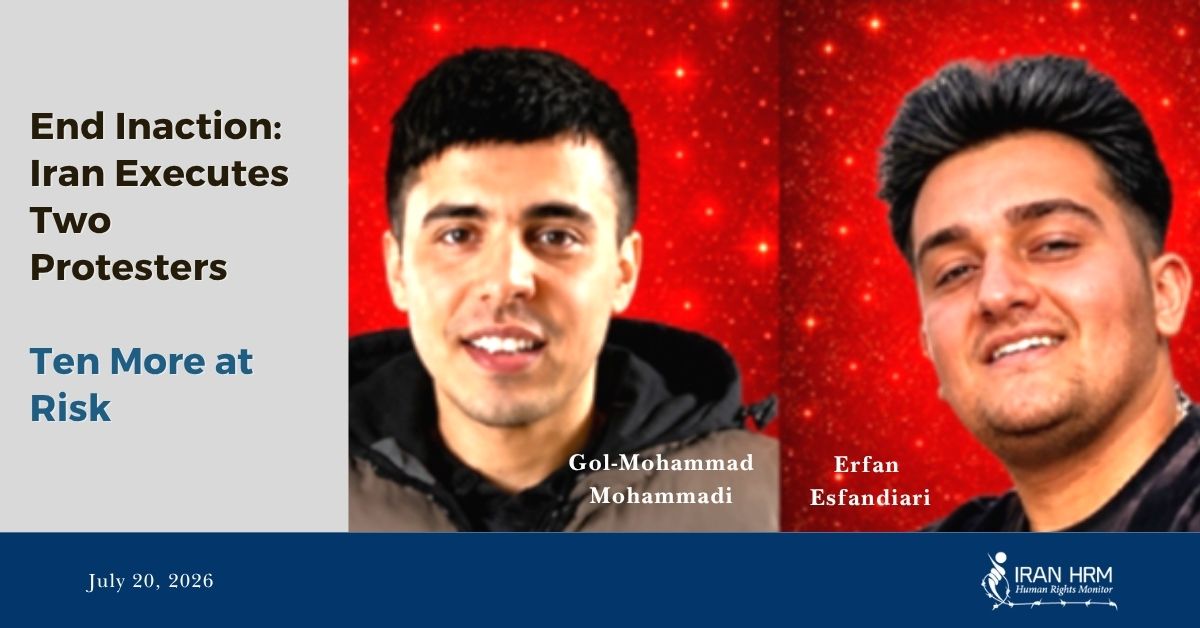
- Gol-Mohammad Mohammadi, an Afghan citizen, 23 (One death sentence – Executed)
- Shervin Bagherian, 18 (Two death sentences)
- Erfan Esfandiari, 18 (One death sentence – Executed)
- Amirhossein Safari, 27 (One death sentence)
- Amirhossein Maleki, 19 (One death sentence)
- Ali Dashti, 19 (One death sentence)
- Abolfazl Ebrahimi, 18 (One death sentence)
- Alireza Raeisi, 21 (One death sentence)
- Amirhossein Ebrahimi Analoucheh, 19 (Two death sentences)
Since the issuance of this warning, unfortunately, two of these detained protesters, Erfan Esfandiari (18) and Gol-Mohammad Mohammadi (23), were executed on July 19, 2026, in Isfahan.
Details of the Executions of Erfan Esfandiari and Gol-Mohammad Mohammadi in Isfahan
The judiciary of the Islamic Republic hanged the two aforementioned protesters on charges including “involvement in the deaths of 4 law enforcement officers, carrying firearms and cold weapons, and destroying a police station with the intent to overthrow the regime.” In addition to executing these two individuals, the judiciary has placed 10 other defendants from the same case on death row under identical charges.
On the morning of Saturday, July 18, all 12 death-row prisoners were removed from the general ward of Dastgerd Prison in Isfahan under the false pretext of “meeting the case judge” and transferred to solitary confinement. This sudden relocation triggered widespread protests and strikes among the remaining inmates. Following the execution of the first two prisoners, 10 remaining detainees now face an immediate and absolute risk of execution.
Grave Concerns Over the Fate of Alireza and Abolfazl Sepahi
Alireza Sepahi (24) and Abolfazl Sepahi (23), who are cousins, are among the 10 prisoners currently held in solitary confinement. Following what their families described as a “final visitation,” fears regarding their imminent execution have intensified. All defendants in this case have been denied access to independent legal counsel; even state-appointed lawyers were denied meaningful access to case files. Furthermore, the court systematically ignored defensive evidence and the defendants’ statements regarding confessions extracted under severe torture and duress. According to an informed source close to the case, defense evidence and CCTV footage proving that Alireza and Abolfazl Sepahi were not even present at Alikhani Square at the time of the incident were completely dismissed.
Flagrant Violations of Due Process: Executions as a Tool for Political Survival
The denial of chosen counsel, the withholding of case files, the implementation of court sessions partially via video conference lasting a mere 3 hours to issue death sentences, and the systematic dismissal of defense evidence and CCTV footage all underscore a flagrant violation of due process. Issuing sentences such as four death penalties for Alireza and three for Abolfazl Sepahi clearly demonstrates that these political executions serve solely to terrorize society and prevent protests against the Islamic Republic that has entirely lost its legitimacy among its people, and the government is determined to carry out these executions by any means necessary.
A Test for the International Community: Where Do You Stand on Human Rights?
In the past week alone, four protesters arrested in connection with the January 2026 nationwide uprising have been executed by the Iranian authorities: Aref Khoshkar in Qezel Hesar Prison, and Mohammad Amini Dehaqani, Erfan Esfandiari, and Gol-Mohammad Mohammadi in Isfahan. At the same time, at least 10 other protesters remain at imminent risk of execution. Meanwhile, approximately 1,500 death-row prisoners convicted of ordinary crimes in Qezel Hesar Prison have entered the seventh day of a hunger strike in protest against executions and in defense of the right to life.
This sharp escalation in the use of the death penalty constitutes a critical test for the international community, the United Nations, and all human rights mechanisms. Silence, inaction, or responses limited to expressions of concern risk emboldening the Iranian authorities to continue carrying out arbitrary executions in violation of international human rights law.
The UN Human Rights Council, the High Commissioner, and democratic governments must immediately deploy tangible, measurable political and diplomatic leverage. Summoning the ambassadors, imposing human rights sanctions on the judges and perpetrators of these sentences, and conditioning bilateral political and economic relations on an immediate moratorium on executions are the minimum actions demanded by human conscience today.
The time for expressions of concern alone has passed. Immediate and concrete action is urgently needed to help prevent further executions and protect those currently facing imminent execution. The response of the international community today will demonstrate its commitment to defending the right to life and upholding international human rights standards.