
Cases of Political Prisoners Sentenced to Death in Iran
Case No. 8 | Case ID: IRN-DP-1404-008 | Last reviewed: 8 December 2025

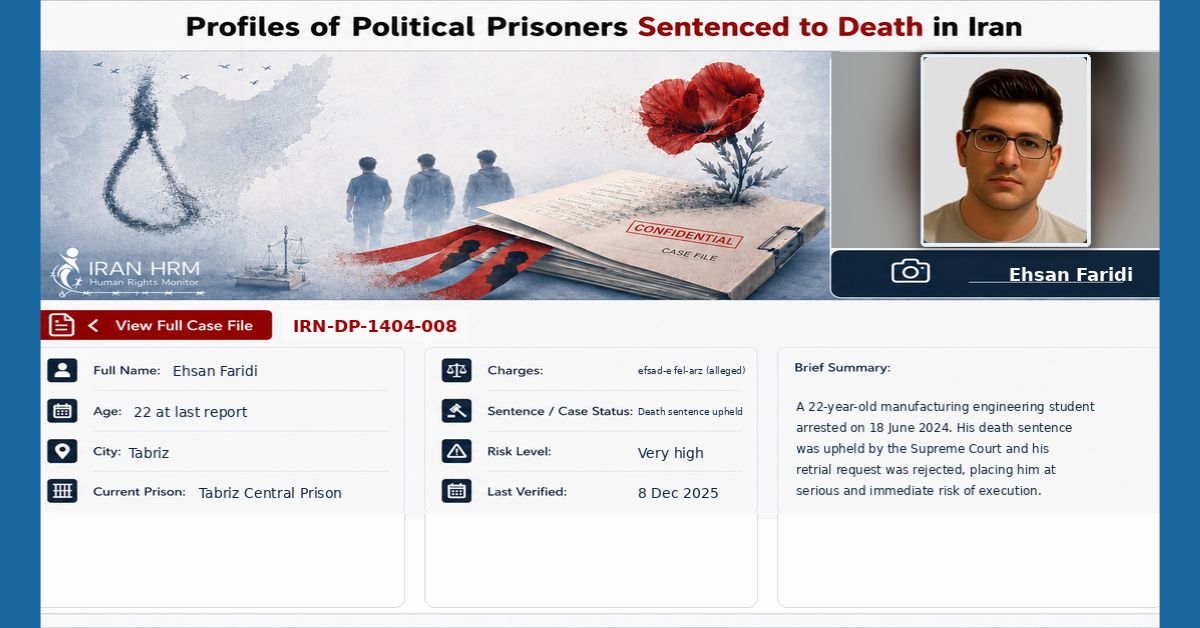
| Ehsan Faridi, born in 2003–2004 and a manufacturing engineering student in Tabriz, was arrested on 18 June 2024 when he attended the Tabriz Prosecutor’s Office. Branch 3 of the Tabriz Revolutionary Court sentenced him to death on the attributed charge of efsad-e fel-arz (corruption on Earth). The Supreme Court upheld the sentence and rejected his request for retrial. He is held in Tabriz Central Prison and faces a very high risk of execution. |
Key Case Information
| Category | Information |
| Full name | Ehsan Faridi |
| Date of birth | 2003–2004; exact date unknown |
| Age | 22 at the latest published report |
| Occupation before arrest | Manufacturing engineering student, University of Tabriz |
| Family status | Unknown |
| Date and place of arrest | 18 June 2024, Tabriz Prosecutor’s Office; first arrested on 8 March 2024 |
| Charges | Efsad-e fel-arz (corruption on Earth); earlier labels included attempted moharebeh, moharebeh and propaganda against the state |
| Court | Branch 3 of the Tabriz Revolutionary Court; Supreme Court |
| Judge | Hassan Fathpour; earlier reports differed on the branch and judge |
| Lawyer | Mahmoud Behzadi-Rad; full access to the case file was reportedly restricted |
| Sentence | Death; upheld by the Supreme Court; retrial request rejected |
| Current place of detention | Tabriz Central Prison |
Human and Personal Background
Ehsan Faridi is from Tabriz and was born in the Iranian year 1382, corresponding to 2003–2004. Before his detention, he studied manufacturing engineering at the Technical Faculty of the University of Tabriz. He was described as 22 years old in the latest available reports, although his exact date of birth is unknown.
Arrest, Trial and Sentencing
He was first arrested on 8 March 2024 and released on bail on 18 March. In connection with that detention, he faced the charge of “propaganda against the state” and received a six-month prison sentence. On 18 June 2024, while attending Branch 15 of the Tabriz Prosecutor’s Office, Faridi was rearrested and transferred to Tabriz Central Prison.
The labels applied to the allegations changed at different stages from “attempted moharebeh” and moharebeh (enmity against God) to efsad-e fel-arz (corruption on Earth). Early reports also referred to alleged membership of the People’s Mojahedin Organization of Iran, while later reporting identified efsad-e fel-arz as the basis of the death sentence. Branch 3 of the Tabriz Revolutionary Court, presided over by Judge Hassan Fathpour, imposed the death sentence. According to counsel, the lawyers were not given full access to the case file and the evidence underpinning the judgment has not been made public.
The Supreme Court upheld the sentence on 9 October 2025. A subsequent request for retrial was rejected. Mahmoud Behzadi-Rad said the request was dismissed within a very short period. None of the available case information attributes an intentional killing to Ehsan Faridi.
Statements from Prison or by Family
After a period of silence reportedly caused by security pressure, Faridi’s mother, Parvin Hayati, said in a public message: “For two full years, I climbed the steps of the prosecutor’s office and the court in fear, hoping that my son’s innocence would be established, and I remained silent … but from today I will no longer remain silent, because I believe that silence in the face of injustice is a betrayal.” She appealed to the public and international institutions to act to save her son’s life.
Government Response and Conduct
Reports indicate that the Tabriz Intelligence Department pressured the family not to publicise the case. In October 2025, Faridi was temporarily transferred to an Intelligence Department detention facility and returned to the general ward on 21 October. Reports have alleged physical and psychological pressure, denial of access to counsel of choice and attempts to obtain coerced confessions. Allegations of corruption and a request for a bribe were also made against the investigator who prepared the indictment; he was reportedly later removed from the judiciary. All these allegations require an independent investigation.
Civil and Student Reactions
On 2 November 2025, 537 Azerbaijani national and civil activists called for the death sentence to be quashed. On 8 December, a group of students at Tabriz University of Medical Sciences also expressed concern about the judicial process, the investigator’s role and the rapid rejection of the retrial request. The reviewed materials contained no case-specific statement by the United Nations, the Independent International Fact-Finding Mission or Amnesty International.
Current Status and Risk of Execution
According to the latest available information, Ehsan Faridi remains in Tabriz Central Prison. The Supreme Court’s confirmation of the death sentence and the rejection of his retrial request have significantly increased the risk of execution. The absence of transparent official information about enforcement of the sentence, together with the reported pressure on his family, makes the case urgent.
Human Rights and Fair Trial Analysis
Right to life: Article 6 of the International Covenant on Civil and Political Rights restricts the death penalty, in states that have not abolished it, to the “most serious crimes”, understood as offences involving intentional killing. The available information attributes no intentional killing to Faridi. The death sentence therefore raises grave concerns under Article 6.
Right to a fair trial: The repeated alteration of the charge, reported restrictions on the lawyers’ access to the case file, reliance on undisclosed security reports, absence of publicly available evidence and rapid rejection of the retrial request raise serious concerns under Article 14 of the Covenant. These concern adequate notice of the charge, sufficient facilities for the defence, effective access to counsel and adjudication by an independent and impartial tribunal.
Prohibition of torture and coerced confession: The reports of physical and psychological pressure, restrictions on contact and attempts to obtain coerced confessions would, if confirmed, be incompatible with Article 7 of the Covenant and the prohibition on using statements obtained through compulsion. The allegations must be independently investigated and any coerced statement excluded from the proceedings.
Conclusion
Ehsan Faridi faces the irreversible punishment of death despite shifting charges, undisclosed evidence, reported restrictions on the defence and the rejection of his retrial request. The absence of any allegation of intentional killing and the serious procedural concerns require an immediate halt to execution and an independent review of the case.
Urgent Appeal
United Nations bodies, the Independent International Fact-Finding Mission, Special Rapporteurs, Amnesty International, governments and international human rights organisations are urged to act immediately to protect Ehsan Faridi’s right to life and fair-trial rights and to prevent his execution.
- Immediately halt any step towards execution and formally disclose the enforcement status of the sentence.
- Quash the death sentence and grant an effective and independent retrial.
- Guarantee immediate and confidential access to counsel of choice and the complete case file.
- Publish the judgment, evidence and legal basis for the sentence and explain the repeated changes to the charge.
- Investigate independently the allegations of torture, coerced confession, judicial corruption and pressure on the family.
- Ensure any retrial takes place before an independent and impartial tribunal without recourse to the death penalty.
- Guarantee regular family contact and protect him from pressure and ill-treatment.