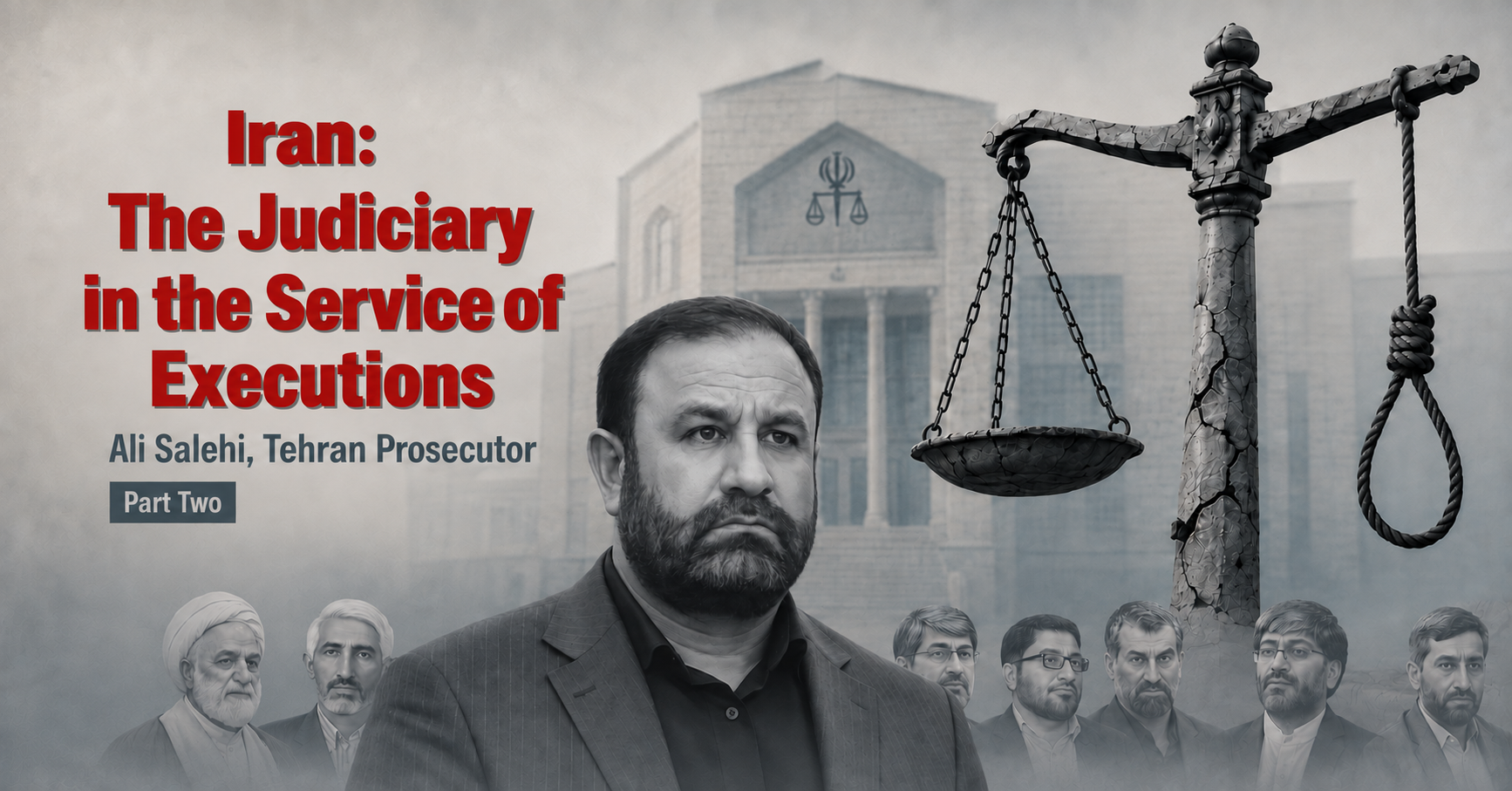
Ali Salehi: Prosecutor in Death Penalty Cases
This series examines the policy of repression and the unprecedented rise in executions in Iran, particularly following the protests of January 2026. The first report showed that, during the protests, the head of the judiciary urged prosecutors and courts to show no leniency. On 7 January 2026, Gholam-Hossein Mohseni-Eje’i said: “I say to the courts, I say to the prosecutors’ offices: this is no time for leniency towards these people.” A week later, while visiting prisons in Tehran, he stressed that judicial action must be “swift” and “timely”, and that a delay would not have “the same effect”. Mizan News Agency, 7 January 2026; televised report on Mohseni-Eje’i’s prison visit, 14 January 2026

This public emphasis on speed and impact, alongside the increase in death sentences, makes it necessary to examine officials with the authority to prosecute and advance protesters’ cases. Part Two focuses on Ali Salehi, the Public and Revolutionary Prosecutor of Tehran, and examines his statements and actions in this context: how has the Tehran Prosecutor’s Office contributed to the acceleration of cases that can result in execution?
Ali Salehi’s Judicial Career: From Shiraz to Tehran
Before becoming Tehran’s prosecutor, Ali Salehi headed the judiciary in Eqlid, led the Protection and Intelligence Office of the Fars provincial judiciary, served as prosecutor in Shiraz and headed the judiciary in Hormozgan province. In November 2021, Gholam-Hossein Mohseni-Eje’i appointed him Public and Revolutionary Prosecutor of Tehran. Mehr News Agency, 9 May 2019; Judiciary Media Centre announcement, 29 November 2021
As prosecutor of Shiraz, Salehi publicly announced the execution of a man in June 2016, saying he had been convicted of “spreading corruption on earth” (efsad-e fel-arz). His announcement demonstrates his public defence of the judicial process in that case; the death sentence was issued by a Revolutionary Court. Tasnim News Agency, 5 June 2016
In response to public gatherings and labour protests, Salehi announced the arrest of organisers of a gathering at Pasargadae in late October 2016. He said they had “chanted norm-breaking and anti-value slogans”. In September 2018, during a lorry drivers’ strike, he spoke of taking firm action against people he said were obstructing the transport of goods and raised the possibility of a charge of “enmity against God” (moharebeh), which can carry the death penalty. Zeitoons, 31 October 2016, citing Mizan; Radio Zamaneh, 27 September 2018
As head of the Hormozgan provincial judiciary, Salehi announced in August 2019 that a prisoner convicted in a drug-related case had been executed in Bandar Abbas Central Prison. Referring to the judgment of the Bandar Abbas Revolutionary Court, he said: “The sentence was carried out in Bandar Abbas Central Prison.” Iran Human Rights, 25 August 2019, citing Mizan
These statements, particularly the suggestion that a strike could lead to a moharebeh charge, provide documented context for examining Salehi’s conduct as Tehran’s prosecutor. Following the 2022 protests, that charge was associated with death sentences in protesters’ cases.
Tehran Prosecutor’s Office During the 2022 Protests
Following the death of Mahsa (Jina) Amini and the start of nationwide protests in 2022, the Tehran Prosecutor’s Office, headed by Ali Salehi, began bringing cases against detainees. Salehi announced that indictments had been issued for 315 people and that indictments charging four people with moharebeh had also been issued. Shabestan News Agency, 24 October 2022
He listed other charges, including “assembly and collusion with the intention of acting against national security”, “propaganda against the system” and “disruption of public order”. These figures and charges came from the Tehran prosecutor’s own account of the work of the office he headed. Shabestan News Agency, 24 October 2022
The use of moharebeh in protest cases was particularly significant because the charge can lead to execution. Salehi’s statement shows that the Tehran Prosecutor’s Office had included it in indictments during the first weeks of the protests. The announcement did not identify the four defendants. Shabestan News Agency, 24 October 2022
At the time, international human rights organisations warned against capital charges being brought against protesters and raised concerns about the absence of fair trial safeguards. A few weeks later, the execution of Mohsen Shekari gave those concerns immediate and concrete force. His case shows how a moharebeh charge arising from the 2022 protests resulted in an execution.
Mohsen Shekari: The First Protest-Related Execution in 2022
Mohsen Shekari was arrested during the protests in Tehran and sentenced to death by a Revolutionary Court on a charge of moharebeh. According to the judiciary, he had blocked a road on Sattarkhan Street and wounded a member of the Basij with a bladed weapon. This was the authorities’ account of the allegations; the court relied on it in its judgment, which was subsequently upheld by the Supreme Court. Shekari was executed on 8 December 2022, the first execution that Iranian officials announced in connection with that year’s protests. Reuters report on the judiciary’s announcement; European External Action Service statement, 8 December 2022
Only 18 days elapsed between the sentence on 20 November and its implementation on 8 December. Amnesty International described the trial and review proceedings as grossly unfair and warned that the speed of the process deprived Shekari of a meaningful opportunity to defend himself. The organisation also emphasised that the allegations against him did not involve intentional killing, whereas international standards restrict the death penalty to the most serious crimes involving intentional killing. Amnesty International, 8 December 2022
After Shekari’s execution, Amnesty International said that the Iranian authorities had acted on their public threats to expedite capital proceedings, and warned that other protesters under sentence of death were at risk. The European Union also condemned his execution and called on Iran to stop using forced confessions broadcast by the media as evidence and to respect defendants’ due process rights. Amnesty International; European External Action Service
Shekari’s case was heard within the Tehran judicial jurisdiction during Ali Salehi’s tenure as prosecutor. Several weeks before the execution, Salehi had publicly announced indictments charging four protest detainees with moharebeh. What this case clearly establishes is that a protester was swiftly executed within the jurisdiction of the Tehran Prosecutor’s Office at a time when its head had announced the use of a capital charge against detainees. Salehi’s statement, 24 October 2022; Amnesty International on the execution
Mehdi Hassani and Behrouz Ehsani Eslamloo
Mehdi Hassani and Behrouz Ehsani Eslamloo were arrested in 2022. In August–September 2024, Branch 26 of the Tehran Revolutionary Court, presided over by Iman Afshari, sentenced them to death. In its announcement of their executions, Mizan News Agency identified “armed rebellion” (baghy) as the basis of their convictions. Mizan also said that the indictment included other charges, among them moharebeh, and that the Supreme Court had upheld the sentences. Mizan News Agency, 27 July 2025; Iran Human Rights on the trial and sentences
The two men were executed on 27 July 2025 in Ghezel Hesar Prison. Amnesty International reported that they and their families received no prior notice and that they were denied a final visit. Maryam Hassani, Mehdi Hassani’s daughter, also said in a video message that the family had not known of her father’s impending execution. Before their deaths, both men had participated in the prisoners’ “No to Execution Tuesdays” campaign and protested against capital punishment. Amnesty International, 28 July 2025; Iran Human Rights, 27 July 2025
Amnesty International said the men had been denied access to a lawyer for nearly two years, that their trial had lasted only five minutes and that they had had no opportunity to defend themselves. It also reported that confessions extracted under duress, including after beatings and prolonged solitary confinement, were used against them; the men themselves had denied the authorities’ allegations. These findings conflict with the judiciary’s account that the “full process of criminal procedure” had been followed. Kristine Beckerle, Amnesty International’s Deputy Regional Director, described the executions as an example of the use of capital punishment to suppress dissent and spread fear in society. Amnesty International, 28 July 2025; Mizan News Agency, 27 July 2025
The indictment in this case was issued within the jurisdiction of the Tehran Prosecutor’s Office during Ali Salehi’s tenure; the judiciary itself recorded the issuance of an indictment in its official account. Mizan did not, however, identify the person who drafted or signed it, or the official who ordered the executions. The relevant judicial records would be needed to establish Salehi’s personal role in those decisions. Mizan News Agency, 27 July 2025
Tehran Amid the Surge in Executions After the January 2026 Protests
On 13 January 2026, Tehran prosecutor Ali Salehi said that cases involving allegations of moharebeh would be sent to court within “the next three or four days”. He also called for protest-related cases to be addressed “as soon as possible”. At a time when detainees faced capital charges, this statement indicated that the Tehran Prosecutor’s Office was moving towards expedited proceedings. Mehr News Agency, 13 January 2026
The consequences of this approach can be seen in cases in Tehran: Amirhossein Hatami, Mohammadamin Biglari, Shahin Vahedparast Kalur and Ali Fahim, four people convicted in a case connected with protests in eastern Tehran, were executed within a five-day period in April 2026. HRANA, report on the eastern Tehran case
In July 2026, Salehi also said that protest-related cases had been sent from the Tehran Prosecutor’s Office to court and that some of the sentences across the set of cases he referred to, including final death sentences, had already been carried out. Tasnim News Agency, 14 July 2026
Women and Compulsory Hijab
As Tehran’s prosecutor, Ali Salehi has made enforcement of compulsory hijab part of the prosecutor’s work. At a meeting on 19 November 2025, more than three years after the protests sparked by Mahsa (Jina) Amini’s death, he said that alongside cultural measures, “restrictive and enforcement measures are necessary”. Salehi called for monitoring online activity and for law-enforcement officers to intervene in matters concerning clothing. He also referred to the rapid handling of related cases by the Special Prosecutor’s Office for Moral Security. His statements show that the Tehran Prosecutor’s Office continues to treat women’s clothing as a matter for surveillance and judicial intervention, an approach that restricts women’s freedom to choose what they wear and to participate freely in public life. Asr-e Iran, 19 November 2025
International Responses to Ali Salehi’s Conduct
Ali Salehi has also been named in official sanctions decisions. On 8 December 2023, the United Kingdom sanctioned him among five individuals linked to the enforcement of compulsory hijab in Iran. Salehi is expressly named in the UK government’s announcement. UK Government, 8 December 2023
On 14 April 2025, the European Union added Salehi to its human rights sanctions list. The official decision states that, as Tehran’s prosecutor, he participated in the prosecution of women who refused to comply with the compulsory hijab law, as well as students and protesters. The EU also cited his participation in the issuance and implementation of death sentences and the authorisation of torture of prisoners, and described him as “responsible for serious human rights violations in Iran”. These are the EU’s stated grounds for sanctioning Salehi. Official Journal of the European Union, 14 April 2025
Conclusion
Ali Salehi’s record as Tehran’s prosecutor cannot be assessed by his title alone. In the first weeks of the 2022 protests, he announced indictments against 315 people and said that four people had also been indicted on moharebeh charges, which can lead to execution. The execution of Mohsen Shekari and the other cases examined in this report reveal the human consequences of the use of capital punishment in the context of the suppression of protests. Following Shekari’s execution, Amnesty International warned that the acceleration of capital proceedings placed other protesters’ lives at risk. Shabestan News Agency, 24 October 2022; Amnesty International, 8 December 2022
Personal responsibility for each execution must be assessed on the basis of the records of the individual case. Nevertheless, Salehi’s public statements about indictments and sentences, together with his position at the head of the Tehran Prosecutor’s Office, make scrutiny of the institution’s conduct and his role necessary. His inclusion on the UK and EU human rights sanctions lists shows that this conduct has also become the subject of international calls for accountability. “Iran’s Judiciary in the Service of Executions” will continue, examining the roles of other judicial officials in prosecution, sentencing and the implementation of death sentences. UK Government; Official Journal of the European Union