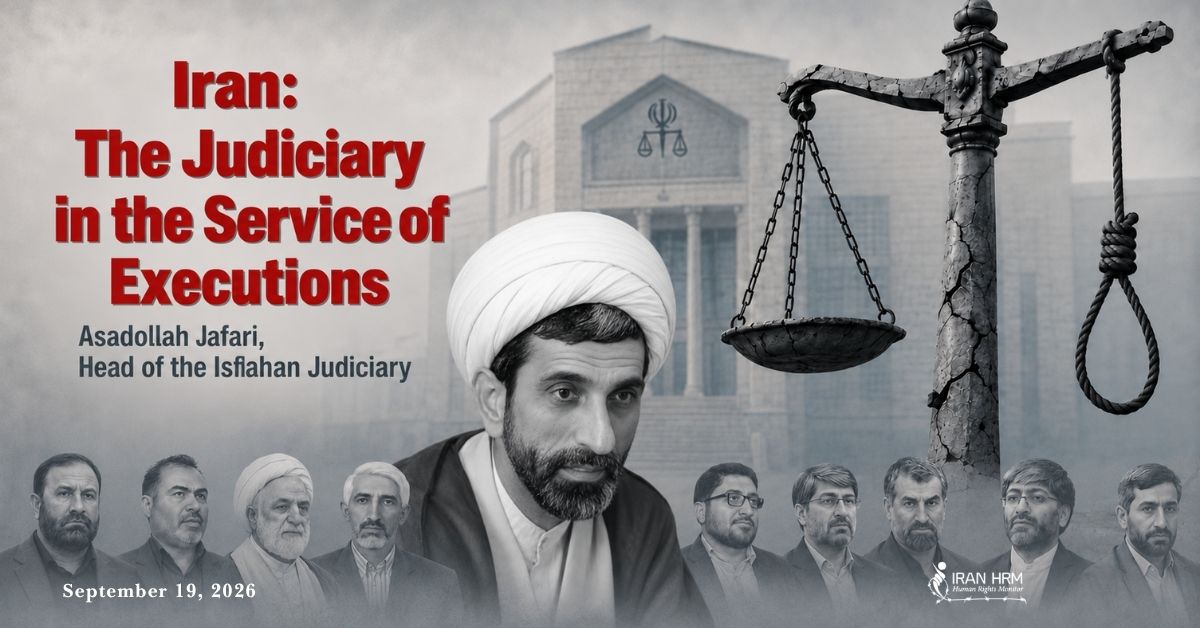
Iran: The Judiciary in the Service of Executions – Part Three
Executions in Iran do not result solely from judgments issued by Revolutionary Courts. Prosecutors’ offices, provincial chief justices, judges, the Supreme Court and sentence enforcement units form different parts of a process that links the arrest of protesters to death sentences and their implementation.

Part Three of the series “Iran: The Judiciary in the Service of Executions” examines Asadollah Jafari. He was appointed Chief Justice of Isfahan Province in November 2021. His tenure has included the executions of defendants in the “House of Isfahan” case, the opening of thousands of cases against protesters, public executions in Ali-Khani Square and the implementation of amputation sentences.
This report examines Jafari’s judicial record, public statements and role in these cases. It distinguishes between direct involvement, supervisory responsibility and events that occurred during his tenure without evidence of his personal participation.
The role of the province’s highest judicial authority in the execution of protesters
and the use of amputation
Asadollah Jafari’s judicial career
Asadollah Jafari served as Public and Revolutionary Prosecutor of Mazandaran Province from May 2007 until December 2017. He subsequently served for nearly four years as Chief Justice of North Khorasan Province.
On 4 November 2021, Jafari became Chief Justice of Isfahan Province and remained in office at least until 22 August 2026. The Isfahan water protests, the nationwide uprising of 2022 and the January 2026 protests occurred during this period. His recorded statements indicate that he played an active role in setting provincial judicial policy, initiating cases against protesters and publicly defending actions taken by the judiciary.
Record of executions and amputation
Jafari’s record was associated with executions and corporal punishment before his appointment in Isfahan. The European Union has stated that, while serving as prosecutor in Mazandaran, he sought the death penalty in cases under his prosecution, resulting in a significant number of executions, including public executions.
In 2013, after four fingers of a prisoner’s hand were amputated, Jafari described the punishment as one of the judiciary’s “religious and legal duties” and stated: “The issuing and implementation of such sentences are among the legitimate demands of the people.” On 10 June 2025, as Chief Justice of Isfahan Province, he also announced the amputation of the hands of two prisoners in Isfahan Central Prison. According to Jafari, the sentences were implemented after being upheld by the Supreme Court.
Thousands of cases against protesters
In June 2026, Jafari stated that more than 4,000 cases relating to protests had been opened in Isfahan Province and that indictments had been issued against thousands of defendants. According to him, the resulting punishments ranged from fines and lengthy prison terms to death sentences, and proceedings would continue “without leniency”. The “House of Isfahan”, “Ali-Khani Square” and “Shohada Square” cases are the most prominent examples of this process.
The House of Isfahan case
The “House of Isfahan” case arose from protests on 16 November 2022, when three members of government forces were killed. Saleh Mirhashemi, Majid Kazemi and Saeed Yaghoubi were subsequently arrested and sentenced to death on the charge of moharebeh, or “enmity against God”.
Their arrest and trial were accompanied by reports of torture, forced confessions and denial of access to lawyers of their own choosing. Documented allegations concerning Majid Kazemi included beatings, electric shocks, mock executions and threats against members of his family. In an audio message from prison, he also said that he had not possessed a weapon and had been tortured into making statements dictated by interrogators.
In December 2022-January 2023, Jafari described the torture allegations as “untrue” and said that the charges had been established on the basis of “evidence” and “confessions”. He confirmed Majid Kazemi’s transfer out of the general ward and, on 29 March 2023, called for the Supreme Court to announce its final decision promptly.
United Nations special rapporteurs warned on 18 May 2023 that the sentences were at imminent risk of being implemented. All three men were nevertheless executed the following day, 19 May, in Dastgerd Prison in Isfahan. There is no evidence that Jafari personally issued the death sentences or signed the final execution orders. However, his rejection of the torture reports, reliance on contested confessions and request for an expedited Supreme Court decision demonstrate his direct involvement in defending and advancing the proceedings.
The Ali-Khani Square case
The Ali-Khani Square case is the most significant case involving the execution of protesters during Jafari’s tenure. It followed protests on 8 January 2026, during which, according to the Iranian authorities, four members of the police and Basij were killed. At least 59 people were arrested. Twelve were sentenced to death and 23 others received prison terms of between five and ten years.
Those sentenced to death were Alireza Sepahi, 24; Abolfazl Sepahi, 23; Ghaem Hosseini, 20; Gol-Mohammad Mohammadi, 23; Shervin Bagherian, 18; Erfan Esfandiari, 18; Amirhossein Safari Hosseinabadi, 27; Amirhossein Maleki, 19; Ali Dashti, 19; Abolfazl Ebrahimi, 18; Alireza Reisi, 21; and Amirhossein Ebrahimi Enalucheh, 19. Several received more than one death sentence.
Erfan Esfandiari and Gol-Mohammad Mohammadi were executed in Dastgerd Prison on 19 July 2026. Six days later, the Independent International Fact-Finding Mission on the Islamic Republic of Iran reported that at least ten other defendants faced imminent execution and that the families of two had been summoned for “final visits”. The Mission called for the executions to be halted and expressed concern about fair trial guarantees, effective legal representation and the defendants’ access to fair proceedings.
On 28 July 2026, Abolfazl Sepahi and Amirhossein Safari Hosseinabadi were executed in public in Ali-Khani Square on Jafari’s orders. Security forces were positioned in surrounding streets and on nearby rooftops. People present protested against the executions and, according to reports, officers used tear gas to disperse them. The return of executions to a public space, at the site of the protests themselves, turned capital punishment into a display of judicial power and an instrument of intimidation.
Supplementary information received by the Iran Human Rights Society also identifies Ghaem Hosseini as having been executed, although the available information does not establish the exact date. Seven other defendants remain at risk of execution. Denial of the defendants’ right to choose their lawyers, restrictions on court-appointed lawyers’ access to the case file and the collective imposition of death sentences raise serious concerns about the integrity of the proceedings.
The Shohada Square case in Isfahan
This case concerns 16 people arrested in connection with the January 2026 protests. Several defendants owned or worked in shoe shops around Shohada Square and had no known history of political activity. Three women, Taraneh Rahimi, Romina Rahimi and Setayesh Saedi, are among the defendants.
The first hearing was held on 13 July 2026 inside Dastgerd Prison rather than in a courthouse. Defence lawyers had no access to significant parts of the case file, and their request for an adjournment was refused. Ahmadreza Saeidi told the judges that interrogators had beaten him and administered electric shocks to his neck and genitals. One of the female defendants also alleged that she had been sexually assaulted during her arrest. The court issued its judgment without examining these complaints.
At first instance, Branch One of the Revolutionary Court of Isfahan sentenced Taraneh Rahimi, Navid Elyasi, Abolfazl Dadgostar, Mehdi Mansouri, Ahmadreza Saeidi, Mehrdad Boeri, Mohammadmehdi Asadi, Armin Gholami, Parsa Jafari and Mehdi Jafari, also known as Mehdi Khosravi, to death.
Romina Rahimi and Milad Boeri were each sentenced to 25 years’ imprisonment, Hamed Mehralian to 15 years, and Setayesh Saedi, Sajjad Abedi and Ali Boeri to five years each. All 16 defendants also received separate sentences on charges including “assembly and collusion”, “incitement” and “propaganda against the system”.
Although a member of the Islamic Revolutionary Guard Corps and a homeless civilian were killed during the protests, the indictment did not charge the defendants directly with either killing, and no evidence was presented demonstrating any defendant’s specific involvement in the two deaths. No evidence has been published that Jafari personally signed the sentences. Nevertheless, holding the trial inside a prison, restricting lawyers’ access and failing to examine allegations of torture and sexual assault engage his supervisory responsibility as the province’s highest judicial authority.
Women and compulsory hijab
In September 2015, while serving as prosecutor in Mazandaran, Jafari announced coordination between the prosecutor’s office, the police and the Basij to take action against women who, in his words, did not “observe Islamic norms”. He said that judicial cases had been opened against a number of women at beaches and recreational areas, and insisted that “no negligence is acceptable” in confronting what he called “manifestations of vice and immorality”. This policy made women’s clothing and presence in public spaces subject to intervention by the police, the Basij and the judiciary.
European Union sanctions
In its official statement of reasons for sanctioning Jafari, the European Union states that, as a prosecutor in Mazandaran, he sought the death penalty, resulting in numerous executions, including public executions. The same statement identifies him as responsible for unlawful arrests and violations of the rights of Baha’i detainees, from their initial arrest through their detention in solitary confinement at an Intelligence Ministry detention centre.
Regarding Isfahan, the European Union states that Jafari ordered a violent response against protesters during the November 2021 water protests, established a special office to investigate detainees and ordered that some participants in the 2022 protests be convicted. EU sanctions are restrictive measures and do not constitute a criminal conviction by a court. Their official statement of reasons nevertheless records Jafari’s history of seeking death sentences, suppressing protests and violating detainees’ rights.
Human rights assessment and Jafari’s responsibility
Imposing death sentences following trials marked by allegations of torture, forced confessions and denial of access to lawyers of the defendants’ own choosing violates the rights to life and a fair trial under Articles 6, 7 and 14 of the International Covenant on Civil and Political Rights. Torture to obtain confessions and denial of the right to counsel also contravene Articles 35 and 38 of the Constitution of the Islamic Republic of Iran. Amputation and the use of public executions to intimidate society constitute cruel, inhuman or degrading punishment.
The evidence concerning Jafari’s role is not the same in every case. In the House of Isfahan case, he rejected torture reports and pressed for an expedited process. In the Ali-Khani Square case, the available information attributes the order for the public executions to him. In the Shohada Square case, his responsibility is primarily supervisory and institutional. As head of the provincial judiciary, he is accountable for the conduct of its courts, prosecutors’ offices and sentence enforcement units, particularly where allegations of torture and sexual assault remain without an independent investigation.
Conclusion
From his tenure as prosecutor in Mazandaran to his leadership of the judiciary in Isfahan, Jafari’s record has included seeking and defending executions, implementing amputation sentences, prosecuting women over compulsory hijab and pursuing protesters on a large scale. The executions in the House of Isfahan case, the death sentences and executions in the Ali-Khani Square case, and the ten death sentences in the Shohada Square case demonstrate that capital punishment has become one of the tools used against protest by the judicial apparatus under his leadership.
The remaining death sentences must be halted, and allegations of torture, sexual assault and forced confessions must be investigated by an independent body. Jafari and other responsible officials must be held accountable for their roles in issuing, upholding and implementing these sentences.