Executive Summary
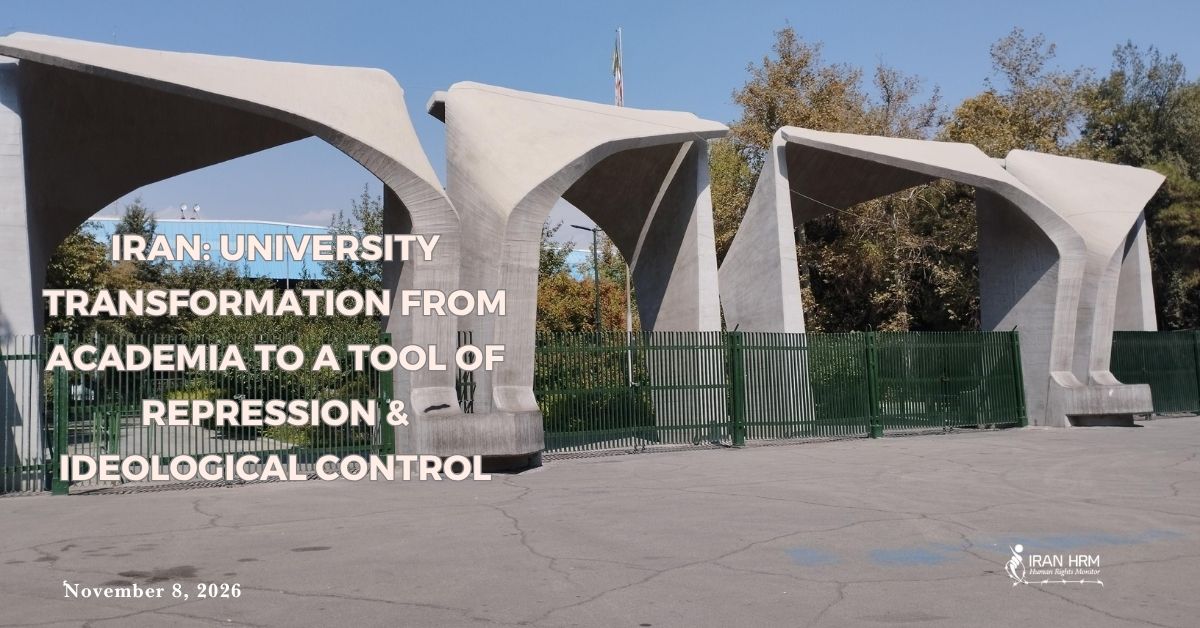
This report examines the escalating ideologization and security governance of higher education in the Islamic Republic of Iran—a process through which the university has been transformed from an independent academic and educational institution into an instrument for the government’s political, ideological, and security objectives.

An analysis of official government statements, institutional documents, student expulsions and suspensions, intelligence interventions in academic environments, and documented human rights reports reveals that the crackdown on critical students and faculty members cannot be viewed as isolated or sporadic incidents. Rather, these actions form part of a structural policy whose broader and fundamental objective is to establish an authoritarian model of governance for the complete subjugation of the academic sphere, the imposition of ideological monopoly, the eradication of critical thought, and the systemic suppression of the independence of educational institutions.
The available evidence demonstrates that the Iranian government views the university not as a space for independent research, the free exchange of ideas, and scientific critique, but as a “bastion,” the “frontline of cognitive warfare,” a “center for clarifying propaganda (Jihad-e Tabyin),” and part of the ideological defense mechanism of the state. Within this framework, faculty members are designated as “commanders” and students as “officers,” and the university is expected to actively participate in reproducing the official state narrative and countering critical viewpoints.
Concurrently, to confront any independent voice, the ruling authorities go beyond administrative pressures—resorting to systematic repression, intimidating intelligence summons, judicial case-building, arbitrary detentions, severe educational deprivations, chain expulsions, and even the deprivation of the right to life (such as the execution of student protesters)—to raise the cost of free thought and independent activity to the highest possible level. Recent reports from the University of Sistan and Baluchestan, the University of Tehran, and other higher education institutions across the country document examples of this trend.
This report concludes that the ideologization and securitization of higher education in Iran constitute a systematic and severe violation of Iran’s international obligations regarding the right to education, academic freedom, freedom of expression, freedom of assembly, and institutional autonomy, and require an immediate and decisive response from international human rights mechanisms.
Introduction and Legal Framework
In human rights-based systems, the university is not merely a place for the transfer of knowledge or the training of human resources; rather, it is a social institution whose mission is the independent production of knowledge, the cultivation of critical thinking, the development of free research, and participation in societal advancement.
According to international standards, academic freedom and institutional autonomy are fundamental prerequisites for higher education. In its “Recommendation concerning the Status of Higher-Teaching Personnel (1997),” UNESCO asserts that higher education can only fulfill its mission in an atmosphere of academic freedom, institutional autonomy, and freedom of expression. Furthermore, the United Nations Special Rapporteur on the right to education has repeatedly underscored academic freedom as an inseparable component of the right to education and an essential condition for academic dynamism and social development.
The situation examined in this report is directly related to the international obligations of the Islamic Republic of Iran under the following instruments:
- Article 13 of the International Covenant on Economic, Social and Cultural Rights (Right to Education)
- Article 19 of the International Covenant on Civil and Political Rights (Freedom of Expression)
- Article 21 of the International Covenant on Civil and Political Rights (Freedom of Peaceful Assembly)
- Article 22 of the International Covenant on Civil and Political Rights (Freedom of Association)
- The principle of non-discrimination in access to education
- International standards concerning academic freedom and institutional autonomy
From a human rights perspective, a university can only fulfill its mission when professors, researchers, and students are able to conduct research, teach, and express their views without fear of security persecution, administrative punishment, educational deprivation, or political pressure. Any structural intervention by political power in this process undermines university independence and alters the fundamental nature of higher education.
Section I: The University in the Eyes of the Islamic Republic: An Academic Institution or a Political and Ideological Arm of the State?
An examination of official statements published by state-affiliated entities demonstrates that the Islamic Republic of Iran has defined a mission for universities that extends far beyond education, research, and knowledge production.
In an official note by Vahid Arayi, Deputy of Scientific and Research Affairs of the University Basij Professors Organization, published on the occasion of the start of the academic year 2026, the university is presented not as an independent academic institution, but as an integral part of a political project titled the “Resurrected Nation.” He explicitly states that the “Resurrected University” is an institution whose duty is to “transform a popular epic into a scientific, cultural, and political mission” and to become the “boiling point of a resurrected nation to defend Islamic Iran.”
In the same note, the university’s responsibilities are outlined as “explaining and shedding light on the actions of the American-Zionist enemy,” countering “enemy plots,” participating in “the jihad of clarification (Jihad-e Tabyin),” “instilling hope,” and defending the official state narrative. These missions are inherently political and ideological rather than educational or research-oriented.
The significance of this framing becomes clearer as Arayi calls the university the “frontline of cognitive warfare” and defines paramilitary roles for members of the academic community. In this narrative, professors are described as “commanders” and students as “officers” of the jihad of clarification front. Furthermore, the university is introduced as a “civilization-building pillar” and an “Ummah-building core,” expected to operate entirely within the framework of the state’s ideological goals.
These descriptions are not mere political metaphors. They demonstrate that the Islamic Republic has assigned a role to the university that is intrinsically in conflict with the concept of institutional autonomy. In this view, the university is not a space for the free examination of ideas, the critique of power, and the independent production of knowledge, but rather part of the state apparatus designed to preserve and reproduce official ideology.
This perspective stands in direct opposition to the fundamental principles emphasized in UNESCO documents and the reports of the UN Special Rapporteur on the right to education. International standards mandate that the role of the university is to provide an environment for presenting diverse viewpoints, conducting independent research, and fostering free critique; however, in the official state narrative, the university is tasked with defending a specific political worldview and countering competing narratives.
The natural consequence of such a definition is the creation of a distinction between the “desirable student” and the “undesirable student.” A student operating within the official state discourse is viewed as an “officer of the jihad of clarification”; however, a student who criticizes state policies, pursues union demands, engages in social protest, or puts forward independent views gradually becomes the target of disciplinary, security, and judicial actions.
For this reason, the suspension, expulsion, summoning, and punishment of students cannot be viewed merely as sporadic responses to student activism. These measures align directly with the initial definition that assigned a political and ideological role to the university. When the university is transformed into a “bastion” and the student into an “officer,” any independent or critical activity is interpreted as a deviation from the state’s expected mission, laying the groundwork for security crackdowns.
Section II: From the Ideological University to the Securitized University
If ideologization reflects the Islamic Republic’s vision for the university, securitization is the practical tool used to realize this vision. Available evidence indicates that in recent years, the authorities have not only sought to align the academic environment with state political and ideological goals, but have also increasingly relied on security, intelligence, and disciplinary mechanisms to achieve this objective.
According to documented reports, dozens of students from the University of Sistan and Baluchestan have been summoned to the Ministry of Intelligence (Intelligence Department) since late October / early November. During these interrogations, students faced accusations such as “ringleading,” “inciting university riots,” and “mercenary work,” with several subjected to pressure to provide self-incriminating confessions or inform on fellow students. Concurrently, a number of students received two-term academic suspension orders, and some were coerced into providing intelligence bodies with information regarding other students, personal communications, and campus activities. Such practices effectively reduce students’ academic and social relationships to subjects of security surveillance.
More alarmingly, reports indicate the transfer of student files and personal details from university disciplinary committees to intelligence agencies. If confirmed, this demonstrates that disciplinary committees—whose mandate should be strictly educational and administrative—have been converted into intermediaries between higher education institutions and security organs. This trend severely blurs the boundary between academia and intelligence apparatuses, completely dismantling student trust in institutional mechanisms.
From a human rights perspective, these developments represent more than individual violations of privacy or educational rights. The direct entry of intelligence agencies into universities and the instrumentalization of campus mechanisms to gather intelligence on students transform the higher education environment into a climate governed by fear, surveillance, and self-censorship. In such an atmosphere, students and faculty members are forced to navigate their scientific, union, and social activities under security considerations, refraining from freely expressing their views.
Within this framework, the securitization of the university is no longer a peripheral phenomenon; it is an element of a broader policy aimed at controlling thought production, restricting independent student organizations, and preventing the emergence of a critical sphere in universities. This situation directly conflicts with the fundamental principles of academic freedom and institutional autonomy, stripping the university of its primary function as a domain for the free generation and exchange of knowledge.
Section III: Punishment of Critical Students and Faculty: From Expulsion and Suspension to Elimination from Higher Education
One of the most significant tools utilized by the government to control the academic community is the instrumentalization of disciplinary mechanisms for political punishment. While disciplinary regulations in many educational systems are designed to maintain academic order, available evidence indicates that in Iran, these mechanisms are increasingly deployed to target critical, protesting, or active students.
In November 2026, it was reported that Parsa Qobakhloo, a 2025 entering student in electrical engineering at the University of Tehran, was sentenced to expulsion from the university by the disciplinary committee. Prior to him, Mahyar Eftekhari and Amirmohammad Karimi had also been expelled from the same university. Concurrently, reports indicate that at least 14 additional expulsion orders have been finalized and issued by the Ministry of Science’s disciplinary committee. These rulings have been linked to cases stemming from student protests and the aftermath of the academic uprisings of March 2026.
The volume of these expulsion orders demonstrates that we are not dealing with isolated cases. On the contrary, the imposition of educational deprivation and expulsion has become an integrated component of the policy to control universities. This trend gains even greater significance when placed alongside the official rhetoric of the state. While government officials speak of the university as a center of “inquiry,” “awareness,” and “elite renaissance,” in practice, students who exercise their right to question or participate in protest activities face elimination from the higher education system.
This situation reveals a fundamental contradiction. In the Islamic Republic’s desired university, a student is deemed valuable only when accepting the prescribed role of an “officer of the jihad of clarification”; however, when that same student critiques state policies, defends civil liberties, protests against security pressures, or participates in student gatherings, they are met with educational deprivation, disciplinary dossiers, and expulsion.
Educational deprivation and university expulsion not only impact the academic and professional futures of students but also send a chilling message to the entire academic community. These actions create an environment where students, to avoid similar consequences, refrain from participating in union, civil, and even scientific activities. The deterrent effect of such a policy extends far beyond the targeted individuals, resulting in the constriction of the public sphere of universities.
For this reason, widespread student expulsions and suspensions cannot be analyzed merely as administrative or educational decisions. These measures form part of a broader pattern aimed at subverting student independence, weakening academic associations, and exercising political control over the higher education landscape. Within this framework, disciplinary committees, rather than fulfilling an educational and supportive role, have transformed into core instruments of pressure against students.
Systematic Repression and Purging of Academic Faculty Members (“Purification” Plan)
An examination of faculty member dossiers reveals that crackdowns on critical professors or those sympathetic to student protests have been carried out through various mechanisms:
- Termination of Collaboration, Expulsion, and Forced Retirement: Ending contracts of fixed-term and contractual professors, non-renewal of academic appointments, and issuing early retirement orders for veteran faculty members.
- Suspension from Teaching and Withholding of Salaries: Depriving professors of classroom access, cutting off access to university educational portals, and withholding salaries and financial benefits.
- Summons to Disciplinary Boards and Security Entities: Summoning faculty members to university disciplinary boards and external intelligence/security agencies to coerce them into signing commitments and to impose ideological pressure.
- Ideological Replacement (“Purification” Plan): Concurrently recruiting and replacing individuals aligned with state-affiliated factions and associated entities (such as the Basij Professors Organization) without adhering to standard academic and scholarly procedures.
Documented Names and Cases of Targeted Faculty Members
Some of the most prominent cases and professors who have faced expulsion, suspension, termination of collaboration, or judicial pressure in recent years include:
-
- Dr. Ali Sharifi Zarchi (Former Assistant Professor of Mathematical Bioinformatics at the Department of Computer Engineering, Sharif University of Technology, Head of the Scientific Committee of the International Artificial Intelligence Olympiad, and member of the Scientific Committee of the International Olympiad in Informatics) – Expelled and collaboration terminated.
- Dr. Azin Movahed (Professor at the Faculty of Fine Arts / Theater) – Suspended and salary withheld.
- Dr. Mehdi Khoee (Professor of Sociology at Allameh Tabataba’i University) – Expelled and contract terminated.
- Dr. Dariush Rahnamian (Professor at the Department of History) – Suspended and teaching courses cancelled.
- Dr. Roham Afghani (Faculty member in Architecture at Shahid Beheshti University) – Collaboration terminated and expelled.
- Dr. Behrouz Chamanara (Professor at the University of Kurdistan and Kurdish language and literature researcher) – Public disqualification and expulsion.
- Dr. Somayeh Sima (Professor of Civil Engineering at Tarbiat Modares University) – Expelled and collaboration terminated.
Section IV: Student Protests and the State’s Response
Widespread student protests following the reopening of universities in March 2026 marked one of the most critical turning points in the relationship between the state and the academic community. During this period, numerous universities across the country witnessed student rallies, sit-ins, and demonstrations, with students demanding the release of political prisoners, an end to the repression of academics, the revocation of disciplinary rulings, and respect for university autonomy.
Slogans and statements issued by students demonstrated that a significant segment of the academic community views the university as a domain for freedom, critique, and intellectual independence. In some statements, the university was characterized as a “bastion of freedom”—a definition standing in stark contrast to the state’s official narrative of the university as a “bastion of the jihad of clarification” and the “frontline of cognitive warfare.”
In November 2026, a group of students at the Faculty of Social Sciences at the University of Tehran staged a sit-in to protest security and disciplinary pressures. The release of political prisoners and detained students, the cancellation of disciplinary sanctions, and accountability from university administration regarding state pressure were among their primary demands. Slogans such as “Imprisoned students must be freed” and “The student is awake, detesting tyranny” illustrated that student protests were not merely about isolated cases but concerned the fundamental nature of the university and the boundaries of state intervention.
The state’s response to these protests has relied primarily on security and disciplinary mechanisms. The summoning of students, opening of disciplinary files, suspensions, expulsions, arrests, and intense pressure on student activists demonstrate that rather than addressing academic grievances, the authorities have sought to suppress protest spaces by inflating the cost of student activism.
These crackdowns highlight that the primary conflict between students and the state extends beyond specific union or political demands; it centers on the definition of the university’s identity. The academic community demands an independent, free, and non-securitized university, while the state endeavors to redefine higher education strictly within its political and ideological framework.
Section V: From Educational Deprivation to Imprisonment and Execution
Pressures exerted against students in the Islamic Republic of Iran are not limited to disciplinary actions or educational deprivations. Documented evidence reveals that critical and protesting students face a spectrum of punishments ranging from academic suspension and expulsion to detention, imprisonment, and the deprivation of the right to life.
Within this framework, Matin Faramarzpour, a Ph.D. candidate in philosophy at the University of Tabriz, was transferred to prison to serve out a custodial sentence. Additionally, Gunesh Fatih, a 21-year-old student from Naqadeh, was released temporarily on heavy bail after approximately one month of detention. These cases illustrate how students’ engagement with social and political issues rapidly draws them into criminal and security apparatuses.
The dossier of Shahin Shokouhi, a Ph.D. candidate in sociology at the University of Tehran, has raised grave concerns regarding student safety under security pressure. Student sources reported that on Sunday, November 1, Shahin Shokouhi committed Self-immolation
and was transferred to a medical facility. Reports indicate he had previously been repeatedly summoned to disciplinary committees and subjected to intense pressure by security agencies outside the university.
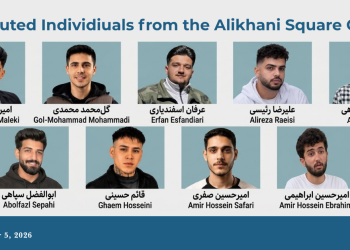
The most severe documented case during the period under review was the execution of Amirhossein Ebrahimi, a medical student, on November 3, 2026. He was executed alongside another defendant in connection with the case known as the “Meydan Alikhani” in Isfahan. Human rights reports have highlighted severe violations of due process, the use of coerced confessions, and the application of the death penalty linked to political protests in this dossier.
The alignment of educational deprivations, university expulsions, security summons, detentions, imprisonment, and executions demonstrates that state policy targeting students is not merely administrative oversight. Rather, it constitutes part of a broader apparatus designed to subjugate the academic environment and maximize the costs of independent student action.
Legal Assessment and Conclusion
The evidence presented in this report demonstrates that the primary issue facing Iranian universities is not merely the violation of the individual rights of a number of students or professors. The core issue is the fundamental transformation of the university’s identity—from an independent academic institution into a component of the state’s political, ideological, and security apparatus.
Official statements by state-affiliated figures indicate that the Islamic Republic has defined a political mission for higher education. When the university is framed as the “frontline of cognitive warfare,” the “center for the jihad of clarification,” and an instrument for defending the official state narrative—and when faculty members and students are characterized as “commanders” and “officers” of an ideological front—institutional autonomy as a foundational principle of higher education is rendered virtually meaningless.
In line with this doctrine, the summoning of students to intelligence agencies, requests to inform on peers, the transfer of student data to security bodies, the initiation of disciplinary proceedings, the issuance of suspension and expulsion orders, and the use of criminal mechanisms against academic activists cannot be viewed as isolated or exceptional actions. These measures are the logical outcome of a governance model that treats the university not as a space for independent critique and knowledge production, but as a tool for the reproduction of official ideology.
From an international legal perspective, this situation stands in severe violation of Iran’s obligations under Article 13 of the International Covenant on Economic, Social and Cultural Rights (ICESCR) regarding the right to education, Articles 19, 21, and 22 of the International Covenant on Civil and Political Rights (ICCPR) concerning freedom of expression, peaceful assembly, and association, as well as the established principles of academic freedom and institutional autonomy emphasized by UNESCO and the UN Special Rapporteur on the right to education.
Furthermore, the instrumentalization of educational deprivation and expulsion as punitive measures for student activism exerts a profound “chilling effect” across the entire academic community. Under such conditions, many students and professors refrain from expressing their views, participating in union activities, or engaging in sensitive research to avoid potential repercussions. The result is the gradual erosion of academic freedom, the expansion of self-censorship, and the severe restriction of the university’s intellectual space.
Accordingly, the securitization and ideologization of higher education in Iran must be classified not as a series of sporadic violations, but as a structural policy directly targeting academic freedom, institutional autonomy, and the right to education.
Therefore, the main issue in Iranian universities is not simply the violation of the rights of specific students or professors, but the establishment of a governance model that strips the university of its natural academic functions and transforms it into an instrument for political and ideological control over society.