Executive Summary
On the evening of 14 November 2026, a bus carrying staff and engineers of the Dehloran oil and gas complex overturned on the Dasht Abbas to Murmuri road in Abdanan, Ilam Province. According to subsequent reports, 13 people were killed and 14 injured. Three days later, on Tuesday 17 November 2026, hundreds and then several thousand residents of Abdanan took to the streets to demand clarification of the cause of the accident, accountability of officials, and action on unsafe roads and unsafe transport of workers.

The response to this gathering was extensive deployment of security and police forces, firing tear gas and reports of pellet gun fire, severe disruption of internet access, and the arbitrary detention of at least 7 people. Among those detained was a 15-year-old child who, after two hours of interrogation at the Abdanan Intelligence Office, was released on a written undertaking. As of the time of writing, no information is available on the place of detention, status, or charges against most of the detainees.
This crackdown took place only one day after Gholamhossein Mohseni Ejei, Head of the Judiciary, on Monday 16 November 2026, ordered the full implementation of the directive to reduce the prison population and to refrain from unnecessary detentions. At the same time as this order, the issuance of death sentences and long prison terms for detainees of the nationwide protests of December 2025- January 2026 continued, and two protesters in Karaj were executed on 8 November.
This report shows that the order of 15 November is not a sign of a change of approach by the Head of the Judiciary, but part of the dual conduct of the same authority who bears institutional and command responsibility for the judicial apparatus.
Gholamhossein Mohseni Ejei, who has headed the Judiciary since July 2021 by appointment of the Supreme Leader of the Islamic Republic and previously served as Minister of Intelligence, Prosecutor General, and First Deputy of the Judiciary, simultaneously ordered the acceleration of security cases on 31 October and on 31 August threatened that the Judiciary would act “more decisively than ever” in trying and punishing protesters.
Therefore, the issuance of an order to reduce detentions alongside continued arbitrary detentions in Abdanan and the issuance of death sentences for protesters is not a failure to implement a benevolent order, but an instrumental use of rights language to conceal the continuation of repression. The recurring pattern of arrests in Abdanan in recent months confirms the same conclusion.
The Underlying Incident: Bus Overturn and Death of 13 Engineers and Workers
On the evening of Saturday 14 November 2026, a bus carrying 30 employees of the Oil Industries Commissioning and Operation Company (OICO), working at the Dehloran Petro-Refinery complex, overturned on the Dasht Abbas to Murmuri road in Abdanan.
In the initial report, the number of dead was announced as 12 and the number of injured as 16. In subsequent reports, the number of dead rose to 13 and the number of injured was stated as 14. One of the injured said the bus had been travelling at high speed before overturning and had rolled several times after leaving the road.
Initial reports identified the unsafe road, the technical condition of the bus, and the driver’s performance as the main subjects of investigation into the accident. The Prosecutor of the provincial capital of Ilam initiated criminal proceedings against the CEO of Dehloran NGL Company and the Director General of Road Maintenance and Road Transport of the province, and the President has also ordered an investigation. However, as of the time of writing, the final result of the investigation into the responsibility of each factor has not been clarified, and the families of the deceased have not been transparently informed of the investigation process and expert findings.
Abdanan is a city that for years has faced deprivation, lack of infrastructure, unsafe roads, and limited employment opportunities. According to the Housing Foundation, more than 1,600 residential units in this county were damaged during the war. In such a context, the death of 13 workers became a spark for anger and a demand for accountability.
The Protest of 17 November: From a Demand for Accountability to a Peaceful Assembly
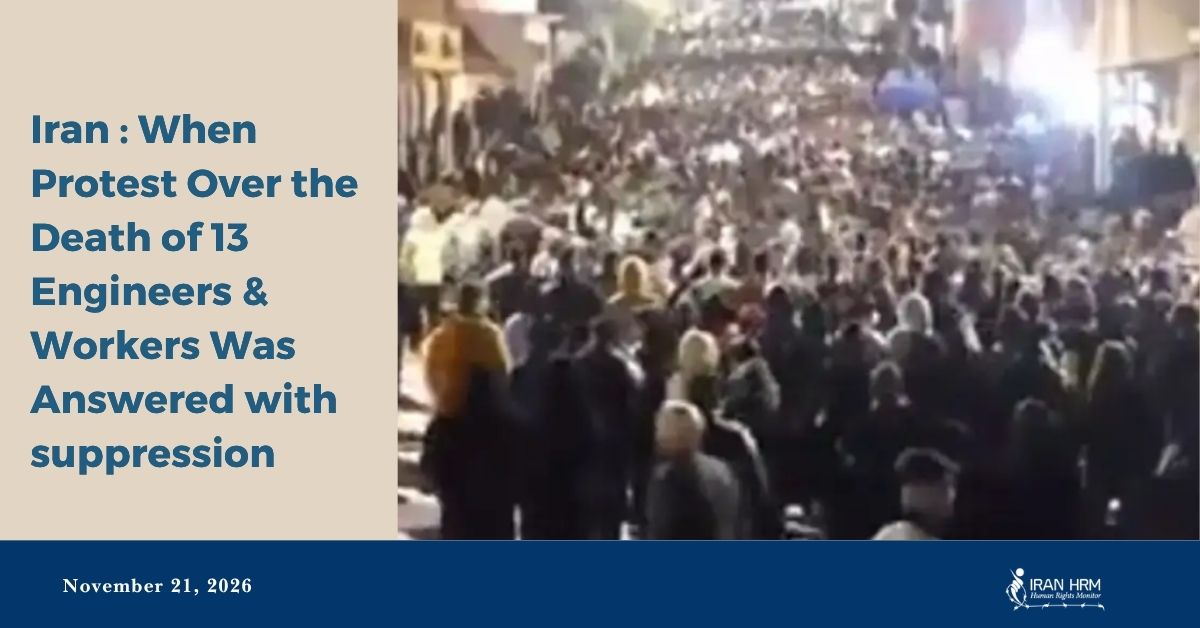
The gathering of the people of Abdanan on Tuesday 17 November 2026 began at Vali Asr Square. Protesters, chanting “Today is mourning, today is mourning” [Aza Azast Emrooz], “Resign, resign” [Estefa, Estefa] and “Incompetent official, resign, resign” [Masoul-e Bileiaghat, Estefa Estefa], demanded investigation into the accident and accountability of officials.
The number of participants was initially reported as several hundred and later rose to several thousand. The Fars News Agency, affiliated with the Islamic Revolutionary Guard Corps (IRGC), also confirmed the occurrence of the protest gathering and the increase in the crowd to several thousand. Part of the bazaar in the city also went on strike in solidarity with the protesters and the families of the deceased.
In the course of the gathering, groups of protesters also chanted political slogans. This does not negate the peaceful nature of the initial gathering. Under international standards, the right to peaceful assembly includes assemblies whose demand is criticism of officials and public policies, and chanting political slogans alone does not justify a security crackdown and arbitrary detention.
The Security Response: Tear Gas, Pellet Guns, Communications Shutdown, and Reports of Heavy Weapons
According to reports received, hours after the protests began, police and security forces and anti-riot special units were deployed in the streets of Abdanan. Reports have been published of clashes between protesters and security forces and the Basij, firing of tear gas, and firing of pellet guns at protesters.
At the same time, there are reports of shutdown or severe disruption of internet access in Abdanan and disruption of mobile phone lines. This shutdown coincided with the start of the protests and occurred in the early hours of the gatherings.
This pattern repeats the pattern observed during the crackdown on the nationwide protests of December 2025 – January 2026. In that period, widespread internet shutdowns were also aimed at preventing coordination among protesters and preventing the dissemination of images and field reports. On 8 and 9 January 2026, there were reports of the use of heavy weapons, including Dushka heavy machine guns, against citizens, which was accompanied by mass killings.
In Abdanan, there have also been reports of the transfer of DShK heavy weapons to the streets, the encirclement of parts of the city, and the beginning of arrests of protesters. Although these reports require independent verification, their coincidence with the internet shutdown and the experience of Dey 1404 shows that this combination, namely shutdown of communications and display and use of heavy weapons, is not an isolated incident, but a pattern for creating terror and preventing the spread of protest.
Shutdown of communications makes independent reporting on the situation of citizens and detainees, coordination for assistance, and documentation of the crackdown difficult, and at the same time increases the risk of unmonitored abuses.
According to reports, efforts have also been made to bring the families of the deceased into the formal investigation process. The aim of this measure has been to separate the families from the body of protesters: by drawing the families into the formal process and promising judicial follow-up, they are told that their demand will be pursued through administrative channels and that there is no need for street presence, while at the same time they are pressured not to allow the name and memory of their loved ones to become a symbol of protest and to be used in gatherings. In this way, an attempt is made to limit the incident to a purely technical and judicial case and to sever the link between the families’ demand for justice and the public protest.
The families of the deceased have the right to be transparently informed of the investigation process and expert findings, but this right must not be turned into a tool for isolating the families and controlling the official narrative.
The Detainees: At Least 7 People, Without Information on Place of Detention and Charges
The number of citizens detained in connection with the protest gathering in Abdanan has so far reached seven. The reported names are as follows:
- Asghar Akbari
- Armin Soleymani
- Iraj Heidari
- Saeed Abdollahi
- Behnam Moradi
- Sina Darvishi, 15 years old, was released after two hours of interrogation at the Abdanan Intelligence Office after signing a written pledge
- Peyman Karimzadeh
Another citizen, Mohsen Bavir, was also detained in connection with the gatherings and released after a couple of hours. Apart from Sina Darvishi and Mohsen Bavir, who have been released, as of the time of writing, no information has been obtained on the place of detention, status, and charges against the remaining detainees.
Detention without presentation of a judicial warrant, failure to inform the family of the place of detention, deprivation of access to a lawyer, and failure to inform the detainee of the charges, if confirmed, constitute arbitrary detention and a violation of the right to liberty and security of person. The detention of a 15-year-old child also raises the State’s special obligations towards children.
The Order of 16 November by Ejei: Words and Deeds
Gholamhossein Mohseni Ejei, Head of the Judiciary, on Monday 16 November 2026 at the meeting of the Supreme Council of the Judiciary, tasked the Prosecutor General with fully implementing the directive to reduce the prison population. He said that when there is no necessity to detain an accused person, a detention order should not be issued, nor should other orders be set that ultimately lead to the person’s imprisonment.
Ejei also said that even one night of detention can have serious consequences for the person and their family, and he asked judicial officials to continue visiting prisons.
Ejei has been Head of the Judiciary since 2021 and, due to his role in repression, detention, ill-treatment and forced confessions, has previously been placed on the human rights sanctions lists of the European Union, the United States and the United Kingdom. The European Union sanctioned him in 2011 for his role in torture and unfair trials, and the United Kingdom sanctioned him in 2022 for death sentences against protesters. He also said on 31 August 2026 that the Judiciary would act “more decisively than ever” in prosecuting and punishing protesters.
Therefore, his words of 25 Aban appear to emphasise respect for the rights of the accused, but the actual practice in the same period shows a different course:
- Successive issuance of death and prison sentences for protesters of the nationwide protests of December 2025– January 2026: Mohammad Mehdi Parsa in Ahvaz was sentenced to death and 20 years’ imprisonment, Omid Janmi in Isfahan to death, and Mohammad Mehdi Toghyani to 21 years’ imprisonment. In Mashhad, death sentences were issued for five detainees named Abolfazl Sadaghat, Matin Faryan, Vahid Khodrikhah, Ali Zaghi and Ilia Akbari. In Karaj, four defendants in a 14-defendant case were also sentenced to death.
- Execution of sentences: Hassan Divband and Hamid Kazemi, two detainees of the protests of 8 and 9 January 2026 (18 and 19 Dey 1404) in Karaj, were executed on 8 November 2026 in Qezel Hesar Prison. Their executions took place after reports of torture, forced confessions and mock executions.
- Prior order to accelerate security cases: On 31 October 2026, Ejei called for acceleration in deciding the cases of persons whom he described as accused of cooperation with the enemy and action against the state. In cases where charges such as *moharebeh* [waging war against God], *baghi* [armed rebellion], *efsad fil-arz* [spreading corruption on earth] and *ejtema va tabani* [assembly and collusion] are raised, emphasis on speed of proceedings can limit the opportunity for access to a lawyer, examination of evidence, and preparation of an effective defence.
The proof of this contradiction is Abdanan itself. One day after the order of 25 Aban to refrain from unnecessary detentions, the peaceful gathering of the people of Abdanan was answered with deployment of anti-riot special units (Yegan-e Vijeh), firing of tear gas, internet shutdown and detention of at least 7 people. Among the detainees was a 15-year-old child who was released after interrogation at the Intelligence Office after signing an undertaking, and there is no information on the status and charges of the others. When an order is violated within one day, in a specific and verifiable case, that order has been rendered void in practice. Abdanan proved that this order is not implemented and is only cover for the continuation of arbitrary detentions.
Abdanan in a Context of Repetition: History of Repression in This City
The November protest took place in a city that in recent months has repeatedly witnessed discontent, protest and security crackdowns. This background is important for understanding the pattern of conduct, not for generalizing an accusation to a single incident.
December 2025-January 2026: Abdanan was the scene of widespread protests and violent crackdown by security forces. Alireza Seydi, a 16-year-old child from this city, was killed during those protests. His funeral and 40th-day memorial ceremony also became a scene of protest.
16 and 17 February 2026: Coinciding with the 40th-day memorial ceremony for Alireza Seydi, 9 young Kurds were detained in Abdanan and Sarableh: Saeed Naderi, 35, Hossein Behnameh, 27, Abolfazl Darbandi, 20, Behzad Akbari, 35, Saeed Yari, Mohammad Amin Nazari, Yousef Khatavi, Amin Farajollahi, 27, and Sirous Qobadi from Sarableh. According to reports, these detentions were carried out without presentation of a judicial warrant, and at the time of publication of the news, there was no information on the reasons for detention, place of detention, or physical condition of the detainees.
22 April 2026: Behrouz Hemmati, 42, an employee of one of the hospitals in Abdanan, was detained by security forces without presentation of a judicial warrant and transferred to Mahpareh Prison in Darreh Shahr. He has so far been deprived of the right to access a lawyer, and no information has been obtained on the reasons for detention and charges against him.
18 March 2026: Two Kurdish brothers from Abdanan, Mahan Hemmati, 17, and Nima Hemmati, a master’s student in ethnomusicology, were stopped in Isfahan by armed persons using a private car, without presentation of a judicial warrant, and after being handcuffed and blindfolded, were transferred to an unknown location. It was later announced that they were held in Ward “Alef-Ta” of Dastgerd Prison in Isfahan, without reference to the reasons for detention or charges.
March 2026: The detention of Yaghoub Mohammadi, a teacher and former political prisoner, also brought people to the streets.
These cases show that in Abdanan we are not faced with an isolated incident. Detention without a warrant, families left uninformed, deprivation of a lawyer, and detention of children have become a consistent practice throughout Iran. In Karaj two protesters were executed, in Mashhad death sentences were issued for five people, in Isfahan and Ahvaz protesters also faced the same charges and the same deprivations. In Dey 1404 this practice led to the killing of thousands of people. Abdanan today shows the same practice on a smaller scale: one city, seven detentions; one 15-year-old child.
When we put this picture together, it becomes clear that we are not faced with a few individual errors, but with a nationwide and systematic repression that operates in all cities with the same method.
Legal Analysis
Right to freedom of expression and peaceful assembly: Articles 19 and 20 of the Universal Declaration of Human Rights and Articles 19 and 21 of the International Covenant on Civil and Political Rights (ICCPR) emphasize freedom of expression and the right to peaceful assembly. Article 27 of the Constitution of Iran also recognizes the right to assembly without carrying arms. A crackdown on a gathering that began with a demand for accountability for a deadly incident violates these obligations.
Arbitrary detention: Article 9 of the ICCPR prohibits arbitrary detention and guarantees the right to be informed promptly of the reasons for detention, access to a lawyer, and prompt judicial review. Articles 32, 35 and 37 of the Constitution and Articles 7, 48, 190 and 237 of the Code of Criminal Procedure also emphasize respect for the rights of the accused and the limited nature of pre-trial detention. The detention of 7 citizens in Abdanan without announcing the place of detention and charges violates these provisions.
Rights of the child: Sina Darvishi, 15, and Mahan Hemmati, 17, were children at the time of detention. Article 37 of the Convention on the Rights of the Child permits detention of a child only as a measure of last resort and for the shortest appropriate period and emphasizes the right to prompt access to a lawyer and contact with family.
Use of force and shutdown of communications: Under the United Nations Basic Principles on the Use of Force and Firearms by Law Enforcement Officials, the use of force must be lawful, necessary and proportionate. Firing tear gas and pellet guns at a peaceful gathering and shutting down the internet violate the principle of proportionality and Article 19 of the ICCPR on freedom of access to information.
Right to life and fair trial in protesters’ cases: Article 6 of the ICCPR guarantees the right to life and Article 14 guarantees the right to a fair trial. Issuance of death sentences in cases where reports of torture, forced confessions and deprivation of a lawyer of choice have been published creates a risk of arbitrary deprivation of the right to life.
Right to work, occupational safety and the duty of effective investigation: Article 7 of the International Covenant on Economic, Social and Cultural Rights (ICESCR) guarantees the right to safe working conditions. The State is obliged to conduct a prompt, independent, transparent and effective investigation into an incident that led to the death of 13 workers, to publish its results, and to hold those responsible accountable. Bringing charges against two managers, without publishing the results of the investigation, does not by itself fulfil this obligation. The State is also obliged to conduct an independent investigation into allegations of disproportionate use of force and detentions in Abdanan.
Conclusion
Abdanan began with a demand for accountability. The people of a city that for years has faced unsafe roads, deprivation and lack of infrastructure took to the streets for the death of 13 workers and engineers and wanted to know why the bus had overturned and who was responsible. The answer to this demand was deployment of anti-riot special units (Yegan-e Vijeh), firing of tear gas, reports of pellet gun fire, internet shutdown, and detention of at least 7 people, including a 15-year-old child who was released after two hours of interrogation at the Intelligence Office after signing a written pledge, while there is still no information on the fate of the other detainees.
This incident was not an individual error or an isolated one. Abdanan showed the same pattern that in January 2026 led to the killing of thousands of people and in the following months in Karaj, Mashhad, Isfahan and Ahvaz led to executions and heavy sentences for protesters. Detention without a warrant, families left uninformed, deprivation of a lawyer, detention of children, and shutdown of communications at the moment of protest have been repeated in all these cities with the same method. When we put this picture together, it becomes clear that we are faced with nationwide and systematic repression, not with a few separate violations.
The order of 16 November by Mohseni Ejei must also be understood in this framework. One day after the Head of the Judiciary spoke of refraining from unnecessary detentions, the peaceful gathering of the people of Abdanan was answered with detention. This contradiction shows that the order was not a sign of a change of approach, but a linguistic cover for the continuation of the same repression. Ejei’s record, from the order to accelerate security cases on 31 October to the threat to act “more decisively than ever” on 31 August and the continued issuance and execution of death sentences for protesters, confirms this conclusion. For this reason, internal promises to reduce detention and respect the rights of the accused cannot be trusted when, within one day, in a specific and verifiable case, the same promise is violated.
From a legal perspective, what happened in Abdanan is a violation of the right to peaceful assembly, a violation of the prohibition of arbitrary detention, a violation of the rights of the child, and a violation of the State’s obligation to conduct an effective investigation into the death of 13 workers and into allegations of disproportionate use of force. The experience of Abdanan and December 2025- January 2026 shows that the Islamic Republic does not implement these obligations without effective international pressure and conceals the repression and killing of protesters with legal language and superficial orders.