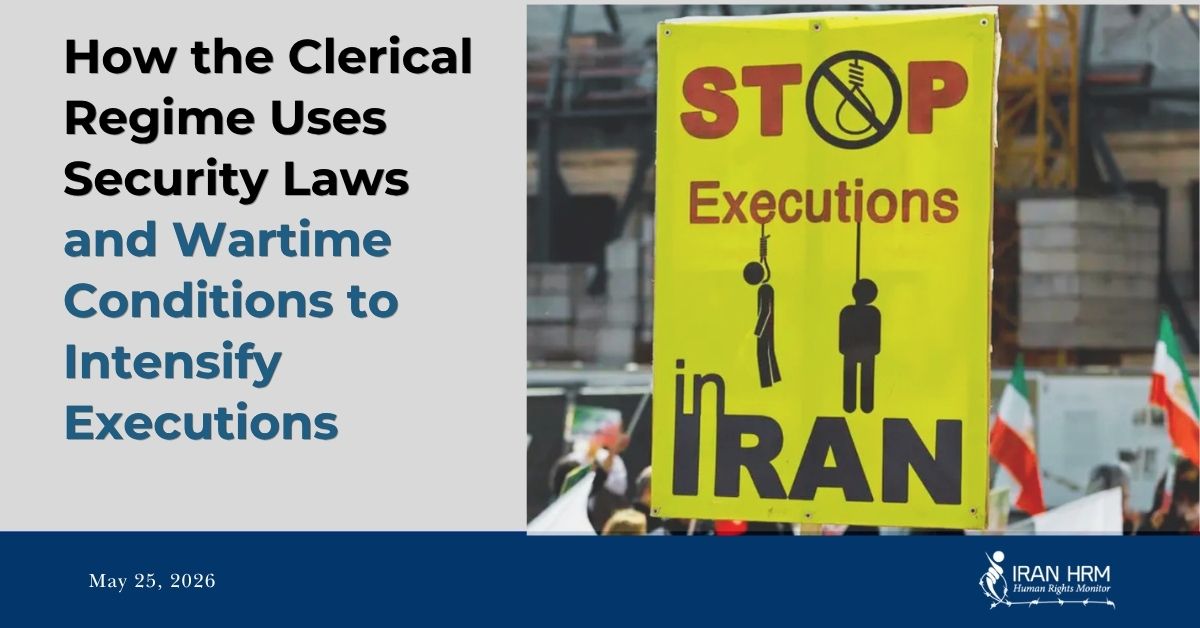
Recent warnings issued by Volker Türk and Amnesty International regarding the accelerating wave of executions in Iran have once again highlighted the systematic nature of repression under the ruling regime in Iran. Their statements indicate that the death penalty is no longer functioning merely as a judicial punishment, but increasingly serves as a political instrument used to intimidate society, suppress dissent, and eliminate perceived opponents.

Volker Türk condemned the executions of political prisoners Ramin Zaleh and Karim Maroufpour and warned that the authorities in Iran are intensifying the use of capital punishment against political dissidents and individuals accused in security-related cases. According to Türk, at least 34 individuals accused of political or national security offenses have been executed since the escalation of recent military tensions. He warned that the authorities are exploiting wartime conditions and national security rhetoric to increase pressure on critics and opponents.
Amnesty International similarly called for urgent diplomatic action to halt executions in Iran and stated that at least 2,159 executions were recorded in the country during 2025. According to the organization, the pace of executions accelerated significantly following the 12-day war in June 2025, as authorities expanded the use of security-related charges and intensified political repression through the death penalty.
The current wave of executions cannot be understood merely as a temporary reaction to military tensions or political instability. Rather, it reflects the operation of a deeply institutionalized system in which laws, security agencies, Revolutionary Courts, and political authorities function together to sustain repression.
The evidence demonstrates that executions in Iran are embedded within a broader architecture of political control, where law, security policy, and judicial mechanisms are systematically used to suppress dissent.
Laws That Institutionalize Repression
The legal framework of the ruling regime in Iran, from the Constitution to the Islamic Penal Code, provides the legal foundation for systematic human rights violations and political repression. The evidence shows that repression in Iran is not solely the result of security force abuses, but is embedded within the country’s legal and institutional structure.
Article 4 of the Constitution states that all laws and regulations must be based on Islamic criteria. In practice, this provision places internationally recognized human rights protections under the authority of state interpretations of religious law.
Articles 5 and 110 of the Constitution grant extensive powers to the Supreme Leader, including command of the armed forces, appointment of the head of the judiciary, and oversight of major state policies. This concentration of authority effectively eliminates meaningful institutional accountability and independent oversight.
Within the Islamic Penal Code, Articles 278–284 concerning “moharebeh” constitute one of the regime’s primary legal tools for suppressing protesters and political opponents. These provisions permit punishments including execution, amputation, and exile. In recent years, moharebeh charges have repeatedly been used against detainees arrested during nationwide protests, including Mohsen Shekari, who was executed following the 2022 demonstrations.
Article 500 of the Islamic Penal Code criminalizes “propaganda against the state,” a vague and broadly interpretable offense repeatedly used against journalists, civil society activists, human rights defenders, and political dissidents. Such provisions allow authorities to redefine peaceful political and civic activities as national security crimes.
Article 638 of the Islamic Penal Code provides the legal basis for the repression of women under mandatory hijab laws. This provision, alongside discriminatory civil laws such as Article 1105 regarding male authority over the family, Article 1133 granting unilateral divorce rights to men, and Article 1041 permitting the marriage of girls under the age of 13 with judicial and paternal consent, demonstrates that gender discrimination is institutionalized within Iran’s legal structure.
In October 2025, the authorities implemented a new law titled “Intensifying Punishment for Espionage and Cooperation with the Zionist Regime and Hostile States Against National Security and National Interests.” The legislation expanded the scope of capital punishment for vaguely defined security offenses such as cooperation with hostile governments and espionage. In the post-war environment, the law effectively allowed authorities to portray political dissent as collaboration with foreign enemies.
Courts That Produce Death Sentences
Iran’s judiciary lacks genuine independence due to its appointment structure and integration within the broader political system.
Under Article 157 of the Constitution, the head of the judiciary is appointed directly by the Supreme Leader. This structure fundamentally undermines judicial independence and transforms the judiciary into part of the ruling establishment’s political and security apparatus.
The Revolutionary Courts play a central role in political and security-related prosecutions. Established in 1979 by decree, these courts have become the primary institutions responsible for prosecuting protesters, dissidents, political activists, and individuals accused of national security offenses.
Cases involving Navid Afkari, Mohsen Shekari, Majidreza Rahnavard, and other protesters executed after the 2022 nationwide uprising were marked by serious due process concerns, including denial of independent legal counsel, torture, forced confessions, secret proceedings, and expedited death sentences.
Article 169 of the Islamic Penal Code explicitly states that confessions obtained under coercion are invalid. Nevertheless, televised confessions and statements extracted in security detention facilities continue to play a decisive role in political prosecutions.
In 2022, Judiciary Chief Gholamhossein Mohseni Ejei publicly described televised confessions as evidence of “cooperation with the judiciary.” Such statements indicate that forced confessions are not treated as isolated abuses, but rather as accepted elements within the country’s security and judicial practices.
Following the June 2025 conflict, Mohseni Ejei called for the acceleration of prosecutions and punishments against individuals accused of supporting hostile states. Combined with the newly adopted security legislation, these directives significantly increased the risk of arbitrary death sentences against political detainees and activists.
Security Institutions and the Chain of Repression
Iran’s execution machinery does not begin in courtrooms. Before death sentences are issued, security institutions play the central role in arrests, interrogations, torture, forced confessions, and case fabrication.
Although the Islamic Revolutionary Guard Corps was formally established as a military institution under Article 150 of the Constitution, it now plays a major role in internal repression and political control. The Intelligence Organization of the IRGC operates with extensive powers and minimal transparency, becoming one of the country’s primary institutions involved in political arrests and interrogations.
During the 2022 protests, a significant number of detainees were arrested and interrogated by IRGC intelligence forces. Cases such as the “Khaneh Esfahan” case reflected patterns of arbitrary arrests, forced confessions, and death sentences issued on the basis of disputed evidence.
The Ministry of Intelligence has likewise been implicated by UN experts in arbitrary detention, torture, intimidation of families, and suppression of political activism.
The Basij paramilitary organization has functioned as a frontline force during protest crackdowns. According to forensic data referenced in human rights reporting, more than 50 percent of those killed during the 2022 protests were reportedly targeted with organizational weapons linked to Basij forces.
Together, these institutions form a coordinated security structure in which arrests, interrogations, torture, prosecutions, and executions function as interconnected stages of repression rather than separate institutional processes.
Executions as State Policy
Within this system, executions function not only as punishment, but as political messaging intended to intimidate society and deter dissent.
Amnesty International reported that at least two protesters arrested during the 2022 uprising, Mojahid Abbas Korkori and Mehran Bahramian, were arbitrarily executed in 2025. The organization also referred to the secret and arbitrary executions of political prisoners Behrouz Ehsani and Mehdi Hassani following convictions by Revolutionary Courts on charges including “moharebeh” and “corruption on earth.”
Ethnic minorities have been disproportionately targeted by this policy. Human rights monitoring groups have repeatedly reported that Baluch prisoners account for a disproportionately high percentage of executions relative to their population size.
In Kurdish regions, security crackdowns have involved live ammunition, mass arrests, and extensive security prosecutions. During the 2022 protests, security forces used lethal force against demonstrators in Kurdish cities.
The repression of women likewise forms part of the same structure. From Article 638 of the Islamic Penal Code to the “Chastity and Hijab” legislation, the authorities have increasingly linked control over women’s bodies and social participation to surveillance systems, financial penalties, social restrictions, and street-level enforcement.
Internet shutdowns have also become a complementary instrument of repression. During the 2022 protests, internet access was severely disrupted across 28 provinces in an effort to prevent protest coordination, restrict the dissemination of evidence, and isolate society from international scrutiny.
Impunity as the Final Layer of Repression
No system of repression can endure without impunity. In Iran, institutional impunity remains one of the central mechanisms enabling continued human rights violations.
No meaningful accountability measures were implemented in response to the death of Mahsa Amini in morality police custody, the “Bloody Friday” massacre in Zahedan, or the killings of hundreds of protesters during the 2022 uprising.
In the Mahsa Amini case, state forensic authorities claimed that her death resulted from “underlying medical conditions,” a narrative widely challenged by public opinion and the victim’s family.
At the same time, officials implicated in repression retained their positions or were promoted. Following the 2022 crackdown, IRGC Commander Hossein Salami received public praise from Supreme Leader Ali Khamenei. Ahmadreza Radan, despite longstanding international allegations of human rights violations, was appointed chief commander of Iran’s police forces.
Families of victims have also faced intimidation and pressure. The families of Nika Shakarami, Hadis Najafi, and Kian Pirfalak are among those reportedly subjected to threats and attempts to silence public advocacy.
This climate of impunity sends a clear message to state institutions and officials that serious human rights abuses are unlikely to result in accountability and may even be rewarded through political advancement.
Conclusion
The recent warnings issued by Volker Türk and Amnesty International regarding the accelerating wave of executions in Iran must be understood within a broader structural context. What is unfolding in Iran today is the result of the interaction between security laws, politically controlled courts, intelligence institutions, wartime rhetoric, and institutional impunity.
Legal provisions such as Articles 278–284 concerning moharebeh, Article 500 regarding propaganda against the state, Article 638 concerning mandatory hijab enforcement, Articles 5, 110, and 157 of the Constitution, and the October 2025 national security legislation collectively demonstrate that repression in Iran is reproduced not only through street violence, but through law, institutions, and official state policy.
The post-war escalation in executions following the June 2025 conflict represents the continuation and intensification of a longstanding pattern in which the ruling regime in Iran uses the death penalty to eliminate opponents, intimidate society, and transform security crises into opportunities for repression.
In this context, executions in Iran can no longer be viewed merely as judicial punishments. They constitute part of a broader machinery of death in which laws, courts, security institutions, and impunity operate together in the service of political survival.