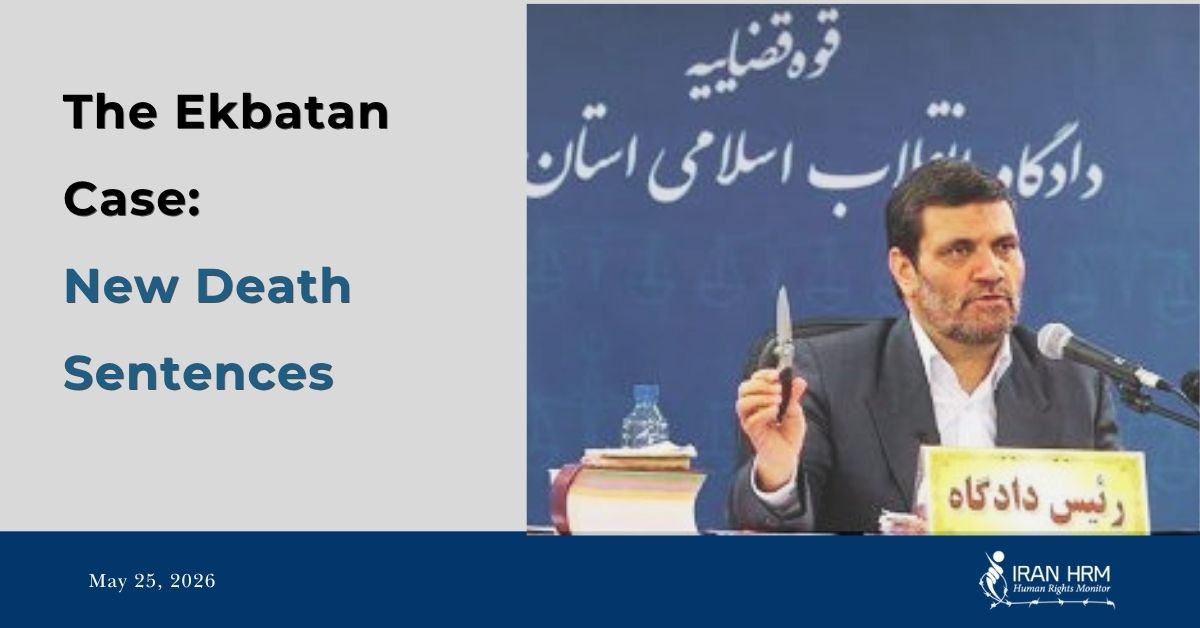
Condemning defendants (four of them to death) in Iran in the Ekbatan Case who were previously acquitted of murder charges or sentenced to short-term imprisonment in the Criminal Court demonstrates that the law is merely a decorative shell to legitimize judicial terror. The issuance of death sentences for four defendants in the Ekbatan Case by Branch 15 of the Tehran Revolutionary Court represents the most blatant form of systematic slaughter of the law and the utilization of the death penalty as a tool for political intimidation.

Structural Division of the Case: The Mechanism of Security Trapping
One of the most critical dimensions of ambiguity in the Ekbatan Case was its engineered division into two parallel pathways: the criminal section in Branch 13 of Criminal Court One, and the security section in Branch 15 of the Revolutionary Court. This segregation of legal standards created a deliberate vacuum for the apparatus of repression to advance its political objectives:
- Retreat in the Criminal Section: After the Supreme Court overturned the six initial death sentences in September 2025 due to “serious ambiguities and defects,” Branch 13 of Criminal Court One was forced to make an admission in the Ekbatan Case. This court fully acquitted Alireza Barmarzpournak, Hossein Nemati, and Navid Najaran of the charge of premeditated murder due to a lack of sufficient material evidence, while sentencing three other defendants to five years in prison.
- The Revolutionary Court’s Ambush: Just when public opinion assumed that the danger of execution had departed from the Ekbatan Case, Abolghasem Salavati intervened. Completely ignoring the ruling of the criminal authority, he sentenced four of the defendants in this case to death under the abstract and elastic charge of “Moharebeh” (enmity against God). This implies that even when the system is incapable of proving murder, it utilizes the leverage of security charges to send protesters to the gallows.
Verbal Notification and the Expulsion of Defense Lawyers in the Ekbatan Case
The process leading to the issuance of these verdicts in the Ekbatan Case bears no relation to legal formalities and stands as a prime example of a clandestine trial. Based on objective documentation, Judge Salavati verbally notified the defendants of the death sentences and refused to provide an official written copy to the defense lawyers—a rushed action carried out effectively to burn the statutory timeframe and complicate the legal appeal process.
Furthermore, the right to access a chosen counsel has been completely butchered at this stage of the Ekbatan Case. Mohammad Paknia, the official defense attorney for Alireza Barmarzpournak, revealed that Salavati barred him from entering the trial sessions without any legal justification:
“There is no form of due process in this proceeding; how is it possible to bar the lawyer from both the trial session and the verdict notification session?”
This exact illegal procedure was repeated for Ali Sharifzadeh, the defense lawyer for Milad Armon, leaving the defendants in the Ekbatan Case in an absolute defensive vacuum.
Forced Confessions: The Invalid Basis of Salavati’s Verdicts
The backbone of the Ekbatan Case relies not on technical or scientific evidence, but on forced confessions extracted under the most horrifying psychological and physical pressures in solitary confinement cells. The explicit testimony of Milad Armon in court serves as an indictment of this scenario-building in the Ekbatan Case:
“I was kept in solitary confinement for months. I carried no weapon and struck no blow. The interrogators told me exactly what to say in front of the camera and threatened that if I did not repeat it, they would arrest my family.”
The prolonged use of blindfolds, sensory deprivation, and media intimidation through broadcasting fabricated documentaries were all part of the project to strip away the presumption of innocence in the Ekbatan Case, paving the way for the death sentence to be handed down by internationally sanctioned judges.
Violation of International Standards and the Urgent Need for Global Action
The new verdicts of the Revolutionary Court in the Ekbatan Case present a complete package of violations of international treaties to which Iran is officially a state party. This glaring judicial contradiction between criminal acquittal and security-based death sentences proves that the Ekbatan Case is not a legal matter, but a case of political vendetta aimed at consolidating the hegemony of intimidation.
Call to the International Community
The international community, the United Nations Human Rights Council, and international bar associations must not stand by as silent observers of this official judicial terror in the Ekbatan Case. The time for neutral statements has passed. Four young men in the Ekbatan Case have fallen victim to blatant scenario-building and a complete inversion of justice. Urgent action to initiate international legal cases under Universal Jurisdiction, the expulsion of the Islamic Republic’s ambassadors from European capitals, the suspension of diplomatic missions, and the documentation of the names of the agents of these sham courts for criminal prosecution in international tribunals represent the minimum tangible steps required to halt the nooses that Judge Salavati has woven verbally in the Ekbatan Case.
Table of Documentation and Judicial Contradictions in the Ekbatan Case:
| Defendant’s Name | Verdict of Criminal Court One (Branch 13) | Verdict of Revolutionary Court (Branch 15 / Salavati) | Latest Legal Status / Charge | Access Status to Chosen Counsel |
| Milad Armon | 5 years imprisonment and payment of Diya (blood money) | Death Sentence | Sentenced to death on the charge of “Moharebeh” / Confession extracted under torture in solitary confinement | Prevention of the lawyer (Ali Sharifzadeh) from entering the court |
| Navid Najaran | Full acquittal from the charge of premeditated murder | Death Sentence | Sentenced to death on the charge of “Moharebeh” despite criminal acquittal | Material deprivation of the right to defense and verbal notification of the verdict |
| Mehdi Imani | Faced no death sentence in the criminal stage | Death Sentence | Sentenced to death on the charge of “Moharebeh” in the Revolutionary Court | Deprivation of fair trial standards |
| Seyyed Mohammad Mehdi Hosseini | Faced no death sentence in the criminal stage | Death Sentence | Sentenced to death on the charge of “Moharebeh” in the Revolutionary Court | Deprivation of fair trial standards |
| Amir Mohammad Khosh-Eghbal | 5 years imprisonment and payment of Diya | 5 years for “Assembly & Collusion” + 2 years for “Propaganda” + 2-year ban from cyberspace & residency in Tehran/Alborz. | Sentenced to a total of 7 years imprisonment, exile, and ban from cyberspace | Imposition of restrictions on accessing the case file |
| Alireza Kafaie | 5 years imprisonment and payment of Diya | 5 years for “Assembly & Collusion” + 2 years for “Propaganda” + 2-year ban from cyberspace & residency in Tehran/Alborz. | Sentenced to a total of 7 years imprisonment, exile, and ban from cyberspace | Imposition of restrictions on accessing the case file |
| Alireza Barmarzpournak | Full acquittal from the charge of premeditated murder | 5 years for “Assembly & Collusion” + 2 years for “Propaganda” + 2-year ban from cyberspace & residency in Tehran/Alborz. | Sentenced to a total of 7 years imprisonment despite acquittal from the primary charge | Illegal and arbitrary expulsion of the lawyer (Mohammad Paknia) from sessions |
| Hossein Nemati | Full acquittal from the charge of premeditated murder | 5 years for “Assembly & Collusion” + 2 years for “Propaganda” + 2-year ban from cyberspace & residency in Tehran/Alborz. | Sentenced to a total of 7 years imprisonment despite acquittal from the primary charge | Imposition of restrictions on accessing the case file |