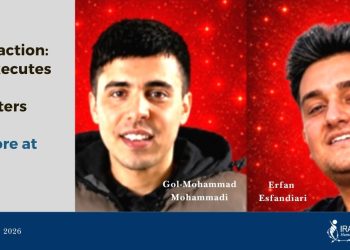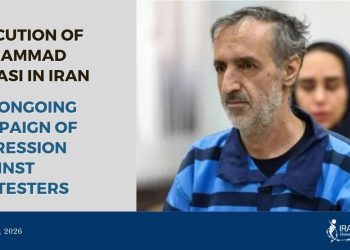
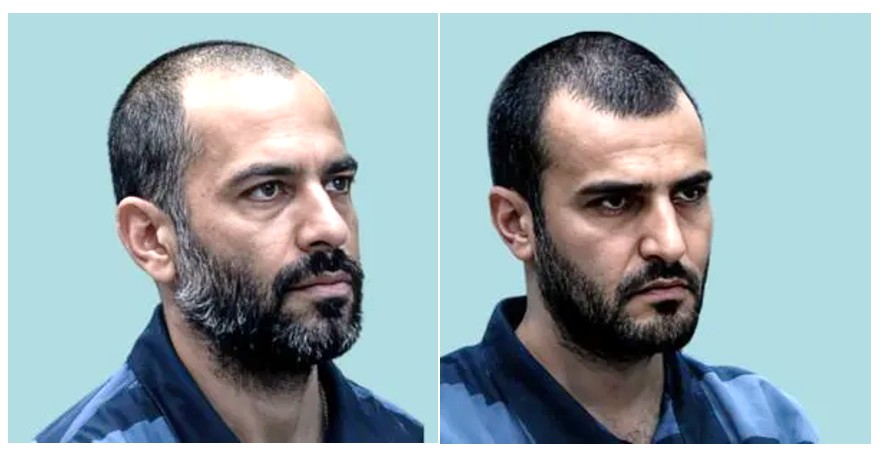
On June 1st, the very first news was the grim announcement of the execution of two more political prisoners; two protesters of the January 2026 uprisings, named Mehrdad Mohammadi-Nia and Ashkan Maleki. Just the day before, human rights organizations had issued urgent warnings regarding the imminent execution of these two protesters in a case known as the “Koy-e Nasr Case.” Yet, the deafening silence of the international community and their lack of any tangible, material intervention claimed the lives of these two young individuals as well. We are left to ponder: why does this ongoing onslaught on humanity, which the Iranian regime has unleashed against political prisoners for decades, remain unaddressed by the international community and human rights bodies, completely devoid of any practical action for accountability and containment?

An Unprecedented Surge in the Execution of Political Prisoners
If we mark our calculations from March 19, 2026 onward, a staggering 37 political prisoners have been executed, including members of the People’s Mojahedin Organization of Iran (PMOI/MEK) Resistance Units and protesters of the January uprisings.
This unprecedented figure translates to the execution of one political prisoner every 49 hours; in other words, approximately one human being hanged every two days. These unprecedented figures represent real people whose lives have been taken. These were individuals who sought nothing but freedom and the realization of human rights for themselves and their fellow compatriots. By executing them, the regime has not only violated their fundamental human rights, but this relentless onslaught on humanity has systematically crushed and traumatized their families, friends, and consequently, the entire fabric of society.
To comprehend the sheer velocity of this killing machine, it is enough to note that during the entire previous year, 22 political prisoners were executed, and in the year before that, the total number stood at 5. Is this exponential and merciless escalation not a final alarm? If it is, why does it remain fundamentally unaddressed by the international community and human rights organizations, leaving the regime in a state of absolute exemption from accountability?
Onslaught on Humanity: Fabricated Espionage Charges and Death Sentences
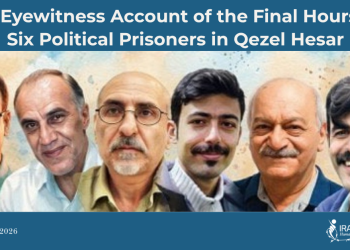
Two 20-year-old twin brothers detained in Karaj’s Qezel Hesar Prison, Hassan Amiri and Hossein Amiri, at an age when they should be enjoying their youth, life, and future, have been sentenced to death by Branch 26 of the Tehran Revolutionary Court, presided over by Judge Iman Afshari. Why? According to an informed source close to their case, the indictment issued against them cites the mere presence of photos of damaged buildings from the recent war on their mobile phones as one of the primary foundations for the heavy charge of “espionage for Israel.”
Hassan and Hossein Amiri were arrested at a routine checkpoint. Security agents detained the two brothers immediately after inspecting their mobile phones. Following their arrest, they were transferred to Qezel Hesar Prison in Karaj, where they were held in a prolonged state of administrative limbo for nearly two months.
One of the most heart-wrenching dimensions of this case is the unique life circumstances of Hassan and Hossein Amiri. These twin brothers have been raised in state welfare centers (orphanages) since the age of two; they have no family or advocates on the outside to pursue their judicial, legal, or human rights status. The regime has flagrantly exploited their vulnerability and isolation.
Presently, they are detained in Suite 35 of Qezel Hesar Prison—a section originally designated for solitary confinement, quarantine, and the holding of death-row inmates in the final days preceding their execution. However, in recent months, a large number of detained protesters—many bearing security or political charges—have been systematically transferred to this grim sector. Can you fathom the immense psychological trauma and crushing mental pressure inflicted upon these two defenseless youths? If there is any conscience left to perceive this profound isolation and injustice, why does it remain unanswered by the international community and human rights bodies, leaving this unmitigated oppression completely unchallenged?
Onslaught on Humanity: “You Are a Mohareb”
Sajjad Veisi (30 years old) and Shayan Veisi, two young Kurdish men and followers of the Yarsan faith who are cousins, remain held in a debilitating state of limbo in Diezelabad Prison, Kermanshah, four months after their initial arrest. The case of these two prisoners has been referred to the Revolutionary Court of Kermanshah under the lethal and draconian charge of “Moharebeh” (enmity against God), and the looming threat of heavy sentences, including the death penalty, severely jeopardizes their lives.
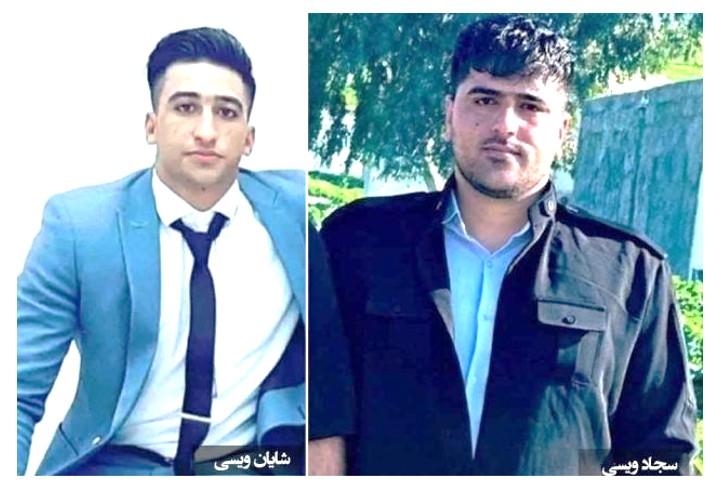
The charges leveled against these two young men are entirely predicated on fabricated files engineered by security apparatuses and forced confessions extracted under severe pressure and torture—a reality that continuously escalates their family’s profound anguish over their fate. Shayan Veisi was arrested during the January protests and had previously been detained during the 2022 nationwide uprisings in Kermanshah. His cousin, Sajjad Veisi, was abducted by state forces on Sunday, February 22, 2026, while traveling toward Sarpol-e Zahab along the Darreh-Derizh route.
Crucially, Sajjad Veisi is the brother of Meysam Veisi and Mojtaba Veisi; these two brothers were protesters of the January uprising who were intensely pursued by security forces and the regime, which is why they were hiding in a safe house. Tragically, on the morning of May 27, 2026, during a brutal raid by Islamic Revolutionary Guard Corps (IRGC) forces on their refuge in the village of Qaleh-Kahvash, they were extrajudicially killed by IRGC troops. This security framework and the charge of Moharebeh are being pushed forward while the Veisi family is simultaneously mourning the horrific state-orchestrated killing of two of their sons and must now endure the nightmare of the imminent execution of two more of their youth. This is no longer a judicial process; it is a structural vendetta aimed at the total annihilation of a lineage. Does such an onslaught on humanity against a single family not demand a definitive and deterrent response? If it does, why does it remain unaddressed by the international community and human rights bodies, completely devoid of any practical action for accountability?
Urgent Warnings: The Bell Tolls for Political Prisoners in Absolute Vulnerability
Amnesty International has released a series of urgent statements on the social media platform X, warning of the imminent danger of execution facing several political prisoners in Iran and demanding immediate, tangible action from the international community to halt these executions.
The organization officially declared that Zahra Shahbaz Tabari, Abolfazl Salehi Siavashani, Karim Khojasteh, Ehsan Hosseinipour Hesarloo, and Mansour Jamali have been sentenced to death following “grossly unfair trials” and face a critical, immediate risk of execution. Amnesty International emphasized in its messages that these ruthless sentences were predominantly issued in connection with allegations such as “real or perceived affiliation with banned opposition groups” or participation in nationwide protests, demonstrating that the Iranian authorities continue to wield the death penalty as an overt tool of terror to intimidate protesters and silence dissent.
Judicial Obstinacy in the Death Sentence of Zahra Shahbaz Tabari
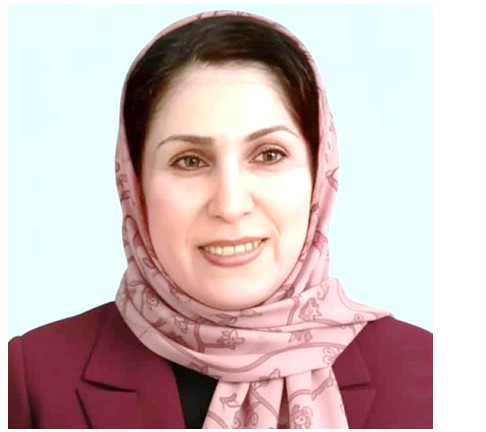
- Initial Death Sentence: Issued in November 2025.
- Supreme Court Ruling: The Supreme Court of Iran overturned the initial death sentence of Zahra Shahbaz Tabari and remanded the case back to a parallel branch for retrial.
- Insistence on Execution: In a sudden and obstinate move, Branch 2 of the Rasht Revolutionary Court re-issued the death sentence on April 14, 2026. This sentence was recently served to this political prisoner within Lakan Prison in Rasht.
- The Charge: “Baghi” (armed rebellion) through alleged membership and activity in the People’s Mojahedin Organization of Iran (MEK).
- Judicial Standing: The court session was extremely brief, conducted remotely via “videoconferencing,” and she was strictly denied access to independent legal counsel of her choice. She herself has denounced the absurd proceedings as “completely lacking any legal basis.”
Where is the International Community?
This agonizing reality of the political prisoners in Iran, subjected to a continuous onslaught on humanity, can be documented with countless other facts, documents, and names. The great Persian poet, Saadi Shirazi, famously wrote:
Human beings are members of a whole,
In creation of one essence and soul.
If one member is afflicted with pain,
Other members uneasy will remain.
Today, the awakened consciences of the world must be confronted with a vital question: imagine for a moment that the international community and human rights organizations, upon the commencement of political executions in Iran during the 1980s, had practically stood up against the Islamic Republic. Imagine if they had conditioned all their economic, political, and diplomatic relations with Tehran on the immediate cessation of executions, particularly political executions in Iran. Do you not think the face of the world, or at the very least the Middle East, would look entirely different today?
If the answer is yes, then why does the containment of this execution machinery remain unaddressed by the international community and human rights bodies, completely devoid of any practical action for accountability and containment?
We must not allow this onslaught on humanity—which is executed not only within Iran, against the people of Iran, and against every single political prisoner, but has also set the entire Middle East ablaze—to be reinforced by inaction and a lack of accountability. Stop the Islamic Republic of Iran right now.