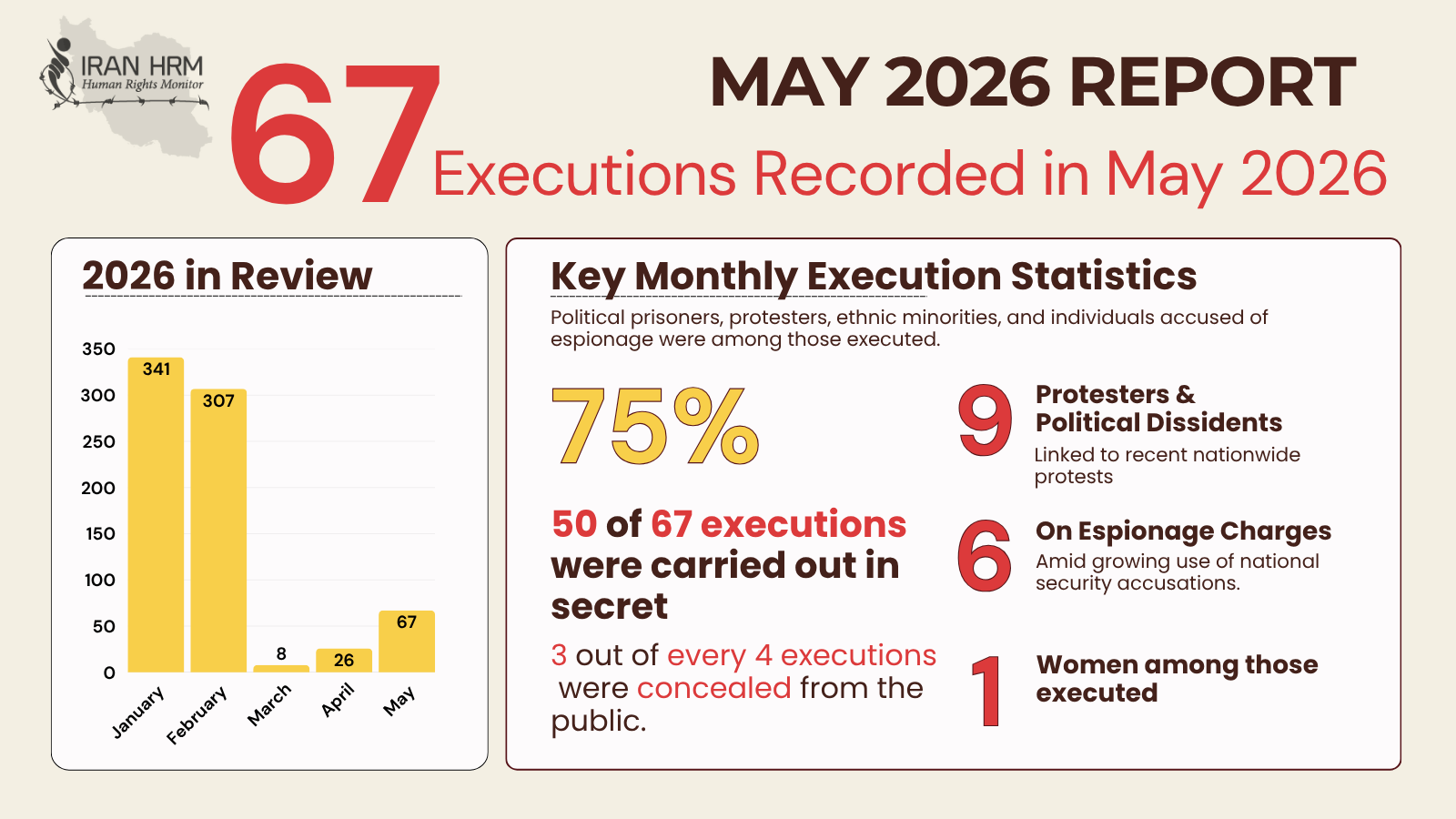
During May 2026, the human rights situation in Iran experienced a severe deterioration. The Iranian judiciary, operating in tandem with state security forces and intelligence agencies, escalated its implementation of the death penalty to stifle domestic dissent and project an atmosphere of absolute fear. According to data verified by Iran Human Rights Monitor (Iran HRM), at least 67 individuals were executed across various prisons in Iran during this month. A highly concerning aspect of this trend is the lack of transparency: 50 of these executions were carried out secretly without any official media coverage or announcement by the judiciary, while only 17 executions were formally acknowledged by state organs.

The demographic distribution of those executed reflects the targeted nature of the regime’s suppressive machinery. Among the victims was at least one woman, while nine of the executed individuals were political dissidents or protesters arrested during recent popular uprisings. Furthermore, six individuals were executed under espionage charges, and a significant portion of those hanged belonged to marginalized ethnic minorities, specifically Kurdish and Baluch communities. In parallel, the judiciary issued several new death sentences, upheld prior capital verdicts, and intensified pressure on political prisoners and their families, particularly those associated with the People’s Mojahedin Organization of Iran (PMOI/MEK).
Execution of Protesters and Political Dissidents
The judicial apparatus systematically executed individuals who participated in recent uprisings, labeling their acts of protest as armed rebellion (Baghi), enmity against God (Moharebeh), or corruption on Earth (Mofsed-e-filarz).
Mehrab Abdollahzadeh: On May 3, 2026, Mehrab Abdollahzadeh, a 28-year-old Kurdish protester, was executed in Urmia Central Prison. He had been arrested in October 2022 by the Intelligence Organization of the Islamic Revolutionary Guard Corps (IRGC) during the nationwide protests. Abdollahzadeh was accused of participating in the killing of a Basij member, Abbas Fatemieh. Despite a complete lack of credible forensic evidence and his consistent denial of all charges, Judge Reza Najafzadeh of the Urmia Revolutionary Court sentenced him to death in September 2024, a verdict swiftly implemented without a fair appeal process.
The Mashhad Executions: On May 4, 2026, authorities in Vakilabad Prison in Mashhad executed three young men: Mehdi Rasouli (25), Mohammad-Reza Miri (21), and Ebrahim Dowlatabadi. The judiciary accused them of acting as ringleaders during the January protests, utilizing Molotov cocktails, and causing the deaths of security personnel. Specifically, Rasouli and Miri were convicted of involvement in the death of a security agent, Hamidreza Yousefinejad, while Dowlatabadi was accused of directing demonstrations in the Tabarsi region. All three were denied international standards of due process.
Mohammad Abbasi: In the early hours of May 13, 2026, 55-year-old Mohammad Abbasi was hanged in Qezel Hesar Prison. Arrested during protests in Malard, Abbasi was accused of killing a State Security Force (SSF) Colonel, Shahin Dehghan. He was subjected to severe interrogation and physical torture in solitary confinement in Evin Prison’s Ward 209 before Judge Abolqasem Salavati of Branch 15 of the Tehran Revolutionary Court sentenced him to death. Abbasi’s daughter, Fatemeh Abbasi, who was arrested alongside him, is currently serving a 25-year prison sentence in Evin Prison.
Abbas Akbari Faizabadi: On May 25, 2026, Abbas Akbari Faizabadi was executed in Nain, Isfahan province. Charged with Moharebeh, he was accused of leading armed riots, targeting the local governor’s office, and opening fire on security personnel during the January protests.
Mehrdad Mohammadinia and Ashkan Maleki: On June 1, 2026, the judiciary executed these two young men who were classified as leaders of the January protests. They were sentenced by Judge Salavati of the Tehran Revolutionary Court on charges of setting fire to a Basij base at the Jafari Mosque in Kuy-e Nasr (Gisha) and clashing with security forces.
Executions on Espionage Charges
The regime continued to utilize espionage charges as a pretext for executions. On May 13, 2026, the judiciary announced the execution of 33-year-old Ehsan Afreshteh, who had been arrested in April 2024 on charges of collaborating with Israeli intelligence services. Previously, on May 11, 2026, 29-year-old Erfan Shakourzadeh was executed. Arrested in February 2025 by IRGC Intelligence, Shakourzadeh was convicted of cooperating with foreign intelligence services and disclosing classified scientific data.
Targeting of Ethnic Minorities: Baluchistan and Kurdistan
Ethnic minority regions continue to bear a disproportionate burden of the regime’s execution campaign. On May 12, 2026, Abduljalil Shahbakhsh, a Baluch political prisoner, was executed in Zahedan Prison. He was convicted of armed rebellion and membership in the opposition group Ansar al-Furqan. In another incident highlighting state violence in the region, Ministry of Intelligence agents opened fire on a civilian vehicle on the Pahreh-Sarbaz road on May 11, 2026, killing four Baluch citizens. In Iranian Kurdistan, on May 21, 2026, the judiciary executed two Kurdish political prisoners, Ramin Zalleh and Karim Maroufpour, in Naghdeh Central Prison, on charges of armed rebellion and the assassination of an IRGC base commander.
Severe Sentences, Death Verdicts, and Prison Abuse
The judiciary has increasingly resorted to upholding capital verdicts and issuing lengthy prison terms to deter ongoing resistance:
Zahra Tabari: The 68-year-old electrical engineer, holding a Master’s degree from Sweden, was sentenced to death for a second time by the Second Branch of the Rasht Revolutionary Court, presided over by Judge Mohammad Ali Darvish-Goftar, on charges of Baghi due to her support for the PMOI/MEK.
Amin (Peyman) Farahavar: The 38-year-old poet and MEK supporter had his death sentence upheld by Branch 39 of the Supreme Court, placing him at imminent risk of execution in Lakan Prison. Farahavar is currently suffering from severe post-surgical medical complications and has been systematically denied medical care.
Manouchehr Fallah: The 36-year-old political prisoner’s death sentence was reconfirmed by the Revolutionary Court in Rasht on charges of active MEK membership.
Bijan Kazemi: The 45-year-old political prisoner was sentenced to 37 years and six months in prison by Judge Salavati after enduring 16 months of physical torture in secret detention centers.
Mojtaba Taghavi: In an effort to inflict psychological torment, 58-year-old Mojtaba Taghavi, whose brother Mohammad Taghavi was executed in March 2026, was forcibly transferred from prison to the Aminabad psychiatric hospital while being denied his essential daily medications.
Systemic Pressure on Female Prisoners and Families
At Evin Prison, human rights conditions for female political prisoners deteriorated. Female inmates Shiva Esmaeili and Elaheh Fouladi, both supporters of the MEK, received an additional six-month sentence for protesting the death of fellow prisoner Somayyeh Rashidi at Qarchak Prison. Additionally, seven female political prisoners—Zahra Safaei, Forough Taghipour, Marzieh Farsi, Elaheh Fouladi, Arghavan Fallahi, Shiva Esmaeili, and Golrokh Iraee—were deprived of family visits for chanting anti-execution slogans during the “No to Execution Tuesdays” campaign. Concurrently, the Ministry of Intelligence has systematically summoned and threatened the families of political prisoners and MEK supporters, including the families of Sedigheh Moradi, Azar Karvandi, and the late Akbar Daneshvarkar, threatening them with the confiscation of property if they refuse to participate in state-sponsored television propaganda.
Urgent Call to Action
Iran Human Rights Monitor (Iran HRM) strongly condemns the systematic use of the death penalty, torture, and arbitrary detention by the Iranian authorities. The escalating rate of secret executions, the denial of basic medical care to critically ill prisoners, and the persecution of families of dissidents constitute grave violations of international human rights law and potential crimes against humanity. Iran HRM calls upon the United Nations Security Council, the UN High Commissioner for Human Rights, and the international community to take immediate, concrete actions. We urge the dispatch of an independent international fact-finding mission to inspect Iranian detention facilities, engage with political prisoners, and hold the perpetrators of these systematic human rights abuses accountable under international law.