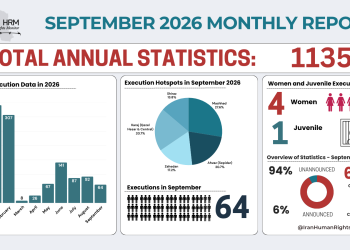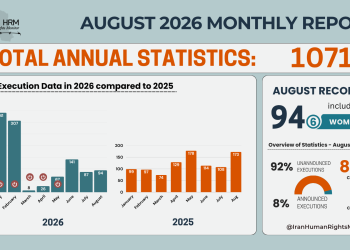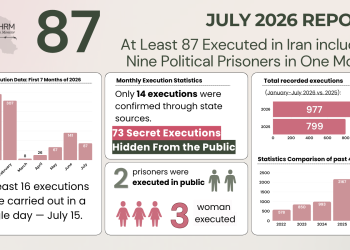
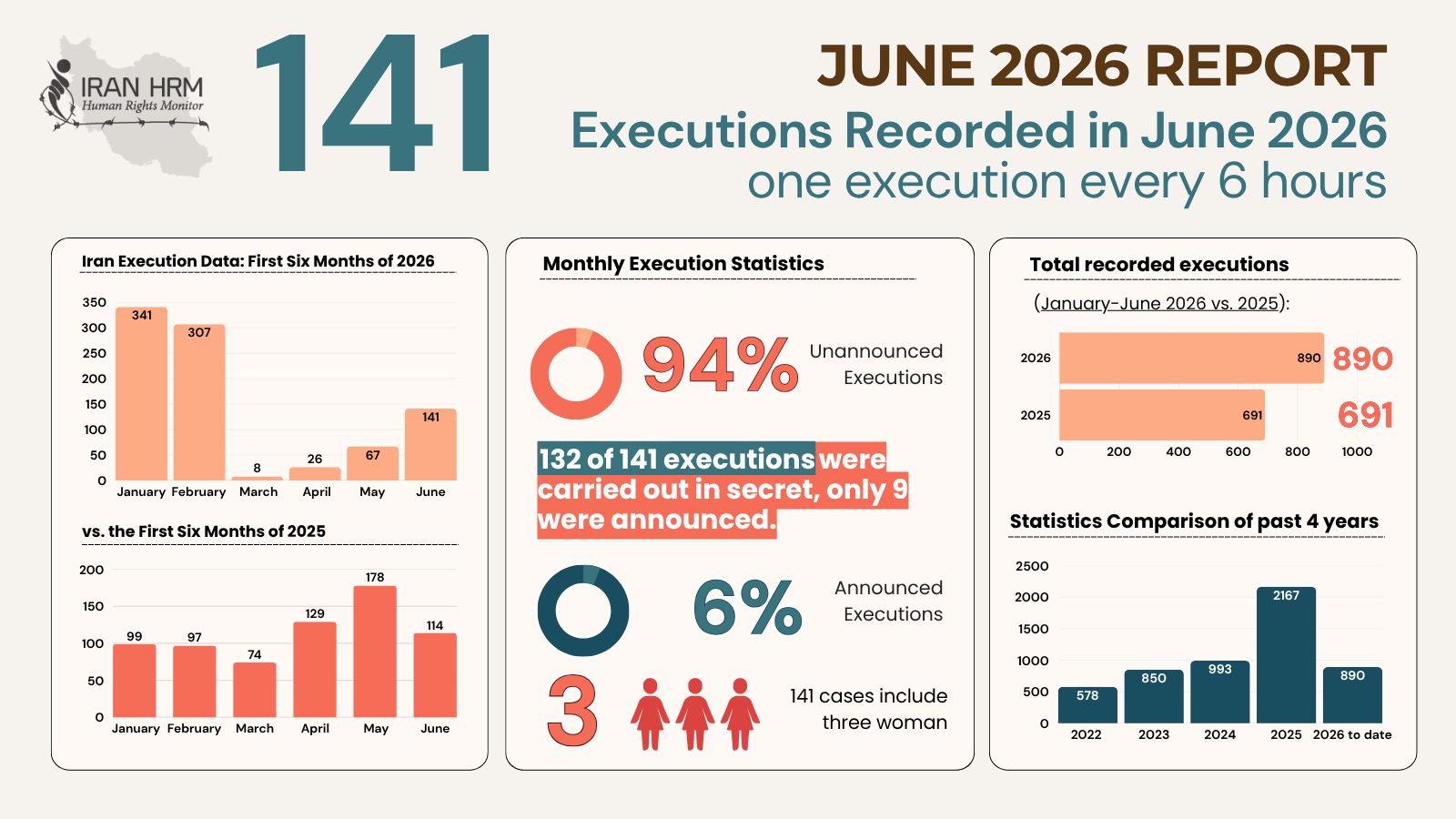
June 2026 was characterized by an intensified crackdown by the Iranian regime, primarily targeting political dissidents, protesters, ethnic minorities, and students, amidst a palpable fear of renewed nationwide uprisings. A staggering total of 141 executions were recorded, with the vast majority remaining unannounced by state media, highlighting a deliberate policy of obfuscation and intimidation. The regime’s judicial and security apparatus continued to employ brutal tactics, including arbitrary arrests, severe prison conditions, torture, and capital punishment, to stifle any form of dissent.

The Execution Crisis: 141 Lives Lost in a Single Month
June 2026 witnessed a horrifying surge in state-sponsored killings, with Iran HRM documenting 141 executions. Of these, 132 executions were carried out without official announcement, a practice that deprives victims and their families of due process and public scrutiny. These unannounced executions included at least three women. The nine officially acknowledged executions included five individuals who were arrested during recent protests, underscoring the regime’s use of the death penalty as a tool for political suppression.
Executions of Protesters
A significant portion of the executions were directly linked to individuals involved in the January 2026 uprising.
On June 16, Javad Zamani and Abolfazl Saedi, two young men from Shahroud, were executed after being labeled as ‘armed leaders’ of the January uprising. They faced charges including ‘Moharebeh’ (enmity against God) and ‘corruption on Earth,’ based on accusations such as drawing firearms, opposing the system, disrupting public order, damaging bank branches, and setting a police car on fire.
On June 3, Fathollah Avari, 42, arrested in Malard, was executed in Hamedan Prison. He was charged with involvement in the death of a State Security Force (SSF) major during the January uprising in Hamedan.
On June 1, Mehrdad Mohammadinia and Ashkan Maleki were hanged in Tehran. They were branded as leaders of the recent January uprising and charged with “operational actions against national security,” setting fire to a Basij center and a seminary, destroying public property, clashing with SSF agents, and blocking streets. The Basij center in question, located at the Jafari Mosque in Kuy-e Nasr (Gisha), has been identified as a significant center of repression in western Tehran.
Mass Executions Across Prisons
Numerous group executions were reported throughout the month.
On June 21, at least six individuals—Isa Rahmani (36), Nematollah Barahouyi in Zahedan, Mirveis Khalilzadeh and Ebrahim Ahmadshahi in Shiraz, and Homayoun Noorzehi and Hossein Yousefzehi in Zabol—were executed.
On June 17, 14 prisoners were hanged across several cities, including Reza Nazif (28), Noorjalal Mojahed (27), and Esfandiar Sadri in Yazd; Fereydoun Varasteh in Shirvan; Ali Aghahosseini (38) in Maragheh; Rashid Arefi (38) in Borujerd; Khaleq Shahriari in Gorgan; Abdollah Jalali (25), Taher Shahouzehi and another unnamed prisoner in Zahedan; Aref Barahouyi (34) in Zabol; and Farzad Bahrami (36), Alireza Maleki and Ramin Bagheri in Hamedan.
Between June 13 and 16, at least 31 prisoners were executed, averaging one execution every three hours. This wave included Seyyed Akbar Bani-Hashem and Amir-Abbas Dekavand in Qezel Hesar Prison (among eight executed on June 13), Hassan Hosseini Narouei and Ali-Bakhsh Raeisi (27, Baluch compatriots) in Zahedan (among ten executed on June 14), Mohammad Amin Narouei and Balal Saadat-Jahani (Gorgij, 35) in Birjand (among eight executed on June 15), and Omar Shahbakhsh and Ghafoor Shahbakhsh (Baluch) in Yazd (among five executed on June 16).
On May 31 and June 1, at least 18 prisoners were executed. On May 31, 12 prisoners were hanged, including Parviz Valizadeh (27) in Zanjan, Aslan Amiri (33) in Arak, and ten in Shiraz, among whom were Saeed Dehghanzadeh, Borzou Mousavizadeh (30), Abbas Bayat (30), Ali Akbar Sarabi-Moghadam, Salar Sheikhi (29), three Baluch (Mohammad Osman Daneh-chin, Mohammad Sediq Baluchi, Qader Khodamoradi), and two Afghan nationals. On June 1, six prisoners were executed, including Morteza Sadeghzadeh in Damghan, Hassan Tahmasebi and Kouhyar Abbasi in Qorveh, and Behnam Nemati (38), who was subjected to a public execution in Rasht.
Systematic Repression of Political Prisoners and Dissidents
The regime continued its intensified pressure on political prisoners, especially those affiliated with opposition groups or involved in protests.
Death Sentences for PMOI/MEK Supporters:
Yaghoub Derakhshan, 51, a supporter of the People’s Mojahedin Organization of Iran (PMOI/MEK) held in Lakan Prison in Rasht, was sentenced to death for the second time in June 2026. He was initially sentenced in August 2025 on charges of ‘Baghi’ (armed rebellion) in sham trials conducted via video conference and without his chosen lawyer. Despite a referral for retrial, the Second Branch of the Revolutionary Court in Rasht, presided over by Mohammad Ali Darvish-Goftar, re-issued the death sentence, placing him in imminent danger.
Zahra Tabari, 68, an electrical engineer, also received her second death sentence from the Rasht Revolutionary Court. She was first sentenced in November 2025 on charges of ‘armed rebellion’ through PMOI/MEK membership after a ten-minute sham trial. The Supreme Court’s referral for retrial led to the same criminal verdict by the Second Branch of the Revolutionary Court in Rasht in April 2026, which was communicated to her in June.
Pressure on Female Political Prisoners in Evin
Several female political prisoners in Evin Prison faced increased harassment, including the cutting off of their telephone access. Among those affected were:
Shiva Esmaeili (60), sentenced to 10 years and six months.
Marzieh Farsi (59), sentenced to six years.
Forough Taghipour (32), sentenced to six years.
Golrokh Iraee, sentenced to six years, previously serving six years.
Sakineh Parvaneh, sentenced to six years, previously imprisoned for three years.
Zahra Safaei (63), sentenced to five years, currently imprisoned for the third time, having spent eight years in the 1980s for supporting the PMOI/MEK.
Elaheh Fouladi, sentenced to five years.
Deplorable Conditions in Qezel Hesar Prison
Prisoners of the January 2026 uprising held in Wards 35 and 37 of Unit 3 in Qezel Hesar Prison are subjected to inhumane conditions. Many suffer from severe injuries, including broken bones and teeth, yet are crammed into wards lacking basic living and sanitary amenities. Ward 37, housing around 200 prisoners, reportedly lacks any cooling system in extreme heat, and running water is frequently cut off, with prisoners being forced to pay for water delivered by tankers.
Arbitrary Arrests and Disappearances
Milad Sajjadian, 32, a former political prisoner and PMOI supporter, was arrested in Shiraz. Following a hunger strike in protest, he was hospitalized and then transferred to Adelabad Prison. He has since been moved to an unknown location, and there is no information regarding his fate or whereabouts. He had previously served three years for supporting the PMOI.
Resistance and Calls for Justice: “No to Executions Tuesdays” Campaign
Despite the heightened repression, political prisoners inside Iran continued their acts of resistance. The “No to Executions Tuesdays” campaign entered its 127th consecutive week on June 30, with inmates in 57 prisons across Iran participating in coordinated hunger strikes.
The campaign condemned the regime’s reliance on executions as a primary tool of intimidation and highlighted the ongoing crackdown following the January 2026 protests.
The regime’s judiciary has acknowledged that 3,292 individuals have been arrested since January on accusations of “cooperating with the enemy.” Many of these detainees now face severe judicial consequences, including death sentences or long-term imprisonment.
Regional reports further illustrated the repression: authorities in Sari reportedly opened 700 legal cases against January protesters, while in Mashhad, thousands of cases were filed.
The campaign reported that 140 people were executed during the Iranian month of Khordad (May 22–June 21), emphasizing that capital punishment remains a key tool for silencing dissent.
A poignant aspect of the campaign focused on the suffering of families denied the right to mourn. The case of Vahid Bani Amerian, a PMOI member and political prisoner executed in Qezel Hesar Prison earlier this year, was highlighted; his family, like many others, has not been informed of his burial location. The campaign denounced this practice as a continuation of punishment after death and a blatant violation of human dignity.
Prisons participating in the hunger strikes included Evin, Qezel Hesar, Greater Tehran, Qarchak, Adelabad, Zahedan, Rasht, Tabriz, Urmia, Sanandaj, and Kerman, among dozens of others, demonstrating the widespread nature of this organized resistance.
Conclusion and Call to Action
The human rights situation in Iran in June 2026 deteriorated drastically, marked by an unprecedented surge in executions, systematic repression of political prisoners, and a severe crackdown on students. The regime’s fear of popular uprisings drives these brutal measures, as evidenced by the high number of executions of protesters and the broad suppression of dissent in universities and prisons.
Iran Human Rights Monitor (Iran HRM) strongly condemns the widespread and systematic human rights violations perpetrated by the Iranian regime. We urge the international community, including the United Nations, its relevant bodies, the Human Rights Council, and all human rights organizations, to:
- Immediately and unequivocally condemn the escalating wave of executions and call for an urgent halt to all capital punishment in Iran.
- Demand the immediate and unconditional release of all political prisoners, including those sentenced to death for their participation in protests or their affiliation with opposition groups.
- Call for an independent international fact-finding mission to visit Iran’s prisons, particularly Evin and Qezel Hesar, to investigate the inhumane conditions and systematic torture.
- Pressure the Iranian regime to cease its brutal suppression of students and to respect academic freedoms and the right to peaceful assembly.
Silence and inaction only embolden the regime to continue its atrocities. Effective and urgent measures are imperative to hold the Iranian regime accountable for its egregious violations of human rights and to protect the lives and fundamental freedoms of the Iranian people.