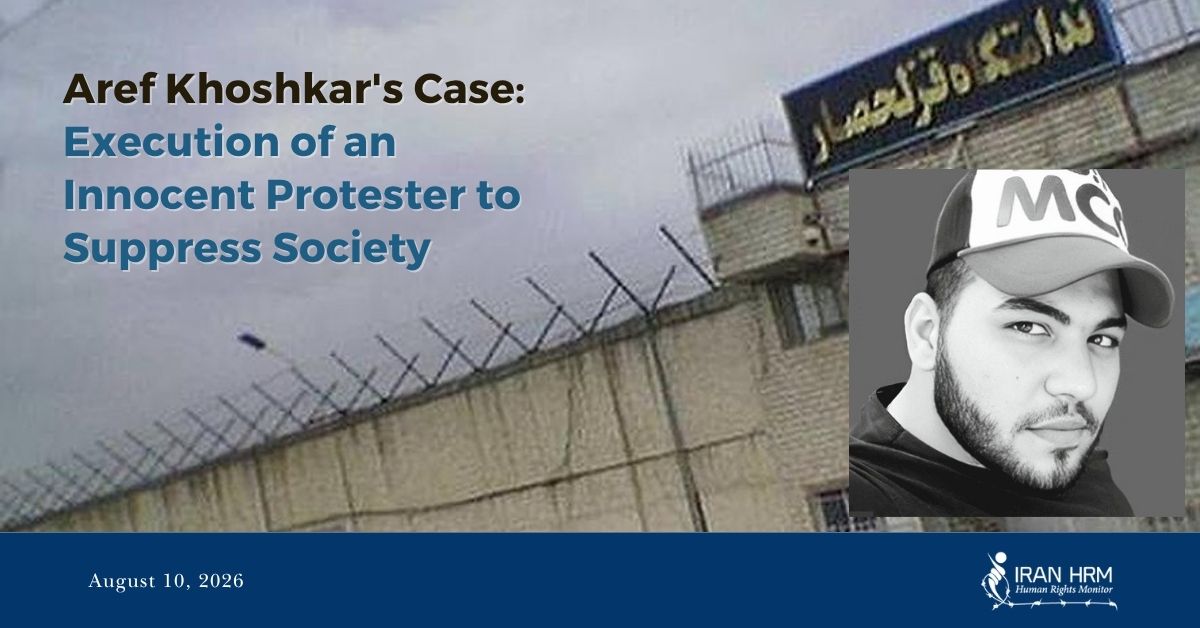
Aref Khoshkar, a detained protester from the 2022 protests, was tried by the judiciary of the Islamic Republic of Iran on charges of killing a Basij member during the protests and was sentenced to death. Aref Khoshkar was arrested in the Fallah neighborhood of Tehran on November 11, 2022, and was hanged in Ghezel Hesar Prison on July 15, 2026. Examining the documents of Aref Khoshkar’s case—who is one of dozens of protesters being hanged while innocent, solely to suppress society and prevent massive social protests—clearly illustrates how Iran’s judiciary has transformed into a tool for the survival of its rulers. A dangerous precedent that, if not halted by the international community, will undoubtedly spread rapidly to other non-democratic regimes; because they will know there is no accountability and that they can freely violate human rights and the right to life to whatever extent they wish without facing any practical accountability from the international community.

What Documents Reveal
Documents obtained from Aref Khoshkar’s trial and their examination clearly indicate that the judgment issued by Branch 13 of the First Criminal Court of Tehran contained serious ambiguities regarding the identity of the shooter, the type of weapon, the correlation between the forensic report and available evidence, the manner of relying on witness testimonies, and the basis for attributing the murder. Despite this, the sentence of Qisas (retribution in kind / execution) was issued and carried out in this case.
This judgment is compiled in eight pages, comprising the description of charges, statements of the defendants, testimonies of certain individuals, the forensic medical opinion, reports from interrogators/agents, and ultimately the court’s verdict. Studying these documents shows that the case does not rely on a single narrative; rather, across its different sections, multiple conflicting narratives are presented regarding the incident’s occurrence, the location of individuals, the types of weapons, and the identity of the shooter.
Under such circumstances, the court is expected to thoroughly analyze these discrepancies, clarifying which narrative it deemed valid and why it dismissed the others. However, the text of the judgment—in the available version to us—reaches its final conclusion in many instances without resolving these contradictions.
Was the Court Judgment Certain in Determining the Defendant’s Identity?
In various sections of the judgment, the presence of several armed individuals around the scene of the incident is mentioned. In some parts, other individuals are introduced as those who possess weapons or fired shots. Furthermore, in parts of the statements from defendants and others, names of individuals other than Aref Khoshkar appear as holders or users of firearms.
Nevertheless, the court’s final ruling fails to explain how, among all these individuals, Aref Khoshkar’s direct role in the murder was established. In a case where the penalty is the deprivation of life, determining the identity of the primary shooter is one of the most critical pillars of proving guilt; without it, how can a defendant be sentenced to death?
The text of the judgment repeatedly mentions the presence of multiple people in the alley, the parking area, behind the building, and around the Basij base. Additionally, some individuals provided explanations regarding shots fired from different directions, the movement of individuals, and the transfer or swapping of weapons. The existence of these narratives demonstrates that the crime scene was not an isolated conflict between two people but rather involved a group of individuals. In such a scenario, definitively attributing a fatal shot to a specific defendant is absolutely impossible without a precise scene reconstruction and technical trajectory analysis of the projectile.
One-Sided Scene Reconstruction
In murder cases, particularly when multiple people are present at the scene, precise and technical scene reconstruction is one of the most essential tools for discovering the truth. Although the judgment mentions that a scene reconstruction was conducted, the court relied merely on the narratives of security agents and initial reports instead of conducting a scientific, expert reconstruction with independent ballistics specialists to determine the victim’s exact position, firing angles, and impact feasibility.
Furthermore, the largest legal contradiction in the judgment lies in the failure to recover the weapon and establish its type. The text of the judgment explicitly states that “no weapon was recovered from the defendant,” and the defendant also mentioned in initial statements having an air rifle or a Winchester-style gun. Nonetheless, based on the forensic report declaring the cause of death as severe brain injury from a metallic pellet, ultimately labeling the assumed weapon as a “12-gauge hunting shotgun”! The fundamental question remains: when the actual weapon was never recovered and no ballistic matching test was performed between the weapon and the recovered pellet, on what basis did the court determine the weapon’s type and caliber and attribute it to Aref Khoshkar?
Unclarified Ambiguities in the Judgment
The most critical legal and technical ambiguities that should be prioritized in a homicide investigation and serve as the basis for adjudication during the trial have not been clarified in this judgment:”
- The presence of multiple armed individuals at the scene;
- The lack of definitive identification of the fatal shooter;
- The absence of a clear ballistic report within the text of the judgment;
- Ambiguity in the link between the weapon attributed to the defendant and the fatal pellet;
- Discrepancies in parts of the witness statements;
- The court’s ultimate reliance on “Knowledge of the Judge” (Elm-e Qazi);
- Sufficiency of evidence to issue a death sentence.
One of the most vital components of any murder case is matching the weapon type with the nature of the injury. In the present judgment, weapons with differing characteristics are mentioned. In contrast, the forensic report relied upon by the court declared the cause of death to be severe brain damage resulting from a metal pellet hitting the head area. However, the judgment fails to clarify: Did the recovered pellet match the weapon attributed to Aref Khoshkar? Did the technical specifications of the seized/alleged weapon have the capability to cause that exact type of injury? Was a comparative analysis performed between the pellet and the firearm?
Additionally, there is no independent or explicit ballistic examination report in the text of the judgment—a test essential for proving a direct causal link between the weapon attributed to Aref Khoshkar and the fatal shot. A ballistic report must address issues such as pellet matching, probable distance, angle of entry, and presence of gunpowder residue, yet the court contented itself with a forensic medical report lacking ballistic matching and technical scene analysis.
Parallel Prosecution: Splitting Charges to Guarantee a Death Sentence
Another blatant aspect of injustice in this judgment is the multi-layered, parallel prosecution against the defendant. On the final page of the judgment, the Criminal Court announces that it drops the charge of “disrupting public order” because the exact same conduct was referred to the Revolutionary Court under the heavier charge of “Moharebeh” (enmity against God). This division of charges and simultaneously sending the case to both the Revolutionary Court and Criminal Court Division 1 indicates an orchestrated scenario: the judiciary intended to secure a sentence of life deprivation (execution) against this protester under any circumstances—whether through “Qisas” in Criminal Court or “Moharebeh” in Revolutionary Court—to utilize it as an instrument of terror and intimidation.
Imposing Intent and Dismissing Defense Arguments Based on Speculation
The contradictions in the ruling of Branch 13 do not end here. On the final page of the judgment, when the defense attorney objects to the non-recovery of the weapon and the inconsistency between initial statements and available evidence, the court issues an astonishing and legally unsound response, asserting that “the non-recovery of the weapon is no proof of innocence, as the defendant was on the run for 21 days and had the opportunity to hide it!” This reasoning clearly violates the “Presumption of Innocence” and the legal principle of Dar’ (‘resolving boundary punishments and retributions in favor of the defendant when doubt exists) (In dubio pro reo)).
Moreover, the court ignored the defendant’s statement regarding firing “blindly out of fear” and, relying on Paragraph B of Article 290 of the Islamic Penal Code, claimed that firing at that distance had “a near-certain probability of hitting the target”; this is despite the fact that, even according to the forensic report, the entry angles of the pellet do not technically match the alleged position of the shooter. The judiciary of the Islamic Republic confiscated all technical ambiguities of the case in favor of issuing a death sentence, demonstrating that in trials of protesters, the presumption is “conviction to death,” not “discovery of the truth.”
The Gravity of the Issue: A Dangerous Pattern and the “Knowledge of the Judge“
Such negligence is not limited to the execution case of Aref Khoshkar. When Gholamhossein Mohseni-Eje’i, the head of the Judiciary of the Islamic Republic of Iran, emphasizes maximum speed in finalizing cases of arrested protesters rather than maximum justice—aiming to swiftly turn these cases into deterrents against any future major social protests—nothing less can be expected.
One of the court’s key premises is Aref Khoshkar’s presence at the scene and his participation in the day’s events. However, from a criminal law perspective, presence at a crime scene is not synonymous with participation in murder—a pattern observed in the cases of many executed protesters. A review of the judgment clearly shows that rather than relying on independent technical evidence to reach a retribution verdict, the court relied on a collection of agent reports and, ultimately, the “Knowledge of the Judge (Elm-e Qazi). In the final section of the judgment, after reviewing statements, agents’ reports, and forensic opinions, the court declared that the totality of these circumstantial indicators generated the “Knowledge of the Judge” regarding the attribution of the crime.
How Can the International Community act ?
The case and judgment of Aref Khoshkar are not merely a judicial document, but a stark testimony to the fragile structure and institutionalized injustice within the judiciary of the Islamic Republic, where “Knowledge of the Judge” and “agents’ reports” replace technical evidence, scientific ballistics, and established principles of criminal proof. Carrying out this execution sentence proved once again that the goal of Iran’s judicial system is not to seek truth or administer justice, but to construct a deterrent tool for instilling terror and suppressing social protests.
The international community, UN Special Rapporteurs, and international human rights organizations must not remain silent in the face of this dangerous trend. It is time for international fact-finding missions to move beyond issuing punitive statements and exercise “Universal Jurisdiction,” condition diplomatic relations, and hold accountable all orchestrators and judges of such courts to stop the cost-free firing at the right to life of the Iranian people; because inaction against this legal precedent will serve as a green light to other totalitarian regimes to sacrifice human lives for political survival.