Cases of Political Prisoners Sentenced to Death in Iran
Case No. 5 | Case ID: IRN-DP-1404-005 | Last reviewed: 13 August 2026

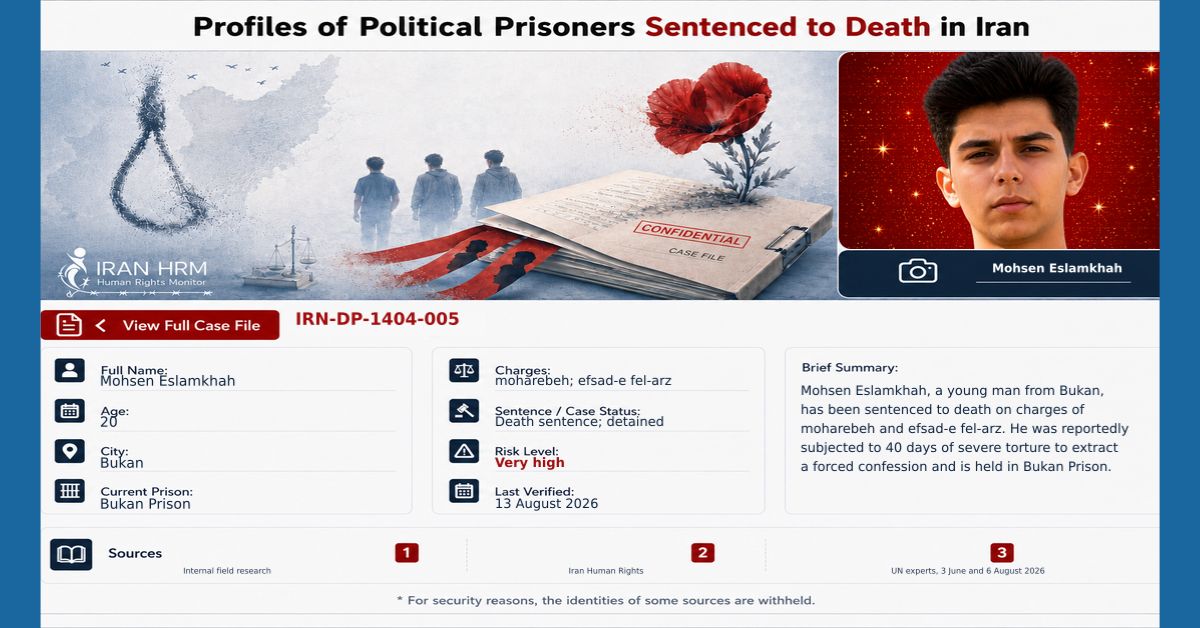
| Mohsen Eslamkhah, a young Kurdish man from Bukan, was prosecuted over the 2022 protests, when he was 16. After returning to Iran, he was arrested and, according to credible information, subjected to severe torture and pressure to confess for 40 days at the Urmia Intelligence detention facility. Branch One of the Mahabad Revolutionary Court sentenced him to death for moharebeh (enmity against God) and efsad-e fel-arz (corruption on Earth). He is held in Bukan Prison. His age, reported torture and United Nations warnings of imminent execution make his situation urgent. |
Key Case Information
| Category | Information |
| Full name | Mohsen Eslamkhah |
| Date of birth | 2006–2007; Bukan |
| Age | About 20; aged 16 in 2022 |
| Occupation before arrest | Unknown |
| Family status | Unknown |
| Date and place of arrest | 22 February 2026; location unknown |
| Charges | Moharebeh (enmity against God); efsad-e fel-arz (corruption on Earth) |
| Court | Branch One, Mahabad Revolutionary Court |
| Judge | Unknown |
| Lawyer | Unknown |
| Sentence | Death |
| Current place of detention | Bukan Prison |
Human and Personal Background
Mohsen Eslamkhah is a young Kurdish man from Bukan, born in Iranian calendar year 1385 (March 2006–March 2007). He was 16 during the 2022 protests. Security forces raided and searched his father’s home three times. His occupation, education and family status are unknown.
Arrest, Trial and Sentencing
After living in Iraqi Kurdistan, Mohsen Eslamkhah returned to Iran on 1 August 2025 and was arrested the next day by the Bukan Intelligence Department. At its Urmia detention facility, he endured 40 days of torture and pressure to confess. He was then transferred to Bukan Prison and released after 11 days on bail of five billion tomans.
In February 2026, Branch One of the Mahabad Revolutionary Court sentenced him to death for moharebeh (enmity against God) and efsad-e fel-arz (corruption on Earth). The sentence was served on 17 February 2026. He was rearrested on 22 February and transferred to Bukan Prison. The judge, lawyer, judgment, evidence and status of judicial review remain unknown.
Joint Case and Status of Co-defendants
Raouf Sheikh-Maaroufi and Mohammad Faraji, two other Kurdish political prisoners sentenced to death, are held with Mohsen Eslamkhah in Bukan Prison. Reports of torture and uncertainty over fair-trial safeguards increase the risk of execution. Each defendant’s responsibility must be assessed separately by an independent and fair tribunal.
On 6 August 2026, United Nations experts warned that Mohsen Eslamkhah, Raouf Sheikh-Maaroufi and Mohammad Faraji faced imminent execution and called for the sentences to be halted.
Government Response and Conduct
Government conduct has included raids on his father’s home, arrest by the Intelligence Department, transfer to its Urmia detention facility, torture, Revolutionary Court proceedings and a death sentence. No information has been published about an independent torture investigation, medical examination or exclusion of coerced confessions.
On 28 May 2026, two United Nations Special Rapporteurs sought a halt to the execution and an explanation concerning his arrest, trial, torture and age at the time. The government responded on 10 August 2026, but its reply remained unpublished when this report was reviewed.
Current Status and Risk of Execution
Mohsen Eslamkhah remains under sentence of death in Bukan Prison. The execution date and status of judicial review are unclear. The United Nations warning, reported torture and his age at the time make his situation urgent and critical; the absence of an announced date does not remove the risk.
Human Rights and Fair Trial Analysis
Prohibition on executing persons who were under 18: Article 6(5) of the International Covenant on Civil and Political Rights and Article 37(a) of the Convention on the Rights of the Child prohibit execution for an offence committed under the age of 18. Iran is party to both treaties; his sentence is incompatible with its obligations.
Prohibition of torture and coerced confession: Articles 7 and 14 of the Covenant prohibit torture and compelled self-incrimination. The reported 40 days of torture require independent investigation, and any statement obtained under pressure must be excluded.
Right to a fair trial: Article 14 guarantees an independent tribunal, the presumption of innocence, an opportunity to defend oneself and effective counsel. Missing information about his lawyer, judgment, evidence and judicial review raises serious concerns about his defence rights.
Right to life: Serious fair-trial violations in a capital case may cause arbitrary and irreversible loss of life. The labels moharebeh and efsad-e fel-arz cannot replace clear proof of conduct, intent and individual responsibility.
Conclusion
Mohsen Eslamkhah was sentenced to death for events occurring when he was 16. Reported torture, missing information about his lawyer and judicial review, and his detention in Bukan Prison create urgent concern. The execution must be halted, the sentence quashed and a retrial held without coerced confessions.
Urgent Appeal
United Nations bodies, governments, and international human rights organisations are urged to act immediately to prevent the execution of Mohsen Eslamkhah.
- Immediately halt any steps towards the execution of Mohsen Eslamkhah and formally notify his family and lawyer.
- Quash the death sentence because he was 16 and international law prohibits execution for offences committed under the age of 18.
- Transparently disclose the status of any appeal or judicial review, and publish the text of the judgment and its legal basis.
- Guarantee immediate, effective and confidential access to chosen counsel and adequate facilities for his defence.
- Guarantee a retrial before an independent and impartial tribunal, without the death penalty or coerced confessions.
- Provide an independent medical examination and investigate promptly and impartially the alleged torture and coerced confession.
- Protect his family and informed sources from pressure, and guarantee regular contact and visits with his family.