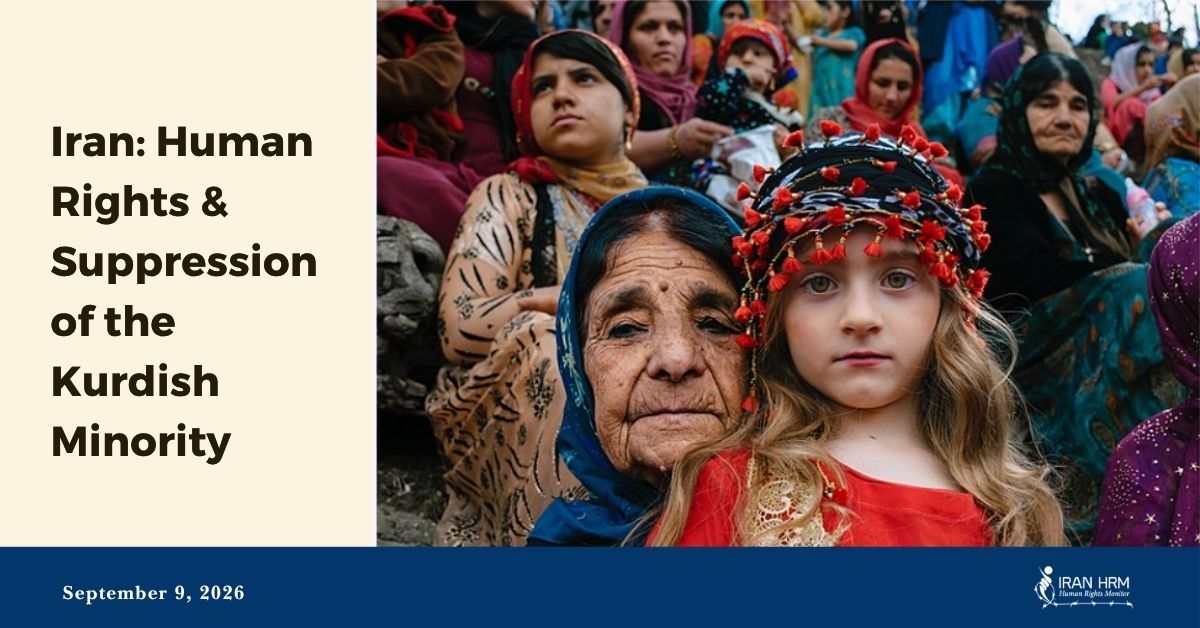
Comprehensive Report on Violations of the Right to Life, Executions, Detention of Civil Activists, the Situation of Kolbars, and Systematic Repression of the Kurdish Minority in Iran from December 2025 to 2026
In 2026, Kurdish-populated regions of Iran, along with other parts of the country, were impacted by a new wave of state repression that intensified following the outbreak of nationwide protests on 28 December 2025 (7 Dey 1404). Available evidence indicates that Kurdish citizens have been subjected to a wide range of human rights violations, including the killing of protesters, mass detentions, trials based on security charges, the issuance and execution of death sentences, restrictions on cultural and civic activities, and the lethal use of force against Kolbars (cross-border labor couriers). These measures have occurred against a backdrop of structural discrimination and the ongoing securitization of civic and identity-based demands of Kurds.

This report argues that these documented cases cannot be viewed merely as an isolated series of infractions; rather, they form part of a continuous pattern that affects the civil, political, economic, social, and cultural rights of Iranian Kurds.
Introduction
Kurds represent one of the largest ethnic minorities in Iran, residing predominantly in the provinces of Kurdistan, Kermanshah, West Azerbaijan, and Ilam. Despite statutory guarantees regarding the equality of citizens, Kurdish regions have consistently faced high levels of security interference, restrictions on political and cultural activities, detentions of civil activists, and violent crackdowns over past decades.
The nationwide protests commencing on 28 December 2025 once again brought this dynamic to the fore. In many Kurdish areas, demonstrations were met with a heavy security presence and violent force. In the months following, mass arrests, the issuance of security-related sentences, and the execution of capital punishment against Kurdish citizens persisted.
Suppression of Nationwide Protests in Kurdish Regions
The nationwide protests of Dey 1404 (winter 2025–2026) constituted one of the most significant domestic challenges faced by the Islamic Republic in recent years. Kurdish regions participated extensively in these protests and consequently faced a severe response from security forces.
Documented reports indicate that live ammunition was deployed against protesters during the crackdown, with numerous cases of direct fire reported. Furthermore, victims’ families faced security pressure, restrictions on holding memorial services, and measures preventing public reporting.
By January 2026, the Kurdistan Human Rights Network (KHRN) had documented the identities of at least 228 Kurdish citizens killed during the crackdown on protests. The organization also reported instances of direct shooting at protesters, harassment of families, and falsification of causes of death on official documents.
The sustained security presence in Kurdish regions following the initial wave of demonstrations indicates that the state response aimed not merely at crowd control, but at broader social and civic containment across these regions.
Mass Detentions and the Securitization of Civic Activities
Throughout 2026, the detention of Kurdish citizens remained a critical human rights concern. Civil activists, journalists, teachers, students, environmental activists, and cultural figures were subjected to summonses, arrests, and security prosecutions.
During the nationwide protests of winter 2025 and 2026, over 2,000 Kurdish citizens were detained.
A common feature across many of these cases is the reliance on charges defined in vague and overly broad terms, including “propaganda against the state,” “acting against national security,” “Moharebeh” (enmity against God), “Baghi” (armed rebellion), and “Efsad-fil-Arz” (corruption on Earth). These charges allow peaceful civic and cultural activities to be characterized as national security threats.
These charges, primarily brought under Articles 279 (Moharebeh), 286 (Efsad-fil-Arz), and 287 (Baghi) of the Islamic Penal Code, feature elastic definitions and grant broad room for judicial discretion. This framework enables the criminalization of peaceful civic participation, human rights advocacy, and cultural identity initiatives under the broad mandate of national security threats.
The securitization of cultural and identity demands has directly impacted Kurdish civil society. Under such conditions, engaging in Kurdish language instruction, organizing cultural events, or advocating for minority rights carries heightened risks of judicial prosecution.
Capital Punishment, Capital Sentences, and Fair Trial Concerns
A major concern in 2026 remained the continued application of the death penalty against Kurdish citizens. Numerous death sentences against Kurdish prisoners on security-related charges were reported. UN experts have likewise expressed alarm regarding the execution of members of ethnic minorities, particularly Kurds.
In 2026, concerns escalated over the use of capital punishment against Kurdish detainees. UN Special Rapporteurs stated in August 2026 that at least 22 members of the Kurdish minority had been executed in 2026 alone, with additional individuals facing imminent risk of execution.
Specifically, UN experts raised urgent warnings regarding the execution risk for Youssef Ahmadi, Raouf Sheikh-Maroufi, Mohammad Faraji, and Mohsen Eslamkhah, while expressing deep concern over allegations of torture, forced confessions, and due process violations in their trials.
Furthermore, human rights reports from 2026 recorded the executions of several Kurdish political prisoners, including Naser Bakerzadeh, Mehrab Abdollahzadeh, and Ramin Zaleh—cases that similarly raised serious fair trial concerns.
The core concern extends beyond the severity of capital punishment to fundamental flaws in judicial proceedings. In multiple cases, credible allegations have been raised regarding torture, coerced confessions, denial of access to legal representation of choice, and widespread violations of fair trial standards.
Carrying out execution sentences under these circumstances heightens the risk of an irreversible violation of the right to life. Under international law, any severe breach of due process invalidates the legitimacy of imposing or executing the death penalty.
Continued Shooting of Kolbars and Violations of the Right to Life in Border Areas
Kolbari (informal cross-border load-carrying) is a direct consequence of economic deprivation in border regions of Iranian Kurdistan. Thousands of individuals rely on carrying goods across mountainous border tracks to secure basic livelihoods.
Despite the non-military nature of this activity, Kolbars face continuous direct fire from border security forces. In addition to shootings, landmines, hazardous terrain, and the absence of safe, legal economic opportunities continuously endanger their lives.
Security agencies maintain a predominantly militarized stance toward Kolbars, despite the phenomenon being rooted in systemic poverty, underdevelopment, and economic exclusion. The persistent deployment of firearms against Kolbars raises grave questions regarding adherence to the principles of necessity and proportionality in the use of force.
Kolbars remain among the most vulnerable groups in border areas. Documented reports confirm that lethal force against Kolbars and border couriers continued throughout 2026. Published data indicates that in the first half of 2026, at least 2 Kolbars or border couriers were killed and 6 wounded. Furthermore, the Kurdistan Human Rights Network’s August 2026 report recorded 3 additional Kolbars killed and 2 wounded. These figures indicate that by the end of August 2026, at least 5 Kolbars had been killed and 8 injured; however, due to restricted access for independent monitors, actual totals may be higher.
Linguistic Rights, Cultural Activities, and Security Crackdowns
Pressure on the Kurdish community in Iran extends beyond arrests, trials, and executions to encompass cultural and linguistic dimensions. In recent years, cultural activists, Kurdish language teachers, artists, writers, and organizers of cultural events have faced summonses, detentions, activity bans, and security charges. Activities that represent fundamental cultural and identity rights in international standards are routinely treated in Iran through a security lens.
International reports indicate that Kurdish citizens engaging in civic, cultural, or social activities linked to Kurdish identity face disproportionate security surveillance, summonses, and detentions compared to the broader population.
This ongoing pattern raises serious concerns regarding Iran’s compliance with its obligations under Article 27 of the International Covenant on Civil and Political Rights (ICCPR) and the UN Declaration on the Rights of Persons Belonging to National or Ethnic, Religious and Linguistic Minorities—instruments that explicitly safeguard the rights of minorities to preserve, develop, and express their cultural and linguistic identity without interference.
International Legal Framework
The Islamic Republic of Iran is a state party to the International Covenant on Civil and Political Rights (ICCPR) and the International Covenant on Economic, Social and Cultural Rights (ICESCR). It is consequently bound to respect fundamental human rights, including the right to life, freedom of expression, peaceful assembly, fair trial guarantees, and the enjoyment of cultural rights.
Additionally, the UN Declaration on the Rights of Persons Belonging to National or Ethnic, Religious and Linguistic Minorities affirms that minority populations hold the right to maintain and develop their culture, use their language, and participate fully in public life without discrimination.
It is to be reminded that observed practices concerning the Kurdish population directly violate Iran’s binding international human rights obligations.
Conclusion
An analysis of documented evidence from the onset of nationwide protests on 28 December 2025 to the present reveals a persistent, multi-faceted pattern of repression against Kurdish citizens in Iran. The killing of protesters, mass detentions, security-based death sentences, restrictions on civic and cultural space, and lethal force against Kolbars—operating alongside structural discrimination—reflect a systematic reliance on security, judicial, and penal apparatuses to control and suppress Kurdish society. The continuation of these practices presents severe violations of the Islamic Republic of Iran’s international commitments concerning minority rights, the right to life, freedom of expression, peaceful assembly, and due process.
Actionable Requests to UN Mechanisms
- Special Rapporteur on the Situation of Human Rights in Iran: Dedicate a distinct and ongoing focus to the situation of the Kurdish minority in upcoming reporting and mandates.
- Special Rapporteur on Minority Issues: Request an official country visit to Iran focusing specifically on the Kurdish-populated regions and minority rights.
- Special Rapporteur on Extrajudicial, Summary or Arbitrary Executions: Initiate dedicated inquiries into capital punishment cases involving Kurdish prisoners and deaths of Kurdish protesters during demonstrations.
- Special Rapporteur on the Independence of Judges and Lawyers: Conduct an independent assessment of security trials based on charges of “Moharebeh,” “Baghi,” and “Efsad-fil-Arz” brought against Kurdish citizens.
- UN Special Procedures Mechanisms: Call upon the Islamic Republic of Iran to immediately stay all execution sentences issued against prisoners where credible allegations of due process violations exist.
- UN Fact-Finding Missions and Documentation Mechanisms: Systematically document and preserve evidence concerning killings, arbitrary detentions, and torture of Kurdish citizens during the 2025–2026 protests.
- Office of the High Commissioner for Human Rights (OHCHR): Issue a dedicated report on the lethal use of force against Kolbars and the humanitarian impact of security policies on border populations.
- UN Human Rights Council: Should executions, protester killings, and systematic repression of Kurdish citizens persist, establish a dedicated thematic focus on this minority within ongoing accountability and documentation mechanisms to ensure individual and institutional accountability.
Annex: Sources & References
- OHCHR, A/HRC/61/59: Situation of human rights in the Islamic Republic of Iran in 2025 and the nationwide protests (2026). [ohchr.org]
- OHCHR, UN experts urge Iran to end escalating targeting of ethnic minorities (6 August 2026). [ohchr.org]
- UN General Assembly, Report of the Special Rapporteur on the situation of human rights in Iran (A/80/349). [documents.un.org]
- UK Home Office, Country Policy and Information Note: Kurds and Kurdish Political Groups, Iran (2025). [gov.uk], [assets.pub…ice.gov.uk]
- UK Home Office, Country Bulletin: Iran, Kurds and Kurdish Political Groups (May 2026). [ecoi.net], [gov.uk]
- Kurdistan Human Rights Network (KHRN), Kurdish citizens killed in protests across Iran (2026). [kurdistanh…rights.org]
- Washington Kurdish Institute, Kurdistan Annual Report 2025. [dckurd.org]
- Hengaw Organization for Human Rights, Reports on executions and Kurdish political prisoners in 2026. [hengaw.net], [hengaw.net]
- Kurdistan Human Rights Network (KHRN), Special Report on Kurdish Protesters Killed (28 January 2026) https://kurdistanhumanrights.org/en/publications/special-reports/2026/01/28/kurdish-citizens-killed-in-protests-across-iran
- Kolbar News, Overview of Kolbari Incidents in the First Half of 2026 (1 July 2026). https://en.kolbarnews.com/kolbarnews-exclusive-report-overview-of-kolbari-incidents-in-the-first-half-of-2026/ )
- Kurdistan Human Rights Network (KHRN), Monthly Report of August 2026 (6 September 2026). [https://kurdistanhumanrights.org/en/publications/monthly-reports/2026/09/06/monthly-report-of-august-2026/](https://kurdistanhumanrights.org/en/publications/monthly-reports/2026/09/06/monthly-report-of-august-2026/)