Deteriorating Schools, Low-Quality Education and Government Responsibility
The first two chapters examined the scale of educational deprivation and the situation of women, children, migrants, persons with disabilities, and ethnic and linguistic minorities. The evidence showed that some groups are excluded from education altogether or face serious obstacles to continuing their studies.

However, the education crisis in Iran is not limited to exclusion from school. Millions of students who do attend school face teacher shortages, overcrowded classrooms, deteriorating buildings and inadequate facilities. Under such conditions, official enrolment alone cannot demonstrate the fulfilment of the right to education.
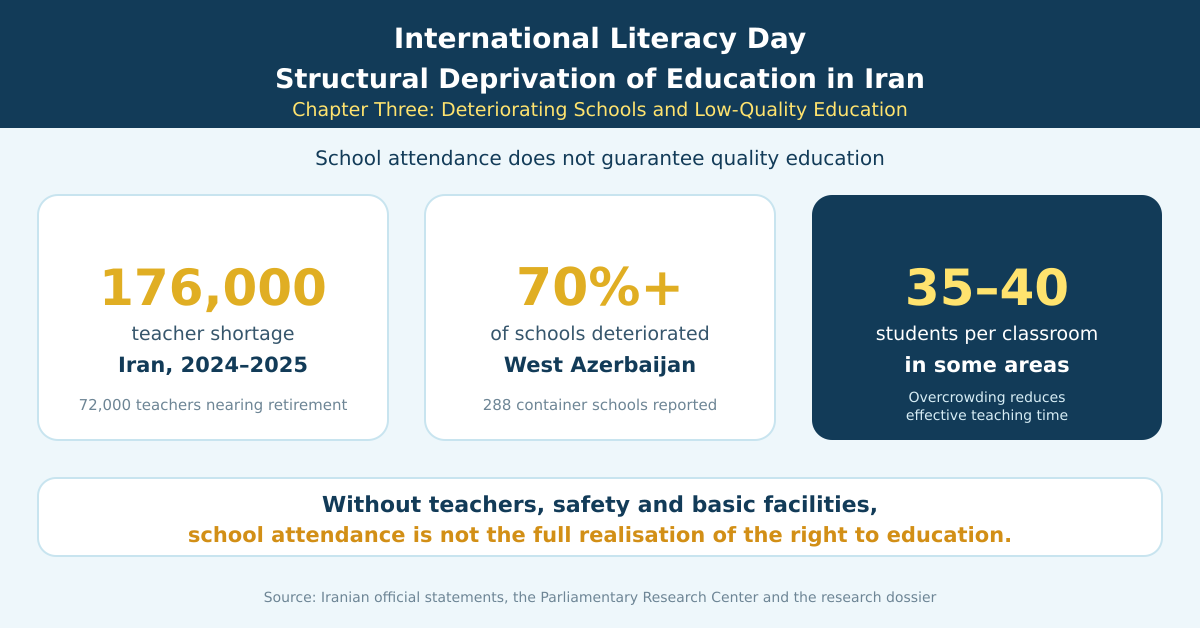 Teacher shortages, deteriorating schools and overcrowded classrooms in Iran
- Teacher Shortages and Declining Educational Capacity
The Parliamentary Research Center reported a shortage of approximately 176,000 teachers for the 2024–2025 academic year. At the same time, approximately 72,000 teachers were expected to retire.
Measures Used to Compensate for Teacher Shortages
| Measure | Reported consequence |
| Employing teacher-soldiers | Reduced stability and professional capacity |
| Using retired teachers | Delayed payment of remuneration and continued staffing shortages |
| Purchasing educational services | Outsourcing part of education to unofficial personnel |
| Assigning teaching duties to school principals and deputies | Reduced time for management and educational supervision |
| Using non-specialist personnel | Threat to the quality of education |
The head of the Parliamentary Research Center stated that the Ministry of Education relies on teacher-soldiers, purchases services from the non-governmental sector, employs retirees and assigns teaching duties to principals and deputy principals to compensate for staffing shortages. He warned, however, that these methods do not ensure the required quality of education and student development.
Ghasem Ahmadi-Lashki, Deputy Minister of Education for Legal and Parliamentary Affairs, reported that the number of officially employed teachers stood at 735,350. He also stated that, in some schools, principals and deputy principals were required to teach classes.
Teacher shortages have more severe consequences in disadvantaged areas. Recruitment and retention of teachers are more difficult in these regions, and students may face multi-grade classes, non-specialist teachers or temporary suspension of classes. The shortage of female teachers in rural and ethnic regions also makes it more difficult for girls to continue their education.
- Deteriorating Schools and Unsafe Classrooms
A significant number of students attend schools whose buildings, sanitation facilities and educational equipment are inadequate. The materials compiled for this report refer to stone-built, container and makeshift schools, as well as shortages of drinking water, sanitation facilities, heating and cooling systems.
Infrastructure Conditions in West Azerbaijan Province
| Indicator | Reported figure |
| Deteriorated schools | More than 70 percent |
| Classroom shortage relative to the national standard | 34,200 classrooms |
| Container schools | 288 schools |
| Students out of school | 5,605 |
| Educational space per student | 4.04 square metres |
| Reported national average | 5.45 square metres |
| Reported national standard | 8.40 square metres |
| Number of students in some classrooms | 35–40 |
In some areas of the province, the shortage of schools has led to overcrowded classrooms and multi-shift schooling. These conditions reduce the amount of effective teaching time and make it difficult for teachers to provide individual attention to students.
At the national level, one report referred to more than 4,000 stone-built schools and more than 1,000 container schools. This figure should be compared with data from the Organization for Development, Renovation and Equipping of Schools of Iran before being used as a definitive national statistic. Nevertheless, the existence of schools without standard buildings has been documented in official and media reports from several parts of the country.
In 2017, the government reportedly promised to allocate three billion US dollars for the reinforcement of schools. The materials compiled for this report state that only approximately 1.4 percent of this amount was allocated. This figure requires direct verification through budget documents and official infrastructure reports.
- Educational Quality and Learning Outcomes
The infrastructure crisis and teacher shortages have contributed to declining learning outcomes. According to data from PIRLS 2021, Iranian students reportedly achieved a score of 413 in reading. Reports reviewed for this research placed Iran near the bottom of the participating countries.
The reported score for girls was 422, compared with 405 for boys. These figures should be checked against the official assessment report and its methodology. Nevertheless, alongside other evidence, they point to weaknesses in the acquisition of basic learning skills.
The average grade of Iranian students has also been reported at approximately 11.5 out of 20. This figure alone cannot provide a complete assessment of the education system, but together with teacher shortages, overcrowded classrooms and inadequate facilities, it indicates declining academic performance in parts of the country.
Factors Affecting Educational Quality
- Shortages of qualified teachers;
- Multi-grade and overcrowded classrooms;
- Deteriorating schools without adequate facilities;
- Shortages of laboratories and libraries;
- Limited access to the internet and digital tools;
- Reliance on unofficial personnel;
- Major disparities between privileged and disadvantaged schools;
- Educational content that does not adequately respond to students’ needs.
Children from wealthier families can compensate for weaknesses in the public education system through private tutoring, supplementary materials and digital education. Students from low-income families generally lack these opportunities. As a result, declining educational quality places the greatest burden on groups that are already economically and socially disadvantaged.
- Official Government Positions and the Performance Gap
The Iranian government has emphasized broad school coverage, free education and programmed intended to return children to school. At the same time, official
Official Commitments and Promises
| Commitment or promise | Related figure |
| Primary-school coverage | Approximately 98 percent, as officially reported |
| Identification of children out of school | 152,287 children aged 6–11 in 2025 |
| Return to school | Approximately 29,000 children |
| Free education | Commitment established under Article 30 of the Constitution |
| Infrastructure development | 24,150 schools built or renovated between 2013 and 2023 |
Evidence That the Crisis Continues
| Crisis indicator | Figure |
| Children out of school in 2022–2023 | 902,188 |
| Children out of school in 2023–2024 | 928,729 |
| School dropouts in 2022–2023 | 287,617 |
| Teacher shortage in 2024–2025 | Approximately 176,000 |
| Students with special educational needs out of school | More than 15,000 |
| Deteriorated schools in West Azerbaijan | More than 70 percent |
This contradiction does not, by itself, establish an intention to discriminate. It does, however, demonstrate a significant gap between official commitments and the practical outcomes of education policies. The government refers to high primary-school coverage while simultaneously acknowledging rising numbers of children out of school, teacher shortages, deteriorating schools and regional inequality.
- Human-Rights Analysis and State Responsibility
Under Article 26 of the Universal Declaration of Human Rights, Articles 13 and 14 of the International Covenant on Economic, Social and Cultural Rights, and Articles 28 and 29 of the Convention on the Rights of the Child, education must be accessible, free, safe and non-discriminatory.
Iran is required to:
- guarantee free and compulsory primary education;
- expand equal access to secondary education;
- provide safe and sanitary schools;
- address teacher and equipment shortages;
- ensure access to education for migrant and undocumented children;
- make education accessible to children with disabilities;
- reduce gender-based, ethnic, linguistic and economic barriers;
- publish transparent and disaggregated education statistics.
Sanctions may affect education through inflation, declining purchasing power and difficulties in obtaining educational equipment. However, the Iranian government remains directly responsible for budget allocation, school construction, teacher recruitment, support for low-income families and the removal of enrolment barriers.
Conclusion
The evidence presented in the three chapters shows that educational deprivation in Iran is structural and multilayered.
This deprivation takes three principal forms:
- Poverty and education-related costs: Families lose the ability to meet the costs of schooling.
- Discrimination and group-based exclusion: Women, children, migrants, persons with disabilities and ethnic and linguistic minorities face additional barriers.
- Structural weaknesses in the education system: Teacher shortages, deteriorating schools, overcrowded classrooms and declining learning outcomes deprive even enrolled students of effective education.
On International Literacy Day, the issue in Iran is not merely the existence of illiteracy. It is the exclusion of millions of people from equal, continuous, safe and quality education. Reported high enrolment rates cannot demonstrate the fulfilment of the right to education without guarantees of educational quality and students’ ability to remain in school.
To address this situation, the Iranian government must:
- make primary and secondary education genuinely free;
- reduce the hidden costs of education for low-income families;
- resolve teacher shortages;
- renovate deteriorating and container schools;
- expand education in disadvantaged and ethnic regions;
- remove enrolment barriers affecting migrant children;
- make schools accessible to persons with disabilities;
- prevent girls from dropping out because of early marriage;
- publish education data disaggregated by gender, ethnicity, language, disability, migration status and place of residence;
- protect the peaceful advocacy activities of teachers and education activists.
Until these measures are implemented, the gap between the right to education and the lived reality of millions of people in Iran will remain