The first chapter examined statistics on children out of school and school dropouts, educational poverty and the growing class divide in Iran’s education system. These data showed that access to education is not equal for all and that household income and place of residence play a decisive role in educational opportunities.

However, educational deprivation is deeper and more complex for certain groups. Women and girls, child labourers, Afghan children, persons with disabilities, and ethnic and linguistic minorities face not only poverty and inadequate facilities, but also gender-based, identity-related, geographical and social barriers.
Educational barriers affecting women, children and minorities in Iran
- Women and Girls: Restricted Access to Education Through Poverty and Early Marriage
Educational deprivation among girls in Iran is not solely the result of a lack of schools. The distance between home and school, the absence of safe transportation, shortages of female teachers, household poverty, early marriage and discriminatory attitudes are among the main factors driving girls out of education.
In its assessment of the situation in Iran, the UN Committee on the Rights of the Child expressed concern about:
- low enrolment rates among girls in rural areas;
- girls dropping out after reaching puberty;
- shortages of female teachers;
- the long distance between homes and schools;
- early marriage;
- disparities in facilities between urban and rural schools.
Indicators Related to Marriage and Girls’ School Dropout
| Indicator | Reported figure |
| Women aged 20–24 who married before the age of 18 | 17 percent |
| Women aged 20–24 who married before the age of 15 | 3 percent |
| School dropouts attributed to marriage in Khuzestan in one year | 89 cases |
| Girls under 18 who married during a ten-year period | More than one million; requires final verification |
In Khuzestan, a provincial education official reported that 89 cases of school dropout due to marriage had been recorded during the previous year. The official also stated that, in recent years, particularly during the year under review, the number of girls out of school had exceeded the number of boys.
In Sistan and Baluchestan, the absence of secondary schools near many villages, the long distance to educational centers and the lack of safe transportation have made it difficult for girls to continue their education. Some media reports have cited high rates of school dropout among girls in the province. However, because the figures differ in terms of year, educational level and statistical definition, they should not be used as definitive provincial statistics until the original source has been examined.
The educational deprivation of girls has consequences extending beyond the loss of years of schooling. Dropping out reduces access to higher education and formal employment and increases the likelihood of early marriage, economic dependency and the intergenerational transmission of poverty.
- Child Labourers and Children Out of School
Poverty and the absence of effective social protection have forced many children to choose between school and work. The head of Iran’s State Welfare Organization announced that 2,088 children out of school had been identified among the 243,000 children under the organization’s coverage.
Approximately 4,000 child labourers in Tehran have also been identified and placed under supervision. The head of the State Welfare Organization warned that poverty and economic pressures could force these children back into the labour market.
Factors Contributing to Children Being Out of School
| Factor | Example or consequence |
| Poverty | Inability to meet education-related costs |
| Child labour | Income from the child replacing education |
| Migration | Disruption of schooling and difficulties with enrolment |
| Lack of documentation | Inability to enrol or continue education |
| Illness and disability | Lack of appropriate services and schools |
| Absence of parental care or inappropriate guardianship | Increased risk of dropping out |
| Distance from school | Reduced ability to attend regularly |
In North Khorasan Province, of the 1,304 children identified as out of school, 442 had returned to school while the status of 862 remained under review. Some of these children had been unable to enter the education system because of migration, illness, physical conditions, lack of parental care or inappropriate guardianship, or inaccurate identity records.
In Markazi Province, 1,598 students were reported to be out of school. The provincial official stated that this group primarily included children with disabilities, child labourers and street children, as well as children from families at risk.
These figures show that returning a child to school, without providing economic support to the family, ensuring access to food and addressing identity and family-related problems, does not guarantee that the child will remain in education.
- Afghan Children and Identity-Related Barriers
Afghan children, particularly those without identity or residency documents, face additional barriers to accessing education.
UNICEF reported that more than 600,000 Afghan children had enrolled in Iran’s public schools during the 2023–2024 academic year. Nevertheless, residency status, identity documents, family poverty, limited school capacity and overcrowded classrooms continue to affect their access to education.
Some undocumented Afghan children depend on charitable and informal centres to continue their education. This dependence transforms education from a stable and universal right into an insecure service contingent on the capacity of charities.
Therefore, the enrolment of more than 600,000 Afghan children does not, by itself, demonstrate the full realization of their right to education. The quality of education, the possibility of continuing their studies, access to school services and protection from discrimination must also be examined.
- Children with Disabilities
Children with disabilities face barriers that, in many cases, result not from their disabilities themselves but from the absence of accessibility measures and government support.
Iran’s Minister of Education reported that more than 15,000 students with special educational needs had been left out of education.
The main barriers affecting this group include:
- the absence of accessible schools;
- shortages of educational and rehabilitation equipment;
- inadequate school sanitation facilities;
- transportation difficulties;
- the absence of accessible educational materials;
- insufficient support services for families.
In West Azerbaijan Province, approximately 2,800 students with special educational needs were reported, while a lack of appropriate educational space, rehabilitation equipment and accessible sanitation facilities was identified as one of their main problems.
The exclusion of these children from education violates not only their right to education, but also their opportunities for development, rehabilitation, personal independence and social participation.
- Ethnic and Linguistic Minorities
In ethnic and linguistic regions, educational deprivation is linked to poverty, geographical distance, shortages of schools and teachers, and the absence of education adapted to students’ linguistic and cultural circumstances.
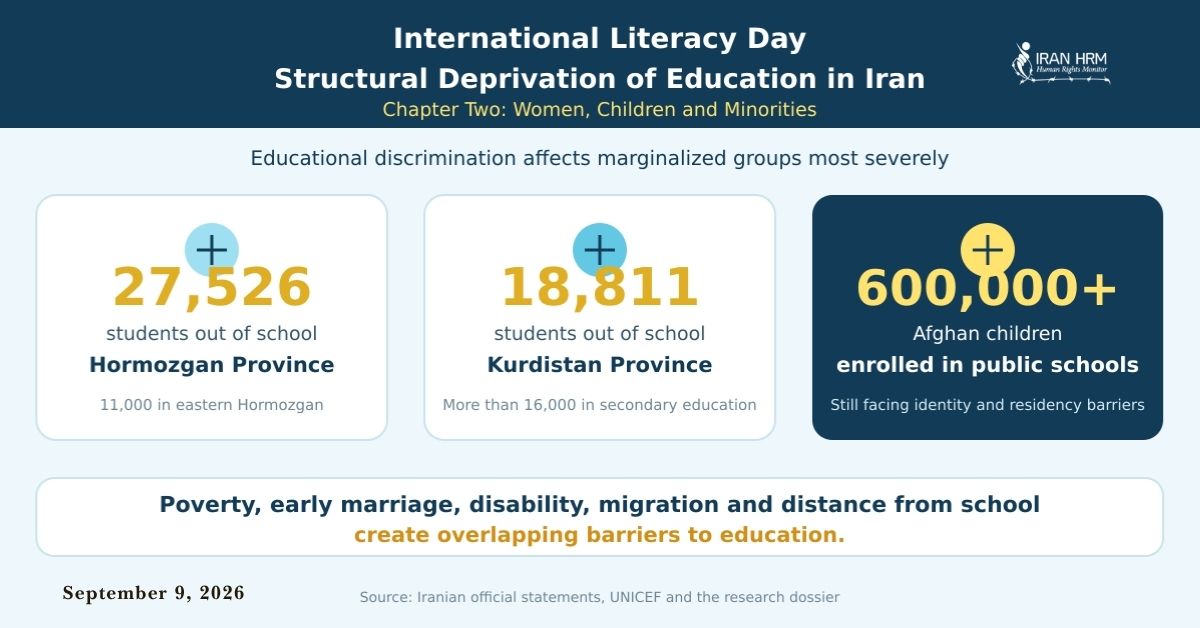 Selected Statistics from Ethnic and Disadvantaged Regions
| Province | Indicator |
| Kurdistan | 18,811 students out of school |
| Kurdistan | 2,376 out-of-school students in primary education |
| Kurdistan | More than 16,000 out-of-school students in secondary education |
| Kurdistan | 265,000 people over the age of six reported as illiterate |
| Kurdistan | Shortage of approximately 3,000 teachers |
| Khuzestan | Approximately 8,000 children aged 6–11 out of school |
| Hormozgan | 27,526 students out of school |
| West Azerbaijan | 5,605 students out of school |
| West Azerbaijan | More than 70 percent of schools reported as deteriorated |
In Kurdistan, most children are out of school in secondary education. This indicates that continuing education after primary school is more difficult for students in disadvantaged areas.
In Sistan and Baluchestan, shortages of secondary schools, the distance between villages and educational centers and the absence of safe transportation particularly affect girls. In Khuzestan, officials have identified poverty, migration, child labour, early marriage, disability and the long distance to schools as among the main causes of children being out of school.
The difference between the language spoken at home and the language of instruction may also affect early learning, family involvement and the likelihood of dropping out. However, there are currently no sufficient national data to determine the impact of monolingual education on dropout rates among Kurdish, Baluch, Arab or Azerbaijani children.
Conclusion to Chapter Two
Educational deprivation in Iran does not affect all groups equally. Girls, child labourers, Afghan children, persons with disabilities and ethnic and linguistic minorities face additional and overlapping barriers.
These barriers include poverty, early marriage, child labour, lack of identity documents, disability, distance from schools, teacher shortages, deteriorating infrastructure and differences between the language spoken at home and the language of instruction. Consequently, general enrolment policies, without addressing these obstacles, cannot constitute the effective realisation of the right to education.
Follow Chapter Three:
Deteriorating Schools, Low-Quality Education and Government Responsibility
Chapter Three examines teacher shortages, overcrowded classrooms, container schools and schools lacking basic facilities, declining educational quality, the government’s official positions, the gap between its promises and performance, and the Iranian state’s human-rights responsibilities.