Report at a Glance:

- Judicial Threats: Chief Justice Mohseni-Ejei’s emphasis on dealing with protesters “more decisively than ever” using vague security rhetoric.
- Dissent Within the Crackdown Apparatus: Public emergence of livelihood grievances among Law Enforcement Command (FARAJA) personnel and subsequent security reprisals against protesting officers.
- Resurgence of Pressure Tactics: Heightened reliance on forced confessions and coerced video recantations to silence dissent.
- Targeting Women and Universities: Formulation of new mandatory hijab regulations in universities aimed at shrinking civic space.
Recent statements by senior judicial officials in the Islamic Republic of Iran, alongside reports regarding livelihood grievances within the law enforcement apparatus and intensified efforts to enforce mandatory hijab policies, have raised grave concerns about the further constriction of civic space and the escalation of repressive measures.
Available evidence indicates that amid mounting economic pressures and widespread social discontent, authorities of the Islamic Republic are simultaneously emphasizing the security apparatus’s readiness to confront potential protests while strengthening social control mechanisms, particularly targeting women and university students.
Threats of Judicial and Security Crackdowns on Protests
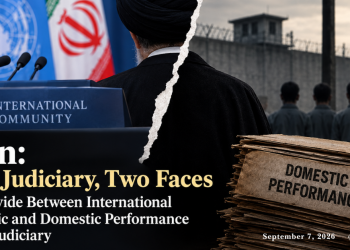
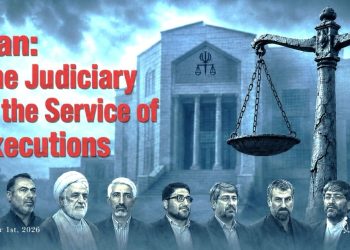
On August 31, 2026 (9 Shahrivar 1405), Gholamhossein Mohseni-Eje’i, Head of the Judiciary of the Islamic Republic, declared that “the enemy, through its mercenaries inside the country, seeks to disrupt public security and incite unrest,” warning that a “decisive response” would be delivered should such circumstances arise. He further emphasized that intelligence, security, and law enforcement forces are at the highest state of readiness, and that the judiciary will act “more decisively than ever” in prosecuting and punishing those who compromise national security.
The use of vague terms such as “enemy,” “mercenary,” “henchmen,” and “disrupters of security” without clear legal definitions has repeatedly served in past years as a pretext for the detention and prosecution of civil activists, journalists, human rights defenders, students, and peaceful protesters. This security-centric rhetoric risks paving the way for further restrictions on the rights enshrined in Articles 19, 21, and 22 of the International Covenant on Civil and Political Rights (ICCPR), including freedom of expression, freedom of peaceful assembly, and freedom of association.
Livelihood Grievances Within Law Enforcement and Suppression of Free Expression
A report published by the Tose’e Irani newspaper on September 1, 2026, highlighted videos released by law enforcement officers detailing severe economic hardships, wage shortfalls, living costs, and financial strain.
According to the report, Third Lieutenant Reza Tavassoli referred to a gross monthly salary of 38 million Toman, which drops to approximately 21 million Toman after various deductions. He also cited issues related to duty locations, physical health conditions, and the elimination of certain job benefits, emphasizing that his goal was not political opposition, but simply addressing the livelihood of law enforcement personnel. Similarly, Captain Mohammad Khodayar expressed in another video his inability to meet his family’s basic needs, stating that he had faced threats of dismissal and even death.
The human rights’ significance of these cases lies not merely in the severity of economic conditions, but in the government’s response to the expression of these demands. According to Tose’e Irani, past experience with similar cases shows that protesting officers often face disciplinary action, short-term detention, or coerced appearances in videos labeled as “explanations” or “corrections of statements.”
If verified, pressuring individuals to recant their statements or deliver forced statements violates the right to freedom of expression. Furthermore, this pattern reflects a longstanding practice used against civil activists, journalists, and political prisoners through the broadcast of forced confessions and coerced statements of regret, a practice widely condemned by international bodies.
Concerns Over Continued Reliance on Forced Confessions
A significant portion of the Tose’e Irani report addresses the reality that policies built on denial, forced confessions, and the broadcast of video recantations no longer hold their former deterrent effect, yet continue to be deployed as tools of repression.
When individuals face threats, administrative pressure, detention, or coercion to express regret simply for speaking out about their living or working conditions, it raises severe concerns regarding the violation of the prohibition against self-incrimination, the right to freedom of expression, and human dignity. Such practices are fundamentally incompatible with international fair trial standards and the absolute prohibition against compelling individuals to speak against their will.
Intensified Control Over Women and Students Under the Pretext of Hijab
Concurrently with these developments, officials of the Islamic Republic and members of parliament have escalated pressure to finalize and implement social control measures.
According to statements by the Deputy for Cultural and Political Affairs of the Supreme Leader’s Representative Office in Universities, a new directive has been drafted in cooperation with the Ministry of Science and the Ministry of Health, scheduled for distribution across universities nationwide. The official emphasized that conditions in universities “must not mirror what occurs on the streets.”
Simultaneously, political pressure within the establishment to formalize repressive hijab legislation has intensified. According to reports, during the open parliamentary session on September 6, 2026 (15 Shahrivar 1405), several MPs explicitly demanded the immediate notification of the so-called “Hijab and Chastity” law to the President. MP Mohammad Seraj criticized what he termed the proliferation of “un-veiling,” claiming that “malicious elements have become unrestrained,” and insisted that society must not be left unmonitored. Furthermore, Mostafa Moeini Arani, MP representing Kashan and Aran va Bidgol, characterized the absence of mandatory hijab as a “deep wound” on society, criticized any “expediency” or delays, and called upon the Speaker of Parliament to formally submit the law to the President for immediate execution.
Beyond imposing restrictions on individual freedoms, these measures, security-oriented rhetoric, and the push to expedite the “Hijab and Chastity” law signify the weaponization of social control legislation as a structural pretext for state repression, the criminalization of peaceful dissent, and the justification of coercive security interventions. At a time when Iranian women have played a pivotal role in fundamental societal demands, widespread criminalization under the guise of dress codes enables the authorities to hyper-militarize civic and academic spaces, facilitate arbitrary detentions, and systematically infringe upon the rights to privacy, freedom of expression, freedom of thought, equal access to higher education, and equal participation in public life.
Conclusion
Recent developments illustrate a deep concerning pattern wherein:
- Senior judicial authorities signal harsher crackdowns on individuals accused of disrupting security;
- Reports emerge of pressure and retaliation against individuals voicing livelihood concerns, including within the law enforcement apparatus;
- The systemic use of forced confessions and coerced video recantations persists;
- Mandatory hijab regulations and social control over women in universities are once again being intensified.
The convergence of these actions highlights serious risks that the Islamic Republic of Iran, in response to rising social and economic discontent, is moving toward strengthening preventive repression and expanding social control—a trajectory that threatens to subject the fundamental rights of citizens, particularly women, students, civil activists, and peaceful critics, to further grave violations.
Actionable Human Rights Requests
- The Special Rapporteur on the situation of human rights in Iran is requested to examine the impact of threatening statements by judicial officials on civil liberties and the public sphere in Iran.
- The Special Rapporteur on the promotion and protection of the right to freedom of opinion and expression is requested to address reports of threats, punishment, or coercion targeting individuals forced to retract their statements.
- The Working Group on Arbitrary Detention is requested to investigate potential cases of detention and pressure exerted on individuals peacefully raising livelihood demands.
- The Special Rapporteur on violence against women and girls and the Working Group on discrimination against women and girls are requested to monitor and document the consequences of implementing new university hijab directives and hijab directives addressing the society.
- The UN Human Rights Council is requested to address the aforementioned issues within the broader framework of systematic suppression of free expression, forced confessions, restriction of civic space, and intensified discrimination against women, utilizing relevant mechanisms—including the Special Rapporteur and independent fact-finding bodies—to collect, preserve, and analyze evidence of these violations.
- The Special Rapporteur on Iran and other relevant UN mechanisms are requested to document the role and responsibility of officials, institutions, and individuals involved in issuing, executing, or justifying repressive policies, and to make this information available to competent international mechanisms to pave the way for accountability measures, including remedial measures, targeted human rights sanctions based on universal jurisdiction, and individual responsibility mechanisms.
Sources:
https://www.toseeirani.ir/fa/tiny/news-93155
https://www.toseeirani.ir/fa/tiny/news-93177
https://www.toseeirani.ir/fa/tiny/news-93386
https://www.toseeirani.ir/fa/tiny/news-93326