Executive Summary
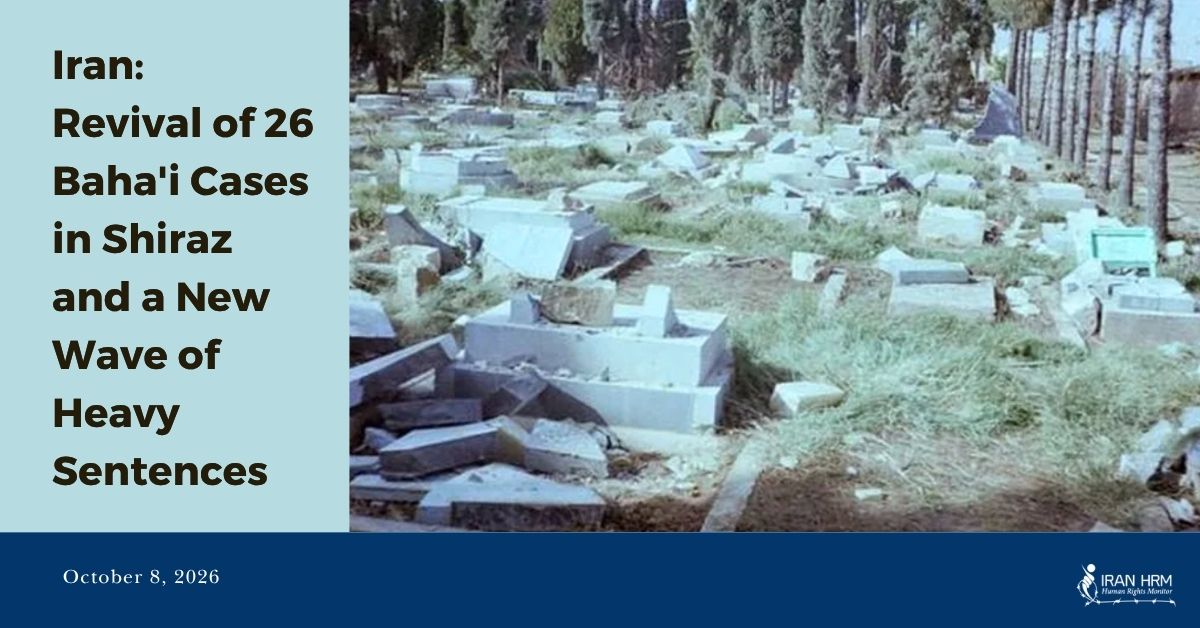
This report examines the alarming dimensions of the revival of the judicial case involving 26 Baha’i citizens in Shiraz after a decade of legal proceedings and an acquittal ruling. The case—which followed the overturning of initial rulings by the Supreme Court and a definitive acquittal issued by the Shiraz Court of Appeal in January 2023—has now been re-initiated following an objection by the Chief Justice of Fars Province and the invocation of Article 477 of the Code of Criminal Procedure.

In addition to this case, the document highlights a widespread wave of heavy sentences issued against Baha’i citizens in various cities (including Tehran and Karaj) in recent months, providing a legal analysis of the judiciary’s invocation of Article 500 bis of the Islamic Penal Code and its blatant contradiction with fair trial standards and the International Covenant on Civil and Political Rights (ICCPR).
Introduction
The violation of the rights of religious minorities, particularly Baha’i citizens in Iran, has always been a core pillar of the repressive policies implemented by the Islamic Republic’s judicial structure. In recent months, the judiciary has organized a new wave of pressure, summons, arrests, and heavy prison sentences against followers of the Baha’i faith by activating extraordinary legal mechanisms such as Article 477 and applying vague charges such as Article 500 bis of the Islamic Penal Code. While documenting the case of the 26 Baha’i citizens in Shiraz and several other cases in Tehran and Karaj, this report evaluates the legal dimensions and blatant contradictions of these judicial practices with the Iranian government’s international obligations.
- Revival of the Case of 26 Baha’i Citizens in Shiraz After a Decade
Twenty-six Baha’i citizens in Shiraz have once again been summoned to Branch 1 of the Revolutionary Court of this city after about 10 years of legal proceedings. The hearing for their case has been scheduled for October 11, 2026, and Mahmoud Sadati, the same judge who issued the initial verdict, will preside over the court.
- Previous Background of the Case: These individuals were arrested in 2016. In 2022, they were collectively sentenced to 85 years in prison, 24 years of internal exile, and 52 years of exit bans. The sentences issued in the appeal stage were also upheld, but the Supreme Court overturned them. Subsequently, Branch 1 of the Court of Appeal of Fars Province acquitted all 26 individuals in January 2023.
- Extraordinary Intervention: Despite the issuance of a definitive acquittal ruling, the case has been reopened following an objection by the Chief Justice of Fars Province and a request to apply Article 477.
- Names of the 26 Baha’i Citizens: Parisa Rouhizadegan, Esmail Rousta, Bahareh Nowruzi, Behnam Azizpour, Samareh Ashnaei, Ramin Shirvani, Rezvan Yazdani, Soroush Eighani Soghadi, Saeed Hasani, Shadi Sadegh Aghdam, Shamim Akhlaghi, Sohba Farahbakhsh, Sohba Moslehi, Ahdieh Enayati, Farbod Shadman, Farzad Shadman, Lala Salehi, Mojgan Gholampour Saadi, Marjan Gholampour, Maryam Eslami Mehdiyabadi, Mahyar Sefidi Miyandoab, Nabil Tahzib, Nasim Kashaninejad, Noushin Zenhari, Vargha Kaviani, and Yekta Fahandezh Saadi.
- A New Wave of Cases and Heavy Sentences Against Baha’is in Various Cities
In August, September, and October 2026, numerous cases against Baha’i citizens were reported, prominent examples of which include:
- The Case of Hengameh Sharifinia, Fouad Abdolghaffari, and Fahim Agahi (Tehran): Branch 15 of the Tehran Revolutionary Court, presided over by Abolqasem Salavati, tried Hengameh Sharifinia and Fouad Abdolghaffari along with Fahim Agahi. Hengameh Sharifinia was sentenced to a total of 15 years in prison (10 years enforceable) based on Articles 500 bis and 499 of the Islamic Penal Code regarding educational and religious activities. Fouad Abdolghaffari was sentenced to 10 years in prison (5 years enforceable), an 80 million Toman fine, a 2-year travel ban, and a 2-year ban on activity in associations. With the inclusion of Fahim Agahi’s sentence, the total prison terms for these three citizens have reached 35 years.
- Arrest of 5 Baha’i Citizens in Karaj: Babak Zeinali, Sohba Taef, Fouad Taefi, Shervin Shaborokh, and Ali Bagherkashi were arrested on Monday, August 31, 2026, after referring to the Shahriar Revolutionary Court to serve a one-year prison sentence (invoking Article 500 bis). The ambiguity surrounding their exact detention locations (between the Shahriar detention center, Greater Tehran Prison, and Qezel Hesar Prison) and the authorities’ refusal to provide clear answers have made it difficult for families to access them.
- Arrest of Arsalan Yazdani (Tehran): The Baha’i artist was arrested at his home by Ministry of Intelligence agents on the morning of Saturday, August 22, 2026. Agents searched his home and confiscated his mobile phone, laptop, and other personal belongings. This arrest was carried out to enforce a 5-year prison sentence (out of a total 6-year sentence issued in December 2023 by the Tehran Revolutionary Court on charges of “membership in the Baha’i community” and “propaganda against the state”).
In addition to judicial and criminal restrictions, reports concerning the search of homes, confiscation of mobile phones, computers, and other personal belongings of Baha’i citizens have raised serious concerns regarding the right to privacy. Article 12 of the Universal Declaration of Human Rights prohibits any arbitrary interference with privacy, family, home, or correspondence and emphasizes the right to legal protection against such interference. Reports regarding house searches and the seizure of personal belongings of Baha’i citizens, lacking sufficient transparency regarding the necessity and legal basis of these actions, warrant attention from the perspective of this international standard.
- Legal Review of Articles 477, 500, and 500 bis of the Islamic Penal Code
- Article 477 of the Code of Criminal Procedure: An extraordinary method of retrial according to which, if the Head of the Judiciary deems a definitive ruling to be “manifestly contrary to Sharia,” he can order a retrial and refer the case to special branches of the Supreme Court to overturn the previous ruling.
- Article 500 of the Islamic Penal Code: Pertains to the crime of “propaganda activity against the state” (activity in favor of opposition groups or against the Islamic Republic), which is widely used against civil and religious activists.
- Article 500 bis of the Islamic Penal Code (Added in 2020): This article addresses activities of groups or sects that operate through mind control, psychological suggestion, financial/sexual exploitation, or educational and propaganda activities deemed “deviant or contrary to Sharia” by the law. Paragraph 2 of this article specifically criminalizes any “deviant educational or propaganda activity contrary to or disruptive of the sacred Sharia of Islam,” including claims of divinity, prophethood, imamate, or communication with prophets and Imams, prescribing imprisonment, fines, and social deprivation for it.
Evaluation from the Perspective of International Standards of Fair Trial and Human Rights
An examination of the cited legal provisions and the judicial practice of the Islamic Republic in Baha’i cases reveals serious conflicts with foundational principles of international human rights law:
- Article 477 and the Principle of Judicial Independence and Legal Certainty:
By granting absolute discretion to the Head of the Judiciary to overturn definitive court rulings based on the determination of being “manifestly contrary to Sharia,” Article 477 is in overt tension with Article 14 of the International Covenant on Civil and Political Rights (ICCPR) concerning the right to a “competent, independent and impartial tribunal.” Furthermore, this practice undermines the principle of Legal Certainty and the finality of judgments, which are essential for the stability of judicial rulings. In addition, the concept of “manifestly contrary to Sharia” lacks transparency, precise boundaries, and predictability.
- Article 500 and Violation of Freedom of Expression and Belief:
Invoking Article 500 of the Islamic Penal Code under the heading of “propaganda activity against the state” to prosecute and punish peaceful religious activities conflicts with Article 19 of the ICCPR, which guarantees freedom of expression, the right to receive and impart information, and freedom of belief. Furthermore, criminal prosecution, summons, arrest, and the issuance of prison sentences against Baha’i citizens due to religious, educational, and social activities related to their religious beliefs violate Article 18 of the same Covenant, which recognizes the right to freedom of thought, conscience, and religion. This right includes the freedom to manifest and teach religious beliefs, perform religious rituals, and participate in religious activities, either individually or collectively.
- Article 500 bis and the Principle of Legality of Crimes (Nullum crimen, nulla poena sine lege):
By utilizing vague concepts such as “deviant propaganda activity,” “contrary to Sharia,” “false claims,” and “mind control,” Article 500 bis conflicts with Article 15 of the ICCPR and the legal principle of “no crime or punishment without a clear and specific law.” The ambiguity of these terms increases the possibility of broad, arbitrary, and repressive interpretations by security and judicial institutions.
Conclusion
The revival of the case of 26 Baha’i citizens in Shiraz after a decade and the issuance of heavy prison sentences for other Baha’i citizens in Tehran and Karaj attest to the ongoing systematic violation of human rights and fundamental religious freedoms in Iran. The instrumental use of vague provisions such as Articles 500 and 500 bis and extraordinary tools like Article 477 indicates the efforts of security and judicial institutions to circumvent the principles of fair trial and international standards. This practice constitutes a flagrant violation of the Iranian government’s obligations under Articles 14, 15, 18, and 19 of the ICCPR.
These cases demonstrate that the mere conclusion of a judicial process and even the issuance of an acquittal ruling do not guarantee an end to the judicial harassment of Baha’i citizens in Iran.