Examining Violations of Children’s Rights in Iran: Child Marriage, Child Abuse, Legal Discrimination and Militarisation

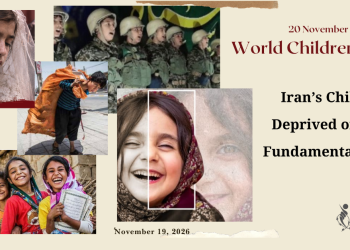
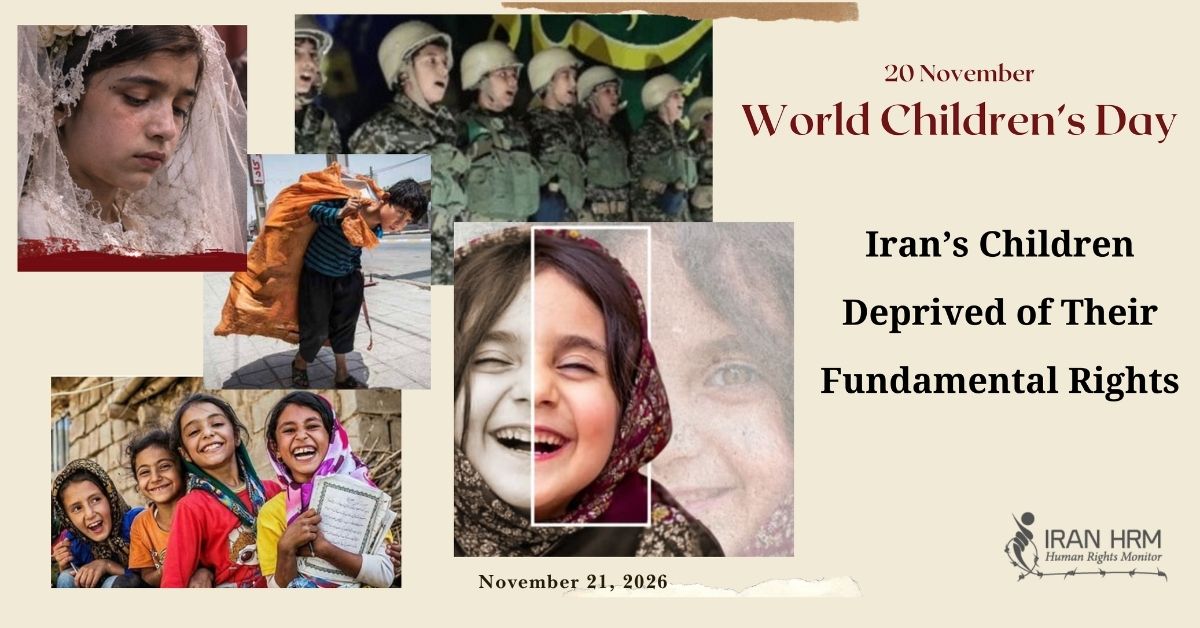
20 November, World Children’s Day, provides an opportunity to examine the gap between the Islamic Republic’s international obligations and the realities of children’s lives in Iran. The first part of this report examined poverty, exclusion from education, child labour, malnutrition and the absence of social protection. Yet deprivation tells only part of the story of children in Iran. For many, danger begins in the places that should provide the greatest security: their homes, families and schools.
This second part addresses another dimension of violations of children’s rights: child marriage, domestic violence, legal discrimination and the involvement of military institutions in education. These threats place children’s safety, freedom and futures at risk.
Sogand Moshtaraki, a 14-year-old girl who had recently given birth, was killed by her husband in Kerman Province in Aban 1405 (October–November 2026). Narin and Aylin, sisters aged 15 and seven in Sanandaj, were taken to hospital after suffering severe violence in the home of their father and stepmother. In the same country, the Student Basij Organisation, affiliated with the Islamic Revolutionary Guard Corps (IRGC), is expanding its activities in primary and secondary schools, exposing hundreds of thousands of pupils to programmes associated with the culture of war and martyrdom.
These events point to three distinct but connected aspects of children’s rights: protection from violence, equal protection under the law, and the right to develop in a safe, age-appropriate environment.
The Islamic Republic has been a party to the Convention on the Rights of the Child since 1994. Nevertheless, laws governing marriage age and criminal responsibility, shortcomings in the social protection system, and the growing ideological activities of military institutions in public education raise serious questions about compliance with its obligations.
Drawing on official statistics, individual cases and statements by public officials, this report examines these conditions and the authorities’ responsibility to protect children.
Part One — International Obligations and Domestic Law: Legal Protection Subject to Discriminatory Exceptions
The Convention on the Rights of the Child provides special protection for everyone under the age of 18 and requires States to address violence, abuse, exploitation and practices harmful to children’s development.
Some provisions of Iranian domestic law, however, distinguish between girls and boys or make legal protection dependent on decisions by a guardian and a court.
| Children’s right | International obligation | Law and practice in Iran |
| Protection from early marriage | Articles 3, 12, 19 and 24 of the Convention: the child’s best interests, participation in decision-making and protection of health. | Article 1041 of the Civil Code permits marriage of girls under 13 and boys under 15 with the guardian’s permission and a court determination that the marriage is in the child’s interests. |
| Protection from violence | Article 19: protection against physical and psychological violence, neglect and abuse. | The Law on the Protection of Children and Adolescents, enacted in 1399 (2020), provides safeguards, but shortcomings in implementation and certain criminal-law exceptions remain matters of concern. |
| Right to life and equal justice | Articles 6 and 37: protection of life and prohibition of the death penalty for offences committed before the age of 18. | Despite mitigating provisions under Article 91 of the Islamic Penal Code, Iran’s criminal justice system still allows qisas sentences in certain cases for offences committed during childhood. |
| Freedom of thought and education | Articles 12, 14 and 29: respect for children’s views and the free development of their personality. | The expansion in schools of ideological programmes affiliated with military institutions raises concerns about educational independence. |
| Protection from involvement in conflict | Article 38: special safeguards for children in war and restrictions on the recruitment and participation of children under 15. | Iran has signed, but not ratified, the Optional Protocol on the involvement of children in armed conflict. |
A common feature of these inconsistencies is that certain legal powers exercised by adults, or government policies, take precedence over the child’s best interests, safety and autonomy.
Part Two — Child Marriage: A Legal Framework That Permits Early Marriage
26,974 marriages involving girls under 15 recorded in one year
According to data from the Statistical Centre of Iran, 26,974 marriages involving girls under 15 and 15 marriages involving boys in the same age group were registered in the Iranian calendar year 1401 (March 2022–March 2023). In the winter of that year alone, 6,227 girls under 15 were married.
These figures cover registered marriages and do not establish the number of unregistered marriages or cases involving coercion. Research reports also indicate that the Statistical Centre stopped publishing age-disaggregated marriage data in its quarterly reports from spring 1402 (March–June 2023), making subsequent trends harder to assess.
Sogand Moshtaraki: A 14-year-old mother killed by her husband
Sogand Moshtaraki, from the village of Soltanabad in Arzuiyeh County, Kerman Province, was married at the age of 13. In November 2026, only days after giving birth, she died following a beating by her husband.
Judicial and law-enforcement officials in Arzuiyeh confirmed the killing and her husband’s arrest, initially attributing the incident to family disputes.
Sogand became a mother while still legally a child under the Convention on the Rights of the Child. Her death highlights the need to examine the role of early marriage, access to preventive protection and the responsibility of judicial and social welfare institutions.
Sepideh Raeisi: Violence that continued beyond childhood
According to published reports, Sepideh Raeisi, a 21-year-old woman from the village of Zagh in Jahrom County, Fars Province, had married at 13.
In November 2026, when she was the mother of a three-year-old child and four months pregnant, she was shot dead by her husband. Published accounts state that she had previously sought a separation.
Sepideh’s case illustrates how the consequences of child marriage do not necessarily end at the age of 18. Economic dependence, limited access to legal protection and continuing violence can carry the effects of early marriage into adulthood.
Goli Kouhkan: Married at 12 and sentenced to qisas
Goli Kouhkan, a Baluch woman without a birth certificate, was forced into marriage at the age of 12 and gave birth at 13. Her case, involving an accusation of killing her husband and a sentence of qisas (retribution in kind under Iranian criminal law), prompted a response from United Nations human rights experts in 2025–2026.
In December 2025, she was spared the implementation of the qisas sentence after public donations helped raise the required compensation payment (diyeh, or blood money) and the victim’s next of kin agreed to waive their right to demand retribution.
Her case shows how early marriage, lack of identity documentation, domestic violence and unequal access to legal resources may intersect in one person’s life.
Part Three — Child Abuse: Violence at Home and Failures in Preventive Protection
Narin and Aylin: Two sisters confined in a house in Sanandaj
In Khordad 1405 (May–June 2026), reports of abuse involving Narin, aged 15, and Aylin, aged seven, two sisters living in Sanandaj, caused widespread public concern.
Following reports from members of the public, Social Emergency Services personnel and police entered the house with judicial authorisation and rescued the two children, who had been confined in a bathroom.
Narin was taken to hospital with bone fractures, severe wounds and other physical injuries, requiring surgery and specialist care. Judicial officials announced the arrest of the stepmother and said the case was being investigated.
The children’s mother also alleged in media interviews that she had previously encountered serious obstacles in visiting and protecting her daughters.
Intervention by Social Emergency Services led to the children’s rescue, but the seriousness of their injuries raises the question of why monitoring and protection mechanisms had not identified the danger sooner.
Niyan Cheliani: The death of a young girl in Bukan
The cases compiled for this report include that of Niyan Cheliani, a seven-year-old girl from Bukan who, according to reports, died after suffering severe abuse within the family.
Her mother alleged that she had been unable to see or protect her daughter and that her attempts to secure intervention by the responsible authorities had been unsuccessful.
Details of the allegations in this case, including the nature of the abuse and the responsibility of individuals involved, still require corroboration against judicial records and independent original reports.
Violence in residential care: Dorsa’s case in Kelardasht
The case of Dorsa, a seven-year-old child with a disability at the Fereshtegan-e Mehr residential care centre in Kelardasht, raises further concerns about the safety of children dependent on others for care.
According to the reports compiled, the child sustained serious physical injuries at the centre, and allegations of staff mistreatment were raised.
If these allegations are substantiated by judicial investigations, the case will raise questions not only about the responsibility of those involved but also about the State Welfare Organisation’s oversight of residential facilities for children with disabilities.
Part Four — Militarisation and Ideological Education: Armed Institutions in Children’s Educational Environments
The Student Basij: Organising children from primary school onwards
The Student Basij Organisation, affiliated with the Islamic Revolutionary Guard Corps (IRGC), operates through three age-based groups: Omidan (‘the Hopeful’) for primary school pupils; Pouyandegan (‘the Seekers’) for lower secondary pupils; and Pishgaman (‘the Pioneers’) for upper secondary pupils.
In official reports issued in the Iranian calendar year 1405 (2026–2027), provincial officials stated that more than 100,000 pupils had participated in Student Basij activities in Lorestan Province and that 700 programmes had been held during Student Basij Week.
This system embeds an organisation affiliated with a military institution within children’s educational settings. However, membership of the Student Basij does not in itself establish recruitment for combat or children’s participation in war; these are separate matters requiring separate examination.
Rahian-e Noor: Hundreds of thousands of pupils in war-related programmes
Official reports have announced that 250,000 pupils were sent on Rahian-e Noor (‘Travellers of Light’) trips, while plans to send a further 300,000 were also publicised. The first figure refers to reported participation; the second is a programme target.
In Aban 1405 (October–November 2026), the dispatch of 3,500 pupils in Zanjan and plans to send 4,000 pupils from Lorestan were announced. Officials highlighted objectives such as strengthening revolutionary identity and promoting a culture of sacrifice and martyrdom.
Rahian-e Noor trips involve visits to former battlefields of the Iran–Iraq War and have been linked to school defence-preparedness lessons. This connection raises questions about where the boundaries lie between teaching history, political socialisation and ideological influence over pupils.
Ideological education and children’s freedom of choice
Student Basij activities, promotional programmes associated with ‘Jihad of Explanation’ (Jihad-e Tabyin), and the involvement of religious and military institutions in schools are presented as components of the government’s educational policy.
Teaching the history of war or introducing civil defence is not, in itself, a violation of the Convention. Human rights concerns arise when education becomes one-sided propaganda, involves pressure to participate, restricts freedom of thought or exposes children to activities inappropriate for their age.
The critical distinction between education and participation in military or security activities
Article 38 of the Convention on the Rights of the Child places specific restrictions on the involvement of children in armed conflict.
Iran signed the Optional Protocol to the Convention on the Rights of the Child on the involvement of children in armed conflict in 2010 but has not ratified it. The Protocol establishes stronger protections for persons under 18.
The documents reviewed did not provide sufficient independent evidence to establish combat recruitment or organised participation by persons under 18 in armed operations during 2024–2026. Consequently, widespread use of children as combatants cannot be presented as an established fact without further investigation.
Nevertheless, the organisation of pupils within IRGC-affiliated structures and the expansion of programmes promoting military culture warrant independent scrutiny and assessment of compliance with children’s rights and best interests.
Part Five — Government Response: Protective Legislation and Mechanisms That Have Proved Insufficient
The Islamic Republic adopted the Law on the Protection of Children and Adolescents in the Iranian calendar year 1399 (2020). The State Welfare Organisation is also responsible, through its Social Emergency Services hotline (123), for intervention in cases of child abuse and other high-risk situations.
Fatemeh Soltani, head of the national Social Emergency Services, has stated that child abuse and family disputes are the leading reasons for calls to the service. In Quchan County, Razavi Khorasan Province, 287 Social Emergency Services cases were reported for the Iranian calendar year 1404 (March 2025–March 2026), with child abuse the most frequently reported concern.
Despite these mechanisms, Narin and Aylin’s case and other allegations of mistreatment highlight the need to examine the timing of intervention, judicial oversight of custody arrangements and children’s access to immediate protection.
In relation to marriage, Article 1041 of the Civil Code continues to permit marriage below the specified ages with legal authorisation. In schools, IRGC and Basij officials have described the expansion of revolutionary programmes and war-related trips as part of their educational objectives.
The government’s response therefore combines protective measures with the retention of policies and legal provisions that may themselves place children’s rights at risk.
Part Six — Human Rights Analysis and Conclusion
The three themes examined in this report give rise to three distinct but connected responsibilities for the Islamic Republic.
First, the duty to reform the law: permitting marriage before the age of 18 and retaining sex-based distinctions in family law are incompatible with the principle of the best interests of the child and the State’s protective obligations. Reform of Article 1041 of the Civil Code, establishing a minimum marriage age of 18 without exception, is a human rights imperative.
Second, the duty to prevent harm and provide protection: the State must identify risks of violence before harm occurs. The existence of hotline 123 and the Law on the Protection of Children and Adolescents is not, in itself, proof of an adequate response. Timely intervention, oversight of custody, quality of care and access to independent protection are equally decisive.
Third, the duty to safeguard children’s autonomy and safety: the presence of organisations affiliated with military institutions in schools must be assessed against children’s freedom of thought, their right to age-appropriate education and protection from any military or security-related exploitation.
This report calls for reform of child marriage laws; the publication of up-to-date, disaggregated statistics; independent investigations into child abuse cases; stronger Social Emergency Services; oversight of residential care facilities; and full transparency concerning military and paramilitary programmes involving pupils.
The United Nations Committee on the Rights of the Child, UNICEF and other international mechanisms should also monitor Iran’s implementation of its obligations in these areas.
World Children’s Day must be more than an occasion for announcing protective programmes. The true measure of a government’s commitment to children’s rights is the safety of a girl in her own home, the freedom of choice of an adolescent facing early marriage, and the ability of every child to grow up free from fear, coercion and exploitation.