Revolutionary Courts and Security Prosecutor’s Offices; The Operational Core of Judicial Repression
In the previous two parts, this report showed that the judiciary in Iran is not an independent institution but rather operates within the framework of Velayat-e Faqih and under the domination of political power. It also demonstrated that the body of this institution is formed not on the basis of professional independence, but on ideological vetting, political loyalty, and the exclusion of independent elements. This part examines the operational stage of that same structure; namely, the Revolutionary Courts and security prosecutor’s offices, where this judicial body is transformed in practice into an instrument of security adjudication, the containment of dissent, and the suppression of political and ideological cases.

Revolutionary Courts and security prosecutor’s offices should not be understood merely as specialized bodies for handling a particular category of offenses. In practice, these institutions form the operational heart of judicial repression in Iran; the point at which political opposition is turned into a security accusation, detention is converted into a judicial file, and the will of security institutions is transformed into a court judgment. Within this structure, law and criminal procedure are used not to restrain power, but to formulate and legitimize its exercise.
From an exceptional mechanism to the institutionalization of the Revolutionary Court
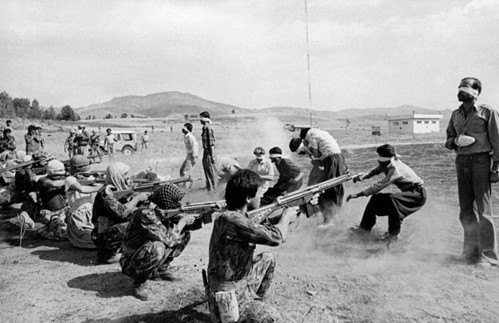
The Revolutionary Courts in Iran did not emerge as a continuation of the ordinary judiciary, but in the exceptional atmosphere that followed the 1979 revolution. From the outset, their function was to handle cases that the new ruling order considered linked to the former regime, “counter-revolution,” or threats to the new political order. For this reason, the basis of their creation rested less on ordinary judicial standards than on the logic of revolutionary and security-oriented adjudication. The 1979 legal bill relating to the Revolutionary Courts, and even the 13 May 1979 decree limiting the use of the death penalty, itself shows that the reach of these courts was broad and problematic from the very beginning.
Multiple accounts from that early period, associated above all with the figure of Sadegh Khalkhali, show that speed in issuing and carrying out judgments, especially in death penalty cases, took precedence over judicial caution and fair process. This background matters because it reveals the original character of the Revolutionary Court: not an institution created to guarantee impartial adjudication, but one designed for the swift elimination of political enemies and the consolidation of the new ruling order.
 The decisive turning point came with the Law on the Establishment of General and Revolutionary Courts, adopted on 6 July 1994. This law consolidated the Revolutionary Court not as a temporary mechanism, but as a formal part of the country’s judicial structure. In this way, the exceptional logic of the early revolutionary period was reproduced in a durable legal form. The Revolutionary Court was not created to secure neutral adjudication; it was created to manage the political enemy under the cover of judicial authority. Its later consolidation meant the institutionalization of that same logic within the judicial order itself.
Legal jurisdiction; the juridical mechanism for securitizing dissent
What has made the Revolutionary Courts one of the judiciary’s most important instruments of repression is not only their origin, but also the breadth of the jurisdiction assigned to them by law. Article 303 of the Code of Criminal Procedure designates the Revolutionary Court as the competent authority for offenses such as crimes against internal and external security, moharebeh, efsad-e fel-arz, baghi, insulting the founder of the regime and the Supreme Leader, as well as a large share of drug, weapons, and ammunition offenses. As a result, the most important political, security-related, and ideological cases are concentrated in this exceptional court rather than entering the ordinary judicial process.
On paper, these categories are defined as legal offenses. In practice, however, they have enabled a broad range of political, civil, and protest-related conduct to be reclassified as security crimes. In particular, concepts such as “crimes against security,” “assembly and collusion,” moharebeh, efsad-e fel-arz, and baghi have, because of their elasticity and broad interpretive scope, become key legal tools for transferring the cases of protesters, political activists, journalists, civil society actors, and certain ideological minorities to the Revolutionary Court. These are not merely criminal law terms; they are the legal bridge through which political opposition is converted into a security crime and then into severe punishment, including execution.
Within this same framework, Article 8 of Iran’s Code of Criminal Procedure is also revealing, because it does not treat crime solely as an offense against public order or individual rights, but speaks of its public dimension “as a transgression against divine limits and regulations.” This formulation pushes crime beyond a purely legal and social phenomenon and gives it a religious and normative charge. In such a setting, the accused is not treated only as a violator of law, but may in practice be cast as a violator of boundaries said to extend beyond public order. In political and security cases in particular, this approach facilitates harsher interpretations, moralizes punishment, and strengthens the logic of elimination rather than fair adjudication.
The same issue is visible in cases connected to the December 2025 protests. Even under the regime’s own narrow legal standards, the question remains how conduct for which no clear killing, bloodshed, or actual large-scale and severe consequences were established could nevertheless be interpreted as efsad-e fel-arz or moharebeh warranting execution. This gap shows that, in practice, these charges have extended far beyond their already narrow legal boundaries and have become tools for the physical elimination of protesters and dissidents.
The security prosecutor’s office; where the security narrative becomes a judicial file
If the Revolutionary Court is where judgment is issued in political and security cases, the security prosecutor’s office is where these cases are built and prepared for entry into court. In Tehran, the Tehran Public and Revolutionary Prosecutor’s Office, District 33, commonly known as Shahid Moghaddas or “security,” appears under that title in judicial documents, and its official name has been explicitly recorded in published summonses and investigative decisions. These documents show that District 33 is a recognized specialized unit within the judicial structure. Its legal basis also appears in Articles 22 and 25 of the Code of Criminal Procedure, which provide for the creation of specialized prosecutor’s offices, including those for security crimes. At the same time, the materials collected indicate that no detailed organizational chart or public directive establishing District 33 has been openly published. That lack of transparency is part of the problem itself.
The importance of this prosecutor’s office lies not only in its administrative status, but also in the nature of the documents that emerge from it. In one sample decision to refer a case to trial, it is stated that, based on the judicial officer’s report, images of the defendant’s condition, and the defendant’s statements and confessions during interrogation, the alleged offense was deemed established. This formulation shows that, at the preliminary investigation stage, the officer’s report, the results of security investigations, and the accused person’s confessions can become the central basis for the investigator’s decision to send the case to the Revolutionary Court. The security prosecutor’s office is therefore not merely a preliminary investigative body; it is the place where security intent is translated into legal language.
The siege of defense rights
In political and security cases, restrictions on defense rights are part of the structure of repression itself. The key legal basis for this restriction is the Note to Article 48 of the Code of Criminal Procedure, which requires defendants in crimes against internal or external security, as well as certain other offenses, to select counsel at the preliminary investigation stage only from among lawyers approved by the head of the judiciary. Thus, at precisely the stage where the basic structure of the case is formed, the right to freely choose a lawyer is curtailed.
The materials collected show that in Tehran, the list of approved lawyers was initially extremely limited and later expanded, but its nature did not change: a security defendant had to choose from a screened list, not from among independent lawyers they trusted. At the same time, in many security cases, full and timely access to the case file is also restricted. When the defendant or counsel lacks adequate knowledge of the officers’ reports, the exact basis of the accusation, or the main documents in the file at the early stages, the possibility of an effective response is lost. As a result, the right of defense is downgraded from a fundamental right to a controlled privilege, and the lawyer is reduced from an independent pillar of due process to a limited and managed presence.
Security institutions; from detention to the production of the judicial narrative
In political and security cases, intelligence and security institutions do not merely act as judicial officers in a narrow sense. In practice, they play a decisive role in constructing the case narrative, shaping the evidentiary record, and directing the judicial outcome. The report of the Independent International Fact-Finding Mission of the United Nations in March 2026 states that Ward 209 of Evin Prison is under the effective control of the Ministry of Intelligence, and Ward 325, or 2-A, is under the effective control of the IRGC. The same report states that detainees in these wards are routinely denied access to lawyers and family visits, coerced into confessions, and subjected to prolonged interrogation and other forms of mistreatment. The mission’s main report also confirms that IRGC Intelligence operates a separate network of detention facilities outside the oversight of the Prisons Organization, while the Ministry of Intelligence administers Wards 209 and 240.
This dependency is not limited to recent reports. The 2014 report of the UN Special Rapporteur had already stated that the Revolutionary Court verdicts reviewed made extensive reference to reports from the Ministry of Intelligence. Amnesty International’s reports reinforce this picture; among other findings, they state that prosecutors, instead of investigating torture and enforced disappearance, became complicit in repression, while judges issued convictions on the basis of torture-tainted confessions. Amnesty’s March 2026 statement further states that defendants in one set of cases were subjected to torture and other ill-treatment before conviction, and that their convictions were based on confessions extracted under torture.
Under such conditions, the issue is not merely that torture occurs in detention. The issue is that the product of that torture enters the text of the case file and the court judgment. When arrest, interrogation, confession-taking, and report production are carried out by the security apparatus, and those same materials later enter the investigator’s reasoning and the court’s ruling, the judiciary is no longer supervising security conduct. It becomes the institutional continuation of that conduct.
Key branches and judges; concentrated nodes of repression
A significant share of political and security cases in Tehran is concentrated in specific branches of the Revolutionary Court, especially Branches 15, 26, and 28. The significance of these branches lies not only in the number of cases referred to them, but in the fact that their names recur in sanctions records, human rights reports, and cases involving political activists, journalists, human rights defenders, religious minorities, and protesters. This concentration indicates that judicial repression in Iran does not function in an incidental or scattered way; it is organized around identifiable judicial nodes.
With respect to Branch 15, official US records identify Abolqasem Salavati as a judge who imposed severe sentences, including death sentences, against political prisoners and protesters. Amnesty International also reported on 31 March 2026 that seven men in a case linked to the 2026 protests were sentenced to death for moharebeh by this very branch.
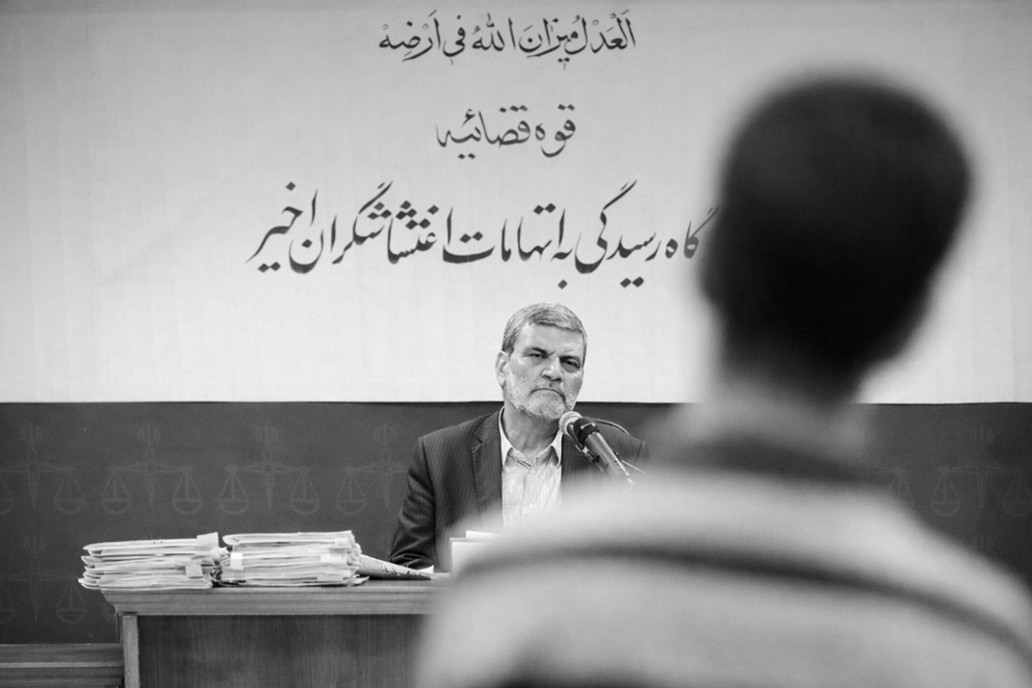
With respect to Branch 28, records concerning Mohammad Moghiseh refer to unfair trials and harsh sentences. Regarding Branch 26, European Union sanctions documents from early 2026 emphasize Iman Afshari’s role in issuing death sentences and lengthy prison terms against political prisoners and human rights activists. These records show that the issue is not merely a handful of notorious judges, but the existence of concentrated and targeted centers of judicial repression within the Revolutionary Court itself.
Part of the role played by these judges has already been examined separately in the report series “Judges of Death.” The purpose here is not to repeat those profiles, but to show that the concentration of political and security cases in specific branches and before specific judges is itself part of the institutionalized machinery of judicial repression.
Conflict with fair trial guarantees and international obligations
The structure of the Revolutionary Courts and security prosecutor’s offices stands in direct conflict with the international obligations of the ruling regime in Iran. Article 9 of the International Covenant on Civil and Political Rights prohibits arbitrary detention; and under the Human Rights Committee’s interpretation, “arbitrary” does not mean merely unlawful, but also includes detention that is unjust, unforeseeable, or disproportionate. From this perspective, the use of broad and elastic charges such as efsad-e fel-arz or “propaganda against the regime” for civil and political acts strips detention of predictability and pushes it toward arbitrariness.
Article 14 of the Covenant also guarantees the right to a competent, independent, and impartial tribunal; the right to be informed promptly of the charges; the right of access to counsel of one’s own choosing; the right not to be compelled to confess guilt; and the right to a fair and public hearing. The materials examined here clearly show that the Note to Article 48 conflicts with the right to freely choose counsel; the use of confessions extracted under pressure is incompatible with the prohibition on compelled confession; and closed, non-transparent proceedings conflict with the principle of public hearings. As a result, fair trial violations in these cases are not exceptional. They are the logical outcome of a structure designed from the outset to respond to security demands rather than to administer justice impartially.
Conclusion
The Revolutionary Courts and security prosecutor’s offices must be understood as the operational core of judicial repression in Iran. This structure is not a temporary product of the early revolutionary period, but a consolidated part of the judicial architecture of the ruling regime in Iran; an architecture in which exception has become the rule. From broad jurisdiction over political and security offenses to the central role of the security prosecutor’s office, from the restriction of defense rights and the use of screened lawyers to the decisive role of security institutions in detention, interrogation, and case-building, all elements of this structure operate in the same direction: removing political opponents from the sphere of ordinary justice and placing them within a cycle of legal and judicial repression.
The Revolutionary Court and the security prosecutor’s office cannot be understood merely as specialized bodies for a certain category of crimes. They are the operational center of judicial repression in Iran; the point at which a political accusation becomes a security crime, a coerced confession becomes evidence, and the will of a security institution becomes a judicial ruling. Within this structure, law is used not to restrain power, but to organize and legitimize repression. If this part has shown the operational structure of that repression, the next part will show how this same structure destroys the right to defense and fair trial from within.